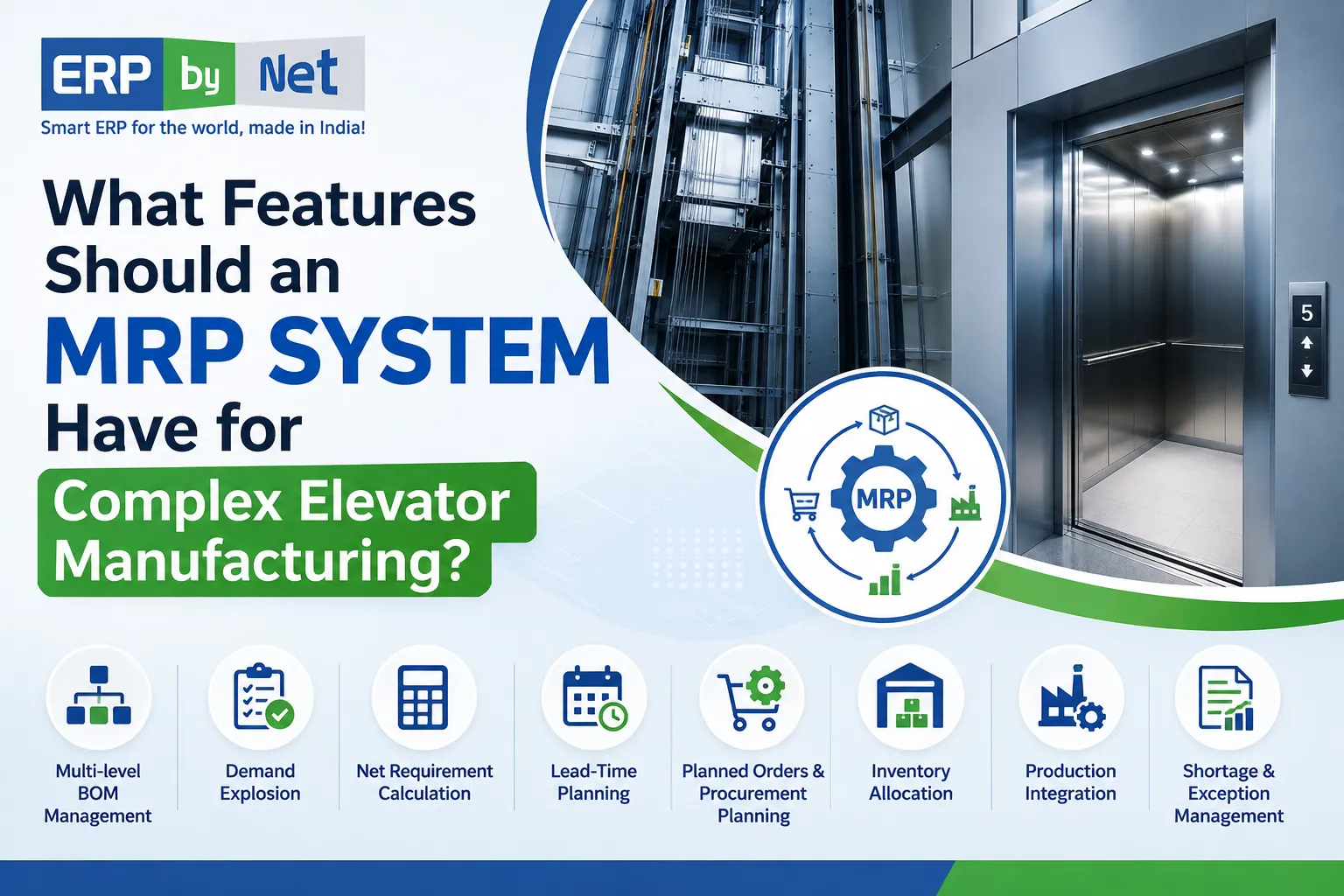
What Features Should an MRP System Have for Complex Elevator Manufacturing?
Key Takeaways
- Complex elevator manufacturing needs more than basic MRP to manage customized products, projects, and materials.
- Multi-level BOMs and demand explosion help calculate component and raw material requirements accurately.
- Inventory, procurement, engineering, and production must work together for effective material planning.
- Lead-time and project-based planning help ensure materials are available when production needs them.
- A connected MRP system helps reduce shortages, overstocking, and reactive purchasing.
What You’ll Learn
- Why basic MRP may not be enough for complex elevator manufacturing.
- How multi-level BOMs and demand explosion simplify material planning.
- How project-based planning and material allocation improve inventory decisions.
- Why lead-time planning and shortage management are important for production.
- How ERPbyNet’s AceMRP connects engineering, inventory, procurement, and production planning.
Real Insights
- Physical stock does not always mean available stock because materials may already be allocated or reserved.
- Engineering changes can change material requirements, making engineering-to-MRP integration important.
- Knowing what material is needed is not enough; manufacturers also need to know when to procure it.
- Exception-based planning helps teams focus on critical shortages instead of checking every material manually.
- The right MRP system turns complex elevator orders into accurate, timely material plans.
Elevator manufacturing is rarely a simple make-and-ship process.
A single project can involve customer-specific configurations, engineering changes, multi-level BOMs, bought-out components, fabricated parts, raw materials, supplier lead times, warehouse allocation, and project-specific production requirements.
That complexity creates a fundamental challenge:
How do you make sure the right material is available, in the right quantity, at the right time—without overstocking or delaying production?
This is where a capable MRP system for elevator manufacturing becomes important.
A modern MRP system should do more than calculate material requirements. It should connect engineering, demand, BOMs, inventory, procurement, and production so manufacturers can make better material decisions before shortages become production problems.
Why Elevator Manufacturing Needs More Than Basic MRP
Traditional MRP can answer:
“What material do we need?”
But complex elevator manufacturing requires much more:
- What is required for each elevator?
- Which project requires it?
- How much is already available?
- How much is already allocated?
- What is currently on order?
- What needs to be manufactured internally?
- What needs to be purchased?
- When should procurement begin?
- Which shortage could affect production?
For an elevator manufacturer, the planning chain often looks like:
Customer Requirement
↓
Product Configuration
↓
Engineering / BOM
↓
Material Demand
↓
MRP Calculation
↓
Procurement / Production
↓
Warehouse
↓
Project Execution
If these activities are disconnected, material planning can quickly become dependent on spreadsheets, manual calculations, and repeated communication between departments.
A suitable MRP system should bring these processes together.
Read More: Why AI Will Fail in Elevator Companies Without the Right ERP Foundation
12 Features an MRP System Should Have for Complex Elevator Manufacturing
1. Multi-Level BOM Management
An elevator is not a single-level product.
It can contain multiple assemblies, subassemblies, components, and raw materials.
For example:
Elevator
│
├── Cabin
│ ├── Cabin Frame
│ ├── Panels
│ └── Flooring
│
├── Door System
│ ├── Door Operator
│ ├── Door Panels
│ └── Sensors
│
├── Drive System
│ ├── Motor
│ ├── Controller
│ └── Related Components
│
└── Safety System
├── Safety Components
└── Associated Hardware
A capable MRP system should understand these relationships and automatically explode the BOM to calculate material requirements at different levels.
Why it matters
If an order contains 20 elevators, planners shouldn’t have to manually calculate every component required across those 20 units.
The system should be able to move from:
20 Elevators → Assemblies → Components → Raw Materials
This significantly reduces manual planning effort and the possibility of calculation errors.
2. Engineering-to-MRP Integration

Engineering changes can directly affect material requirements.
A change in:
- Product configuration
- Component specification
- BOM
- Quantity
- Revision
- Customer requirement
can potentially change what procurement and production need.
That’s why the MRP system should work closely with engineering data.
The ideal flow:
Engineering → BOM → MRP → Procurement → Production
Instead of engineering maintaining one version of product information while procurement works from another spreadsheet, the MRP system should use relevant approved product structures as the basis for material planning.
This creates a stronger connection between what is designed and what needs to be purchased or manufactured.
3. Demand Explosion
One of the most important capabilities of MRP is converting finished-product demand into detailed component requirements.
Suppose an elevator manufacturer receives an order for:
25 elevators
The system should determine the corresponding requirements for:
- Subassemblies
- Components
- Bought-out items
- Manufactured parts
- Raw materials
This process is commonly referred to as BOM explosion or demand explosion.
Instead of asking the planning team to manually calculate requirements, the system performs the calculation based on the applicable product structure.
The result:
25 Elevator Orders
↓
BOM Explosion
↓
Component Requirements
↓
Net Requirements
↓
Procurement / Production Requirements
For high-volume or highly customized elevator manufacturing, this capability can become essential.
4. Project-Based Material Planning
Elevator manufacturing is often closely connected to individual customer orders and projects.
Two elevators may appear similar but have different:
- Capacities
- Finishes
- Dimensions
- Door configurations
- Control requirements
- Customer specifications
- Site requirements
Therefore, material planning should not always operate only at a warehouse-wide level.
The system should help answer:
Which project needs this material?
rather than simply:
How much material is in stock?
Example
Suppose the warehouse shows:
500 units available
But:
- 200 are allocated to Project A
- 150 are reserved for Project B
- 100 are required for current production
The truly available quantity may be only:
50 units
A project-aware MRP system can help planners make decisions using a more realistic view of material availability.
5. Net Requirement Calculation
A strong MRP system should not simply compare demand with physical stock.
It should consider the wider supply picture.
A typical calculation may involve:
Gross Requirement
− Available Inventory
− Relevant Incoming Supply
= Net Requirement
For example:
| Requirement | Quantity |
|---|---|
| Gross requirement | 1,000 |
| Available inventory | 250 |
| Incoming purchase orders | 300 |
| Net requirement | 450 |
This helps prevent two common problems:
Over-purchasing
Buying material that is already available or incoming.
Under-purchasing
Failing to identify material that will be required later.
For complex manufacturing, accurate netting is one of the foundations of effective material planning.
6. Lead-Time-Based Planning
Knowing what is required isn’t enough.
You also need to know when to order it.
Consider a component with a supplier lead time of 45 days.
If production requires that component on:
15 November
the procurement process cannot reasonably begin in November.
The MRP system should work backward:
Required for Production
        ↓
Required Date
        ↓
Supplier Lead Time
        ↓
Planned Procurement Date
This becomes particularly important when elevator manufacturers depend on components with different supplier lead times.
A system that considers lead times can help procurement teams act earlier instead of reacting to shortages after they appear.
7. Planned Orders and Purchase Requirements
An MRP system should not stop with:
“Material shortage detected.”
That’s information.
The real value comes from turning that information into an actionable requirement.
A better process is:
This allows planners and procurement teams to move from shortage detection to planned action.
For materials that need to be manufactured internally, the system can support production requirements.
For externally sourced materials, it can support purchase requirements.
8. Material Allocation and Reservation
One of the biggest mistakes in material planning is assuming:
Physical stock = Available stock
That’s not always true.
Inventory may already be:
- Reserved
- Allocated
- Committed
- Required for another project
- Assigned to production
For project-based elevator manufacturing, this distinction is extremely important.
Consider this:
Warehouse stock: 1,000 units
Allocated: 600 units
Available: 400 units
If an MRP system ignores allocation, it may incorrectly conclude that 1,000 units are available.
Accurate material allocation helps planners make procurement decisions based on usable supply, not just physical inventory.
9. Shortage and Exception Management
Planners shouldn’t have to manually review every material every day.
A good MRP system should help identify exceptions that need attention.
For example: <div style=”border-left:4px solid #333;padding:14px 18px;margin:20px 0;”>
<strong>Critical Material Shortage</strong><br><br>
Required: 500 units<br>
Available: 120 units<br>
Incoming: 100 units<br>
Net shortage: <strong>280 units</strong><br><br>
<strong>Action:</strong> Procurement intervention required. </div>
This kind of exception-focused planning allows teams to prioritize materials that could affect production or project schedules.
Instead of asking:
“Which of the thousands of materials should I check?”
the planner can focus on:
“Which exceptions require action today?”
10. Time-Phased Material Planning
Material requirements aren’t always needed today.
They may be required:
- Next week
- Next month
- During a future production stage
- At a specific project milestone
Therefore, an effective MRP system should consider time as well as quantity.
For example:
| Material | Quantity | Required |
|---|---|---|
| Component A | 500 | Week 2 |
| Component B | 300 | Week 5 |
| Component C | 150 | Week 8 |
| Component D | 700 | Week 10 |
The total quantity isn’t enough information.
Procurement needs to know when each requirement becomes important.
Time-phased planning helps prevent:
Buying too early → Higher inventory
and
Buying too late → Production shortage
The objective is to synchronize material availability with actual requirements.
11. Make-to-Order Planning
Elevator manufacturing often involves customer-specific requirements.
This makes Make-to-Order (MTO) support an important consideration when evaluating an MRP system.
The planning chain should be capable of connecting:
Customer Order
↓
Product Configuration
↓
BOM
↓
Material Requirements
↓
Procurement / Manufacturing
↓
Production
This approach helps manufacturers plan around actual customer requirements rather than relying only on generic forecasts.
For companies handling multiple customized elevator orders, this can make material planning significantly more relevant to actual business demand.
12. Procurement, Inventory and Production Integration
Ultimately, an MRP system should not operate as an isolated planning tool.
Its real value comes from connecting the departments that act on the plan.
The connected manufacturing flow:
<div style=”text-align:center;padding:20px;margin:20px 0;border:1px solid #ddd;”>
<strong>ENGINEERING</strong><br>
↓<br>
<strong>BOM / BOQ</strong><br>
↓<br>
<strong>MRP</strong><br>
↓<br>
<strong>PROCUREMENT</strong><br>
↓<br>
<strong>WAREHOUSE</strong><br>
↓<br>
<strong>PRODUCTION</strong><br>
↓<br>
<strong>PROJECT EXECUTION</strong> </div>
When these processes are disconnected, material information can become fragmented.
When they work together, MRP can become a central planning layer connecting demand with supply.
Basic MRP vs. MRP for Complex Elevator Manufacturing
Not every system marketed as MRP software is necessarily suited to complex elevator manufacturing.
| Basic MRP | Elevator-Focused MRP |
|---|---|
| Standard BOM | Multi-level & project-specific BOM |
| Basic inventory | Available + allocated inventory |
| Generic demand | Customer/project-driven demand |
| Material calculation | Demand/BOM explosion |
| Purchase suggestions | Planned procurement |
| Basic lead time | Material-specific lead-time planning |
| Generic production | Make-to-order manufacturing |
| Static requirements | Time-phased requirements |
| Basic reporting | Shortage & exception management |
| Isolated MRP | Engineering-to-procurement-to-production integration |
The difference isn’t simply the number of features.
It’s whether the system can connect those features into one planning process.
Read More: How Leading Elevator Companies Deliver Better Service with the Same Workforce
How ERPbyNet’s AceMRP Fits Complex Elevator Manufacturing

ERPbyNet’s AceMRP is designed around material requirements planning for manufacturing and project-driven environments.
The objective is to help manufacturers move from reactive material management toward structured planning.
Its capabilities can support areas such as:
BOM & Engineering
Use product structures and engineering requirements as the foundation for material planning.
Demand Explosion
Translate product/project requirements into detailed component-level demand.
Inventory Planning
Consider material availability while determining actual requirements.
Procurement Planning
Identify requirements and support planned purchasing before shortages disrupt execution.
Lead-Time Planning
Consider supplier lead times when determining procurement requirements.
Manufacturing Planning
Connect material requirements with manufacturing requirements.
Project-Oriented Planning
Support material planning around project and order requirements rather than treating all demand as generic inventory.
The broader objective is simple:
Know what material is required, how much is required, and when it needs to be available—before it becomes a production problem.
What Should Elevator Manufacturers Ask Before Choosing an MRP System?
Before investing in an MRP system, don’t limit your evaluation to:
“Does it have MRP?”
Ask more specific questions.
BOM & Engineering
- Can it manage multi-level BOMs?
- Can it handle product variants?
- Can engineering changes flow into material planning?
Material Planning
- Can it perform demand explosion?
- Can it calculate net requirements?
- Can it consider existing and incoming supply?
- Can it support time-phased planning?
Procurement
- Can it calculate purchase requirements?
- Can it consider supplier lead times?
- Can it identify upcoming shortages?
Inventory
- Can it distinguish available, allocated and reserved stock?
- Can material be associated with specific projects or orders?
Manufacturing
- Can it support make-to-order requirements?
- Can it connect material requirements with production planning?
Integration
- Does MRP connect engineering, procurement, inventory and production?
- Can planners work from one consistent source of material information?
These questions will reveal much more than a generic software feature checklist.
Read More: From Complaint to Closure: What Really Happens During Lift Maintenance
The Real Value of MRP in Elevator Manufacturing
The purpose of an MRP system isn’t simply to calculate numbers.
It’s to help manufacturers make better material decisions before problems reach production.
A strong system should connect:
Demand
→ Engineering
→ BOM
→ Material Requirements
→ Inventory
→ Procurement
→ Production
→ Project Execution
When that connection works properly, manufacturers can reduce reactive purchasing, improve material planning, control inventory more effectively, and identify potential shortages earlier.
Final Takeaway
For complex elevator manufacturing, an MRP system should be evaluated on more than basic material calculations.
The right system should understand the complexity of multi-level BOMs, customer-specific requirements, project demand, inventory allocation, supplier lead times, procurement, production and engineering changes.
The most important capabilities include:
- Multi-level BOM management
- Engineering-to-MRP integration
- Demand explosion
- Project-based planning
- Net requirement calculation
- Lead-time-based planning
- Planned procurement
- Material allocation
- Shortage management
- Time-phased planning
- Make-to-order support
- Procurement, inventory and production integration
Ultimately, the question isn’t:
“Does this software have MRP?”
The better question is:
“Can this MRP system turn a complex elevator order into an accurate, timely and actionable material plan?”
For elevator manufacturers, that’s the difference between simply managing materials and planning manufacturing intelligently.
Frequently Asked Questions About MRP for Elevator Manufacturing
What is an MRP system for elevator manufacturing?
An MRP system for elevator manufacturing helps calculate, plan, and manage the materials required to manufacture elevators based on demand, BOMs, inventory, production requirements, and procurement lead times. It helps manufacturers determine what material is needed, how much is needed, and when it is required.
Why is MRP important for elevator manufacturers?
Elevator manufacturing involves complex BOMs, customized configurations, multiple projects, bought-out components, manufactured parts, and varying supplier lead times. MRP helps connect these requirements so manufacturers can identify shortages, plan procurement, and coordinate material availability with production schedules.
What features should an MRP system have for elevator manufacturing?
Important features include multi-level BOM management, demand explosion, net requirement calculation, project-based planning, lead-time planning, planned orders, purchase requirements, material allocation, shortage management, time-phased planning, and integration with procurement and production.
Can MRP handle multi-level BOMs for elevators?
Yes. A capable MRP system should be able to manage multi-level BOMs and automatically calculate component and raw-material requirements from the finished elevator or assembly level down through lower-level components.
How does MRP help prevent material shortages?
MRP compares material demand with available inventory, allocated stock, incoming supply, and planned production or procurement. It can identify net shortages and help planners initiate procurement or manufacturing actions before the shortage affects production.
Can MRP consider supplier lead times?
Yes. Lead-time-based MRP planning helps determine when materials should be ordered based on their required production date and supplier lead time. This is particularly useful for elevator components with longer or variable procurement cycles.
Can MRP support project-based elevator manufacturing?
Yes. An MRP system designed for project-driven manufacturing can associate material requirements with specific customer orders, projects, or elevator configurations. This helps prevent material intended for one project from being incorrectly treated as universally available.
How does MRP connect engineering and procurement?
When engineering BOMs and product requirements are connected with MRP, changes in product structure can influence material requirements. The resulting requirements can then flow into procurement planning, helping purchasing teams work from current engineering and demand information.
How can ERPbyNet AceMRP help elevator manufacturers?
ERPbyNet’s AceMRP supports material requirements planning by connecting BOMs, demand, inventory, procurement, manufacturing, and project requirements. It is designed to help manufacturers move from reactive material purchasing toward structured, demand-driven planning.

COO & Founder Member, XECOM | ERP & Technology Expert
Ganesh Limaye is a technology and business leader with 30+ years of experience in ERP, service management, project-based operations, and business process automation. He specializes in helping elevator, engineering, and service-driven businesses improve operational visibility, productivity, customer service, and business growth.