
Key Takeaways
- AMC revenue leakage extends beyond missed invoices. Unrenewed contracts, unbilled repairs, excess parts consumption, repeat visits and inefficient routing can all weaken service margins.
- Revenue leakage and cost leakage are different problems and need separate tracking and corrective actions.
- Comprehensive AMCs carry greater covered-parts and service-cost exposure, while non-comprehensive AMCs depend on accurate chargeable-work recovery.
- Contract-level profitability analysis helps identify loss-making elevators that may be hidden by overall AMC revenue.
- Connected contract, service, inventory and finance records help elevator companies identify leakage before it accumulates.
What You’ll Learn
- The seven hidden sources of AMC revenue and margin leakage, from missed renewals to delayed billing.
- How unbilled repairs and untracked spare parts affect charge recovery and contract contribution.
- How to calculate AMC service contribution, contribution percentage and unbilled eligible work.
- Which eight service KPIs help monitor renewals, repeat breakdowns, first-time fixes, parts costs and billing recovery.
- How an AMC revenue leakage audit and integrated ERP workflows can connect service execution with financial control.
Real Insights
- A high AMC renewal rate does not automatically mean a profitable service portfolio.
- A completed repair can still become a financial loss when approved chargeable work never reaches invoicing.
- Repeated breakdown visits increase labour and travel costs, even when every service ticket is properly recorded.
- Every spare-parts issue should be traceable to its elevator, service job and coverage category wherever the process allows.
- AMC profitability depends on knowing what was sold, delivered, consumed and billed at contract and, where practical, individual elevator level.
Annual Maintenance Contracts (AMCs) are an important source of recurring revenue for elevator companies. They provide predictable business opportunities, maintain long-term customer relationships and create opportunities for additional repair and modernization work. However, a growing AMC portfolio does not automatically translate into better service profitability.
An elevator company might have hundreds of active maintenance contracts, a steady flow of service requests and a dedicated technician workforce, yet still struggle to maintain healthy service margins. The problem often develops gradually. A replacement part is issued without being billed, an additional repair is treated as goodwill, a contract expires without renewal follow-up, or a technician makes repeated visits to resolve the same breakdown.
Individually, these incidents may appear insignificant. Across hundreds or thousands of maintained elevators, however, they can create a substantial financial burden. The service department may continue reporting healthy revenue while the actual cost of delivering that service increases.
This is the challenge of AMC revenue leakage.
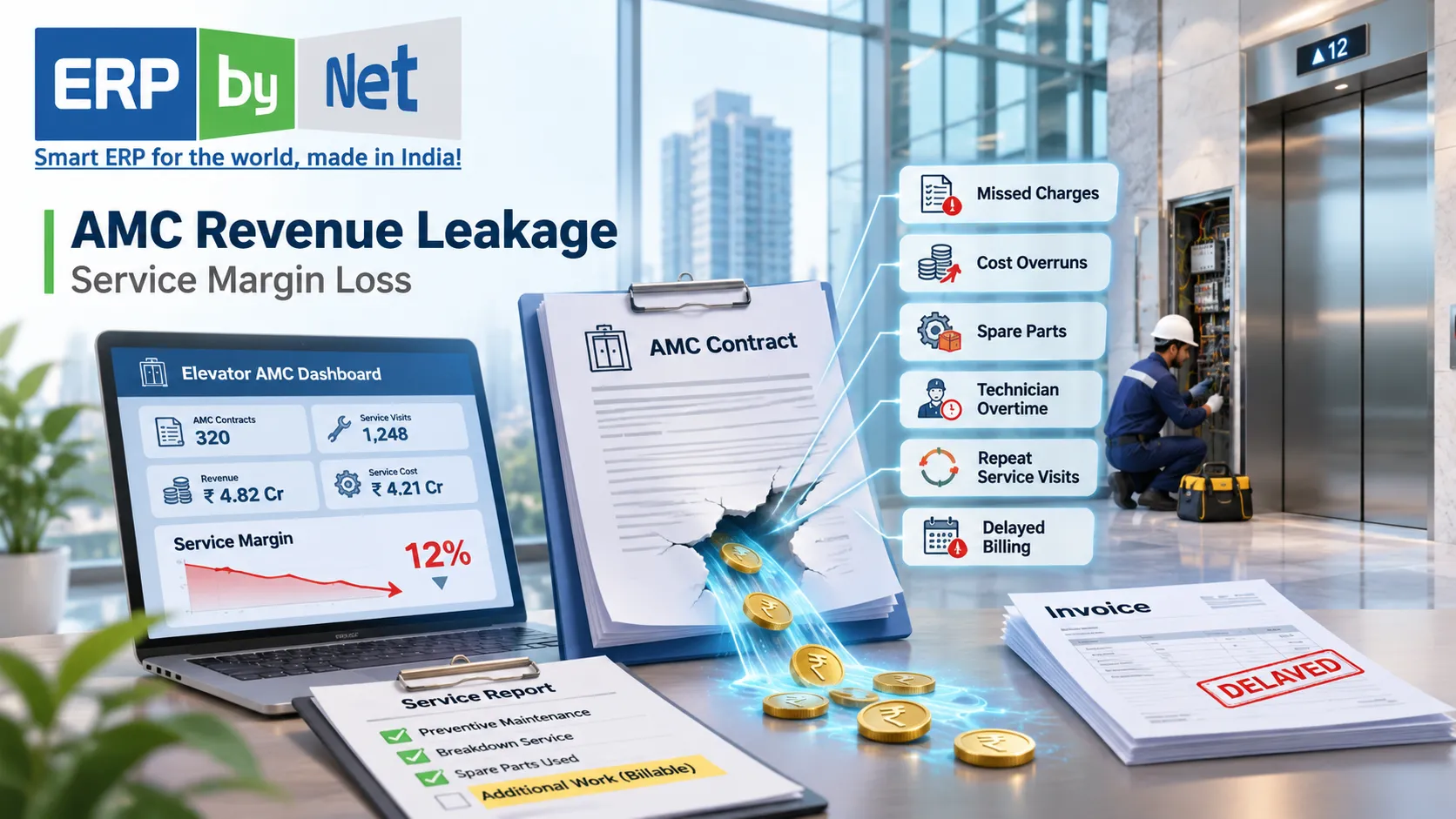
Revenue leakage occurs when a company fails to collect revenue it is contractually entitled to earn, or when avoidable operational expenses reduce the contribution generated by its maintenance agreements. It can originate in contract administration, service execution, spare-parts management, technician coordination, billing or financial reconciliation.
The important distinction is that revenue leakage and profitability loss are related but not identical. Missing an eligible invoice is a revenue-collection problem. Repeated unplanned technician visits are primarily a cost problem. Both can weaken AMC financial performance.
For elevator service providers, understanding these differences is essential. This article examines where AMC revenue leakage originates, how to calculate its financial impact, which indicators deserve attention and how connected service-management processes, including AceService AMC management software, can help prevent recurring losses.
1. What Is AMC Revenue Leakage in Elevator Maintenance?
AMC revenue leakage refers to revenue that an elevator maintenance company could legitimately earn under its agreements but fails to invoice, collect or retain because of gaps in its commercial and operational processes.
It also needs to be examined alongside cost leakage: expenses that exceed what the company expected to incur when pricing and accepting the contract.
A maintenance agreement establishes the commercial relationship between the elevator company and its customer. It defines the equipment covered, maintenance frequency, service responsibilities, contract duration, billing arrangements and the treatment of repairs or replacement components.
However, the actual service operation can become different from the original agreement.
For example, a technician may replace a component that is excluded from the AMC. If the work is completed but the replacement is not recorded as chargeable, the company may lose an opportunity to invoice the customer.
Similarly, an elevator might experience frequent breakdowns that require additional technician visits. Even when every visit is properly documented, the additional labour and travel expenses can reduce the contract’s contribution.
Revenue leakage versus cost leakage
These two problems should be measured separately.
| Financial issue | Example | Business impact |
|---|---|---|
| Missed revenue | Chargeable repair never invoiced | Lost eligible billing |
| Renewal leakage | Expired contract not renewed | Lost recurring revenue opportunity |
| Scope leakage | Additional work delivered without approval or billing | Unrecovered service value |
| Labour cost leakage | Repeated visits for the same fault | Higher service expenditure |
| Parts cost leakage | Chargeable components issued without recovery | Reduced contract contribution |
| Travel cost leakage | Poor technician routing | Higher delivery costs |
| Billing delay | Completed work remains unbilled | Delayed cash flow |
A company should not classify every operational expense as lost revenue. The distinction matters because each problem requires a different corrective action.
Missed invoices require better billing controls. Excessive repeat visits require technical investigation and service-quality improvements. Underpriced contracts require commercial review.
The first step is identifying which type of leakage is affecting the business.
2. Why AMC Revenue Leakage Is Difficult to Detect
Unlike a large financial transaction error, service-margin leakage rarely appears as one obvious incident.
It is distributed across departments.
The sales team manages contract negotiations. The service department schedules maintenance visits and responds to complaints. Technicians execute repairs. Stores issue replacement components. Accounts prepares invoices and follows up on payments.
Each department may maintain accurate information within its own process, but the information does not always move consistently between departments.
Consider a simplified situation.
An elevator technician attends a breakdown complaint and discovers that a component needs replacement. The component is available in the warehouse, so the technician collects it and completes the repair. The customer receives a functioning elevator, and the service ticket is marked completed.
However, the technician records the replacement in a handwritten report rather than linking it to the service job. The warehouse updates its stock register, but accounts does not receive information about the chargeable component.
The repair is complete. Inventory has decreased. The service ticket is closed.
But the eligible charge has not reached the invoice.
The problem is not necessarily a lack of effort by any individual employee. It is a broken information flow.
Five conditions that make leakage difficult to identify
- Fragmented contract records: Contract coverage and billing conditions are maintained separately from service records.
- Incomplete field documentation: Technicians do not consistently record the work completed, parts consumed or additional hours spent.
- Disconnected inventory: Parts are issued without sufficient reference to the customer, equipment or service ticket.
- Manual billing handoffs: Accounts depends on emails, spreadsheets and telephone updates to identify chargeable work.
- Delayed management reporting: Financial reviews happen after costs have accumulated rather than during the contract period.
The result is that management may know how much AMC revenue was generated without knowing exactly how much it cost to deliver that revenue.
Read More: How IoT Telemetry Feeds Directly into ERP Maintenance Workflows for Zero-Downtime Elevators
3. Seven Hidden Sources of AMC Revenue and Margin Leakage

Understanding the individual leakage points is more useful than simply reviewing total annual maintenance revenue.
3.1 Missed AMC Renewals and Expired Contracts
Contract renewals are among the most important activities in a recurring service business.
However, managing renewals becomes increasingly complicated as the installed elevator base expands.
An elevator company may maintain different agreements with residential societies, commercial buildings, hospitals, hotels, industrial facilities and property-management companies. Each contract has its own starting date, expiry date, commercial conditions and renewal requirements.
When renewal information is maintained manually, several problems can occur:
- Expiry dates are not updated after contract amendments.
- Renewal discussions begin too close to the expiry date.
- Customer follow-ups are forgotten.
- Service teams continue attending equipment without confirming the current commercial arrangement.
- Renewal quotations are prepared late.
- Expired agreements remain incorrectly classified as active business.
The financial consequences extend beyond the missed renewal itself.
A lost agreement can also affect technician route planning, expected service revenue and spare-parts demand.
Example: Imagine an elevator company maintaining 300 units across different customer locations. Ten contracts expire during a particular month, but the renewal team receives the information late. Even if some customers eventually renew, the company may experience delays in billing and uncertainty around service coverage.
The solution is to maintain a structured contract lifecycle.
Every AMC should have a clearly recorded start date, expiry date, renewal status, customer information, covered equipment and responsible account owner. Renewal activities should begin sufficiently early to allow commercial discussions before the existing agreement expires.
3.2 Unbilled Repairs and Out-of-Scope Service Work
Not every repair performed during an AMC visit is necessarily covered by the agreement.
The distinction between included maintenance and chargeable additional work is critical.
Depending on the contractual terms, certain components, accidental damage, external electrical problems, special repairs or additional services may fall outside the agreed scope.
The challenge begins when technicians complete these activities without a consistent commercial approval and billing process.
For example, a technician attending a routine maintenance visit may discover a damaged component that is excluded from the agreement. The customer requests an immediate replacement. The technician completes the work to restore elevator operation, but the additional job is not formally registered.
When the service department closes the visit without identifying the chargeable activity, the accounts team may never receive the information needed to raise an invoice.
A controlled process should include:
- Identify the work required.
- Check the relevant AMC coverage.
- Determine whether the work is included or chargeable.
- Obtain the required customer approval.
- Record the materials and labour involved.
- Complete the service job.
- Transfer approved billing information to accounts.
- Track invoice generation and payment.
This is particularly important for comprehensive and non-comprehensive maintenance agreements, where the commercial responsibility for replacement components can differ considerably.
3.3 Spare Parts Consumed Without Financial Recovery
Spare parts are a major consideration in elevator maintenance profitability.
Elevator companies may regularly use door rollers, sensors, switches, contactors, control components, bearings, cables and other replacement items while maintaining their installed equipment base.
The financial treatment of these parts depends on the contract.
Under a comprehensive agreement, eligible replacement parts may be included in the maintenance price. Under a non-comprehensive agreement, specified components may be separately chargeable.
The problem occurs when the company cannot connect the component issued from stores with the relevant service job and contractual coverage.
For instance:
A technician requests a replacement door component from the warehouse. The storekeeper issues it, and the technician completes the repair.
However, the issue transaction contains only the component name and quantity. It does not identify the elevator, customer, job number or AMC coverage.
The company knows that stock has decreased, but it cannot easily establish whether the component was:
- Included in the contract.
- Chargeable to the customer.
- Issued under warranty.
- Used for an internal repair.
- Consumed during an installation activity.
Without proper classification, the finance team may struggle to identify the correct cost and billing treatment.
The practical control: Every material issue should be connected to the relevant service transaction and equipment wherever the business process allows. The system should distinguish covered consumption from chargeable consumption.
This provides a more reliable foundation for both inventory reconciliation and contract-level cost analysis.
3.4 Repeat Breakdown Visits Increasing Technician Costs
Not every AMC loss originates from missed billing.
Sometimes the company performs all contractual activities correctly but spends too much money delivering the service.
Repeated breakdowns are a major example.
An elevator that experiences recurring door-related faults, electrical problems or component failures may require several unplanned visits. Each visit consumes technician time, travel resources and potentially additional spare parts.
The financial impact can be greater than the direct repair expense.
A repeat visit may also:
- Disrupt the technician’s planned maintenance route.
- Delay scheduled preventive maintenance at other locations.
- Require additional overtime.
- Increase supervisor coordination.
- Create customer dissatisfaction.
- Increase the possibility of SLA-related penalties where contractual terms provide for them.
Research published in Engineering Reports examines elevator maintenance-contract profitability through preventive and corrective maintenance costs. Its worked example shows how increasing breakdown frequency can reduce gross margin and, under its assumptions, turn an otherwise positive EBITDA contribution negative. These figures are a research example, not a universal elevator-industry benchmark.
The important lesson is that the number of service tickets alone does not reveal the true cost of maintaining an elevator.
Companies should also examine repeat-fault frequency, time spent resolving breakdowns, parts used and travel associated with each visit.
3.5 Poor Technician Routing and Travel Management
Travel is an operating expense that can quietly accumulate across an AMC portfolio.
An elevator company may have technicians covering multiple societies, commercial buildings and industrial locations across a city.
When assignments are made without considering geography, technician availability, workload and service urgency, unnecessary travel can increase.
Consider a simplified situation.
A technician completes a preventive maintenance visit in one area. The next assignment is located far away, although another available technician is already working nearby.
The company may be able to complete both jobs, but the route creates additional travel time.
Across many technicians and daily assignments, poor routing can reduce productive service hours.
Important indicators include:
- Travel hours per completed service job.
- Number of visits completed per technician.
- Distance between consecutive assignments.
- Emergency visits outside planned routes.
- Overtime associated with route delays.
- Preventive maintenance completed against scheduled maintenance.
Route optimization should not come at the expense of safety, technical competence or emergency response commitments. The goal is to allocate work intelligently while respecting the actual service requirements.
3.6 Incorrect AMC Pricing and Unreviewed Contract Costs
A contract that was profitable when originally signed may become less attractive over time.
Technician wages, transportation, component prices, subcontracting expenses and service requirements can change.
At the same time, the contract value may remain unchanged until renewal.
A company that does not periodically examine contract-level costs may continue delivering agreements under outdated commercial assumptions.
This is particularly relevant when:
- The maintained elevator is older and experiences frequent breakdowns.
- The customer has added equipment to the original agreement.
- Travel distances have increased.
- Maintenance frequency has changed.
- The cost of included replacement components has increased.
- The original quotation underestimated the service effort.
Contract pricing should be reviewed using actual operating information rather than relying exclusively on historical estimates.
However, a price increase is not always the correct response.
Sometimes a recurring breakdown is caused by an underlying technical issue. Correcting the problem may be more commercially sensible than simply increasing the AMC price.
3.7 Billing Delays and Incomplete Financial Reconciliation
The final leakage point appears when operational work does not translate into timely financial action.
A service job may be completed, additional work approved and materials consumed, but the invoice remains pending.
This can happen because:
- Customer approvals are missing.
- Job completion records are incomplete.
- Additional work has not been classified.
- Supporting documents are unavailable.
- Billing information reaches accounts late.
- Invoice preparation depends on manual confirmation.
These gaps can affect working capital and collection planning.
A company may have delivered the service and incurred the expense but still be waiting for the financial transaction to be completed.
A useful control is to compare completed chargeable jobs with invoices generated during the same reporting period.
The difference should be investigated rather than treated as an ordinary administrative delay.
4. Comprehensive vs. Non-Comprehensive AMCs: Where Do Margins Disappear?
The structure of an AMC directly influences how an elevator company earns revenue and absorbs service expenses.
The difference between comprehensive and non-comprehensive contracts is therefore central to understanding maintenance profitability.
Comprehensive maintenance contracts
A comprehensive AMC generally places a broader range of maintenance and replacement responsibilities on the service provider, subject to the agreement’s exclusions and conditions.
The customer pays an agreed recurring amount for the specified coverage.
The service provider must manage the financial risk associated with covered labour, repairs and components.
The main margin risks include:
- Higher-than-expected replacement-part consumption.
- Frequent breakdowns.
- Rising technician costs.
- Additional repair work covered under the agreement.
- Poor preventive maintenance performance.
- Underestimated equipment condition.
A contract may generate consistent revenue but still become expensive to deliver.
Non-comprehensive maintenance contracts
A non-comprehensive AMC generally limits the service provider’s responsibility for certain replacement parts or major repairs.
The precise exclusions depend on the agreement.
This can reduce some component-related cost exposure, but it introduces a different operational requirement: chargeable work must be identified, approved, documented and invoiced correctly.
Potential leakage areas include:
- Parts not billed.
- Repairs completed without customer approval.
- Delayed quotations for replacement components.
- Unrecorded additional labour.
- Disputes over whether a repair falls within the agreed scope.
| Business consideration | Comprehensive AMC | Non-comprehensive AMC |
|---|---|---|
| Contract coverage | Broader, subject to exclusions | More limited, as defined by contract |
| Parts expenditure | Greater exposure to covered components | Some parts may be separately chargeable |
| Pricing considerations | Requires careful cost estimation | Requires clear scope and exclusions |
| Main margin risk | Unexpected service and replacement costs | Unbilled additional work |
| Billing control | Contract billing and exclusions | Contract billing plus approved additional work |
| Key performance focus | Cost per maintained elevator | Cost control and chargeable-work recovery |
Neither model is automatically more profitable.
The outcome depends on the contract price, equipment condition, service frequency, contractual scope and operating efficiency.
For this reason, elevator companies should evaluate profitability separately for different contract types.
5. How to Calculate AMC Profitability and Identify Revenue Leakage
A company cannot control what it does not measure.
However, calculating AMC profitability requires more than comparing total contract revenue against the service department’s overall expenses.
The analysis should be performed at the contract level and, where practical, the individual elevator level.
Step 1: Calculate contract revenue
Start with the actual contractual revenue for the selected reporting period.
Include the applicable AMC fees and separately approved, chargeable work that has been invoiced.
Do not count unapproved quotations or uncollected hypothetical charges as actual revenue.
Step 2: Calculate direct service costs
Identify the costs incurred in delivering the agreement.
These may include:
- Technician labour.
- Travel expenses.
- Covered spare parts.
- Subcontracted maintenance.
- Tools and consumables.
- Overtime.
- Additional breakdown attendance.
The treatment of overheads should be consistent with the profitability measure being calculated.
Step 3: Calculate gross contribution
A simple calculation is:
The corresponding percentage is:
This is an illustrative management calculation. The business should define whether it is measuring gross margin, contribution margin or another profitability measure.
Step 4: Identify missed billing
Compare completed chargeable work with the amount actually invoiced.
Only include work that is genuinely chargeable under the agreement and supported by the required approvals.
Step 5: Review contract performance
Compare actual costs and revenue against the original pricing assumptions.
A practical example illustrates the process.
Illustrative example:
Assume an elevator company has an annual maintenance agreement worth ₹1,20,000.
During the year, it records the following direct service costs:
| Financial component | Amount |
|---|---|
| Annual AMC revenue | ₹1,20,000 |
| Technician labour | ₹30,000 |
| Travel expenses | ₹15,000 |
| Covered spare parts | ₹20,000 |
| Breakdown-related expenses | ₹10,000 |
| Total direct service costs | ₹75,000 |
| Contribution before other costs | ₹45,000 |
The resulting contribution is ₹45,000, or 37.5% of recognised revenue.
Now assume that the company also completed ₹8,000 of approved chargeable work that was not invoiced.
If that amount is legitimately recoverable and later recognised, the financial position changes.
However, it should not simply be added to the existing recognised revenue before the invoice is raised and the appropriate accounting treatment is applied.
This example demonstrates why management needs both operational and financial records to understand contract performance.
The company must know what it sold, what it delivered, what it consumed and what it billed.
6. Eight KPIs Every Elevator Service Manager Should Monitor
Revenue leakage becomes easier to detect when management monitors indicators that connect service activity with financial outcomes.
The following KPIs provide a practical starting point.
| KPI | How to measure it | What it reveals |
|---|---|---|
| AMC Renewal Rate | Renewed eligible contracts ÷ contracts due for renewal × 100 | Renewal performance |
| Preventive Maintenance Completion | Completed scheduled visits ÷ visits due × 100 | Maintenance execution |
| Repeat Breakdown Rate | Repeat breakdowns ÷ total breakdowns × 100 | Recurring technical issues |
| First-Time Fix Rate | Jobs resolved on first visit ÷ total completed jobs × 100 | Repair effectiveness |
| Chargeable Work Recovery | Chargeable work invoiced ÷ approved chargeable work × 100 | Billing discipline |
| Spare Parts Cost per Lift | Relevant parts consumption ÷ maintained lifts | Component expenditure |
| Technician Travel Cost | Total travel expense ÷ completed service jobs | Route efficiency |
| AMC Contribution Margin | Service contribution ÷ recognised AMC revenue × 100 | Contract financial performance |
Why these KPIs should be reviewed together
A high renewal rate does not necessarily indicate a profitable AMC portfolio.
A company may renew almost every agreement while continuing to lose money on older elevators that require frequent corrective maintenance.
Similarly, a high number of completed service visits does not automatically mean technicians are productive. Excessive repeat visits can inflate the total activity count without resolving the underlying problems.
Management should therefore connect operational indicators with financial outcomes.
For example:
- Low first-time fix performance may increase labour and travel expenses.
- High parts consumption may indicate contract pricing or technical problems.
- Low chargeable-work recovery may reveal billing gaps.
- Rising travel cost may indicate inefficient technician allocation.
- Declining contribution margin may indicate that the original contract assumptions need review.
The purpose of KPI reporting is not to create more dashboards. It is to identify which business decisions require attention.
Read More: What Will Predictive Maintenance Actually Look Like for Elevator Companies in 2026?
7. The AMC Revenue Leakage Audit: A Practical Process for Elevator Companies
An effective leakage audit should examine the complete lifecycle of an AMC, from contract creation to renewal and financial reconciliation.
Reviewing only the accounting records may identify the final financial discrepancy without revealing where it originated.
A more effective approach is to follow the information across departments.
Stage 1: Audit the installed elevator and contract records
Begin by creating a reliable list of maintained elevators.
For each unit, verify:
- Customer and site details.
- Equipment identification.
- Contract start and expiry dates.
- Contract value.
- Maintenance frequency.
- Contract coverage.
- Billing frequency.
- Renewal status.
Compare this information with the actual installed equipment base.
This helps identify elevators that are receiving service without a clearly recorded active agreement, as well as contracts that no longer match the equipment being maintained.
Stage 2: Compare scheduled and completed maintenance
Review preventive maintenance schedules against actual visits.
Identify:
- Overdue maintenance activities.
- Missed visits.
- Repeated rescheduling.
- Incomplete checklists.
- Missing technician reports.
- Visits completed without proper closure.
This stage helps management distinguish between scheduled obligations and actual service delivery.
Stage 3: Match breakdown tickets with spare-parts issues
Select a reporting period and compare service tickets with warehouse transactions.
Check whether each part issue contains the relevant equipment and job reference.
Classify the consumption as:
- Included under AMC coverage.
- Chargeable to the customer.
- Covered under warranty.
- Internal or company-related consumption.
Investigate transactions that cannot be classified.
Stage 4: Review technician time and travel
Examine the actual time spent on maintenance and corrective jobs.
Compare technician assignments, travel records, attendance and completed service tickets.
Look for repeated visits, unnecessary travel, excessive overtime and jobs that consume substantially more resources than expected.
Stage 5: Audit chargeable work and billing
Compare approved additional work against invoices generated.
Investigate every difference.
For pending items, identify whether the reason is:
- Missing customer approval.
- Incomplete service documentation.
- Delayed quotation.
- Contract-scope disagreement.
- Billing processing delay.
- Collection follow-up.
Stage 6: Evaluate contract profitability
Calculate the actual revenue and direct costs associated with individual contracts.
Where data permits, perform the calculation at the individual elevator level.
This prevents one profitable machine from concealing another machine’s financial losses within the same customer agreement.
Stage 7: Prepare a corrective action register
Every identified issue should have an owner, a corrective action and a review date.
For example:
| Identified problem | Corrective action | Responsible team |
|---|---|---|
| Expired contracts | Introduce renewal alerts and ownership | Sales / AMC |
| Unbilled repairs | Connect job completion with billing review | Service / Accounts |
| Untracked parts | Record material issues against service jobs | Stores |
| Repeat breakdowns | Investigate recurring fault patterns | Service |
| High travel expenses | Review technician routing | Service Management |
| Loss-making contracts | Review scope, costs and renewal pricing | Management / Finance |
An audit is valuable only when its findings lead to measurable operational changes.
8. How an Integrated ERP Helps Prevent AMC Revenue Leakage
Many AMC problems originate because the contract, service, inventory and finance processes are managed separately.
An integrated ERP approach can connect these activities through shared business information.
Instead of asking employees to repeatedly transfer data between spreadsheets, emails and separate applications, the company can establish a more structured workflow.
The objective is not simply to digitise service records.
It is to make sure that information captured during service execution can support inventory control, billing, cost analysis and management decisions.
Connecting contract management with service execution
An AMC record should provide the relevant contract information needed by the service team.
This includes equipment coverage, contract duration, maintenance requirements, billing terms and renewal information.
When a service request is received, the team should be able to identify the relevant customer, equipment and agreement.
This makes it easier to assess whether the requested work falls within the contract’s scope.
Connecting technician activity with job records
Technicians need a practical way to receive assignments, access service information and update work status.
A mobile field-service application can help capture completed activities and communicate job information to supervisors and back-office teams.
For elevator companies, the process should include:
- Technician assignment.
- Service ticket information.
- Maintenance checklists.
- Work completion status.
- Travel information.
- Additional repair details.
- Relevant job documentation.
This reduces dependence on informal updates that may never reach the department responsible for billing or reporting.
Connecting inventory with service jobs
A service operation should not treat warehouse transactions as isolated stock movements.
Each material issue should be traceable to the relevant business activity.
This makes it possible to understand how spare parts are being consumed and whether they were used for installation, maintenance, warranty work or chargeable repairs.
Inventory and procurement integration can also help stores teams monitor stock availability and replenishment requirements.
Connecting service activity with finance
The financial department needs more than a list of completed service tickets.
It needs information about the commercial treatment of the work, applicable charges, recorded expenses and customer billing.
A connected process can help management compare service activity with financial transactions and identify items requiring reconciliation.
The following workflow illustrates the desired operating model.
This workflow should be configured according to the company’s actual contract terms, approval rules and accounting policies.
Read More: Elevator ERP vs. Standalone Service Software: 7 Differences That Matter as You Grow
9. How ERPbyNet Supports Connected AMC and Service Operations
For elevator companies, preventing AMC revenue leakage requires coordination between contract management, field execution, inventory and financial processes.
ERPbyNet provides an integrated ERP ecosystem for elevator, engineering, manufacturing and project-based businesses.
Its service-management capabilities are relevant to companies that want to reduce manual coordination across maintenance operations and improve the flow of information between technicians, service managers and finance teams.
AceService: AMC Contract and Service Management
Official solution: AceService
AceService supports service workflows including:
- AMC contract management.
- Preventive maintenance scheduling.
- Callback and complaint management.
- Repair job management.
- Warranty tracking.
- Contract renewal tracking.
- Service billing.
- Labour and material billing.
- Service reporting and dashboards.
These functions are relevant to the leakage points associated with missed service schedules, contract administration, additional work and billing coordination.
For example, structured contract records and renewal notifications can help the AMC team identify agreements approaching expiry rather than depending entirely on manual spreadsheet reviews.
Similarly, service-job and billing workflows can help improve the documentation of completed work.
SmartTechnician: Improving Field-Service Accountability
Official solution: SmartTechnician
Field technicians are an important source of operational information.
However, the information they capture must reach the office accurately and promptly.
SmartTechnician supports:
- Technician assignments.
- Mobile service tickets.
- Preventive maintenance checklists.
- GPS-enabled tracking.
- Geo-fencing.
- Travel tracking.
- Job-status updates.
- Supervisor monitoring.
- Overdue-ticket visibility.
These capabilities can support better field coordination and provide supervisors with more consistent information about service execution.
For an elevator company handling multiple sites, this can help reduce the manual effort involved in monitoring technician assignments and outstanding jobs.
MyAceService: Improving Customer and Contract Visibility
Official solution: MyAceService
Customer communication also affects service operations.
When customers cannot access their contract information or service status, they may need to contact the service department repeatedly.
MyAceService provides access to contract details, active and expired contract status, service history, maintenance schedules, callback tickets and service updates.
This helps improve communication between elevator companies and their customers while reducing dependence on repeated manual follow-ups.
AceFinance: Connecting Service Operations with Financial Management
Official solution: AceFinance
Service activity ultimately needs to connect with financial information.
AceFinance supports financial processes including:
- General ledger.
- Accounts receivable.
- Accounts payable.
- Financial accounting.
- Financial reporting.
- Integration with ERPbyNet applications.
When relevant service and financial transactions are connected and correctly recorded, management can work toward more consistent financial reporting and better understanding of service-related expenditure and revenue.
The value of connecting these capabilities
Consider an elevator company that receives a breakdown complaint under an existing AMC.
The service team verifies the contract, assigns a technician and records the repair. If a component is consumed, the relevant material transaction can be recorded through the appropriate inventory process. If additional work is chargeable, the company can follow its approval and billing procedure.
The resulting information can support service reporting and financial review.
The important point is that the entire process should not depend on someone manually forwarding information from one department to another.
ERPbyNet’s relevant capabilities should be evaluated and configured against the company’s actual workflow, contractual rules and reporting requirements. Software does not automatically guarantee that every eligible charge will be collected or that every contract will become profitable.
10. Common Mistakes Elevator Companies Make While Controlling AMC Leakage
Even companies that use service-management software can experience financial leakage when their processes are poorly defined.
The following mistakes deserve attention.
Mistake 1: Monitoring Total AMC Revenue Instead of Contract-Level Performance
Department-level revenue can conceal the financial performance of individual agreements.
Management should review revenue and costs at the contract level and, where possible, at the equipment level.
Mistake 2: Treating Every Service Visit as an Included Activity
A visit does not automatically mean that every activity performed during it is covered by the AMC.
Companies must check the contract before deciding the commercial treatment of additional work.
Mistake 3: Allowing Parts to Leave Stores Without Job References
Unlinked material issues make it difficult to identify which customer, elevator or activity consumed the component.
Mistake 4: Measuring Technician Productivity Only by Visit Count
A technician completing many visits may still be spending excessive time on repeat breakdowns or travelling between distant sites.
Measure job outcomes and service effort, not just activity volume.
Mistake 5: Reviewing Contracts Only When They Expire
Waiting until renewal time to examine contract profitability leaves little opportunity to correct operational problems during the existing agreement.
Review costs and performance periodically.
Mistake 6: Assuming Automation Will Fix Incomplete Data
Software can organise recorded information, but it cannot reliably analyse transactions that were never entered or incorrectly classified.
Accurate equipment records, contract details, service documentation and inventory transactions are essential.
11. Building a More Profitable AMC Operation: A 90-Day Improvement Roadmap
Reducing AMC leakage is an operational improvement exercise, not simply a software installation project.
Elevator companies can approach it in stages.
The following is an illustrative improvement roadmap. The duration should be adjusted according to the size of the installed base, quality of existing records and implementation scope.
Days 1–30: Identify the Leakage
Start by understanding the current AMC portfolio.
- Consolidate contract and equipment records.
- Identify contracts approaching expiry.
- Review overdue preventive maintenance.
- Compare service tickets with parts issues.
- Identify completed chargeable work awaiting invoices.
- Examine repeated breakdowns.
- Calculate direct costs for a sample of contracts.
The output should be a documented list of leakage areas, supported by actual operational and financial records.
Days 31–60: Establish Process Controls
Once the major issues are understood, introduce consistent processes.
- Assign responsibility for contract renewals.
- Standardise service-job documentation.
- Establish material-issue references.
- Define chargeable-work approval procedures.
- Create a service-to-billing reconciliation process.
- Review technician assignment and routing practices.
- Introduce periodic contract-cost reviews.
The objective is to prevent the same problems from recurring.
Days 61–90: Monitor Performance and Improve
The final stage focuses on monitoring.
- Review renewal performance.
- Compare completed work against billed work.
- Track repeat breakdowns.
- Examine parts consumption.
- Monitor technician travel and labour.
- Review contract-level contribution.
- Identify agreements requiring repricing or technical intervention.
Management should establish a regular review cycle so that leakage does not remain unnoticed until the end of the financial year.
12. The Long-Term Objective: Move from AMC Revenue Tracking to AMC Profitability Management
For many elevator companies, AMC management initially focuses on the number of active contracts, total recurring revenue and upcoming renewals.
These are important indicators, but they do not provide a complete picture.
A more mature service-management approach also considers the resources required to honour every agreement.
Management should be able to answer questions such as:
- Which contracts require the highest technician effort?
- Which elevators experience recurring breakdowns?
- Which agreements consume unusually high spare-parts expenditure?
- How much approved chargeable work remains unbilled?
- Which contracts are approaching renewal with declining contribution?
- Are technician routes creating avoidable travel expenses?
- Are completed maintenance activities properly documented?
- Can finance reconcile service transactions with invoices?
These questions shift the focus from simply maintaining a large AMC portfolio to understanding the financial quality of that portfolio.
The distinction becomes particularly important as elevator companies expand into new locations and maintain increasingly diverse equipment.
Without structured processes, additional contracts can create more administrative work, more service coordination and greater cost exposure.
With better contract records, consistent field reporting, traceable inventory transactions and connected financial processes, management can make more informed decisions about service operations.
Stop AMC Revenue Leakage. Protect Your Service Margins.
Track AMC coverage, service visits, technician hours, spare parts, callbacks, and billable work in one connected system. ERPbyNet helps elevator companies identify hidden service costs, reduce missed billing opportunities, and manage AMC profitability with better control.
Conclusion: Protecting AMC Margins Starts with Understanding Where the Money Goes
An expanding AMC portfolio can create a strong foundation for an elevator service business, but recurring revenue alone does not guarantee financial success.
Every contract carries operational responsibilities. Every maintenance visit consumes resources. Every replacement component affects inventory and costs. Every chargeable repair needs appropriate documentation, approval and billing. Every renewal requires a clear understanding of the agreement’s commercial performance.
The real challenge is that these activities often take place across different departments, making it difficult to identify where revenue and margins are being lost.
Elevator companies need to move beyond tracking active contracts and total AMC revenue. They should examine contract coverage, completed service work, technician expenses, spare-parts consumption, billing recovery and individual contract profitability.
A structured service-management process, supported by connected ERP workflows, can help bring these activities together.
ERPbyNet supports elevator companies through its AceService, SmartTechnician, MyAceService and AceFinance capabilities, helping connect maintenance management, field execution, customer communication and financial operations.
The goal is not simply to manage more AMCs. It is to understand the financial performance of every AMC your company delivers.
Ready to improve control over your elevator service operations?
Frequently Asked Questions
1. What is AMC revenue leakage in elevator companies?
AMC revenue leakage occurs when elevator companies fail to invoice or collect revenue they are contractually entitled to earn. Examples include unbilled chargeable repairs, missed renewal opportunities and additional services that are completed without proper billing documentation. Related cost leakage includes excessive technician visits, unplanned travel and uncontrolled spare-parts consumption.
2. What causes elevator AMC profitability to decline?
AMC profitability can decline because of frequent breakdowns, higher technician labour costs, increased travel expenses, expensive replacement components, inaccurate contract pricing and unbilled additional work. The impact depends on the equipment condition, contractual coverage, maintenance requirements and service-delivery efficiency.
3. How can elevator companies identify unbilled AMC services?
Companies should compare completed service jobs with approved chargeable work and invoices generated. They should also check technician reports, material issues, customer approvals and contract exclusions. Every completed chargeable activity should have a traceable record that can be reviewed by the service and finance teams.
4. How do comprehensive and non-comprehensive AMCs affect profitability?
Comprehensive agreements generally involve broader replacement and maintenance responsibilities for the service provider, subject to contractual exclusions. Non-comprehensive agreements may allow certain components and repairs to be billed separately. Profitability depends on contract pricing, equipment condition, parts consumption, labour costs and the ability to enforce the agreed scope.
5. How can technician management affect AMC margins?
Technician management affects labour utilisation, travel expenditure, preventive maintenance completion and repeat breakdown costs. Poor routing and repeated visits can increase the expense of delivering an AMC. Structured assignment, job documentation, GPS tracking and service-performance monitoring can help management identify operational inefficiencies.
6. How should elevator companies calculate AMC profitability?
A practical starting point is to subtract direct service costs from recognised AMC revenue. Direct costs may include technician labour, travel, covered spare parts, subcontracting and corrective maintenance. The resulting contribution should be compared with recognised revenue. Companies should apply consistent accounting definitions and include other costs when calculating broader profitability measures.
7. Can ERP software prevent AMC revenue leakage?
ERP software can help reduce information gaps by connecting contract records, service tickets, technician activity, inventory transactions and financial workflows. However, its effectiveness depends on accurate data, appropriate configuration, defined approval procedures and consistent employee adoption. It cannot independently guarantee that all revenue will be recovered.
8. Which AMC KPIs should elevator companies track?
Useful indicators include AMC renewal rate, preventive maintenance completion, repeat breakdown rate, first-time fix rate, chargeable-work recovery, spare-parts cost per elevator, technician travel cost and contribution margin by contract. Together, these indicators help management understand both service performance and financial outcomes.
9. How often should elevator companies review AMC profitability?
Companies should monitor service activity and costs regularly, with formal contract-profitability reviews at defined intervals. Quarterly reviews can be a useful starting point, while contracts approaching renewal may require earlier examination. The frequency should reflect the size and complexity of the AMC portfolio.
10. How does ERPbyNet support AMC and elevator service management?
ERPbyNet provides AceService for AMC and service management, SmartTechnician for field operations, MyAceService for customer and contract visibility, and AceFinance for financial management. These capabilities can support connected workflows across contract administration, maintenance execution, technician coordination and financial reporting, subject to the selected configuration and implementation scope.

COO & Founder Member, XECOM | ERP & Technology Expert
Ganesh Limaye is a technology and business leader with 30+ years of experience in ERP, service management, project-based operations, and business process automation. He specializes in helping elevator, engineering, and service-driven businesses improve operational visibility, productivity, customer service, and business growth.

