CategoriesElevator Maintenance Management ERP (Enterprise Resource Planning)

From Complaint to Closure: What Really Happens During Lift Maintenance

When a lift stops unexpectedly, makes unusual noises, or fails to operate smoothly, most people only see one part of the lift maintenance process—the technician arriving to fix the issue. In reality, professional lift maintenance begins long before the technician reaches the site and continues even after the lift is safely back in service. Behind every service visit is a well-coordinated operation involving complaint registration, technician dispatch, inspection, spare parts planning, repairs, and final closure to ensure reliable and safe elevator performance.

Every lift complaint sets off a chain of activities involving customer support teams, service coordinators, technicians, inventory managers, and maintenance supervisors. A single service request may require checking maintenance history, verifying spare parts availability, assigning the right technician, conducting safety inspections, documenting repairs, and updating service records. When these steps are managed efficiently, lift downtime is minimized, customers receive faster resolutions, and maintenance teams can work more productively.

However, many Lift Maintenance companies still rely on phone calls, spreadsheets, paper job cards, and disconnected systems. This often results in delayed responses, missed service commitments, duplicate work, misplaced records, and poor visibility into ongoing maintenance activities.

Modern lift service providers are moving towards digital service management, where every complaint is tracked from the moment it is reported until it is successfully resolved. Platforms like ERPbyNet help bring these activities together by connecting complaint management, technician scheduling, inventory control, field service operations, and reporting into one centralized system.

In this guide, we’ll walk through the complete journey of a lift maintenance request—from complaint registration to final closure—revealing what really happens behind the scenes and why an organized workflow makes all the difference.

Key Takeaways

  • An efficient complaint management process ensures every service request moves smoothly from reporting to resolution.
  • Delayed complaint handling increases elevator downtime, customer frustration, and operational costs.
  • Real-time technician dispatch, status tracking, and digital workflows accelerate complaint resolution.
  • Centralized complaint management improves visibility for service teams, managers, and customers.
  • ERP-driven automation transforms the entire complaint lifecycle, delivering faster closures and higher customer satisfaction.

What You’ll Learn

  • How the complete lift maintenance complaint workflow operates from complaint registration to job closure.
  • Why manual complaint handling slows response times and creates communication gaps.
  • How real-time technician assignment and tracking improve field service efficiency.
  • The importance of digital service reports, updates, and customer communication throughout the maintenance process.
  • How ERPbyNet streamlines complaint management with automated workflows, centralized dashboards, and complete service visibility.

Real Insights

  • Most customer complaints are caused by poor coordination rather than technical complexity, making operational efficiency a competitive advantage.
  • Businesses with centralized complaint tracking resolve service requests faster and improve SLA compliance.
  • Real-time visibility enables managers to monitor every complaint, technician activity, and service status from a single platform.
  • Automated notifications and digital documentation reduce follow-ups, paperwork, and communication delays.
  • The best lift maintenance companies treat complaint management as a complete service journey—from the first customer call to verified closure and continuous service improvement.

Why Every Lift Complaint Starts a Much Larger Service Process

A customer reporting a lift issue may seem like a simple phone call or email, but for the maintenance company, it marks the beginning of a structured service workflow.

The reported issue could range from:

  • Lift not moving
  • Doors failing to open or close properly
  • Unusual vibration or noise
  • Lift stopping between floors
  • Faulty display panel
  • Emergency alarm malfunction
  • Slow door operation
  • Incorrect floor leveling
  • Communication system failure
  • Routine preventive maintenance request

Each complaint must be evaluated based on its urgency. A trapped passenger requires immediate attention, while a minor door adjustment can usually be scheduled alongside other service visits.

Without a standardized process, even small complaints can quickly escalate into larger operational challenges. Service coordinators may struggle to identify available technicians, technicians may arrive without the required spare parts, or customer communication may become inconsistent throughout the repair process.

Professional lift maintenance companies therefore treat every complaint as a service ticket that follows a defined lifecycle rather than an isolated event.

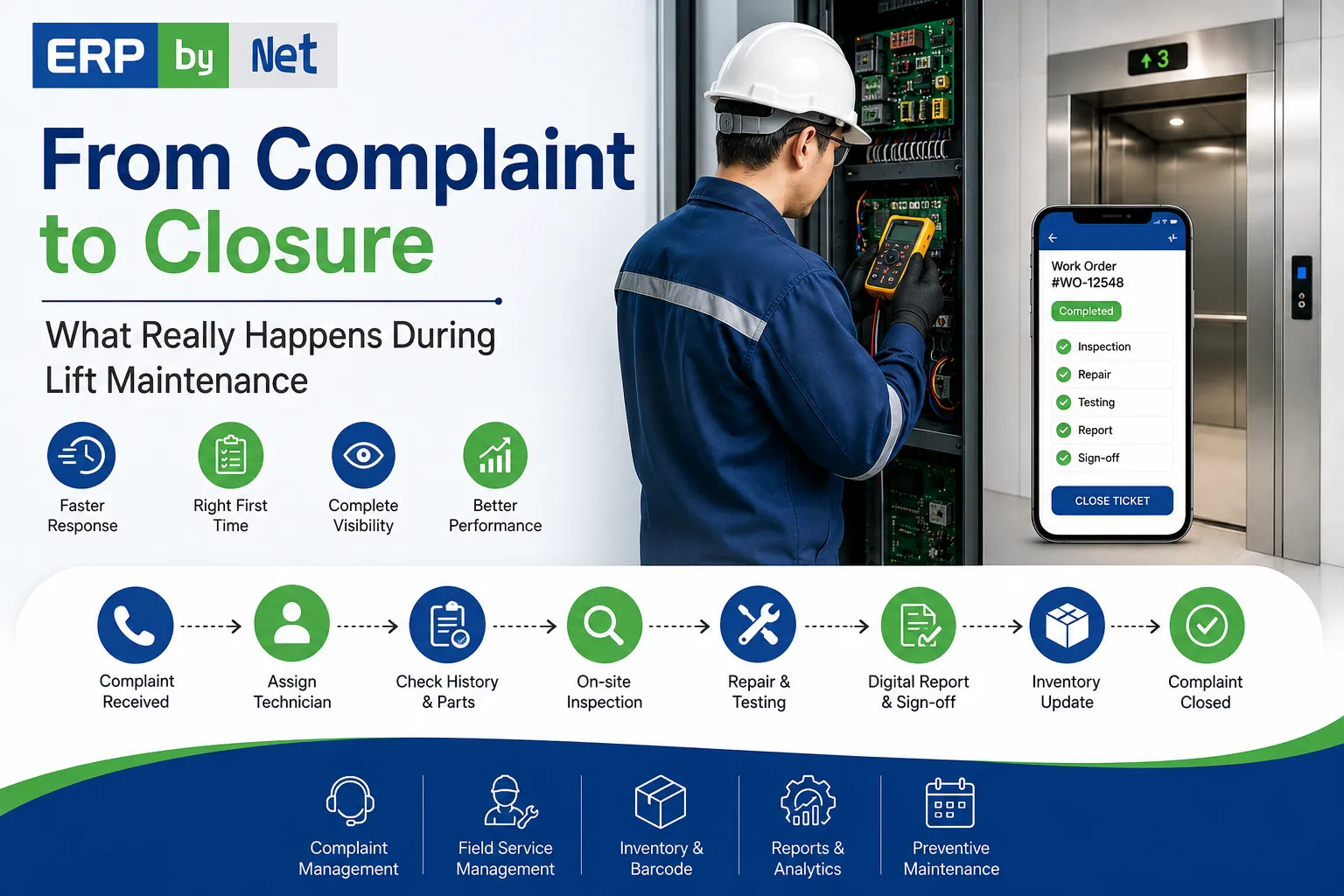
That lifecycle typically includes:

  1. Complaint registration
  2. Priority assessment
  3. Technician assignment
  4. Service history review
  5. Spare parts verification
  6. On-site inspection
  7. Repair or replacement
  8. Safety testing
  9. Digital documentation
  10. Complaint closure
  11. Performance analysis

Managing each stage through a centralized platform like ERPbyNet ensures that every department works with the same information, reducing delays and improving service quality.

Step 1: Complaint Registration – Building the Foundation for Faster Resolution

Lift complaint registration workflow with ticket creation, technician assignment, and service history in ERPbyNet.
#image_title

The quality of a maintenance job often depends on how accurately the complaint is recorded at the beginning.

Many companies still depend on handwritten notes or informal communication through phone calls and messaging apps. While this may work for a small number of service requests, it becomes increasingly difficult to manage as customer bases grow.

Important details may be forgotten, technicians may receive incomplete information, and duplicate complaints may be created for the same issue.

An effective complaint registration process captures all the information needed before dispatching a technician.

Typical information includes:

Customer Information

  • Customer name
  • Company or building
  • Contact details
  • Service contract status

Lift Details

  • Lift identification number
  • Building location
  • Lift model
  • Manufacturer
  • Installation year
  • Maintenance history

Complaint Details

  • Description of the issue
  • Time of occurrence
  • Photos or videos (if available)
  • Current operating status
  • Safety concerns

Service Information

  • Complaint category
  • Priority level
  • Service Level Agreement (SLA)
  • Ticket creation date and time

Capturing this information at the beginning helps eliminate unnecessary follow-up calls and allows technicians to prepare before arriving at the site.

With ERPbyNet’s Complaint Management module, every service request is automatically converted into a trackable ticket, making it easier to monitor progress, assign responsibilities, and maintain a complete service history for every lift.

Step 2: Prioritizing the Complaint Based on Business Impact

Not every lift complaint requires the same response time.

Professional maintenance companies categorize requests based on severity, safety, and customer commitments.

A typical prioritization model may include:

Emergency Complaints

These include situations where:

  • Passengers are trapped
  • The lift is completely non-operational
  • Safety systems have failed
  • There is a risk to passenger safety

Such complaints usually require immediate dispatch and strict adherence to SLA commitments.

High Priority Complaints

Examples include:

  • Frequent lift stoppages
  • Door malfunctions
  • Significant ride quality issues
  • Electrical faults

These should be attended to as soon as possible to prevent further failures.

Routine Service Requests

These generally involve:

  • Minor adjustments
  • Scheduled preventive maintenance
  • Cosmetic issues
  • Inspection requests

Grouping complaints according to priority helps service teams allocate resources efficiently instead of responding on a first-come, first-served basis.

ERPbyNet enables organizations to configure complaint priorities, automate SLA tracking, and highlight overdue tickets so that critical service requests receive immediate attention.

Step 3: Assigning the Right Technician—Not Just the Available One

After a complaint is registered, the next challenge is selecting the most suitable technician.

Many businesses still rely on manual phone calls to determine who is available. This approach often leads to delays, uneven workloads, and unnecessary travel time.

A professional dispatch process considers several factors before assigning a job.

Technician Expertise

Different technicians possess different skill sets.

Some specialize in:

  • Passenger lifts
  • Hospital elevators
  • Freight elevators
  • Hydraulic lifts
  • Traction lifts
  • Machine-room-less (MRL) lifts

Assigning technicians based on expertise improves first-time repair success and reduces repeat visits.

Geographic Location

Sending the nearest qualified technician reduces travel time and improves response speed.

Workload

An overloaded technician may struggle to respond promptly, while another technician may have spare capacity.

Balanced workload distribution helps improve operational efficiency.

Service Commitments

Customers with premium maintenance contracts often require guaranteed response times.

Dispatch systems must consider contractual obligations when assigning jobs.

With ERPbyNet’s Field Service Management capabilities, service coordinators can assign work orders digitally, notify technicians instantly, and monitor job progress in real time—reducing manual coordination and improving response efficiency.

Step 4: Reviewing the Lift’s Complete Service History Before the Visit

One of the biggest mistakes in manual maintenance operations is treating every complaint as a completely new issue.

In reality, most lifts have an extensive maintenance history that provides valuable clues about recurring problems.

Before visiting the site, experienced technicians review historical information such as:

  • Previous complaints
  • Earlier repair reports
  • Components replaced
  • Warranty records
  • Breakdown frequency
  • Preventive maintenance schedules
  • Inspection reports
  • Safety observations
  • Repeat failures
  • Open recommendations from earlier visits

For example, if the same lift has experienced three door-related complaints within the last six months, the technician may decide to inspect the entire door mechanism instead of replacing a single component again.

Similarly, recurring motor faults could indicate deeper electrical issues rather than isolated failures.

Having instant access to service history enables technicians to make informed decisions, arrive better prepared, and reduce diagnostic time.

ERPbyNet maintains a centralized digital service history for every lift, allowing technicians and managers to view previous maintenance activities without searching through paper files or scattered records.

Step 5: Planning Spare Parts Before Leaving for the Site

One of the most common reasons for delayed lift repairs is the unavailability of spare parts.

Imagine a technician diagnosing a faulty door sensor, only to discover that the required replacement part is not available in the warehouse. The technician must return later after the part is procured, increasing lift downtime and frustrating the customer.

Efficient maintenance begins before the technician reaches the site.

Once the likely issue has been identified based on the complaint and service history, the maintenance team should verify whether the required spare parts are available.

This process typically includes:

  • Checking warehouse inventory
  • Verifying stock availability across multiple branches
  • Reserving required components
  • Identifying substitute parts when applicable
  • Generating purchase requests for unavailable items
  • Preparing tools and safety equipment before dispatch

Modern inventory management goes beyond simply knowing whether a part exists. Barcode-enabled inventory systems allow technicians to quickly identify, issue, and track spare parts while maintaining accurate stock records.

By integrating complaint management with inventory control, ERPbyNet enables maintenance teams to verify spare part availability, reserve inventory, and update stock automatically once components are used. This reduces unnecessary repeat visits, improves first-time fix rates, and helps ensure that technicians arrive prepared for the job.

Read More: The Hidden Relationship Between Inventory and Customer Satisfaction

Step 6: On-Site Inspection – Understanding the Real Cause of the Problem

By the time a technician arrives, much of the preparation has already been completed. The complaint has been categorized, the service history has been reviewed, and the necessary tools and spare parts have been arranged. Now begins the most critical phase of the maintenance process—accurately diagnosing the root cause of the issue.

Rather than immediately replacing components, experienced technicians follow a structured inspection process. This ensures the visible symptom is addressed while also identifying any underlying problems that could lead to future breakdowns.

A professional lift inspection typically covers multiple systems, including:

Mechanical Components

The technician examines all moving parts for signs of wear, damage, or improper operation, such as:

  • Door mechanisms
  • Guide rails
  • Rollers
  • Suspension ropes or belts
  • Counterweight system
  • Bearings
  • Braking system
  • Machine room equipment (where applicable)

Any abnormal noise, excessive vibration, or visible wear is documented for further evaluation.

Electrical Systems

Electrical faults are among the most common causes of lift failures. The inspection includes checking:

  • Control panels
  • Power supply
  • Circuit boards
  • Wiring connections
  • Sensors
  • Safety switches
  • Limit switches
  • Emergency battery systems

Even minor electrical irregularities can affect lift performance and passenger safety.

Safety Components

Safety remains the highest priority during every maintenance visit. Technicians verify that all critical safety devices are functioning correctly, including:

  • Emergency brakes
  • Overspeed governor
  • Door safety sensors
  • Alarm system
  • Emergency communication devices
  • Auto-rescue systems
  • Interlocks

Any safety-related defect is addressed before the lift is returned to service.

Ride Quality Assessment

Passengers often notice issues before they become major failures. Technicians evaluate:

  • Smooth acceleration and deceleration
  • Accurate floor leveling
  • Door opening and closing speed
  • Ride comfort
  • Noise levels
  • Travel vibration

These observations help identify developing mechanical or electrical problems before they result in unexpected breakdowns.

Instead of relying on paper checklists, many maintenance companies now use digital inspection forms. Using ERPbyNet’s mobile service application, technicians can complete inspection checklists, capture photographs, record observations, and attach supporting documents directly to the service ticket, ensuring accurate documentation and easy future reference.

Step 7: Diagnosing the Root Cause Instead of Treating the Symptoms

Finding the immediate fault is only part of the job. Professional maintenance teams also investigate why the failure occurred.

For example, if a door sensor repeatedly fails, simply replacing the sensor may solve the immediate issue. However, if the underlying cause is excessive vibration, poor alignment, or electrical fluctuations, the same complaint is likely to return.

Root cause analysis helps maintenance teams:

  • Reduce recurring complaints
  • Improve first-time fix rates
  • Extend equipment life
  • Minimize maintenance costs
  • Improve customer satisfaction

Technicians often consider factors such as:

  • Previous repair history
  • Frequency of similar failures
  • Component age
  • Environmental conditions
  • Installation quality
  • Usage patterns
  • Preventive maintenance compliance

A centralized maintenance history makes this process significantly easier. ERPbyNet allows technicians to review previous repairs, recurring issues, and component replacement history before recommending the most effective solution.

Step 8: Repair, Replacement, and Customer Approval

Once the fault has been identified, the technician determines the most appropriate corrective action.

Some issues can be resolved immediately through minor adjustments, while others require replacement parts or more extensive repairs.

Common corrective actions include:

Minor Repairs

These may involve:

  • Tightening loose components
  • Lubricating moving parts
  • Adjusting door alignment
  • Resetting electrical systems
  • Cleaning sensors
  • Software parameter adjustments

These repairs can often be completed during the first visit.

Component Replacement

If a part has reached the end of its service life, replacement may be necessary.

Examples include:

  • Door rollers
  • Sensors
  • Contactors
  • Brake components
  • Control boards
  • Display panels
  • Emergency batteries

Before replacing expensive components, many maintenance companies require customer approval, particularly for lifts outside warranty or comprehensive maintenance contracts.

Digital work order systems streamline this approval process by generating quotations, recording customer authorization, and linking approved work directly to the service ticket.

With ERPbyNet, technicians and service coordinators can manage quotations, approvals, work orders, and repair records from a single platform, reducing delays caused by manual paperwork and disconnected communication.

Read More: Why Real-Time Visibility Is Becoming Essential for Modern Operations

Step 9: Testing the Lift Before Returning It to Service

Completing a repair does not automatically mean the lift is ready for passenger use.

Every maintenance activity must be followed by comprehensive testing to ensure the problem has been fully resolved and that all safety systems continue to operate correctly.

A post-repair testing procedure typically includes:

Operational Testing

The lift is operated through multiple travel cycles to verify:

  • Smooth movement
  • Accurate floor stopping
  • Door operation
  • Response to floor calls
  • Leveling accuracy
  • Travel speed

Safety Testing

Technicians verify:

  • Emergency stop functionality
  • Alarm operation
  • Door protection devices
  • Brake performance
  • Auto-rescue features
  • Emergency communication systems

Load Testing (When Required)

For major repairs or specific maintenance activities, technicians may conduct controlled load testing to ensure the lift performs safely under operating conditions.

Only after successfully completing all required tests is the lift returned to normal service.

Digital testing records provide valuable evidence that safety procedures were followed and can support future audits or regulatory inspections.

Step 10: Creating a Complete Digital Service Report

One of the biggest improvements modern maintenance software brings is replacing handwritten service reports with detailed digital documentation.

A professional service report provides transparency for both the maintenance company and the customer.

It typically includes:

  • Complaint reference number
  • Date and time of service
  • Technician details
  • Arrival and completion times
  • Inspection findings
  • Root cause analysis
  • Repairs completed
  • Parts replaced
  • Safety tests performed
  • Photographs
  • Recommendations for future maintenance
  • Customer observations
  • Digital signatures

Digital reports eliminate many common problems associated with paper-based documentation, such as lost records, unreadable handwriting, and delayed reporting.

Because every report is linked to the lift’s service history, future technicians have immediate access to previous maintenance activities, allowing them to diagnose issues more efficiently.

ERPbyNet automatically stores these reports within the asset’s maintenance history, creating a complete digital record that can be accessed anytime by service teams and management.

Step 11: Updating Inventory Automatically After Repairs

Maintenance doesn’t end when the technician finishes the repair. Every spare part used during the service visit must be accurately recorded to maintain inventory accuracy.

In manual environments, technicians often submit parts usage reports at the end of the day—or sometimes several days later. This delay creates discrepancies between actual stock and recorded inventory, making it difficult to plan future maintenance.

An integrated inventory system updates stock as soon as parts are issued or consumed.

Typical inventory updates include:

  • Deducting used spare parts
  • Recording serial numbers (where applicable)
  • Updating warehouse balances
  • Tracking technician-issued inventory
  • Monitoring minimum stock levels
  • Triggering reorder alerts
  • Recording part usage against specific lifts

Barcode-enabled inventory management further improves accuracy by allowing technicians to scan parts instead of manually entering item details.

ERPbyNet integrates complaint management with inventory control, ensuring that every part used during maintenance is automatically linked to the corresponding service ticket. This improves inventory visibility, reduces stock discrepancies, and provides complete traceability for future audits and warranty management.

Step 12: Closing the Complaint – More Than Just Marking the Job as Complete

Many people assume that once the lift starts working again, the maintenance job is finished. In reality, professional lift maintenance companies follow several important steps before officially closing a complaint.

The final stage ensures that the repair has been documented, the customer has been informed, inventory has been updated, and management has complete visibility into the service performed.

A typical complaint closure process includes:

  • Confirming the lift is operating normally
  • Verifying all safety tests have passed
  • Recording labor hours
  • Updating spare parts consumption
  • Uploading photographs and inspection reports
  • Obtaining customer confirmation or digital signature
  • Scheduling follow-up visits if required
  • Closing the work order
  • Updating AMC or warranty records
  • Sending the customer a service report

Digital complaint closure creates a complete maintenance record that can be referenced during future inspections, warranty claims, audits, or recurring fault investigations.

With ERPbyNet, every completed job is automatically linked to the lift’s maintenance history, ensuring that no service information is lost and that future technicians have instant access to previous work performed.

What Happens After the Complaint Is Closed?

One of the biggest differences between traditional maintenance and modern service management is what happens after a repair.

Leading lift maintenance companies don’t simply close the ticket and move on. Instead, they use service data to continuously improve maintenance performance.

Every completed job contributes valuable operational insights, such as:

Identifying Recurring Problems

If the same lift generates multiple complaints within a short period, it may indicate:

  • A deeper mechanical issue
  • An aging component
  • Incorrect installation
  • Inadequate preventive maintenance
  • Poor-quality replacement parts

Rather than repeatedly fixing symptoms, maintenance managers can investigate the root cause and implement long-term solutions.

Measuring Technician Performance

Service managers often monitor metrics such as:

  • Average response time
  • Average repair time
  • First-time fix rate
  • Number of completed jobs
  • Repeat visits
  • Customer feedback
  • SLA compliance

These KPIs help identify training opportunities, optimize resource allocation, and improve service quality across the organization.

Planning Preventive Maintenance

Every complaint provides insight into the health of the lift.

Analyzing maintenance trends helps organizations:

  • Replace components before failure
  • Reduce emergency breakdowns
  • Extend equipment lifespan
  • Improve passenger safety
  • Optimize maintenance schedules

This transition from reactive maintenance to predictive planning helps reduce long-term operating costs while improving customer satisfaction.

Read More: Why Elevator Companies Struggle to Track AMC Contracts

Common Challenges When Lift Maintenance Is Managed Manually

Many lift maintenance companies still depend on paper forms, spreadsheets, phone calls, and disconnected software applications.

While these methods may work for a small operation, they become increasingly difficult to manage as the business grows.

Common challenges include:

Lost or Duplicate Complaints

Without a centralized system, complaints can easily be overlooked or logged multiple times, causing confusion and delayed responses.

Delayed Technician Assignment

Manual coordination often involves multiple phone calls before the right technician can be assigned, increasing response times.

Incomplete Service History

Searching through paper files or spreadsheets to understand previous repairs wastes valuable time and often results in repeated diagnostic work.

Spare Parts Uncertainty

Technicians may arrive on-site only to discover that the required spare part is unavailable, leading to repeat visits and extended lift downtime.

Paper-Based Reports

Handwritten service reports can be difficult to read, easily misplaced, and slow to reach management or customers.

Limited Visibility

Managers often struggle to answer basic operational questions, such as:

  • Which complaints are still open?
  • Which technicians are available?
  • Which customers have exceeded SLA limits?
  • Which lifts experience the most breakdowns?
  • Which spare parts require replenishment?

Without real-time information, decision-making becomes reactive instead of proactive.

ERPbyNet
Manage Every Lift Service from Complaint to Closure
ERPbyNet centralizes complaint logging, technician assignments, service updates, spare parts, and job completion into one ERP platform—helping lift maintenance companies deliver faster, more efficient service.
Lift Maintenance ERP • Complaint & Service Tracking
Simplify every stage of your lift maintenance workflow with ERPbyNet.

How ERPbyNet Connects Every Stage of the Lift Maintenance Journey

End-to-end lift maintenance process showing complaint management, technician dispatch, inspection, inventory, reporting, and closure.

Efficient lift maintenance isn’t just about assigning technicians quickly—it’s about ensuring that every team involved, from customer support to field engineers and inventory managers, has access to the same accurate, real-time information.

When these departments operate in separate systems or rely on manual communication, delays, duplicate work, and information gaps become common. ERPbyNet eliminates these challenges by bringing the entire complaint-to-closure process into one unified platform.

Complaint Management

The journey begins the moment a customer reports an issue. ERPbyNet records every complaint digitally, creates a unique service ticket, assigns priorities based on urgency, and starts SLA tracking automatically. This ensures that no request is overlooked and every complaint can be monitored from start to finish.

Smart Service Dispatch

Instead of manually calling technicians, service coordinators can assign jobs based on technician availability, expertise, location, and workload. Work orders are delivered instantly to technicians through the mobile application, helping reduce response times and improve scheduling efficiency.

Complete Asset & Service History

Before visiting the site, technicians can access the lift’s complete maintenance history, including previous complaints, repairs, inspections, replaced components, warranty details, and preventive maintenance records. This historical insight helps diagnose problems faster and reduces repeat failures.

Integrated Inventory & Barcode Management

ERPbyNet connects service operations directly with inventory. Teams can verify spare part availability, reserve required components, and track stock movement using barcode scanning. Once repairs are completed, inventory levels are updated automatically, ensuring accurate stock records without manual data entry.

Digital Field Service Execution

During the service visit, technicians can complete inspection checklists, record observations, capture photographs, update repair details, and document safety tests directly from their mobile devices. This replaces paper-based reporting with accurate, real-time digital documentation.

Faster Approvals & Work Order Management

When repairs require customer approval or additional replacement parts, ERPbyNet simplifies the process by generating quotations, managing work orders, and maintaining complete approval records—all within the same system.

Automated Documentation & Complaint Closure

After the repair is completed, technicians can generate digital service reports, collect customer signatures, update labor hours, record spare parts used, and close the complaint. Every activity is automatically linked to the lift’s service history, creating a complete maintenance record for future reference.

Actionable Reporting & Business Insights

Beyond daily operations, ERPbyNet provides managers with real-time dashboards and analytics that help monitor:

  • Complaint status and SLA compliance
  • Technician productivity
  • First-time fix rates
  • Mean Time to Repair (MTTR)
  • Recurring equipment failures
  • Spare parts consumption
  • Inventory levels
  • Preventive maintenance schedules

These insights enable maintenance companies to make informed decisions, optimize resources, and continuously improve service performance.

One Platform. One Connected Workflow.

By integrating complaint management, field service, asset history, inventory, procurement, reporting, and analytics into a single platform, ERPbyNet helps lift maintenance companies reduce downtime, improve operational visibility, and deliver faster, more reliable service from the first complaint to the final closure.

Key ERPbyNet Modules That Support Lift Maintenance Companies

Rather than functioning as standalone tools, ERPbyNet connects multiple business processes into one ecosystem.

Complaint Management

Track every service request from registration to closure with complete visibility into complaint status, priorities, and response times.

Field Service Management

Assign technicians digitally, manage work orders, monitor job progress, and improve field coordination.

Asset Management

Maintain complete maintenance histories for every lift, including inspections, repairs, warranties, and replacement records.

Inventory & Barcode Management

Monitor spare parts across warehouses, track stock movements, scan items using barcodes, and reduce inventory errors.

Preventive Maintenance Scheduling

Automatically schedule periodic maintenance visits to reduce unexpected breakdowns and improve equipment reliability.

Purchase & Procurement

Generate purchase requests for unavailable spare parts and maintain optimal inventory levels.

Reporting & Analytics

Access dashboards for complaint trends, technician performance, inventory usage, SLA compliance, recurring failures, and operational KPIs.

Best Practices for Faster Lift Complaint Resolution

Regardless of company size, adopting structured maintenance practices can significantly improve service quality.

Some proven best practices include:

  • Record complete complaint information during the first customer interaction.
  • Categorize complaints based on urgency and safety risk.
  • Assign technicians according to skills, availability, and location.
  • Review maintenance history before every service visit.
  • Verify spare parts availability before dispatch.
  • Use barcode-based inventory tracking to improve stock accuracy.
  • Replace paper reports with digital inspection checklists.
  • Capture photographs and technician observations during every visit.
  • Monitor KPIs such as response time, first-time fix rate, and MTTR.
  • Analyze recurring failures to improve preventive maintenance planning.
  • Keep customers informed throughout the maintenance process.

Conclusion

Every lift complaint represents more than a maintenance request—it is a complete operational workflow that requires coordination between customer support, service coordinators, technicians, inventory teams, and management.

Companies that rely on manual processes often face delayed responses, incomplete records, inventory shortages, and limited operational visibility. As maintenance operations grow, these challenges become increasingly difficult to manage.

By adopting a digital, integrated approach, lift maintenance companies can streamline every stage of the service lifecycle—from complaint registration and technician dispatch to inventory management, digital reporting, preventive maintenance, and performance analytics.

ERPbyNet is designed to support this transformation by bringing complaint management, field service operations, asset tracking, barcode-enabled inventory, preventive maintenance scheduling, procurement, and business reporting into one unified platform. The result is faster response times, improved first-time fix rates, greater operational visibility, and a more consistent service experience for customers.

Whether your organization manages hundreds or thousands of lifts, having a structured complaint-to-closure workflow is no longer just an operational advantage—it’s an essential step toward delivering safer, more reliable, and more efficient lift maintenance services.

Frequently Asked Questions

How long does lift maintenance usually take?

Routine preventive maintenance generally takes between 30 minutes and 2 hours, depending on the lift type and inspection requirements. Corrective maintenance may take longer if replacement parts or major repairs are needed.

What is included in a professional lift maintenance visit?

A comprehensive maintenance visit includes mechanical inspections, electrical testing, safety checks, lubrication, adjustments, fault diagnosis, repairs, operational testing, documentation, and recommendations for future maintenance.

Why is service history important during lift maintenance?

Maintenance history helps technicians identify recurring problems, review previous repairs, understand component replacement history, and diagnose faults more quickly.

How can maintenance companies reduce repeat service visits?

Repeat visits can often be reduced by reviewing historical service records, carrying the correct spare parts, performing thorough inspections, and identifying root causes instead of only fixing immediate symptoms.

Why is inventory management important in lift maintenance?

Having the right spare parts available at the right time reduces repair delays, improves first-time fix rates, and minimizes lift downtime.

How does barcode inventory improve maintenance operations?

Barcode scanning reduces manual data entry, improves inventory accuracy, speeds up spare parts issuance, and provides complete traceability of component usage.

What KPIs should lift maintenance companies monitor?

Important performance indicators include:

  • Response Time
  • Resolution Time
  • First-Time Fix Rate
  • Mean Time to Repair (MTTR)
  • SLA Compliance
  • Repeat Complaint Rate
  • Technician Productivity
  • Spare Parts Consumption

Can ERP software improve lift maintenance operations?

Yes. An integrated ERP solution connects complaint management, technician scheduling, inventory, preventive maintenance, work orders, reporting, and customer communication into one platform, improving efficiency and reducing operational delays.

CategoriesElevator Maintenance Management ERP (Enterprise Resource Planning)

How Technology Is Reshaping Elevator Service Management

Key Takeaways

  • Technology is transforming elevator service management through automation, real-time tracking, and cloud-based ERP systems.
  • Manual coordination creates delays and revenue leakage as elevator operations become more complex.
  • Real-time technician tracking and smart scheduling improve response times and operational visibility.
  • Preventive maintenance automation helps reduce unexpected breakdowns and improve customer satisfaction.
  • ERP platforms like ERPbyNet centralize AMC management, service workflows, inventory, billing, and reporting into one system.

What You’ll Learn

  • How digital transformation is changing elevator maintenance operations.
  • Why traditional spreadsheets and manual scheduling no longer support growing elevator businesses.
  • How cloud ERP systems improve technician coordination, complaint handling, and maintenance tracking.
  • The role of IoT, predictive maintenance, and automation in reducing downtime.
  • How ERPbyNet helps elevator companies streamline operations, improve service quality, and scale efficiently.

Real Industry Insights

  • Elevator companies are moving away from reactive maintenance toward predictive and automated service models.
  • Disconnected systems create operational silos that reduce efficiency and increase service delays.
  • Digital workflows improve transparency for technicians, managers, and customers.
  • Cloud-based ERP platforms provide centralized visibility across technicians, inventory, complaints, and AMC contracts.
  • The future of elevator service management depends on automation, real-time data, predictive insights, and scalable ERP infrastructure.

The elevator industry is undergoing a major transformation. As buildings become smarter and customer expectations continue to rise, elevator service companies are facing increasing pressure to deliver faster response times, reduce downtime, improve technician coordination, and manage operations more efficiently than ever before.

Traditional service management methods that once worked for elevator businesses are now creating operational bottlenecks. Manual scheduling, paper-based service reports, delayed technician communication, and disconnected workflows often lead to slower service, missed follow-ups, and customer dissatisfaction.

At the same time, advancements in technology are changing how elevator service businesses operate. Automation, real-time tracking, cloud-based systems, predictive maintenance, and digital workflows are helping companies streamline operations and improve service performance.

Modern Elevator Service Management is no longer just about fixing elevators when problems occur. It is now about creating connected, data-driven, and proactive service operations that improve efficiency across every stage of the workflow.

In this article, we explore how technology is reshaping elevator service management and why digital transformation is becoming essential for modern elevator companies.

The Challenges of Traditional Elevator Service Management

Challenges of manual elevator service management including paper job cards, delayed complaint handling, poor communication, and missed AMC renewals.

For many elevator service companies, daily operations still depend heavily on manual processes. While these traditional systems may have worked in the past, they often create inefficiencies that slow down business growth and impact service quality.

Common operational challenges include:

  • manual technician scheduling
  • paper-based job cards
  • delayed complaint handling
  • poor communication between teams
  • scattered customer records
  • lack of service visibility
  • missed AMC renewals
  • reactive maintenance approaches
  • delayed response times

When operations are managed manually, even small delays can create larger business problems. A technician may receive incomplete service information, customer complaints may not be tracked properly, or service requests may get delayed due to communication gaps.

These inefficiencies directly affect:

  • customer satisfaction
  • technician productivity
  • operational control
  • revenue opportunities
  • long-term client retention

As elevator systems become more advanced and service expectations increase, relying on outdated management methods becomes increasingly difficult.

Modern elevator businesses need systems that provide real-time visibility, centralized operations, and faster coordination across field teams.

Read More : How Much Revenue Are Elevator Companies Losing Due to Poor Scheduling?

The Shift Toward Digital Elevator Service Operations

Technology is changing the way elevator service businesses manage their daily operations. Instead of relying on disconnected manual processes, companies are moving toward centralized digital systems that help improve efficiency and operational control.

Digital transformation in elevator service management includes:

  • cloud-based ERP systems
  • automated scheduling
  • mobile workforce management
  • real-time technician tracking
  • centralized dashboards
  • digital complaint management
  • automated reporting systems

These technologies help elevator companies operate more proactively instead of reactively.

Rather than waiting for operational issues to create delays, digital systems help businesses:

  • identify problems faster
  • streamline communication
  • automate repetitive tasks
  • improve technician coordination
  • reduce service delays

This shift is helping elevator businesses create more structured, scalable, and efficient service operations.

Real-Time Technician Tracking Is Improving Service Response

One of the biggest operational challenges in elevator servicing is coordinating field technicians efficiently. Delays in technician allocation often increase elevator downtime and negatively impact customer satisfaction.

Modern technology is solving this problem through real-time technician tracking systems.

With GPS-enabled tracking and mobile field service applications, elevator companies can now:

  • monitor technician locations in real time
  • assign jobs faster
  • optimize technician routes
  • track service status updates
  • improve communication between teams

This level of visibility helps businesses respond more quickly to breakdowns and emergency service requests.

Real-time tracking also improves workforce productivity by ensuring:

  • better technician utilization
  • fewer scheduling conflicts
  • faster task completion
  • reduced travel inefficiencies

For customers, this creates a better service experience because they receive quicker responses and improved service transparency.

As customer expectations continue to grow, faster response times are becoming a key competitive advantage for elevator service companies.

Predictive Maintenance Is Replacing Reactive Servicing

Traditional elevator maintenance models are largely reactive. Businesses wait until a breakdown occurs before responding to the issue.

However, modern technology is shifting the industry toward predictive maintenance.

Using IoT-enabled monitoring systems, sensors, and connected devices, elevator companies can now collect real-time performance data from elevator systems. This data helps identify potential issues before they become major failures.

Predictive maintenance allows businesses to:

  • detect abnormal system behavior early
  • schedule preventive servicing
  • reduce unexpected breakdowns
  • minimize downtime
  • lower emergency repair costs

Instead of reacting to failures after they occur, companies can proactively address maintenance needs and improve elevator reliability.

This approach not only improves operational efficiency but also enhances customer trust because elevators remain operational more consistently.

Predictive maintenance is becoming one of the most important technological advancements in modern elevator servicing because it helps businesses move from reactive operations to intelligent maintenance planning.

Automation Is Streamlining Elevator Service Workflows

Manual administrative tasks often consume a large amount of time in elevator service businesses. Scheduling follow-ups, updating records, tracking complaints, managing service history, and handling AMC renewals manually can create operational delays and increase the risk of errors.

Automation is helping companies simplify these workflows.

Modern elevator service management systems can automate:

  • complaint ticket generation
  • service scheduling
  • maintenance reminders
  • technician job allocation
  • AMC renewal notifications
  • customer follow-ups
  • service report generation

This significantly reduces manual workload while improving operational consistency.

For example:

Traditional OperationsAutomated ERP-Based Operations
Manual complaint loggingAutomated ticket management
Paper service reportsDigital mobile reports
Phone-based technician assignmentReal-time dispatch systems
Excel-based AMC trackingAutomated renewal alerts
Manual follow-upsAutomated notifications

Automation allows service teams to focus more on actual service delivery instead of repetitive administrative work.

As elevator businesses scale, automation becomes essential for maintaining operational efficiency without increasing management complexity.

Data and Analytics Are Improving Business Decisions

Modern elevator service management is becoming increasingly data-driven.

Digital systems now allow businesses to collect and analyze operational data in real time. This gives managers greater visibility into service performance and helps improve decision-making.

Analytics can provide insights into:

  • technician productivity
  • service response times
  • elevator downtime trends
  • complaint frequency
  • maintenance history
  • customer service performance

This information helps businesses identify operational inefficiencies and improve resource planning.

For example, service managers can analyze:

  • which technicians handle the most service requests efficiently
  • which elevators experience repeated issues
  • which customers require frequent maintenance support
  • where operational delays commonly occur

This level of business intelligence helps elevator companies optimize workflows, improve accountability, and deliver more consistent service experiences.

Technology is no longer only supporting operations — it is now helping businesses make smarter strategic decisions.

Read More : Why Multi-Purpose ERP Software Is Becoming Essential for Modern Businesses

Customer Expectations Are Changing Elevator Service Standards

Today’s customers expect faster, more transparent, and more reliable service experiences.

Building managers, property owners, hospitals, hotels, and commercial facilities increasingly demand:

  • quick complaint resolution
  • faster technician response
  • service transparency
  • preventive maintenance
  • real-time communication
  • minimal elevator downtime

Companies that fail to meet these expectations may struggle to retain long-term clients.

Technology is helping elevator service businesses improve customer satisfaction by creating:

  • faster communication channels
  • real-time service updates
  • better complaint tracking
  • improved maintenance planning
  • centralized customer management systems

Digital platforms also help businesses maintain accurate service history records, making customer support more organized and efficient.

As competition in the elevator industry increases, customer experience is becoming one of the most important differentiators.

Why Elevator Companies Are Moving Toward ERP-Based Management Systems

As operational complexity increases, many elevator businesses are adopting ERP-based systems to centralize and streamline their service management processes.

ERP systems bring multiple operational functions into a single platform, including:

  • technician management
  • complaint handling
  • maintenance scheduling
  • customer management
  • AMC tracking
  • reporting and analytics
  • service history management

This creates better operational visibility and allows businesses to manage workflows more efficiently.

ERP systems also help eliminate data silos by ensuring that service teams, managers, and administrators work from the same centralized information system.

The benefits include:

  • improved operational coordination
  • faster response times
  • reduced paperwork
  • better reporting accuracy
  • increased workforce productivity
  • stronger service consistency

As the elevator industry continues evolving, ERP-based operations are becoming a critical part of modern service management strategies.

How ERPbyNet Helps Modernize Elevator Service Management

ERPbyNet is designed to help elevator service companies streamline operations through centralized digital management.

The platform helps businesses manage:

  • service requests
  • technician scheduling
  • complaint tracking
  • AMC management
  • field workforce coordination
  • service reporting
  • operational analytics

With real-time visibility and automated workflows, elevator companies can improve service efficiency while reducing operational delays.

ERPbyNet supports modern elevator operations through:

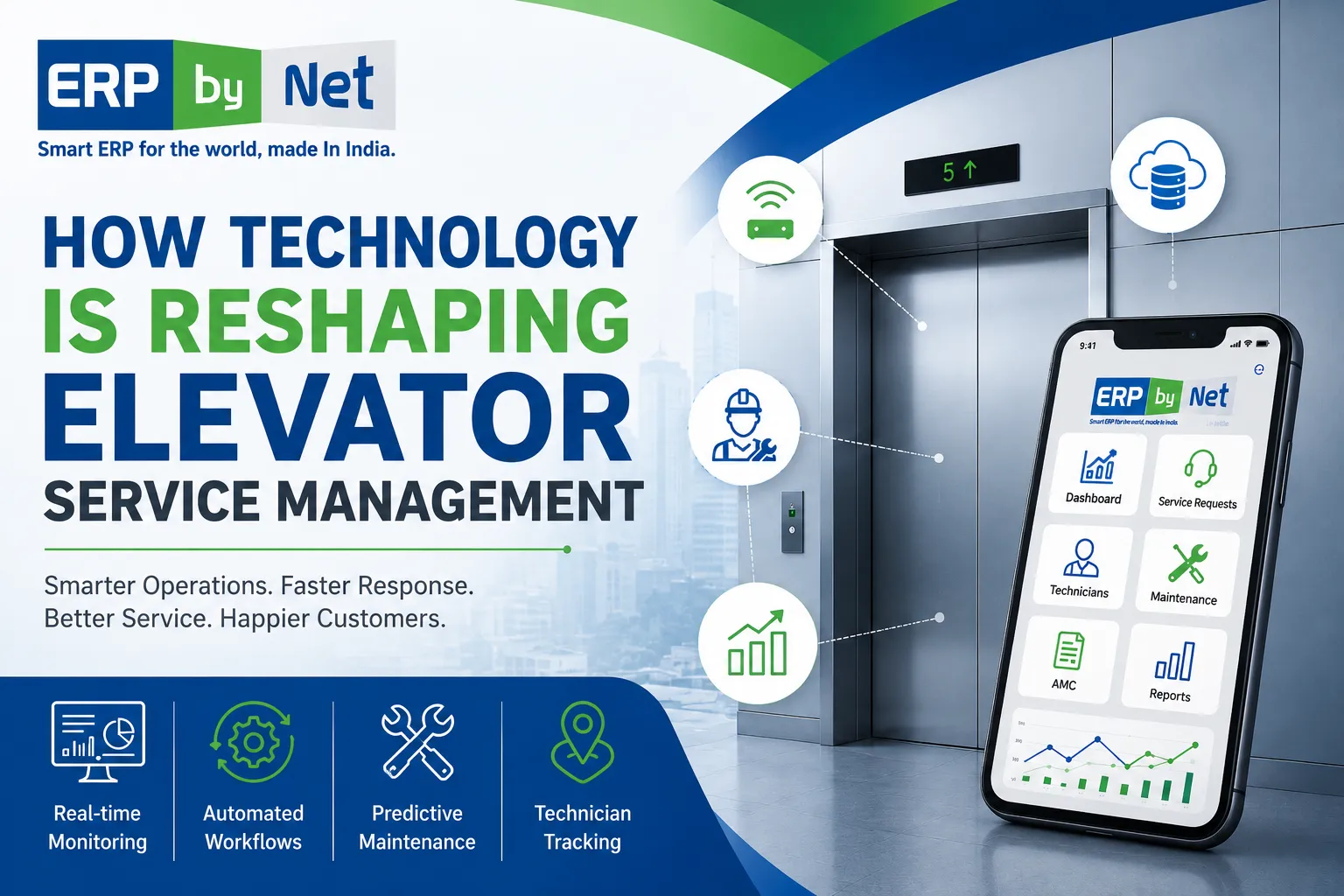
  • real-time technician tracking
  • centralized dashboards
  • automated service workflows
  • digital field service management
  • customer complaint management
  • maintenance scheduling systems
  • reporting and analytics tools

By digitizing service operations, elevator companies can improve:

  • technician productivity
  • response speed
  • customer satisfaction
  • operational control
  • long-term business scalability

As the industry becomes more technology-driven, centralized ERP systems are playing a major role in helping elevator companies remain competitive.

The Future of Elevator Service Management

Technology will continue reshaping the elevator service industry in the coming years.

Emerging innovations such as:

  • AI-powered maintenance systems
  • IoT-enabled elevator monitoring
  • predictive analytics
  • cloud-based operations
  • smart dispatch systems
  • connected service ecosystems

will further improve operational efficiency and service quality.

The future of elevator servicing will depend heavily on:

  • automation
  • real-time visibility
  • intelligent maintenance planning
  • data-driven decision-making
  • digital workforce management

Companies that embrace these technologies early will be better positioned to improve service performance, reduce downtime, and meet growing customer expectations.

Businesses that continue relying on outdated operational methods may struggle to remain competitive in an increasingly digital industry.

Conclusion

Technology is transforming every aspect of elevator service management.

From real-time technician tracking and predictive maintenance to workflow automation and data-driven decision-making, digital systems are helping elevator companies improve efficiency, reduce downtime, and deliver better customer experiences.

The elevator industry is moving toward smarter, faster, and more connected operations. As service demands continue to increase, businesses need modern systems that provide operational visibility, automation, and centralized management.

Companies that invest in digital transformation today will be better prepared for the future of elevator servicing.

ERPbyNet helps elevator service businesses modernize operations through intelligent service management, automated workflows, real-time tracking, and centralized operational control — helping companies build more efficient and future-ready elevator service operations.

FAQs

1. How is technology improving elevator service management?

Technology is helping elevator companies improve operations through real-time technician tracking, automated scheduling, predictive maintenance, digital reporting, and centralized management systems. These tools help reduce downtime, improve response times, and streamline daily workflows.

2. What is predictive maintenance in elevator servicing?

Predictive maintenance uses connected sensors and real-time data to identify potential elevator issues before breakdowns occur. This helps elevator companies reduce unexpected failures, lower repair costs, and improve elevator reliability.

3. Why is automation important for elevator service businesses?

Automation reduces manual tasks such as complaint tracking, service scheduling, AMC reminders, and technician coordination. This improves operational efficiency, minimizes errors, and allows service teams to respond faster to customer requests.

4. How does real-time technician tracking help elevator companies?

Real-time technician tracking helps businesses monitor field teams, assign jobs faster, optimize technician routes, and improve communication. This leads to quicker response times, better workforce productivity, and improved customer satisfaction.

5. How does ERPbyNet help modernize elevator service operations?

ERPbyNet helps elevator companies streamline operations through real-time technician tracking, complaint management, automated workflows, AMC tracking, digital reporting, and centralized service management — helping businesses improve efficiency, reduce downtime, and manage elevator operations more effectively.

Name
Verified by MonsterInsights