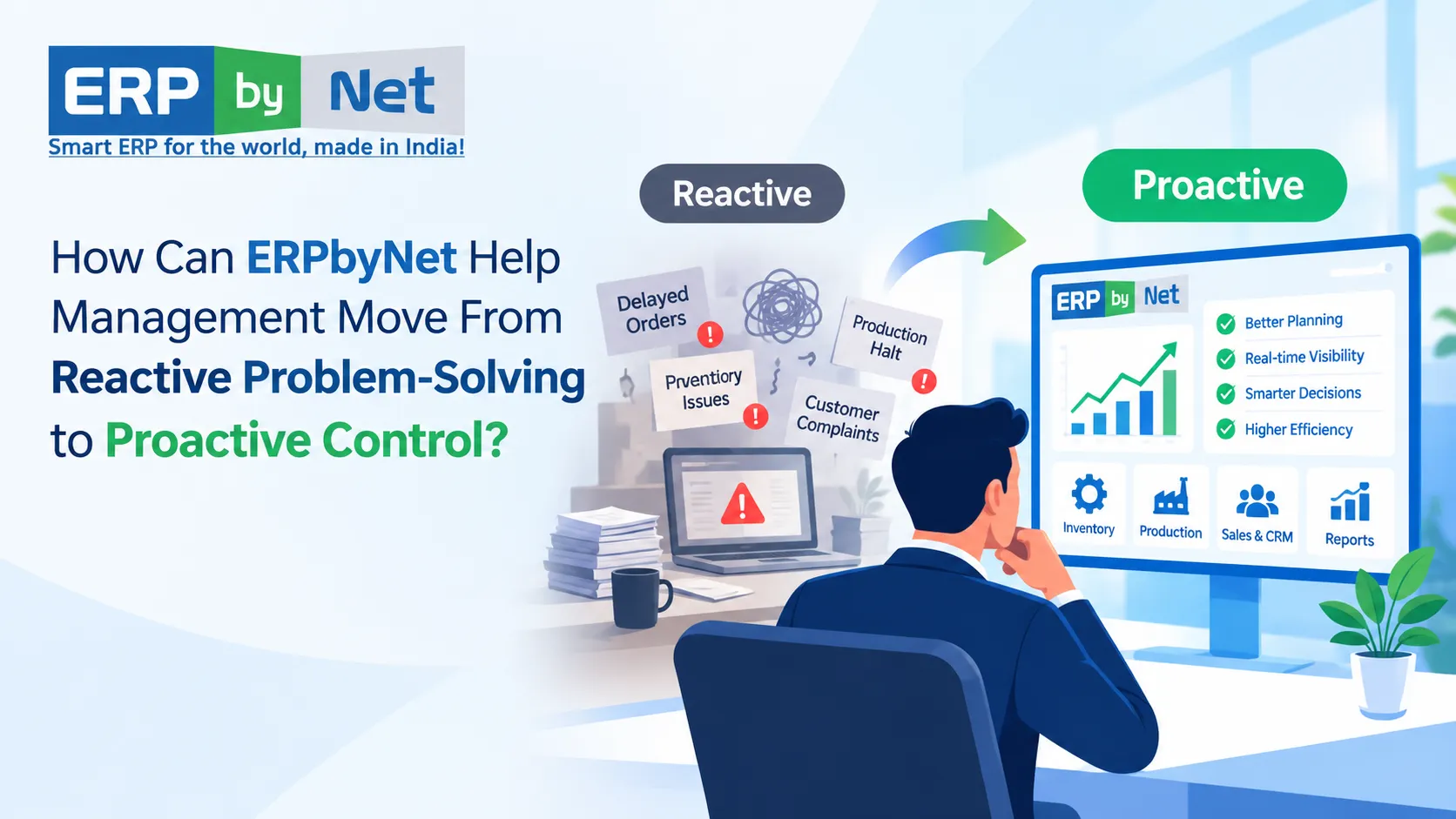
How Can ERPbyNet Help Management Move From Reactive Problem-Solving to Proactive Control?
Key Takeaways
- Reactive management starts when problems are found too late, leaving teams with limited time to respond.
- Disconnected data creates operational blind spots across projects, inventory, service, and procurement.
- Real-time ERP visibility helps identify risks early and supports faster decisions.
- Automated alerts and workflows reduce manual follow-ups and improve operational control.
- ERP helps businesses move from firefighting to proactive management by making problems visible before they become critical.
What You’ll Learn
- Why businesses become reactive as operations grow more complex.
- How real-time ERP visibility improves operational control.
- How early alerts and automated workflows help prevent delays.
- Why connected data across departments improves decision-making.
- How ERPbyNet helps management shift from reactive problem-solving to proactive control.
Real Insights
- Most operational problems become expensive when detected late.
- Manual reports often show what already happened instead of what needs attention next.
- Real-time visibility helps teams spot shortages, delays, and bottlenecks early.
- Proactive management depends on connected information, not more manual reporting.
- The goal of ERP is not just to record problems but to help management act before they escalate.
Management becomes difficult when problems are discovered only after they have already affected operations.
A material shortage is noticed when production is about to stop. A project delay becomes visible when the deadline is already at risk. A customer complaint remains unresolved because nobody has a clear view of its status. A service contract approaches expiry without timely follow-up. Management then has to step in, investigate what went wrong, coordinate different teams, and find a solution under pressure.
This is reactive management.
Modern businesses need a different approach: identifying risks earlier, monitoring operations continuously, and taking action before small issues become expensive problems.
This is where an integrated ERP system can make a significant difference.
ERPbyNet connects sales, projects, manufacturing, inventory, procurement, service, field technicians, finance, and reporting within one integrated ERP ecosystem. This gives management a more complete view of business operations and helps teams move from manual follow-ups and delayed reporting toward real-time visibility, structured workflows, and proactive decision-making.
What Is the Difference Between Reactive and Proactive Management?
Reactive management focuses on solving problems after they occur.
The process often looks like this:
Problem occurs → Someone notices it → Management investigates → Teams coordinate → Corrective action is taken
For example, if a production team discovers that a critical component is unavailable, the procurement team may need to urgently contact suppliers, check alternative sources, update production schedules, and inform management.
The problem is being solved, but the organization is spending time and money responding to something that could potentially have been identified earlier.
Proactive management changes the process:
Business data → Early signal → Management insight → Planned action → Controlled outcome
Instead of waiting for the material shortage, managers can monitor inventory and material requirements, identify potential shortages, and take action earlier.
Instead of discovering a project delay after a milestone is missed, management can monitor project progress and identify deviations while there is still time to correct them.
This is the fundamental shift ERP can enable.
Read More: What Is Really Behind Cost Overruns in Elevator Projects-and How Can ERP Help Control Them?
Why Businesses Struggle With Reactive Problem-Solving

Many businesses do not intentionally choose reactive management. It develops because information is fragmented.
Different departments may use:
- Spreadsheets
- Emails
- WhatsApp messages
- Separate software systems
- Manual reports
- Phone calls
- Paper-based records
The result is that management often receives information after it has already passed through several people and systems.
A project manager may know that a site is delayed, while procurement does not know that the delay is related to material availability. Finance may not immediately see the cost impact. Senior management may only discover the issue during a weekly or monthly review.
When information is disconnected, management becomes dependent on follow-ups instead of visibility.
ERPbyNet addresses this problem by bringing key business functions into one connected platform, including sales, project execution, manufacturing, inventory, service, technician operations, and finance.
How ERPbyNet Helps Management Move Toward Proactive Control
1. Real-Time Visibility Helps Management See Problems Earlier
One of the biggest differences between reactive and proactive management is when the problem becomes visible.
If management receives information only through periodic reports, decisions are naturally based on historical information.
Real-time visibility changes that.
ERPbyNet provides centralized visibility across important operational areas, helping management monitor activities such as:
- Project progress
- Inventory levels
- Material requirements
- Manufacturing operations
- Service requests
- Technician activities
- Maintenance schedules
- Financial information
- Sales activities
- Operational reports
ERPbyNet’s platform is designed to connect departments and provide visibility across complex operational environments rather than forcing managers to collect updates from multiple systems.
This creates a simple but important advantage:
Managers can spend less time asking what is happening and more time deciding what should happen next.
2. Integrated Data Creates a Single Source of Operational Truth
Proactive management depends on reliable information.
If sales, inventory, production, projects, and finance each have different versions of business data, management cannot easily understand the complete situation.
For example, suppose a large customer order enters the business.
Management may need to know:
- Is the required material available?
- Can production meet the required quantity?
- Is additional procurement required?
- Does the production schedule have sufficient capacity?
- Will the order affect existing projects?
- What will be the financial impact?
- Can the delivery timeline be achieved?
When these functions operate independently, answering these questions requires coordination between multiple teams.
An integrated ERP environment connects the information.
ERPbyNet brings sales, engineering, projects, manufacturing, inventory, service, and finance into a connected operational environment.
This helps management make decisions using a broader picture rather than isolated departmental information.
3. ERPbyNet Helps Identify Material and Inventory Risks Before They Become Disruptions
Inventory problems are one of the clearest examples of reactive management.
Without accurate visibility, businesses may discover material shortages only when production or project execution is affected.
ERPbyNet includes material planning, inventory management, warehouse operations, procurement workflows, and manufacturing coordination through its MRP capabilities.
This enables management to monitor material requirements and inventory conditions more effectively.
For example:
Reactive approach
Material shortage → Production affected → Emergency procurement → Delivery delay
Proactive approach
Material requirement identified → Inventory checked → Procurement planned → Material available when required
The goal is not simply to maintain more inventory.
The goal is to have better information about what is required, what is available, and what needs attention.
ERPbyNet’s MRP functionality is designed to support this type of planning and coordination.
4. Project Visibility Helps Management Control Delays Before They Escalate
Project-based businesses face another major challenge: delays can develop gradually.
A project may appear to be progressing normally while small issues accumulate:
- A material delivery is late.
- A site activity is incomplete.
- A technician is unavailable.
- A milestone is delayed.
- Labour productivity is lower than expected.
- A project cost starts moving away from the planned budget.
If management only reviews the project after a milestone is missed, the available time to correct the situation is already limited.
ERPbyNet’s project and site management capabilities provide visibility into project schedules, execution activities, workforce activities, budgets, and site operations.
This allows managers to monitor project execution more closely and intervene when something begins moving away from plan.
The objective is simple:
Don’t wait for the deadline to reveal the problem. Monitor the process that leads to the deadline.
5. Automated Workflows Reduce Dependence on Manual Follow-Ups
Manual follow-ups are another major reason management becomes reactive.
A manager may have to ask:
“Has this approval been completed?”
“Did procurement place the order?”
“Has the technician visited the site?”
“Why is this complaint still pending?”
“Who is responsible for this task?”
When these questions must be answered manually, management spends valuable time chasing information.
ERPbyNet supports configurable workflows, approval systems, and business processes that can reduce manual coordination.
For example, workflows can help structure:
Request → Approval → Assignment → Execution → Update → Completion
This creates greater process discipline and makes responsibilities clearer.
Automation does not eliminate management involvement. Instead, it helps managers focus their attention on exceptions and decisions that actually require management intervention.
6. Service Management Can Shift From Reactive Repairs to Preventive Action
Service businesses often operate reactively.
A customer reports a problem.
Then the business:
- Receives the complaint
- Assigns a technician
- Checks availability
- Arranges spare parts
- Schedules the visit
- Resolves the issue
While reactive service will always be necessary, businesses can reduce avoidable emergencies by using preventive maintenance and service planning.
ERPbyNet’s AceService capabilities support preventive maintenance scheduling, callback ticket management, technician tracking, contract renewals, and service updates.
This allows businesses to manage service operations before every issue becomes an emergency.
For example, instead of waiting for an equipment problem:
Maintenance due → Schedule service → Assign technician → Complete maintenance → Record service history
This creates a more controlled service environment and can improve customer experience.
7. Technician and Field Visibility Gives Management Control Beyond the Office
For businesses with technicians, installation teams, or field employees, office-based management can create a significant visibility gap.
Management may know that a task was assigned but not know:
- Whether the technician reached the site
- What work has been completed
- What issue was found
- Whether additional material is required
- Whether the job is still pending
- How long the activity is taking
ERPbyNet supports mobile applications such as SmartTechnician, MyAceService, and SiteApp to connect field activities with broader business processes. SmartTechnician supports capabilities including GPS-based tracking, route management, ticket updates, check-ins, maintenance reporting, and field communication.
This helps reduce the gap between what management thinks is happening and what is actually happening in the field.
That difference is critical for proactive control.
8. Financial Visibility Helps Management Detect Cost Problems Earlier
Operational problems eventually become financial problems.
A project delay can increase labour costs.
A material shortage can increase procurement costs.
Poor inventory planning can lock working capital into unnecessary stock.
Service inefficiencies can reduce profitability.
If finance information is separated from operational information, management may see the financial impact only after the damage has already occurred.
ERPbyNet’s AceFinance module supports areas including accounts payable and receivable, GST reporting, budgeting, asset tracking, cost allocation, and financial operations.
When financial and operational information are connected, management can better understand the relationship between:
Operational activity → Resource usage → Cost → Profitability
This makes financial control part of day-to-day management rather than something reviewed only after the reporting period.
9. Dashboards and Reports Turn Business Data Into Management Insights
Having data is not the same as having useful information.
A business may have thousands of records, but management needs answers to specific questions:
- Which projects are at risk?
- Which materials require attention?
- Which service requests are pending?
- Which customers require follow-up?
- Where are operational bottlenecks developing?
- Which activities are affecting costs?
- Which teams require additional support?
ERPbyNet supports user-defined reporting and business intelligence reporting across its modules.
This helps management move from simply collecting data to using data for decision-making.
The broader shift is:
Data → Information → Insight → Decision → Action
That is the foundation of proactive management.
10. ERPbyNet Helps Management Focus on Exceptions Instead of Monitoring Everything
Proactive control does not mean that managers need to monitor every transaction every minute.
That would simply replace manual work with another form of information overload.
The better approach is to allow the ERP system to handle routine transactions and provide management with visibility into areas that require attention.
For example:
Normal activity: Continue automatically through the defined workflow.
Exception: Flag the issue for review.
This allows managers to focus on questions such as:
- Why is this project behind schedule?
- Why is this material requirement still pending?
- Why has this service request exceeded the expected timeline?
- Why is this cost higher than planned?
- Why has this approval remained incomplete?
This is where ERP moves beyond being a record-keeping system and becomes a management control system.
Read More : Why Modern AMC Management Needs More Than Renewal Reminders
Reactive vs Proactive Management With ERPbyNet
| Reactive Management | Proactive Management with ERPbyNet |
|---|---|
| Problems are discovered late | Operational signals are visible earlier |
| Managers depend on manual updates | Managers access centralized information |
| Departments work in silos | Processes are connected across departments |
| Inventory shortages cause emergencies | Material requirements can be planned |
| Project delays are discovered late | Project execution can be monitored continuously |
| Service starts after complaints | Preventive maintenance can be scheduled |
| Field teams are difficult to monitor | Mobile field visibility improves coordination |
| Reports explain what already happened | Data supports faster decisions and action |
| Managers spend time chasing updates | Managers can focus on exceptions and priorities |
Why This Matters for Engineering, Manufacturing, Elevator, and Project-Based Businesses
The shift from reactive to proactive control is particularly important for businesses where operations depend on multiple interconnected activities.
For example, an engineering or elevator company may need to coordinate:
Sales → Engineering → Procurement → Inventory → Manufacturing → Project Execution → Installation → Service → Finance
A delay at one stage can affect multiple downstream activities.
ERPbyNet is specifically positioned for elevator companies, engineering businesses, manufacturers, project-based organizations, and service and maintenance businesses. Its platform connects these operational areas to improve coordination and visibility.
That makes proactive control especially valuable.
Instead of managing each department independently, management can look at the complete operational chain.
What Does the Shift From Reactive to Proactive Actually Look Like?
Consider a simple example.
A company is executing an engineering project.
Without integrated ERP
The project manager discovers that a required component is missing.
They contact procurement.
Procurement checks the supplier.
The supplier says delivery will be delayed.
The project manager informs management.
Management asks finance about the additional cost.
Finance requests project information.
Several calls and messages later, everyone understands the situation.
By then, the project schedule may already be affected.
With an integrated ERP approach
The material requirement is connected to project planning.
Inventory availability can be checked.
Procurement requirements can be identified.
Project progress is visible.
Management can review the operational situation through centralized information.
The objective is not that ERP magically prevents every problem.
The objective is that the organization becomes aware of important problems earlier and has better information for deciding what to do next.
That is what proactive control really means.
ERPbyNet Is More Than an ERP System for Recording Transactions
A modern ERP should not only answer:
“What happened?”
It should help management answer:
“What is happening now?”
and increasingly:
“What needs attention next?”
ERPbyNet brings operational functions together through modules and applications covering sales, projects, manufacturing, inventory, service, field operations, finance, reporting, and more.
This integrated approach helps create a foundation for:
- Real-time operational visibility
- Better planning
- Faster decision-making
- Workflow automation
- Improved accountability
- Better cross-functional coordination
- Earlier identification of operational risks
- Stronger project and service control
The result is a management environment where decisions can be based on current operational information rather than delayed updates.
How to Start Moving From Reactive to Proactive Management

Businesses do not need to transform every process overnight.
A practical approach is to start with the areas where reactive problem-solving creates the greatest cost or operational risk.
Step 1: Identify Repeated Problems
Look for issues that management repeatedly has to solve:
- Material shortages
- Project delays
- Service complaints
- Approval delays
- Inventory mismatches
- Technician coordination
- Cost overruns
Step 2: Identify Where Information Gets Delayed
Ask:
Where does management currently have to call, message, or email someone to get an operational update?
These are potential visibility gaps.
Step 3: Connect the Relevant Processes
Instead of managing sales, inventory, projects, service, and finance separately, connect the workflows that influence each other.
Step 4: Automate Routine Processes
Approvals, task assignments, notifications, reporting, and recurring processes can be structured through workflows.
Step 5: Build Management Visibility
Create reports and dashboards around the metrics that actually influence decisions.
Step 6: Manage Exceptions
Once routine operations are structured, management can focus more attention on delays, risks, exceptions, and opportunities.
This is how an organization gradually moves from firefighting to control.
The Business Value of Proactive ERP Management
Moving from reactive to proactive management is not simply about adopting new software.
It changes how the organization operates.
Instead of spending management time on:
“Why did this happen?”
teams can increasingly focus on:
“What should we do next?”
That shift can help businesses improve:
Operational Efficiency
Connected workflows reduce unnecessary manual coordination and information chasing.
Decision-Making
Management gets access to more current and connected operational information.
Project Control
Project progress, activities, resources, and budgets can be monitored more systematically.
Inventory Planning
Material requirements and inventory information can support better procurement and production planning.
Service Performance
Preventive maintenance, technician coordination, service requests, and contracts can be managed through structured processes.
Financial Control
Operational activity can be connected with financial information to improve cost and profitability visibility.
Scalability
Standardized and connected processes make it easier to manage increasing operational complexity.
Why ERPbyNet Can Be a Strong Foundation for Proactive Business Management
The goal of ERP implementation should not simply be to replace spreadsheets with another software system.
The bigger objective is to create a connected operating environment where information flows between departments and management can make decisions with greater visibility.
ERPbyNet is built around this approach.
Its ecosystem connects sales, engineering, projects, manufacturing, inventory, service, field operations, and finance while also providing mobile applications for technicians and site teams.
For businesses dealing with complex projects, manufacturing requirements, field teams, service operations, or elevator and engineering workflows, this connected structure can help reduce the information gaps that often lead to reactive decision-making.
The result is a gradual shift:
From disconnected data → connected information
From delayed reports → real-time visibility
From manual follow-ups → structured workflows
From reacting to problems → identifying risks earlier
From operational firefighting → proactive control
Final Thoughts
Reactive problem-solving will always be part of business management. Unexpected customer requirements, supply disruptions, equipment failures, and operational challenges cannot be completely eliminated.
The difference is how quickly a business can see, understand, and respond to those challenges.
An integrated ERP platform such as ERPbyNet can help management create that visibility by connecting business processes, centralizing operational information, automating workflows, supporting project and inventory planning, monitoring service and field activities, and connecting operational data with financial management.
For engineering, manufacturing, elevator, project-based, and service businesses, this can be particularly valuable because operations are rarely isolated. Sales decisions can affect procurement. Material availability can affect projects. Project delays can affect finance. Service performance can affect customer relationships.
When these processes are connected, management gets a clearer view of how one decision affects the rest of the business.
That is the real move from reactive problem-solving to proactive control:
Don’t wait for the problem to become visible. Build the visibility that helps your team act earlier.
If your business is still depending heavily on spreadsheets, manual reporting, disconnected applications, and constant management follow-ups, ERPbyNet can help you explore a more connected approach to operational management.
Want to see how ERPbyNet can fit your business processes? Talk to the ERPbyNet team to explore the right ERP modules and workflows for your organization.
FAQs
What does proactive management mean in ERP?
Proactive management means using connected business data, real-time visibility, workflows, reports, and planning tools to identify potential issues earlier and take action before they become larger operational problems.
How does ERP help managers make proactive decisions?
ERP centralizes business information across departments, giving managers better visibility into current operations. This can help them identify delays, inventory risks, project issues, service requirements, and financial concerns earlier.
How does ERPbyNet support proactive management?
ERPbyNet connects sales, projects, manufacturing, inventory, service, field operations, and finance. It also supports workflows, reporting, mobile field applications, project visibility, inventory planning, service management, and financial operations.
Can ERPbyNet help prevent inventory shortages?
ERPbyNet includes MRP, inventory management, warehouse operations, procurement workflows, and material planning capabilities. These help businesses monitor material requirements and make more informed procurement and production decisions.
How can ERPbyNet help with project delays?
ERPbyNet supports project and site management with visibility into schedules, execution activities, workforce activities, budgets, and site operations. This gives management better information for monitoring project progress and addressing issues earlier.
Can ERPbyNet support preventive maintenance?
Yes. ERPbyNet’s AceService capabilities include preventive maintenance scheduling, callback ticket management, technician tracking, contract renewals, and service updates.
Is ERPbyNet suitable for engineering and manufacturing companies?
Yes. ERPbyNet is designed for operationally complex businesses, including engineering companies, manufacturing businesses, elevator companies, project-based organizations, and service and maintenance businesses.
What is the biggest difference between reactive and proactive ERP management?
Reactive management focuses on solving problems after they occur. Proactive ERP management focuses on creating visibility, identifying risks earlier, planning actions, and managing exceptions before they become larger problems.