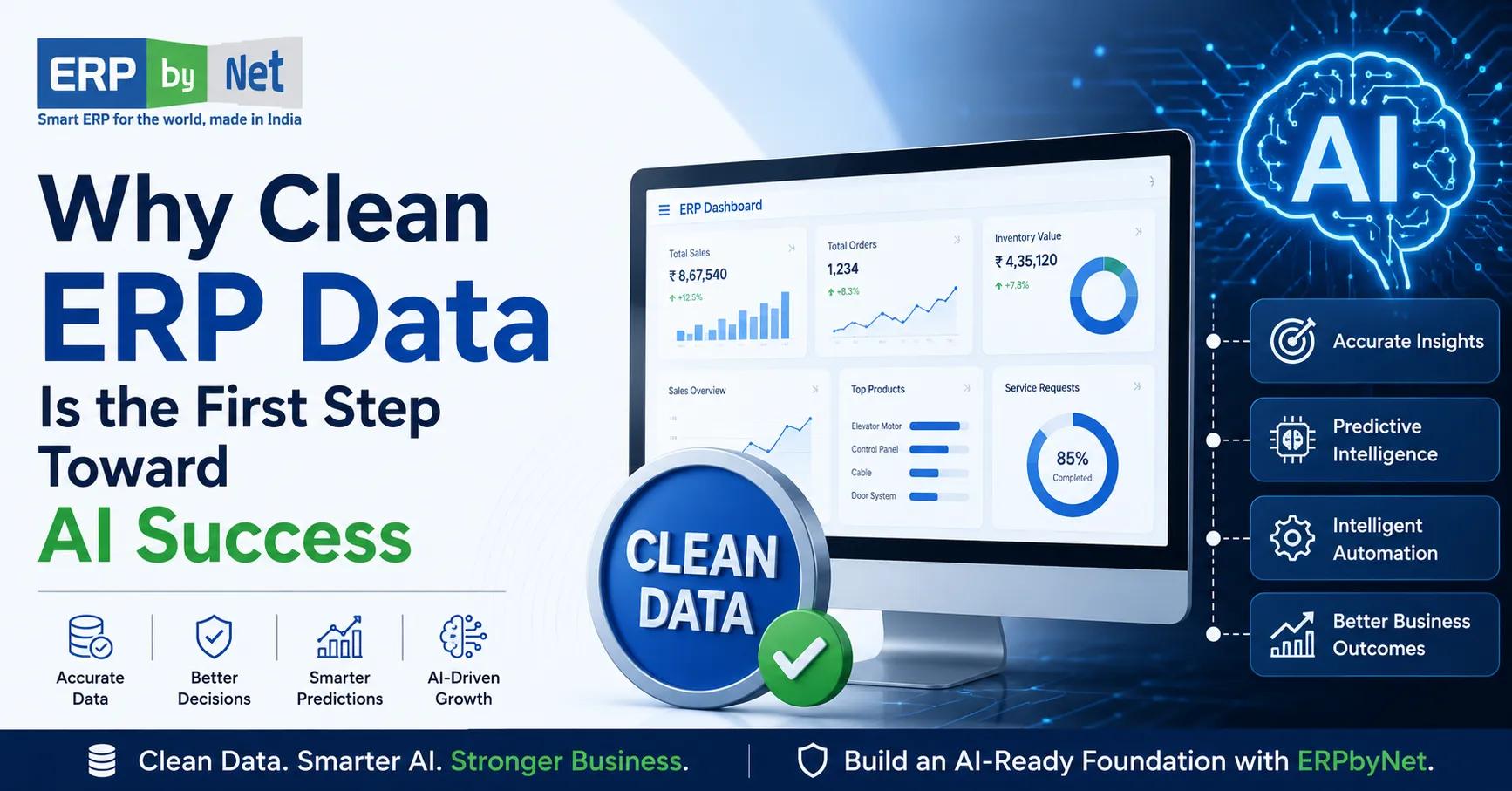
Key Takeaways
- AI is only as effective as the quality of your ERP data; inaccurate or incomplete information leads to unreliable results.
- Clean, structured, and standardized ERP data creates a solid foundation for AI-driven insights and automation.
- Duplicate records and disconnected systems reduce AI accuracy and limit business value.
- Modern ERP platforms automate data validation, helping maintain consistent and reliable business information.
- Preparing clean ERP data today enables faster AI adoption and better long-term business outcomes.
What You’ll Learn
- Why clean ERP data is essential before implementing AI.
- How poor data quality affects forecasting, reporting, and decision-making.
- The role of data governance and standardization in building AI-ready operations.
- Practical steps to improve ERP data quality before adopting AI.
- How ERPbyNet helps businesses maintain clean, accurate, and AI-ready data.
Real Insights
- Most AI projects struggle because of poor business data, not because of the AI technology itself.
- AI amplifies both good and bad data; clean data produces reliable insights, while poor data creates inaccurate recommendations.
- Businesses that prioritize ERP data quality achieve better AI performance and faster digital transformation.
- Consistent master data and automated workflows create the foundation for scalable AI initiatives.
- AI success starts with trusted ERP data, making data quality the first investment every business should make.
Artificial Intelligence (AI) is rapidly changing how businesses forecast demand, optimize inventory, automate customer service, improve project planning, and support decision-making. Across industries, organizations are investing heavily in AI-powered analytics, intelligent automation, predictive maintenance, and digital transformation initiatives.
However, many AI projects fail long before the first model is deployed—not because the technology is ineffective, but because the underlying business data is unreliable.
Every AI system depends on the quality of the data it receives. If your ERP contains duplicate customer records, inaccurate inventory levels, incomplete project information, inconsistent product codes, or outdated service histories, AI will simply process and amplify those errors.
This is why clean ERP data is not an optional improvement—it is the foundation of AI success.
For project-based businesses, engineering companies, manufacturers, and elevator service organizations, ERP serves as the operational backbone. It connects sales, procurement, production, inventory, finance, installation, field service, and customer support into a unified platform. AI can only deliver meaningful insights when this foundation is accurate, structured, and continuously maintained.
At ERPbyNet, we believe that businesses should prepare their data before adopting AI—not after. Organizations that establish clean, standardized, and well-governed ERP data are far more likely to achieve successful AI implementation, faster automation, and better business outcomes.
Why AI Depends on ERP Data More Than Most Businesses Realize
Many organizations view AI as a standalone technology capable of solving operational challenges. In reality, AI does not create business knowledge—it learns from existing business information.
Think of AI as an intelligent employee joining your organization.
Before making recommendations, this employee needs access to:
- Customer records
- Sales history
- Purchase orders
- Inventory levels
- Manufacturing schedules
- Project timelines
- Equipment history
- Financial transactions
- Service reports
- Vendor information
All of this information typically resides inside your ERP system.
Without reliable ERP data, AI lacks the context needed to generate accurate predictions or recommendations.
The Relationship Between ERP and AI
| ERP Provides | AI Uses It For | Business Outcome |
|---|---|---|
| Customer Data | Customer segmentation | Better sales strategies |
| Inventory Data | Demand forecasting | Reduced stock shortages |
| Service History | Predictive maintenance | Less equipment downtime |
| Financial Records | Cost analysis | Improved profitability |
| Procurement Data | Purchasing optimization | Lower procurement costs |
| Project Data | Risk prediction | Better project delivery |
| Production Data | Capacity planning | Increased efficiency |
Instead of replacing ERP, AI extends its capabilities by analyzing patterns across operational data.
Without reliable ERP data, even the most advanced AI models produce unreliable recommendations.
What Does “Clean ERP Data” Actually Mean?

Many people assume clean data simply means removing duplicate records.
In reality, clean ERP data is much broader.
Clean ERP data is business information that is:
- Accurate
- Complete
- Consistent
- Standardized
- Up to date
- Well-structured
- Properly categorized
- Easy to access
- Governed by clear business rules
It ensures that every department works from the same source of truth.
Characteristics of AI-Ready ERP Data
| Characteristic | Why It Matters |
|---|---|
| Accuracy | AI learns from correct information |
| Completeness | Missing values reduce prediction quality |
| Consistency | Standard formats improve analysis |
| Timeliness | AI requires current business data |
| Uniqueness | Removes duplicate customers, suppliers, and products |
| Standardization | Prevents conflicting records |
| Traceability | Supports audits and compliance |
| Accessibility | Enables cross-functional insights |
Businesses often underestimate how much inconsistent data accumulates over time.
Examples include:
- Duplicate customer accounts
- Incorrect product descriptions
- Old supplier information
- Outdated project milestones
- Missing equipment serial numbers
- Incorrect inventory balances
- Inconsistent naming conventions
Each issue may appear minor individually, but collectively they significantly reduce AI accuracy.
Why Dirty ERP Data Causes AI Projects to Fail
AI operates on patterns.
When the data is inconsistent, AI identifies incorrect patterns and produces misleading recommendations.
This concept is commonly summarized as “Garbage In, Garbage Out.”
The quality of AI output can never exceed the quality of the underlying ERP data.
How Poor ERP Data Affects AI
| ERP Data Problem | AI Impact | Business Consequence |
|---|---|---|
| Duplicate customers | Incorrect customer insights | Poor sales targeting |
| Incorrect inventory | Wrong forecasts | Overstocking or shortages |
| Missing service history | Poor maintenance predictions | Increased breakdowns |
| Inaccurate BOM | Procurement errors | Project delays |
| Incorrect financial entries | Misleading profitability reports | Poor business decisions |
| Outdated project schedules | Incorrect delivery predictions | Missed deadlines |
Instead of improving operations, AI begins reinforcing inaccurate assumptions.
Real Business Example: How Bad ERP Data Misleads AI
Imagine an elevator company managing over 15,000 installed elevators across multiple cities.
The company decides to introduce AI-powered predictive maintenance.
The AI model is trained using five years of service history.
Unfortunately, the ERP contains several issues:
- Technicians skipped service reports.
- Equipment serial numbers were entered differently across branches.
- Some assets were duplicated.
- Spare part replacements were never updated.
- Manual spreadsheets were maintained outside the ERP.
The AI now believes:
- Elevators received fewer repairs than they actually did.
- Certain spare parts rarely fail.
- Equipment age is inaccurate.
- Maintenance intervals are inconsistent.
As a result:
- Critical failures are missed.
- Incorrect spare parts are stocked.
- Service schedules become unreliable.
- Customer satisfaction declines.
The AI is not malfunctioning—it is simply making decisions based on poor information.
Read More: The Business Side of Lift Maintenance Nobody Talks About
The Hidden Cost of Poor ERP Data

Dirty data impacts far more than AI initiatives.
It creates operational inefficiencies across the organization.
Sales Team
- Duplicate leads
- Incorrect quotations
- Missed opportunities
- Inaccurate revenue forecasts
Procurement Team
- Wrong purchase quantities
- Duplicate purchase orders
- Supplier confusion
- Excess procurement costs
Inventory Team
- Incorrect stock availability
- Emergency purchasing
- Overstocked warehouses
- Stock obsolescence
Finance Team
- Incorrect reporting
- Delayed month-end closing
- Duplicate invoices
- Compliance risks
Project Team
- Material shortages
- Incorrect budgets
- Schedule delays
- Resource conflicts
Service Team
- Missing maintenance history
- Incorrect equipment records
- Delayed technician response
- Poor customer experience
When AI is introduced into this environment, these existing problems become more visible—and potentially more damaging.
Why AI Cannot “Fix” Bad ERP Data
A common misconception is that AI will automatically clean existing business data.
While AI can assist with:
- Duplicate detection
- Data classification
- Missing value suggestions
- Pattern recognition
- Data validation
it cannot determine the correct business truth without reliable source data.
For example:
If the ERP shows two different installation dates for the same elevator, AI cannot know which one is correct unless the organization has proper governance, audit trails, and validated records.
Similarly, if inventory quantities differ between the warehouse and ERP, AI cannot determine the actual stock level on its own.
This highlights an important principle:
The AI Readiness Pyramid
Organizations often focus on AI tools before addressing foundational data quality.
A more effective approach is to build capabilities in stages.
| Level | Focus | Objective |
|---|---|---|
| Level 5 | AI & Predictive Analytics | Intelligent recommendations |
| Level 4 | Business Intelligence | Reporting and dashboards |
| Level 3 | Process Automation | Workflow efficiency |
| Level 2 | Standardized Business Processes | Consistent operations |
| Level 1 | Clean ERP Data | Reliable business information |
Without a strong Level 1 foundation, every layer above becomes less effective.
This is why organizations that invest in data quality first are more likely to achieve long-term AI success.
The 10 ERP Data Quality Problems That Prevent AI Success
Every organization generates thousands—or even millions—of data points each year. Customer records, quotations, purchase orders, inventory transactions, project updates, financial entries, and service reports all contribute to a growing database.
Without proper governance, this data gradually becomes inconsistent, incomplete, or outdated. While these issues may seem manageable during day-to-day operations, they become major obstacles when implementing AI.
Below are ten of the most common ERP data quality problems that businesses encounter and how they affect AI initiatives.
1. Duplicate Master Records
Duplicate records are among the most common issues in ERP systems.
Examples include:
- The same customer created under different names
- Multiple supplier records for one vendor
- Duplicate equipment or asset entries
- Repeated product master records
Business Impact
- Sales reports become inaccurate.
- Revenue is split across multiple customer records.
- Customer history is incomplete.
- AI creates incorrect customer profiles.
Example
| Duplicate Records | AI Interpretation |
|---|---|
| ABC Industries | Customer A |
| ABC Industries Pvt. Ltd. | Customer B |
| ABC Ind. | Customer C |
Instead of recognizing one loyal customer, AI assumes three separate customers with different buying behaviors.
2. Missing Business Information
Incomplete data creates gaps in AI analysis.
Common examples include:
- Missing installation dates
- Blank serial numbers
- Incomplete project milestones
- Missing supplier details
- Unrecorded technician visits
Why It Matters
AI models rely on historical patterns.
If key information is missing, the model cannot identify trends accurately.
For example:
A predictive maintenance model cannot estimate equipment failure if half of the service records are incomplete.
3. Inconsistent Naming Conventions
Many organizations allow employees to enter data without standardized formats.
Examples:
- Lift
- Elevator
- Passenger Lift
- Passenger Elevator
- Passenger Lift Unit
Although they refer to the same product, AI may interpret them as different categories.
Best Practice
Define standardized naming conventions across all ERP modules to ensure consistency.
4. Outdated Information
Business information changes constantly.
Examples include:
- Customer addresses
- Contact details
- Supplier pricing
- Material lead times
- Inventory locations
AI trained on outdated information produces outdated recommendations.
5. Incorrect Inventory Data
Inventory inaccuracies are especially damaging because they affect procurement, production, and customer service.
Common causes include:
- Manual stock adjustments
- Delayed stock updates
- Barcode errors
- Unrecorded material movement
AI Consequences
Instead of recommending optimal purchasing quantities, AI bases decisions on incorrect stock levels.
This leads to:
- Overstocking
- Stock shortages
- Production delays
- Higher carrying costs
6. Poor Bill of Materials (BOM) Management
For project-based businesses and manufacturers, BOM accuracy is critical.
An incorrect BOM affects:
- Material planning
- Cost estimation
- Procurement
- Production scheduling
If AI learns from inaccurate BOM data, it cannot forecast material requirements correctly.
7. Fragmented Data Across Departments
Many businesses still rely on disconnected systems.
Examples include:
- Sales information stored in spreadsheets
- Projects tracked using separate software
- Inventory managed manually
- Service reports maintained on paper
AI performs best when data flows seamlessly across departments.
Disconnected systems create isolated data silos that prevent meaningful analysis.
8. Manual Data Entry Errors
Human error remains one of the leading causes of poor ERP data quality.
Examples include:
- Typographical mistakes
- Wrong quantities
- Incorrect dates
- Duplicate entries
- Missing mandatory fields
Although each error appears insignificant, thousands of small mistakes collectively reduce AI accuracy.
9. Lack of Data Governance
Without ownership, data quality gradually deteriorates.
Questions every business should answer include:
- Who owns customer data?
- Who validates inventory records?
- Who approves supplier creation?
- Who maintains product master data?
Clear governance ensures long-term data consistency.
10. No Audit Trail
Businesses need complete visibility into data changes.
Without audit trails:
- Errors remain unnoticed.
- Incorrect records cannot be traced.
- AI learns from unreliable historical information.
An ERP system should maintain detailed logs showing:
- Who changed the record
- What changed
- When it changed
- Why it changed
Read More: ERP Myths That Are Secretly Stopping Businesses from Scaling
How Clean ERP Data Powers Every AI Initiative
Clean ERP data supports AI across every business function—not just analytics.
Below are examples of how different departments benefit from high-quality ERP data.
| Department | AI Application | Data Required |
|---|---|---|
| Sales | Lead scoring | Customer history |
| Procurement | Purchase optimization | Supplier performance |
| Inventory | Demand forecasting | Stock transactions |
| Manufacturing | Production planning | BOM accuracy |
| Projects | Delay prediction | Project milestones |
| Service | Predictive maintenance | Equipment history |
| Finance | Profitability analysis | Financial transactions |
| Management | Decision support | Enterprise-wide data |
This illustrates that AI is not a standalone solution. It depends on a well-maintained ERP ecosystem.
Building an AI-Ready ERP: A Practical Framework
Preparing your ERP for AI requires more than a one-time data cleanup. It involves establishing processes that keep data accurate, consistent, and reliable over time.
Step 1: Standardize Master Data
Master data forms the foundation of every ERP system.
Ensure consistency across:
- Customers
- Suppliers
- Products
- Equipment
- Employees
- Warehouses
- Cost centers
Step 2: Eliminate Duplicate Records
Use validation rules to prevent duplicate entries.
Review existing records regularly to identify:
- Duplicate customers
- Duplicate vendors
- Duplicate inventory items
- Duplicate assets
Step 3: Define Data Ownership
Assign responsibility for maintaining data quality.
For example:
| Data Type | Owner |
|---|---|
| Customer Master | Sales Team |
| Product Master | Engineering Team |
| Supplier Data | Procurement Team |
| Inventory Records | Warehouse Team |
| Financial Data | Finance Team |
Clear ownership improves accountability and reduces errors.
Step 4: Automate Data Validation
Manual validation is time-consuming and prone to oversight.
Modern ERP systems can automatically:
- Validate mandatory fields
- Restrict duplicate entries
- Verify data formats
- Enforce approval workflows
Automation improves consistency while reducing manual effort.
Step 5: Integrate Business Processes
An AI-ready ERP should connect every department.
Instead of isolated systems, establish a unified workflow:
Sales → Engineering → Procurement → Inventory → Production → Projects → Installation → Service → Finance
When data flows seamlessly across departments, AI gains complete visibility into business operations.
Step 6: Maintain Continuous Data Quality
Data quality is not a one-time project.
Organizations should:
- Conduct periodic audits
- Review inactive records
- Archive obsolete data
- Monitor data accuracy
- Train employees on data standards
Consistent maintenance ensures that AI continues to receive reliable information as the business grows.
How ERPbyNet Helps Businesses Build AI-Ready Data

AI delivers the greatest value when it is supported by a strong ERP foundation. ERPbyNet is designed to help organizations capture, manage, and maintain high-quality business data across every stage of the business lifecycle.
Rather than relying on disconnected spreadsheets or isolated software, ERPbyNet centralizes information into a single, structured platform.
Sales and CRM
ERPbyNet helps maintain accurate customer and quotation data by:
- Managing customer records from a centralized database
- Standardizing quotation workflows
- Maintaining complete sales history
- Reducing duplicate customer creation
Project Management
Project teams benefit from:
- Centralized project documentation
- Real-time milestone tracking
- Resource planning
- Material requirement visibility
- Progress monitoring
Accurate project data enables AI to identify delays, predict resource shortages, and improve delivery performance.
Inventory and Material Planning
ERPbyNet strengthens inventory accuracy through:
- Centralized inventory management
- Material planning
- Purchase integration
- Barcode-enabled tracking
- Stock movement visibility
Reliable inventory data provides the foundation for AI-powered demand forecasting and procurement optimization.
Field Service Management
Service operations generate valuable operational data.
ERPbyNet captures:
- Equipment history
- Service requests
- Technician reports
- Spare part usage
- Maintenance schedules
- Customer service records
This structured history enables future AI applications such as predictive maintenance and intelligent service scheduling.
Finance
Financial accuracy is essential for AI-driven business insights.
ERPbyNet integrates:
- Accounts payable
- Accounts receivable
- General ledger
- Project costing
- Budget monitoring
- Financial reporting
With consistent financial data, organizations gain more reliable profitability analysis and forecasting.
Real-World Example: How Clean ERP Data Enables AI in an Elevator Company
To understand the importance of clean ERP data, let’s compare two scenarios.
Scenario 1: Business Operating with Dirty ERP Data
A growing elevator company manages over 12,000 installed units across multiple cities. Sales, projects, inventory, service, and finance all use different methods to record information.
The business faces several data issues:
- Customer names are entered differently by different teams.
- Equipment serial numbers are missing or duplicated.
- Spare parts issued during service visits are not updated immediately.
- Installation dates are recorded manually in spreadsheets.
- Project milestones are updated inconsistently.
- Technician reports are incomplete.
- Financial records are reconciled at the end of each month instead of in real time.
The company introduces AI to forecast spare parts demand and predict maintenance schedules.
What Happens?
The AI system receives inconsistent data and generates unreliable recommendations.
| ERP Data Issue | AI Prediction | Business Result |
|---|---|---|
| Incorrect inventory | Believes stock is available | Emergency purchases |
| Duplicate equipment | Counts extra assets | Incorrect maintenance schedules |
| Missing service history | Predicts lower failure rates | Unexpected breakdowns |
| Outdated project data | Delayed project forecasts | Missed customer commitments |
| Incorrect financial records | Miscalculates profitability | Poor investment decisions |
Although the AI technology is advanced, the outcomes are inaccurate because the data foundation is weak.
Scenario 2: Business Using ERPbyNet with Clean ERP Data
Now consider the same company after implementing ERPbyNet.
Every department works within a unified ERP environment.
The workflow looks like this:
Sales Enquiry
      │
      ▼
Quotation
      │
      ▼
Order Confirmation
      │
      ▼
Engineering & BOM
      │
      ▼
Material Planning
      │
      ▼
Procurement
      │
      ▼
Inventory
      │
      ▼
Installation
      │
      ▼
Quality Inspection
      │
      ▼
Service & AMC
      │
      ▼
Finance & Reporting
Each stage automatically updates the ERP database.
Instead of scattered information, every department works from the same source of truth.
As a result, AI can:
- Forecast spare parts demand accurately.
- Predict equipment failures using complete service history.
- Identify delayed projects early.
- Recommend optimal inventory levels.
- Analyze technician productivity.
- Detect unusual purchasing patterns.
- Forecast cash flow more accurately.
The difference isn’t the AI—it’s the quality of the ERP data powering it.
The Business Benefits of Clean ERP Data Before AI Adoption
Organizations that prioritize ERP data quality before implementing AI gain measurable business advantages.
Improved Decision-Making
Business leaders no longer rely on assumptions or outdated reports.
Instead, they receive accurate insights based on trusted operational data.
Benefits include:
- Better forecasting
- Faster reporting
- Reduced uncertainty
- Increased confidence in strategic decisions
Higher AI Accuracy
AI models learn from historical business data.
The cleaner the data, the more accurate the predictions.
This improves:
- Demand forecasting
- Predictive maintenance
- Cost optimization
- Customer recommendations
- Project planning
Faster Process Automation
Automation depends on structured data.
When records are standardized and complete:
- Approval workflows become faster.
- Purchase orders are generated automatically.
- Service scheduling improves.
- Financial reconciliation becomes simpler.
Better Customer Experience
Clean ERP data enables employees to access complete customer information instantly.
This leads to:
- Faster response times
- Accurate quotations
- Better service planning
- Improved issue resolution
- Stronger customer relationships
Lower Operational Costs
Poor data creates unnecessary expenses.
Examples include:
- Duplicate purchases
- Excess inventory
- Production delays
- Emergency procurement
- Incorrect deliveries
Improved data quality helps reduce these avoidable costs.
Read More: Why Multi-Purpose ERP Software Is Becoming Essential for Modern Businesses
Common Myths About AI and ERP Data
Many organizations delay data improvement because of misconceptions about AI.
Let’s separate fact from fiction.
| Myth | Reality |
|---|---|
| AI automatically cleans all business data. | AI can assist, but accurate source data is still essential. |
| We can clean data after implementing AI. | Data preparation should happen before AI deployment. |
| Only large enterprises need clean ERP data. | Businesses of every size benefit from reliable data. |
| ERP modernization alone makes data AI-ready. | Governance, standardization, and accuracy are equally important. |
| AI replaces ERP systems. | AI enhances ERP by providing deeper insights and automation. |
Understanding these realities helps organizations build successful AI strategies from the outset.
AI Readiness Checklist for ERP Data
Before investing in AI, evaluate your ERP system using the following checklist.
| Checklist Item | Status |
|---|---|
| Customer records are standardized | ☐ |
| Product master data is complete | ☐ |
| Duplicate records have been removed | ☐ |
| Inventory balances are accurate | ☐ |
| BOMs are regularly maintained | ☐ |
| Service history is fully recorded | ☐ |
| Project milestones are updated in real time | ☐ |
| Financial transactions are reconciled accurately | ☐ |
| Data ownership is clearly defined | ☐ |
| Approval workflows are standardized | ☐ |
| Audit trails are enabled | ☐ |
| ERP integrates all departments | ☐ |
If several boxes remain unchecked, addressing these gaps before implementing AI will improve the likelihood of a successful deployment.
Why ERPbyNet Is the Right Foundation for AI-Driven Businesses
AI is transforming business operations, but it is only as effective as the information it receives.
ERPbyNet provides the structured, integrated environment businesses need to prepare for AI adoption.
By connecting every stage of the business—from sales and engineering to procurement, inventory, projects, field service, and finance—ERPbyNet creates a reliable data foundation that supports both current operations and future AI initiatives.
Organizations using ERPbyNet can benefit from:
- Centralized master data management
- End-to-end business process integration
- Real-time operational visibility
- Accurate inventory and material planning
- Comprehensive service history
- Integrated financial reporting
- Workflow automation
- Improved collaboration across departments
As AI capabilities continue to evolve, businesses with clean and well-governed ERP data will be better positioned to adopt intelligent technologies with confidence.
Conclusion
Artificial Intelligence has the potential to improve forecasting, automate processes, optimize operations, and support smarter decision-making. However, AI is not a shortcut for fixing poor business data.
The quality of AI outcomes will always depend on the quality of the information stored within your ERP system.
Organizations that invest in clean, accurate, standardized, and well-governed ERP data establish a strong foundation for long-term digital transformation. They reduce operational inefficiencies, improve reporting accuracy, enhance customer experiences, and enable AI to generate insights that can be trusted.
Rather than viewing data cleansing as an administrative task, businesses should recognize it as a strategic investment in future growth.
For project-based businesses, engineering companies, manufacturers, and elevator service organizations, ERPbyNet provides the integrated ERP platform needed to maintain high-quality operational data and prepare for the next generation of AI-powered business intelligence.
As AI continues to reshape industries, the question is no longer whether organizations should adopt AI—but whether their ERP data is ready for it.
Frequently Asked Questions (FAQs)
What is clean ERP data?
Clean ERP data is information that is accurate, complete, consistent, standardized, current, and free from duplicate or incorrect records. It provides a reliable foundation for reporting, automation, and AI-driven decision-making.
Why is ERP data important for AI?
AI relies on historical business data to identify patterns and generate predictions. Poor-quality ERP data results in inaccurate AI insights, while clean ERP data improves forecasting, automation, and business intelligence.
Can AI clean ERP data automatically?
AI can assist with identifying duplicate records, detecting anomalies, and recommending corrections. However, it cannot determine the correct business information without validated source data and proper governance.
How can businesses prepare ERP systems for AI?
Businesses should standardize master data, eliminate duplicate records, improve inventory accuracy, maintain complete service history, establish data governance, automate validation rules, and integrate business processes into a single ERP platform.
How does ERPbyNet support AI readiness?
ERPbyNet centralizes business data across sales, projects, procurement, inventory, manufacturing, service, and finance. By maintaining structured and accurate operational data, it creates a strong foundation for AI-powered analytics, predictive maintenance, intelligent automation, and informed decision-making.