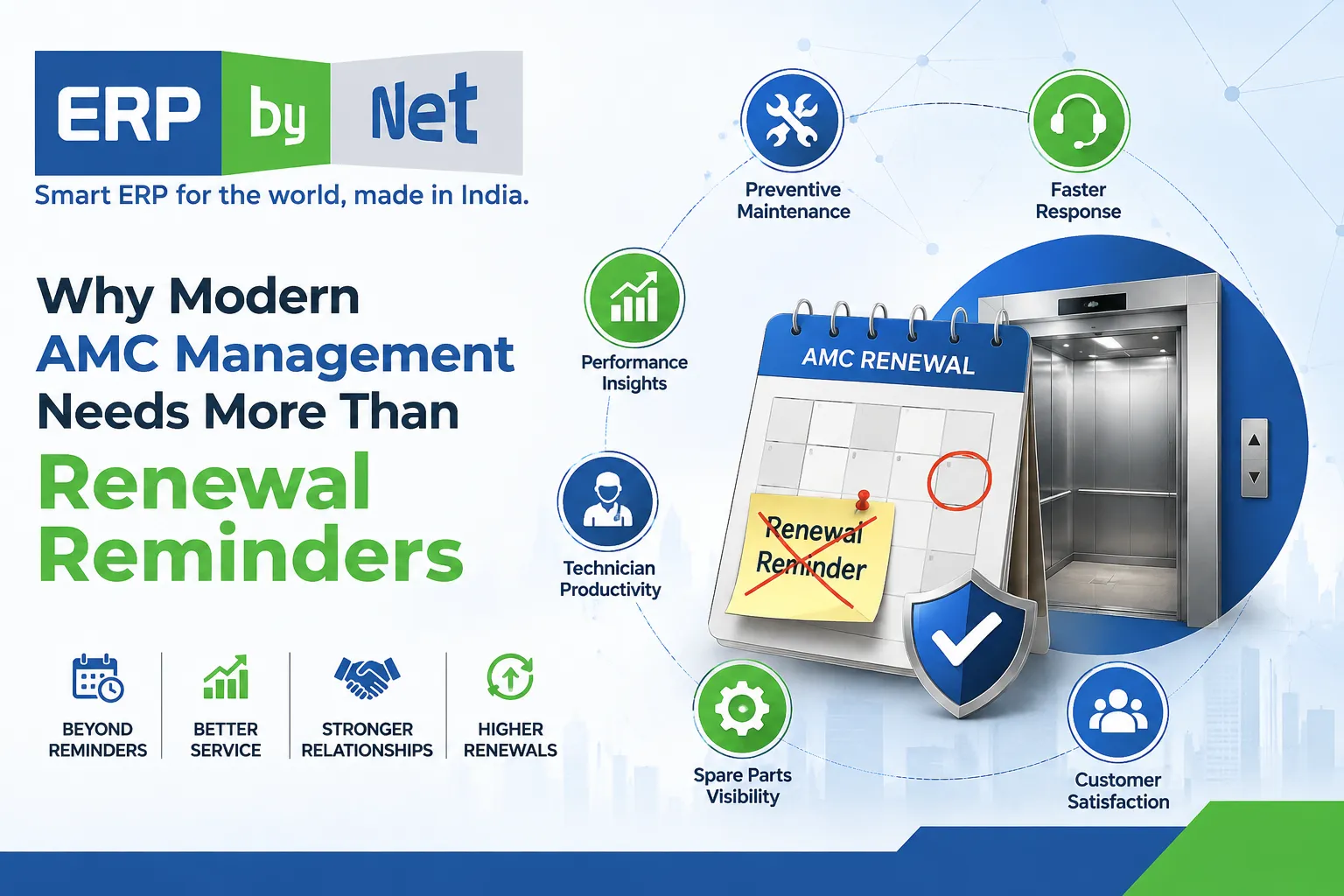
Why Modern AMC Management Needs More Than Renewal Reminders
Your AMC is expiring in 30 days.
A reminder email is automatically sent to the customer.
The sales team gets a notification.
The contract appears under “Renewals Due.”
Everything looks organized.
But there is one important question:
Does anyone know whether that customer actually wants to renew?
For an elevator company, an Annual Maintenance Contract is not simply a document with a start date, end date, and renewal reminder. It represents an ongoing relationship between the service provider, the customer, and the equipment being maintained.
During that relationship, hundreds of things can happen.
Preventive maintenance visits may be completed or delayed. Breakdown calls may increase. Technicians may make repeat visits. Spare parts may be consumed. SLA commitments may be missed. Customers may raise complaints. Service quality may improve—or deteriorate.
By the time the renewal date arrives, the customer’s decision has already been influenced by all of these experiences.
That is why modern AMC management needs to go beyond renewal reminders.
A reminder tells you that a contract is ending.
Modern AMC management should tell you what happened during the contract, what is happening now, what could go wrong next, and what your team should do before the customer makes a renewal decision.
Key Takeaways
- AMC management goes beyond renewal reminders and includes service, maintenance, customer experience, and profitability.
- Service history and contract data help identify renewal risks before the contract expires.
- PM visits, breakdowns, SLAs, technicians, and spare parts all affect AMC performance.
- Connected ERP data improves AMC visibility across service, inventory, finance, and renewals.
- Proactive AMC management improves retention, service quality, and profitability.
What You’ll Learn
- Why renewal reminders alone are not enough for modern AMC management.
- How service history and equipment data reveal renewal risks.
- How to track PM visits, breakdowns, SLAs, and technician performance.
- Why AMC profitability depends on service costs, travel, and spare-parts usage.
- How ERPbyNet connects the complete AMC lifecycle from contract to renewal.
Real Insights
- Two AMCs with the same renewal date can have very different renewal risks.
- Repeated breakdowns and delayed PM visits can signal customer dissatisfaction.
- High technician visits and spare consumption can reduce AMC profitability.
- Connected service data helps teams act before renewal problems grow.
- Modern AMC management is about managing the customer relationship, not just the expiry date.
What Is AMC Management Software?
AMC management software helps companies manage Annual Maintenance Contracts digitally instead of relying on spreadsheets, calendars, emails, paper records, and disconnected systems.
A typical AMC management system may help businesses manage:
- Contract details and validity
- Customer information
- Equipment or asset records
- Preventive maintenance schedules
- Service calls
- Breakdown complaints
- Technician assignments
- Service history
- SLA commitments
- Renewal dates
- Billing and payment information
For elevator and lift companies, however, AMC management is more complex because a contract is closely connected with physical equipment and field service operations.
A single customer may have multiple elevators across several locations, different maintenance schedules, different service requirements, and hundreds of service interactions throughout the year.
That means the value of AMC software should not be measured only by its ability to answer:
“Which contracts are expiring?”
It should also answer:
“How healthy is each contract?”
“How well have we serviced this customer?”
“What is putting the renewal at risk?”
“How much does this AMC actually cost us to service?”
“What action should our team take next?”
That is where modern AMC management begins.
Why Renewal Reminders Alone Are Not Enough
Renewal reminders solve an important administrative problem: they reduce the possibility of forgetting a contract expiry date.
But they do not solve the operational problems that determine whether the customer will renew.
Consider a simple example.
An elevator company has an AMC with a commercial building. The contract expires next month.
The system sends the renewal reminder on time.
However, during the previous year:
- Three preventive maintenance visits were delayed.
- The customer raised six breakdown complaints.
- Two complaints required repeat technician visits.
- One critical spare part was unavailable.
- Response time exceeded the agreed SLA twice.
- The customer complained about poor communication.
- The renewal proposal has not yet been discussed.
From a reminder-based system, this may simply appear as:
AMC expires in 30 days.
From a modern AMC management system, it should appear as:
AMC expires in 30 days + multiple service-risk signals require attention.
That difference is extremely important.
The first system helps you remember.
The second helps you make a decision.
The Real AMC Lifecycle Is Much Bigger Than Renewal
An AMC does not begin when the expiry reminder is generated.
It begins when the contract is created and continues through every service interaction that affects the customer’s experience.
For an elevator company, the lifecycle may look like:
Contract → Equipment → PM Planning → Technician Assignment → Service → Breakdown → Spare Parts → SLA → Customer Experience → Billing → Renewal
Every stage produces valuable information.
For example, contract information tells you what service has been promised.
Equipment information tells you which lift is being maintained.
PM information tells you whether scheduled maintenance is happening.
Breakdown information tells you how frequently the equipment is failing.
Technician information tells you how efficiently field resources are being used.
Spare-parts information tells you what materials are being consumed.
SLA information tells you whether service commitments are being met.
Customer information tells you whether the relationship is healthy.
Financial information tells you whether the contract is commercially sustainable.
If all of these activities are disconnected, the renewal team may see only the contract expiry date.
If they are connected, the company can understand the complete AMC story.
Read More: The Business Side of Lift Maintenance Nobody Talks About
5 Major Blind Spots of Reminder-Based AMC Management

1. You Know the Expiry Date but Not the Renewal Risk
Two customers can have AMCs expiring on the same date but completely different renewal probabilities.
Customer A may have:
- 100% PM completion
- Fast complaint resolution
- No major SLA issues
- Low breakdown frequency
- Positive service history
Customer B may have:
- Repeated breakdowns
- Delayed maintenance
- Multiple complaints
- High technician visits
- Poor response times
A basic renewal reminder treats both customers equally.
Modern AMC management should not.
It should help the business identify which contracts are healthy and which require attention before the renewal conversation begins.
2. You Track Complaints Without Seeing the Pattern
A single breakdown does not always indicate a serious problem.
But repeated breakdowns involving the same elevator, component, or location may reveal a pattern.
For example, suppose one lift generates four complaints related to the same door system within six months.
If those complaints are treated as isolated service calls, the pattern may never become visible.
When service history is connected to equipment records, management can identify recurring problems and take preventive action.
This can improve customer experience while potentially reducing future service costs.
3. You Schedule PM Visits Without Measuring Their Completion
Preventive maintenance is one of the most important activities within an elevator AMC.
But scheduling a visit does not mean the visit actually happened.
A modern system should help answer:
- Which PM visits are scheduled?
- Which are completed?
- Which are overdue?
- Which were rescheduled?
- Which technicians handled them?
- What issues were identified?
- What follow-up work is required?
Without this visibility, companies may believe they are delivering the contracted service while important maintenance activities remain incomplete.
4. You Manage Technicians Without Understanding Service Efficiency
Technician productivity directly affects AMC service costs.
Repeated travel, inefficient scheduling, repeat visits, and unnecessary delays can increase operational expenses.
For example, if a technician visits a customer three times because the required spare part was unavailable, the company is effectively paying for additional travel and technician time.
The customer may also become frustrated.
Connected AMC and field-service information helps companies identify these inefficiencies and improve scheduling, resource allocation, and service execution.
5. You Send Renewal Proposals Without Understanding the Customer Experience
A renewal proposal is a commercial document.
But renewal is fundamentally a customer decision.
Customers may ask themselves:
- Did this company respond quickly?
- Were maintenance visits completed on time?
- Were breakdowns resolved properly?
- Did technicians communicate clearly?
- Did the elevator remain reliable?
If the answer to these questions is negative, a perfectly timed renewal email may not save the contract.
The renewal process therefore needs to start long before the expiry date.
Modern AMC Management Should Measure Contract Health
A better approach is to think about every AMC as having a measurable health status.
Instead of asking only:
“Which AMCs expire this month?”
management should ask:
“Which AMCs are healthy, which are stable, and which are at risk?”
A contract health view could consider several signals.
| AMC Signal | What It Can Reveal |
|---|---|
| PM Completion | Whether contracted maintenance is being delivered |
| Breakdown Frequency | Whether equipment is experiencing recurring problems |
| SLA Compliance | Whether service commitments are being met |
| Repeat Complaints | Whether problems are being fully resolved |
| Technician Visits | Whether service effort is increasing |
| Spare Consumption | Whether maintenance costs are rising |
| Customer Feedback | Whether service experience is improving |
| Renewal Status | Whether the commercial conversation has started |
| Payment Status | Whether financial issues may affect renewal |
| Contract Profitability | Whether the AMC remains commercially viable |
This changes the role of AMC software.
It is no longer simply a reminder engine.
It becomes a decision-support system.
From Reactive AMC Management to Proactive AMC Management
Traditional AMC management often follows this sequence:
Expiry Approaching → Reminder → Follow-Up → Proposal → Renewal
The problem is that most action happens near the end of the contract.
A proactive model starts much earlier:
Monitor → Identify Risk → Take Action → Improve Service → Engage Customer → Renew
Imagine an AMC that expires in 60 days.
Instead of waiting until the final month, the system identifies:
- Two overdue PM visits
- Three recent breakdowns
- One unresolved complaint
- High spare consumption
- Poor SLA performance
That information creates an opportunity.
The company can resolve the service issues before discussing renewal.
The conversation changes from:
“Your AMC is expiring. Would you like to renew?”
to:
“We noticed recurring issues with this elevator and have already scheduled corrective action to improve reliability.”
That is a completely different customer experience.
Why This Matters Even More for Elevator Companies
Elevator maintenance is highly dependent on field operations.
Unlike a simple subscription contract, an elevator AMC is connected to physical assets that require continuous attention.
A single AMC may involve:
- Multiple lifts
- Different equipment models
- Multiple customer locations
- Preventive maintenance schedules
- Emergency breakdowns
- Technician assignments
- Travel
- Spare parts
- Service reports
- SLA commitments
- Customer communication
- Recurring billing
- Renewal proposals
This creates a significant amount of operational data.
The challenge is not necessarily a lack of data.
The challenge is connecting the data.
The sales team may know that the AMC is expiring.
The service team may know that complaints are pending.
The technician may know that the same elevator has recurring issues.
The warehouse team may know that a specific spare part is frequently unavailable.
Finance may know that invoices are overdue.
Management needs to see all of these signals together.
That is why AMC management should not operate as an isolated department.
AMC Management Is Also a Profitability Problem
Renewing an AMC is good.
Renewing a profitable AMC is better.
Consider two contracts with the same annual value.
| Metric | Contract A | Contract B |
| Annual AMC Value | ₹2,00,000 | ₹2,00,000 |
| Breakdown Calls | Low | High |
| Technician Visits | Low | High |
| Travel Cost | Low | High |
| Spare Consumption | Normal | High |
| SLA Issues | Few | Frequent |
| Service Effort | Controlled | Intensive |
| Profitability | Healthy | At Risk |
From a sales perspective, both contracts are worth ₹2,00,000.
From an operational perspective, they are very different businesses.
This is why modern AMC management should connect contract information with service and financial data.
Companies can then identify:
- High-value customers
- High-cost contracts
- Frequently serviced equipment
- Contracts with excessive spare consumption
- Contracts affected by SLA penalties
- Contracts that may require repricing
- Contracts that could benefit from modernization
- Contracts with strong renewal potential
This moves AMC management from administrative tracking to business intelligence.
How ERPbyNet Helps Modernize AMC Management

ERPbyNet takes a broader approach to managing project-based and engineering business operations, including the requirements of elevator companies.
Instead of treating the AMC as a standalone record, ERPbyNet can connect the activities that surround the contract and customer relationship.
This can include:
- Contract and AMC management
- Preventive maintenance planning
- Service calls and complaints
- Technician operations
- Service history
- Spare-parts visibility
- Customer information
- Billing processes
- Financial information
- Renewal workflows
The advantage of this connected approach is simple.
The renewal team does not have to work with one set of information while the service team works with another.
The same customer and equipment information can support multiple business functions.
For example:
- Sales can understand renewal status and customer history.
- Service teams can monitor PM schedules, complaints, and breakdowns.
- Technicians can receive assigned work and update service information from the field.
- Inventory teams can understand spare usage and material requirements.
- Finance teams can connect contract activity with billing and financial processes.
- Management can gain a broader view of service performance, operational costs, and contract profitability.
The objective is not simply to send renewal reminders faster.
The objective is to create a stronger operational foundation for customer retention.
Read More: How Leading Elevator Companies Deliver Better Service with the Same Workforce
What Should You Look for in AMC Management Software?
If you are evaluating AMC management software, don’t make automatic reminders your main selection criterion.
Ask these questions instead.
Contract Management
Can the system:
- Track every active AMC?
- Store contract terms and coverage?
- Link contracts to specific elevators or equipment?
- Track expiry, renewal, and cancellation?
- Maintain historical contract information?
Preventive Maintenance
Can it:
- Automatically plan PM activities?
- Track scheduled and completed visits?
- Highlight overdue maintenance?
- Maintain service history?
- Monitor maintenance performance across locations?
Breakdown and Service Management
Can it:
- Record customer complaints?
- Link complaints to equipment?
- Track response and resolution time?
- Identify repeat breakdowns?
- Monitor SLA performance?
Technician Management
Can it:
- Assign work based on availability?
- Provide technicians with relevant service information?
- Capture field updates?
- Track service activity?
- Reduce unnecessary repeat visits?
Spare-Parts Management
Can it:
- Track parts consumed during service?
- Connect material usage to equipment?
- Identify frequently used parts?
- Improve material availability?
- Help reduce service delays caused by stock shortages?
Renewal Management
Can it:
- Identify upcoming renewals?
- Create renewal workflows?
- Track proposal status?
- Show customer service history before renewal?
- Highlight contracts that require attention?
Financial Visibility
Can it:
- Connect AMC billing with finance?
- Track receivables?
- Monitor contract revenue?
- Understand service-related costs?
- Help identify profitable and loss-making contracts?
If your answer to these questions is yes, you are moving beyond basic AMC tracking.
You are moving toward complete AMC lifecycle management.
The Future of AMC Management Is Proactive
The future of AMC management is not about sending more emails.
It is about making better decisions earlier.
Instead of knowing only:
“This AMC expires next month.”
a modern system should help you understand:
“This AMC expires next month, all preventive maintenance visits are complete, breakdown frequency is low, there are no unresolved complaints, the renewal proposal has been sent, and the customer relationship is healthy.”
It should also identify the opposite scenario:
“This AMC expires next month, two PM visits are overdue, breakdown frequency has increased, a complaint remains unresolved, and service costs are rising.”
The second scenario requires action.
Without connected information, management may discover the problem only after the customer decides not to renew.
With better visibility, the company has time to intervene.
That is the real value of modern AMC management.
Final Takeaway: Don’t Just Manage the Expiry Date
Renewal reminders are useful.
But they are only one small part of the AMC lifecycle.
For elevator companies, effective AMC management should connect:
Contract → Equipment → Maintenance → Service → Technician → Spare Parts → Customer → Finance → Renewal
When these activities work together, companies can move beyond reactive contract administration.
They can improve preventive maintenance.
They can identify recurring service problems.
They can improve technician utilization.
They can control service costs.
They can understand customer experience.
And most importantly, they can approach renewal conversations with much better information.
Because the real question is not:
“Did we remind the customer that their AMC is expiring?”
The better question is:
“Did we manage the customer relationship well enough to make renewal the obvious choice?”
That is the difference between managing an AMC and managing the relationship behind it.
And for modern elevator companies, that difference can have a direct impact on service quality, customer retention, operational efficiency, and profitability.
Frequently Asked Questions About AMC Management Software
1. What is AMC management software?
AMC management software helps businesses manage Annual Maintenance Contracts from one platform. It can track contracts, customers, equipment, preventive maintenance, service requests, technicians, complaints, renewals, and billing, giving service teams better visibility throughout the contract lifecycle.
2. Why is AMC management software important for elevator companies?
Elevator companies manage recurring maintenance, breakdown calls, technicians, spare parts, SLAs, and customer relationships. AMC software connects these activities, helping companies reduce missed maintenance, improve service response, track equipment history, and manage renewals more effectively.
3. Is AMC software only used for renewal reminders?
No. Renewal reminders are only one part of AMC management. Modern AMC software can also manage preventive maintenance, breakdowns, service calls, technician assignments, equipment history, SLA tracking, spare parts, customer information, and renewal workflows.
4. How does AMC software help improve customer retention?
AMC software provides visibility into service quality before the renewal date. Companies can identify delayed maintenance, repeated breakdowns, unresolved complaints, or SLA issues early and take corrective action before these problems affect the customer’s renewal decision.
5. Can AMC software manage preventive maintenance?
Yes. AMC software can help schedule and track preventive maintenance visits, assign technicians, monitor completed and overdue activities, and maintain service history. This helps elevator companies ensure that contracted maintenance activities are performed on time.
6. Can AMC management software help control service costs?
Yes. By connecting service activity with technician visits, travel, breakdowns, and spare-parts consumption, AMC software can help companies identify contracts that require excessive resources and understand where service costs can be reduced.
7. What should I look for in AMC management software?
Look for features that cover the complete AMC lifecycle, including contract management, preventive maintenance, service and breakdown management, technician scheduling, equipment history, SLA tracking, renewal management, inventory visibility, and financial integration.
8. What is the difference between AMC software and ERP?
AMC software primarily focuses on managing maintenance contracts and related service activities. An ERP connects AMC operations with wider business functions such as sales, projects, inventory, procurement, technicians, and finance, providing a more integrated view of the business.
9. Can ERPbyNet manage the complete AMC lifecycle?
ERPbyNet is designed to connect AMC and service operations with other business processes. For elevator companies, this can provide a connected view across contracts, preventive maintenance, service calls, technicians, spare parts, customer information, billing, and renewal activities.

COO & Founder Member, XECOM | ERP & Technology Expert
Ganesh Limaye is a technology and business leader with 30+ years of experience in ERP, service management, project-based operations, and business process automation. He specializes in helping elevator, engineering, and service-driven businesses improve operational visibility, productivity, customer service, and business growth.