CategoriesERP (Enterprise Resource Planning) ERP Solutions

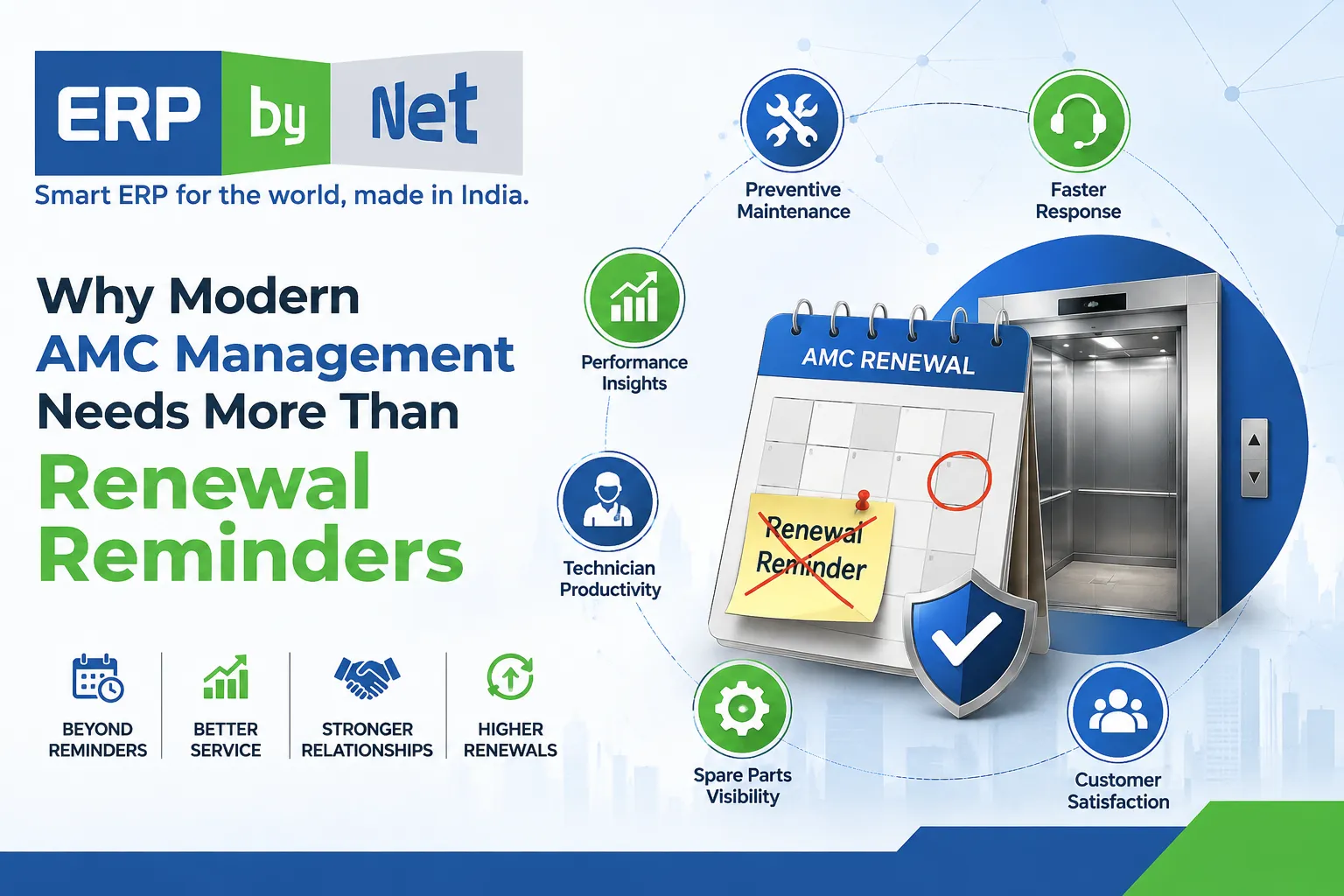
Why Modern AMC Management Needs More Than Renewal Reminders

Your AMC is expiring in 30 days.

A reminder email is automatically sent to the customer.

The sales team gets a notification.

The contract appears under “Renewals Due.”

Everything looks organized.

But there is one important question:

Does anyone know whether that customer actually wants to renew?

For an elevator company, an Annual Maintenance Contract is not simply a document with a start date, end date, and renewal reminder. It represents an ongoing relationship between the service provider, the customer, and the equipment being maintained.

During that relationship, hundreds of things can happen.

Preventive maintenance visits may be completed or delayed. Breakdown calls may increase. Technicians may make repeat visits. Spare parts may be consumed. SLA commitments may be missed. Customers may raise complaints. Service quality may improve—or deteriorate.

By the time the renewal date arrives, the customer’s decision has already been influenced by all of these experiences.

That is why modern AMC management needs to go beyond renewal reminders.

A reminder tells you that a contract is ending.

Modern AMC management should tell you what happened during the contract, what is happening now, what could go wrong next, and what your team should do before the customer makes a renewal decision.

Key Takeaways

  • AMC management goes beyond renewal reminders and includes service, maintenance, customer experience, and profitability.
  • Service history and contract data help identify renewal risks before the contract expires.
  • PM visits, breakdowns, SLAs, technicians, and spare parts all affect AMC performance.
  • Connected ERP data improves AMC visibility across service, inventory, finance, and renewals.
  • Proactive AMC management improves retention, service quality, and profitability.

What You’ll Learn

  • Why renewal reminders alone are not enough for modern AMC management.
  • How service history and equipment data reveal renewal risks.
  • How to track PM visits, breakdowns, SLAs, and technician performance.
  • Why AMC profitability depends on service costs, travel, and spare-parts usage.
  • How ERPbyNet connects the complete AMC lifecycle from contract to renewal.

Real Insights

  • Two AMCs with the same renewal date can have very different renewal risks.
  • Repeated breakdowns and delayed PM visits can signal customer dissatisfaction.
  • High technician visits and spare consumption can reduce AMC profitability.
  • Connected service data helps teams act before renewal problems grow.
  • Modern AMC management is about managing the customer relationship, not just the expiry date.

What Is AMC Management Software?

AMC management software helps companies manage Annual Maintenance Contracts digitally instead of relying on spreadsheets, calendars, emails, paper records, and disconnected systems.

A typical AMC management system may help businesses manage:

  • Contract details and validity
  • Customer information
  • Equipment or asset records
  • Preventive maintenance schedules
  • Service calls
  • Breakdown complaints
  • Technician assignments
  • Service history
  • SLA commitments
  • Renewal dates
  • Billing and payment information

For elevator and lift companies, however, AMC management is more complex because a contract is closely connected with physical equipment and field service operations.

A single customer may have multiple elevators across several locations, different maintenance schedules, different service requirements, and hundreds of service interactions throughout the year.

That means the value of AMC software should not be measured only by its ability to answer:

“Which contracts are expiring?”

It should also answer:

“How healthy is each contract?”

“How well have we serviced this customer?”

“What is putting the renewal at risk?”

“How much does this AMC actually cost us to service?”

“What action should our team take next?”

That is where modern AMC management begins.

Why Renewal Reminders Alone Are Not Enough

Renewal reminders solve an important administrative problem: they reduce the possibility of forgetting a contract expiry date.

But they do not solve the operational problems that determine whether the customer will renew.

Consider a simple example.

An elevator company has an AMC with a commercial building. The contract expires next month.

The system sends the renewal reminder on time.

However, during the previous year:

  • Three preventive maintenance visits were delayed.
  • The customer raised six breakdown complaints.
  • Two complaints required repeat technician visits.
  • One critical spare part was unavailable.
  • Response time exceeded the agreed SLA twice.
  • The customer complained about poor communication.
  • The renewal proposal has not yet been discussed.

From a reminder-based system, this may simply appear as:

AMC expires in 30 days.

From a modern AMC management system, it should appear as:

AMC expires in 30 days + multiple service-risk signals require attention.

That difference is extremely important.

The first system helps you remember.

The second helps you make a decision.

The Real AMC Lifecycle Is Much Bigger Than Renewal

An AMC does not begin when the expiry reminder is generated.

It begins when the contract is created and continues through every service interaction that affects the customer’s experience.

For an elevator company, the lifecycle may look like:

Contract → Equipment → PM Planning → Technician Assignment → Service → Breakdown → Spare Parts → SLA → Customer Experience → Billing → Renewal

Every stage produces valuable information.

For example, contract information tells you what service has been promised.

Equipment information tells you which lift is being maintained.

PM information tells you whether scheduled maintenance is happening.

Breakdown information tells you how frequently the equipment is failing.

Technician information tells you how efficiently field resources are being used.

Spare-parts information tells you what materials are being consumed.

SLA information tells you whether service commitments are being met.

Customer information tells you whether the relationship is healthy.

Financial information tells you whether the contract is commercially sustainable.

If all of these activities are disconnected, the renewal team may see only the contract expiry date.

If they are connected, the company can understand the complete AMC story.

Read More: The Business Side of Lift Maintenance Nobody Talks About

5 Major Blind Spots of Reminder-Based AMC Management

Infographic showing five blind spots of reminder-based AMC management, including different customer renewal risks, missed service issues, overdue maintenance, technician travel costs, and delayed renewal proposals.

1. You Know the Expiry Date but Not the Renewal Risk

Two customers can have AMCs expiring on the same date but completely different renewal probabilities.

Customer A may have:

  • 100% PM completion
  • Fast complaint resolution
  • No major SLA issues
  • Low breakdown frequency
  • Positive service history

Customer B may have:

  • Repeated breakdowns
  • Delayed maintenance
  • Multiple complaints
  • High technician visits
  • Poor response times

A basic renewal reminder treats both customers equally.

Modern AMC management should not.

It should help the business identify which contracts are healthy and which require attention before the renewal conversation begins.

2. You Track Complaints Without Seeing the Pattern

A single breakdown does not always indicate a serious problem.

But repeated breakdowns involving the same elevator, component, or location may reveal a pattern.

For example, suppose one lift generates four complaints related to the same door system within six months.

If those complaints are treated as isolated service calls, the pattern may never become visible.

When service history is connected to equipment records, management can identify recurring problems and take preventive action.

This can improve customer experience while potentially reducing future service costs.

3. You Schedule PM Visits Without Measuring Their Completion

Preventive maintenance is one of the most important activities within an elevator AMC.

But scheduling a visit does not mean the visit actually happened.

A modern system should help answer:

  • Which PM visits are scheduled?
  • Which are completed?
  • Which are overdue?
  • Which were rescheduled?
  • Which technicians handled them?
  • What issues were identified?
  • What follow-up work is required?

Without this visibility, companies may believe they are delivering the contracted service while important maintenance activities remain incomplete.

4. You Manage Technicians Without Understanding Service Efficiency

Technician productivity directly affects AMC service costs.

Repeated travel, inefficient scheduling, repeat visits, and unnecessary delays can increase operational expenses.

For example, if a technician visits a customer three times because the required spare part was unavailable, the company is effectively paying for additional travel and technician time.

The customer may also become frustrated.

Connected AMC and field-service information helps companies identify these inefficiencies and improve scheduling, resource allocation, and service execution.

5. You Send Renewal Proposals Without Understanding the Customer Experience

A renewal proposal is a commercial document.

But renewal is fundamentally a customer decision.

Customers may ask themselves:

  • Did this company respond quickly?
  • Were maintenance visits completed on time?
  • Were breakdowns resolved properly?
  • Did technicians communicate clearly?
  • Did the elevator remain reliable?

If the answer to these questions is negative, a perfectly timed renewal email may not save the contract.

The renewal process therefore needs to start long before the expiry date.

Modern AMC Management Should Measure Contract Health

A better approach is to think about every AMC as having a measurable health status.

Instead of asking only:

“Which AMCs expire this month?”

management should ask:

“Which AMCs are healthy, which are stable, and which are at risk?”

A contract health view could consider several signals.

AMC SignalWhat It Can Reveal
PM CompletionWhether contracted maintenance is being delivered
Breakdown FrequencyWhether equipment is experiencing recurring problems
SLA ComplianceWhether service commitments are being met
Repeat ComplaintsWhether problems are being fully resolved
Technician VisitsWhether service effort is increasing
Spare ConsumptionWhether maintenance costs are rising
Customer FeedbackWhether service experience is improving
Renewal StatusWhether the commercial conversation has started
Payment StatusWhether financial issues may affect renewal
Contract ProfitabilityWhether the AMC remains commercially viable

This changes the role of AMC software.

It is no longer simply a reminder engine.

It becomes a decision-support system.

From Reactive AMC Management to Proactive AMC Management

Traditional AMC management often follows this sequence:

Expiry Approaching → Reminder → Follow-Up → Proposal → Renewal

The problem is that most action happens near the end of the contract.

A proactive model starts much earlier:

Monitor → Identify Risk → Take Action → Improve Service → Engage Customer → Renew

Imagine an AMC that expires in 60 days.

Instead of waiting until the final month, the system identifies:

  • Two overdue PM visits
  • Three recent breakdowns
  • One unresolved complaint
  • High spare consumption
  • Poor SLA performance

That information creates an opportunity.

The company can resolve the service issues before discussing renewal.

The conversation changes from:

“Your AMC is expiring. Would you like to renew?”

to:

“We noticed recurring issues with this elevator and have already scheduled corrective action to improve reliability.”

That is a completely different customer experience.

Why This Matters Even More for Elevator Companies

Elevator maintenance is highly dependent on field operations.

Unlike a simple subscription contract, an elevator AMC is connected to physical assets that require continuous attention.

A single AMC may involve:

  • Multiple lifts
  • Different equipment models
  • Multiple customer locations
  • Preventive maintenance schedules
  • Emergency breakdowns
  • Technician assignments
  • Travel
  • Spare parts
  • Service reports
  • SLA commitments
  • Customer communication
  • Recurring billing
  • Renewal proposals

This creates a significant amount of operational data.

The challenge is not necessarily a lack of data.

The challenge is connecting the data.

The sales team may know that the AMC is expiring.

The service team may know that complaints are pending.

The technician may know that the same elevator has recurring issues.

The warehouse team may know that a specific spare part is frequently unavailable.

Finance may know that invoices are overdue.

Management needs to see all of these signals together.

That is why AMC management should not operate as an isolated department.

AMC Management Is Also a Profitability Problem

Renewing an AMC is good.

Renewing a profitable AMC is better.

Consider two contracts with the same annual value.

MetricContract AContract B
Annual AMC Value₹2,00,000₹2,00,000
Breakdown CallsLowHigh
Technician VisitsLowHigh
Travel CostLowHigh
Spare ConsumptionNormalHigh
SLA IssuesFewFrequent
Service EffortControlledIntensive
ProfitabilityHealthyAt Risk

From a sales perspective, both contracts are worth ₹2,00,000.

From an operational perspective, they are very different businesses.

This is why modern AMC management should connect contract information with service and financial data.

Companies can then identify:

  • High-value customers
  • High-cost contracts
  • Frequently serviced equipment
  • Contracts with excessive spare consumption
  • Contracts affected by SLA penalties
  • Contracts that may require repricing
  • Contracts that could benefit from modernization
  • Contracts with strong renewal potential

This moves AMC management from administrative tracking to business intelligence.

How ERPbyNet Helps Modernize AMC Management

Infographic showing how ERPbyNet connects sales, AMC contracts, service teams, technicians, inventory, customer information, billing, and finance for elevator companies.

ERPbyNet takes a broader approach to managing project-based and engineering business operations, including the requirements of elevator companies.

Instead of treating the AMC as a standalone record, ERPbyNet can connect the activities that surround the contract and customer relationship.

This can include:

  • Contract and AMC management
  • Preventive maintenance planning
  • Service calls and complaints
  • Technician operations
  • Service history
  • Spare-parts visibility
  • Customer information
  • Billing processes
  • Financial information
  • Renewal workflows

The advantage of this connected approach is simple.

The renewal team does not have to work with one set of information while the service team works with another.

The same customer and equipment information can support multiple business functions.

For example:

  • Sales can understand renewal status and customer history.
  • Service teams can monitor PM schedules, complaints, and breakdowns.
  • Technicians can receive assigned work and update service information from the field.
  • Inventory teams can understand spare usage and material requirements.
  • Finance teams can connect contract activity with billing and financial processes.
  • Management can gain a broader view of service performance, operational costs, and contract profitability.

The objective is not simply to send renewal reminders faster.

The objective is to create a stronger operational foundation for customer retention.

Read More: How Leading Elevator Companies Deliver Better Service with the Same Workforce

What Should You Look for in AMC Management Software?

If you are evaluating AMC management software, don’t make automatic reminders your main selection criterion.

Ask these questions instead.

Contract Management

Can the system:

  • Track every active AMC?
  • Store contract terms and coverage?
  • Link contracts to specific elevators or equipment?
  • Track expiry, renewal, and cancellation?
  • Maintain historical contract information?

Preventive Maintenance

Can it:

  • Automatically plan PM activities?
  • Track scheduled and completed visits?
  • Highlight overdue maintenance?
  • Maintain service history?
  • Monitor maintenance performance across locations?

Breakdown and Service Management

Can it:

  • Record customer complaints?
  • Link complaints to equipment?
  • Track response and resolution time?
  • Identify repeat breakdowns?
  • Monitor SLA performance?

Technician Management

Can it:

  • Assign work based on availability?
  • Provide technicians with relevant service information?
  • Capture field updates?
  • Track service activity?
  • Reduce unnecessary repeat visits?

Spare-Parts Management

Can it:

  • Track parts consumed during service?
  • Connect material usage to equipment?
  • Identify frequently used parts?
  • Improve material availability?
  • Help reduce service delays caused by stock shortages?

Renewal Management

Can it:

  • Identify upcoming renewals?
  • Create renewal workflows?
  • Track proposal status?
  • Show customer service history before renewal?
  • Highlight contracts that require attention?

Financial Visibility

Can it:

  • Connect AMC billing with finance?
  • Track receivables?
  • Monitor contract revenue?
  • Understand service-related costs?
  • Help identify profitable and loss-making contracts?

If your answer to these questions is yes, you are moving beyond basic AMC tracking.

You are moving toward complete AMC lifecycle management.

The Future of AMC Management Is Proactive

The future of AMC management is not about sending more emails.

It is about making better decisions earlier.

Instead of knowing only:

“This AMC expires next month.”

a modern system should help you understand:

“This AMC expires next month, all preventive maintenance visits are complete, breakdown frequency is low, there are no unresolved complaints, the renewal proposal has been sent, and the customer relationship is healthy.”

It should also identify the opposite scenario:

“This AMC expires next month, two PM visits are overdue, breakdown frequency has increased, a complaint remains unresolved, and service costs are rising.”

The second scenario requires action.

Without connected information, management may discover the problem only after the customer decides not to renew.

With better visibility, the company has time to intervene.

That is the real value of modern AMC management.

Final Takeaway: Don’t Just Manage the Expiry Date

Renewal reminders are useful.

But they are only one small part of the AMC lifecycle.

For elevator companies, effective AMC management should connect:

Contract → Equipment → Maintenance → Service → Technician → Spare Parts → Customer → Finance → Renewal

When these activities work together, companies can move beyond reactive contract administration.

They can improve preventive maintenance.

They can identify recurring service problems.

They can improve technician utilization.

They can control service costs.

They can understand customer experience.

And most importantly, they can approach renewal conversations with much better information.

Because the real question is not:

“Did we remind the customer that their AMC is expiring?”

The better question is:

“Did we manage the customer relationship well enough to make renewal the obvious choice?”

That is the difference between managing an AMC and managing the relationship behind it.

And for modern elevator companies, that difference can have a direct impact on service quality, customer retention, operational efficiency, and profitability.

ERPbyNet
Go Beyond AMC Renewal Reminders
ERPbyNet helps elevator companies manage AMC renewals, service schedules, contracts, technicians, customer follow-ups, and service performance from one connected platform.
AMC Management • Service Operations
Manage the complete AMC lifecycle with ERPbyNet.

Frequently Asked Questions About AMC Management Software

1. What is AMC management software?

AMC management software helps businesses manage Annual Maintenance Contracts from one platform. It can track contracts, customers, equipment, preventive maintenance, service requests, technicians, complaints, renewals, and billing, giving service teams better visibility throughout the contract lifecycle.

2. Why is AMC management software important for elevator companies?

Elevator companies manage recurring maintenance, breakdown calls, technicians, spare parts, SLAs, and customer relationships. AMC software connects these activities, helping companies reduce missed maintenance, improve service response, track equipment history, and manage renewals more effectively.

3. Is AMC software only used for renewal reminders?

No. Renewal reminders are only one part of AMC management. Modern AMC software can also manage preventive maintenance, breakdowns, service calls, technician assignments, equipment history, SLA tracking, spare parts, customer information, and renewal workflows.

4. How does AMC software help improve customer retention?

AMC software provides visibility into service quality before the renewal date. Companies can identify delayed maintenance, repeated breakdowns, unresolved complaints, or SLA issues early and take corrective action before these problems affect the customer’s renewal decision.

5. Can AMC software manage preventive maintenance?

Yes. AMC software can help schedule and track preventive maintenance visits, assign technicians, monitor completed and overdue activities, and maintain service history. This helps elevator companies ensure that contracted maintenance activities are performed on time.

6. Can AMC management software help control service costs?

Yes. By connecting service activity with technician visits, travel, breakdowns, and spare-parts consumption, AMC software can help companies identify contracts that require excessive resources and understand where service costs can be reduced.

7. What should I look for in AMC management software?

Look for features that cover the complete AMC lifecycle, including contract management, preventive maintenance, service and breakdown management, technician scheduling, equipment history, SLA tracking, renewal management, inventory visibility, and financial integration.

8. What is the difference between AMC software and ERP?

AMC software primarily focuses on managing maintenance contracts and related service activities. An ERP connects AMC operations with wider business functions such as sales, projects, inventory, procurement, technicians, and finance, providing a more integrated view of the business.

9. Can ERPbyNet manage the complete AMC lifecycle?

ERPbyNet is designed to connect AMC and service operations with other business processes. For elevator companies, this can provide a connected view across contracts, preventive maintenance, service calls, technicians, spare parts, customer information, billing, and renewal activities.

CategoriesERP (Enterprise Resource Planning) ERP Solutions

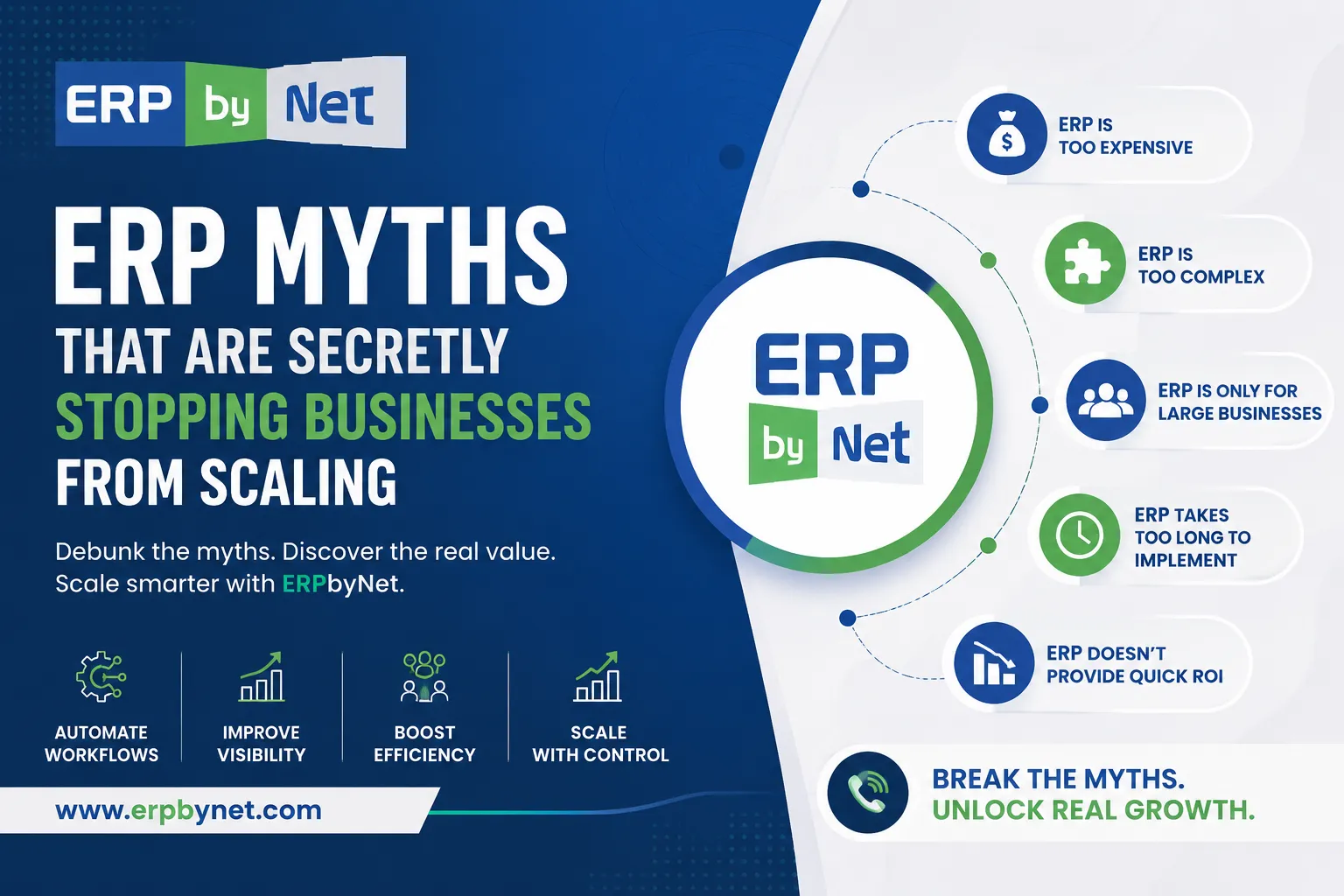
ERP Myths That Are Secretly Stopping Businesses from Scaling

Key Takeaways

  • Many businesses delay ERP adoption because of common myths that no longer reflect modern ERP capabilities.
  • ERP is not just for large enterprises; small and mid-sized businesses can benefit significantly from automation and centralized operations.
  • Modern cloud ERP solutions are affordable and scalable, making implementation easier than ever before.
  • Manual processes and disconnected systems often become the biggest barriers to business growth.
  • Businesses that overcome ERP misconceptions gain better visibility, efficiency, and long-term scalability.

What You’ll Learn

  • The most common ERP myths that prevent businesses from scaling.
  • Why spreadsheets and disconnected software tools create operational bottlenecks.
  • How modern ERP systems streamline workflows across departments.
  • Why ERP implementation is no longer as costly or complex as many businesses assume.
  • How ERPbyNet helps growing businesses automate operations and scale with confidence.

Real Insights

  • The cost of avoiding ERP is often higher than implementing it, especially when inefficiencies grow with business expansion.
  • Businesses relying on manual coordination frequently face delays, errors, and limited operational visibility.
  • Cloud-based ERP solutions provide faster deployment and easier adoption than traditional on-premise systems.
  • Scalable businesses need centralized data and real-time reporting to make informed decisions.
  • Successful growth starts with eliminating operational myths and embracing technology that supports long-term expansion.

Businesses today are under constant pressure to grow faster, improve customer experience, reduce operational delays, and maintain complete visibility across departments. Whether it is a service business, maintenance company, distributor, or operational enterprise, modern growth depends heavily on how efficiently workflows are managed internally.

However, many businesses still operate using disconnected systems such as spreadsheets, manual approvals, WhatsApp coordination, paper records, and scattered reporting tools. While these methods may seem manageable initially, they gradually become one of the biggest obstacles preventing businesses from scaling efficiently.

One major reason behind this problem is the continued belief in outdated ERP myths.

Even today, many organizations assume ERP software is:

  • too expensive for growing businesses,
  • only useful for large enterprises,
  • difficult to implement,
  • overly complicated for employees,
  • or unnecessary for service operations.

Because of these misconceptions, businesses continue depending on manual operational systems long after they have outgrown them.

The result is increasing operational confusion, slower decision-making, reporting delays, workflow bottlenecks, poor coordination, and limited visibility across teams.

Modern ERP platforms like ERPbyNet are helping businesses replace disconnected operational structures with centralized systems that improve visibility, automate workflows, and support long-term scalable growth.

In this blog, we will break down some of the biggest ERP myths that stop businesses from scaling and explain why modern operational visibility has become essential for sustainable business growth.

Why Businesses Struggle to Scale Without ERP

Growing business facing operational chaos due to spreadsheets, manual processes, disconnected communication, and lack of ERP software
Image Source: ChatGPT

Many companies believe scaling challenges are caused by market competition, staffing limitations, or business expansion pressure.

In reality, operational inefficiency is often one of the biggest hidden reasons businesses struggle during growth phases.

In the early stages of a business, manual coordination usually works because operations are relatively simple. Teams are smaller, approvals are fewer, and communication happens directly between employees.

But as the business grows, operational complexity increases rapidly.

Businesses begin managing:

  • larger teams,
  • more customer requests,
  • higher inventory movement,
  • multiple service workflows,
  • technician coordination,
  • branch operations,
  • approvals,
  • and reporting requirements.

Without centralized systems, these growing workflows become difficult to control efficiently.

Departments begin operating independently, information gets scattered across different tools, and managers lose real-time visibility into daily operations.

This eventually creates operational silos that slow productivity and impact customer experience.

Common Operational Problems Businesses Face Without ERP

Operational AreaCommon Challenges Without ERP
Inventory ManagementStock mismatch, delayed updates, poor visibility
Service OperationsMissed complaints, delayed assignments, inconsistent updates
ReportingManual reports, delayed analysis, inaccurate data
Team CoordinationDependency on calls, WhatsApp, spreadsheets
Customer ManagementScattered communication and poor tracking
ApprovalsDelayed decision-making and workflow bottlenecks
Maintenance OperationsPoor scheduling and inconsistent service records

Over time, these operational gaps begin affecting:

  • customer satisfaction,
  • team productivity,
  • operational efficiency,
  • and overall business scalability.

This is where ERP systems become critical.

ERP is no longer just software for accounting or manufacturing. Modern ERP acts as a centralized operational system that connects departments, automates workflows, and improves business visibility in real time.

Read More: The Hidden Cost of Using Multiple Business Tools Instead of One ERP

Myth 1: ERP Is Only for Large Enterprises

One of the most outdated misconceptions about ERP systems is that they are designed only for multinational corporations or massive manufacturing companies.

This belief prevents many growing businesses from modernizing operations early enough.

Years ago, ERP systems were indeed expensive and infrastructure-heavy. Businesses needed dedicated servers, large IT teams, and long implementation cycles.

Modern ERP systems are completely different.

Today’s cloud-based ERP platforms are designed specifically for:

  • growing businesses,
  • service companies,
  • field service organizations,
  • maintenance businesses,
  • distributors,
  • AMC providers,
  • and multi-location operations.

Modern ERP systems are modular and scalable, which means businesses can start small and expand gradually based on operational requirements.

For example, a service business may initially implement ERP for:

  • complaint management,
  • technician tracking,
  • and attendance monitoring.

Later, the same business can expand into:

  • inventory management,
  • maintenance scheduling,
  • AMC management,
  • customer communication,
  • and reporting automation.

This flexibility makes ERP practical even for medium-sized businesses.

Traditional ERP vs Modern ERP

Traditional ERPModern ERP
High upfront investmentFlexible subscription models
Complex infrastructureCloud-based deployment
Long implementation cyclesFaster phased implementation
Heavy IT dependencyUser-friendly systems
Limited flexibilityScalable modular structure

The reality is that smaller growing businesses often need ERP earlier because operational inefficiencies affect them faster during expansion.

Without centralized operational visibility, businesses eventually become dependent on:

  • manual coordination,
  • employee memory,
  • scattered spreadsheets,
  • and disconnected communication.

This creates operational instability that limits scalability.

Myth 2: Spreadsheets Are Enough to Manage Operations

Many businesses continue relying heavily on spreadsheets because they initially seem simple and cost-effective.

However, spreadsheets are not designed to manage growing operational ecosystems.

As businesses expand, spreadsheets slowly become one of the largest sources of operational inefficiency.

Different departments often maintain separate sheets for:

  • inventory,
  • attendance,
  • complaints,
  • service schedules,
  • approvals,
  • reporting,
  • and customer updates.

Because these systems operate independently, information becomes fragmented across the organization.

Managers often struggle with:

  • outdated reports,
  • version confusion,
  • duplicate entries,
  • delayed updates,
  • and inconsistent operational visibility.

This becomes especially problematic for service and maintenance businesses where workflows are highly dynamic.

For example, businesses managing field technicians manually often face challenges such as:

  • delayed technician allocation,
  • missed service requests,
  • inventory mismatch,
  • poor complaint tracking,
  • and delayed reporting.

Employees spend large amounts of time coordinating information manually instead of improving productivity.

What Happens When Businesses Depend Too Much on Spreadsheets

Operational Visibility Becomes Limited

Managers cannot access real-time operational insights because information is scattered across multiple files and departments.

Reporting Becomes Slow

Teams spend hours preparing reports manually, reducing decision-making speed.

Human Errors Increase

Manual data entry creates duplication, missing information, and inaccurate reporting.

Workflow Coordination Weakens

Departments struggle to stay aligned because updates are not centralized.

Scaling Becomes Difficult

As operational complexity increases, manual systems become increasingly difficult to manage.

ERP systems solve these problems by centralizing workflows into one connected operational platform.

With ERPbyNet, businesses can manage:

  • complaint workflows,
  • technician coordination,
  • inventory movement,
  • maintenance scheduling,
  • attendance tracking,
  • customer management,
  • and operational reporting

through one centralized system.

This improves operational clarity while reducing dependency on scattered manual systems.

Read More:Why Real-Time Visibility Is Becoming Essential for Modern Operations

Myth 3: ERP Is Too Expensive

One of the biggest misconceptions about ERP is that implementation cost is too high for growing businesses.

However, many companies fail to calculate the actual cost of operational inefficiency.

Businesses operating without centralized systems often experience hidden losses such as:

  • duplicate work,
  • reporting delays,
  • inventory leakage,
  • missed follow-ups,
  • technician inefficiency,
  • delayed approvals,
  • and poor workflow coordination.

These inefficiencies silently increase operational expenses over time.

For example, businesses managing AMC operations manually may lose revenue because renewal tracking becomes inconsistent. Service businesses may experience customer dissatisfaction due to delayed complaint handling or poor technician visibility.

These operational losses accumulate gradually and often become much more expensive than ERP implementation itself.

Hidden Cost of Manual Operations

Manual Operational ProblemBusiness Impact
Delayed reportingSlower decision-making
Inventory mismatchFinancial loss and stock issues
Missed service requestsPoor customer experience
Manual approvalsWorkflow bottlenecks
Disconnected communicationOperational confusion
Technician inefficiencyReduced productivity
Poor visibilityLimited operational control

Modern ERP systems are also significantly more affordable than traditional ERP platforms because:

  • cloud deployment reduces infrastructure costs,
  • subscription models reduce upfront investment,
  • and phased implementation reduces operational risk.

ERP should not be viewed simply as software expenditure.

It should be viewed as an operational investment that improves visibility, productivity, workflow efficiency, and long-term scalability.

Myth 4: ERP Systems Are Too Complicated for Employees

Many businesses fear employees may struggle to adapt to ERP systems.

However, most organizations are already operating within highly complicated manual environments without realizing it.

Employees often work across:

  • spreadsheets,
  • WhatsApp groups,
  • email threads,
  • manual approvals,
  • repeated reporting,
  • and disconnected software tools.

This creates operational confusion that reduces efficiency and increases dependency on manual coordination.

Modern ERP systems are designed specifically to simplify workflows by centralizing operational information into one structured platform.

Instead of searching through multiple systems, employees can access:

  • customer details,
  • complaint status,
  • inventory visibility,
  • technician schedules,
  • service reports,
  • approvals,
  • and operational dashboards

through a single interface.

This improves:

  • workflow clarity,
  • coordination speed,
  • operational transparency,
  • and accountability across departments.

ERP systems are not designed to complicate operations.

They are designed to remove unnecessary operational friction that businesses experience during growth.

Read More: Why Elevator Companies Struggle to Track AMC Contracts

Before ERP vs After ERP: The Transformation Businesses Experience

As businesses grow, manual processes and disconnected systems often struggle to keep pace with increasing operational demands. This leads to inefficiencies, communication gaps, and limited visibility across departments. Implementing an ERP system transforms these challenges into streamlined, automated workflows that support sustainable growth.

Before ERP ImplementationAfter ERP Implementation
Customer complaints are tracked manually, causing delays and missed follow-ups.Complaints are logged, assigned, and tracked automatically for faster resolution.
Inventory information is scattered across spreadsheets, leading to stock discrepancies.Real-time inventory visibility ensures accurate stock management and better planning.
Technician assignments rely on calls and manual coordination.Technician scheduling and tracking are automated with real-time status updates.
Customer communication is fragmented across emails, calls, and messages.All customer interactions are centralized for better service management.
Reports require manual preparation, consuming valuable time.Automated reports provide instant access to accurate business insights.
Approval processes are slow and difficult to monitor.Digital workflows streamline approvals and improve accountability.
Departments operate independently, creating information silos.Connected workflows improve collaboration and information sharing across teams.
Management lacks real-time visibility into operations.Live dashboards provide complete operational visibility and performance tracking.

The Result: A More Scalable Business

With ERP in place, businesses gain centralized control over their operations, allowing teams to work more efficiently and make better decisions based on real-time data. Instead of spending time managing operational bottlenecks, organizations can focus on improving customer satisfaction, increasing productivity, and driving business growth.

This shift from manual coordination to automated workflow management enables businesses to scale with greater efficiency, visibility, and control while reducing operational complexity.

How ERPbyNet Helps Businesses Scale Efficiently

ERPbyNet ERP software dashboard connecting complaint management, technician tracking, inventory, AMC management, and reporting automation for business growth
Image Source: ChatGPT

ERPbyNet helps growing businesses move from disconnected manual processes to a fully centralized and automated ERP system. As operations expand, managing teams, customers, inventory, and services becomes complex. ERPbyNet simplifies this by bringing everything into one platform with real-time visibility and control.

Instead of relying on spreadsheets, WhatsApp, and separate tools, businesses get one connected system where every workflow is trackable, measurable, and easy to manage.

ERPbyNet supports key business operations such as:

  • Complaint Management: Centralized logging, tracking, and faster resolution of customer issues.
  • Technician Tracking: Real-time monitoring of field staff, job allocation, and task progress.
  • Maintenance Workflows: Timely scheduling and execution of preventive maintenance tasks.
  • Inventory Operations: Accurate stock tracking and real-time inventory visibility.
  • Attendance Systems: Automated tracking for employees and field teams.
  • AMC Management: Efficient tracking of contracts, renewals, and service schedules.
  • Operational Dashboards: Real-time insights for faster decision-making.
  • Reporting Automation: Instant, accurate business reports without manual effort.

By connecting all operations in one system, ERPbyNet removes manual coordination and improves overall efficiency across departments.

This leads to better workflow speed, improved visibility, stronger coordination, and reduced operational delays. As businesses grow, ERPbyNet ensures scaling remains smooth, structured, and fully controlled without operational chaos.

Final Thoughts

ERP myths continue to stop many businesses from modernizing operations, even as operational complexity keeps increasing across industries. What begins as manageable manual work eventually turns into disconnected workflows, delayed communication, and reduced visibility across teams.

The reality is that manual systems create limitations in productivity, reporting speed, customer experience, and overall workflow efficiency. As businesses grow, these issues become harder to manage without a centralized system.

Modern ERP systems are now scalable, flexible, cloud-based, user-friendly, and easier to implement than ever before. They help businesses bring structure and automation into daily operations.

Businesses that adopt ERP early gain a clear advantage by scaling efficiently without losing control or visibility.

ERP solutions like ERPbyNet help businesses move from manual processes to centralized, growth-focused systems that support long-term success.

If you’re ready to improve operational efficiency, contact us today to get started with ERPbyNet.

Frequently Asked Questions (FAQs)

Why do businesses delay ERP implementation?

Many businesses delay ERP implementation because they assume it is expensive, complex, or only meant for large enterprises. However, as operations grow, manual processes and disconnected systems start creating delays, inefficiencies, and poor visibility that slow down overall business growth.

Is ERP only useful for manufacturing companies?

No, ERP is widely used across service industries, maintenance companies, retail, logistics, healthcare, distributors, and field service businesses. It helps organizations centralize operations, automate workflows, and improve visibility across all departments.

How does ERP help businesses scale?

ERP supports business growth by centralizing workflows, automating repetitive tasks, and providing real-time operational visibility. This helps businesses manage increasing workloads, teams, and complex operations without losing control or efficiency.

Are spreadsheets enough for managing growing operations?

Spreadsheets may work in the early stages, but they quickly become inefficient as businesses grow. They often lead to duplicate data, reporting delays, version confusion, and disconnected workflows that reduce accuracy and operational control.

Is cloud ERP affordable for medium-sized businesses?

Yes, cloud ERP is affordable because it reduces infrastructure costs and offers flexible subscription-based pricing. Businesses can also implement modules gradually based on their operational needs, making it easier to adopt without heavy upfront investment.

CategoriesERP (Enterprise Resource Planning) ERP Solutions

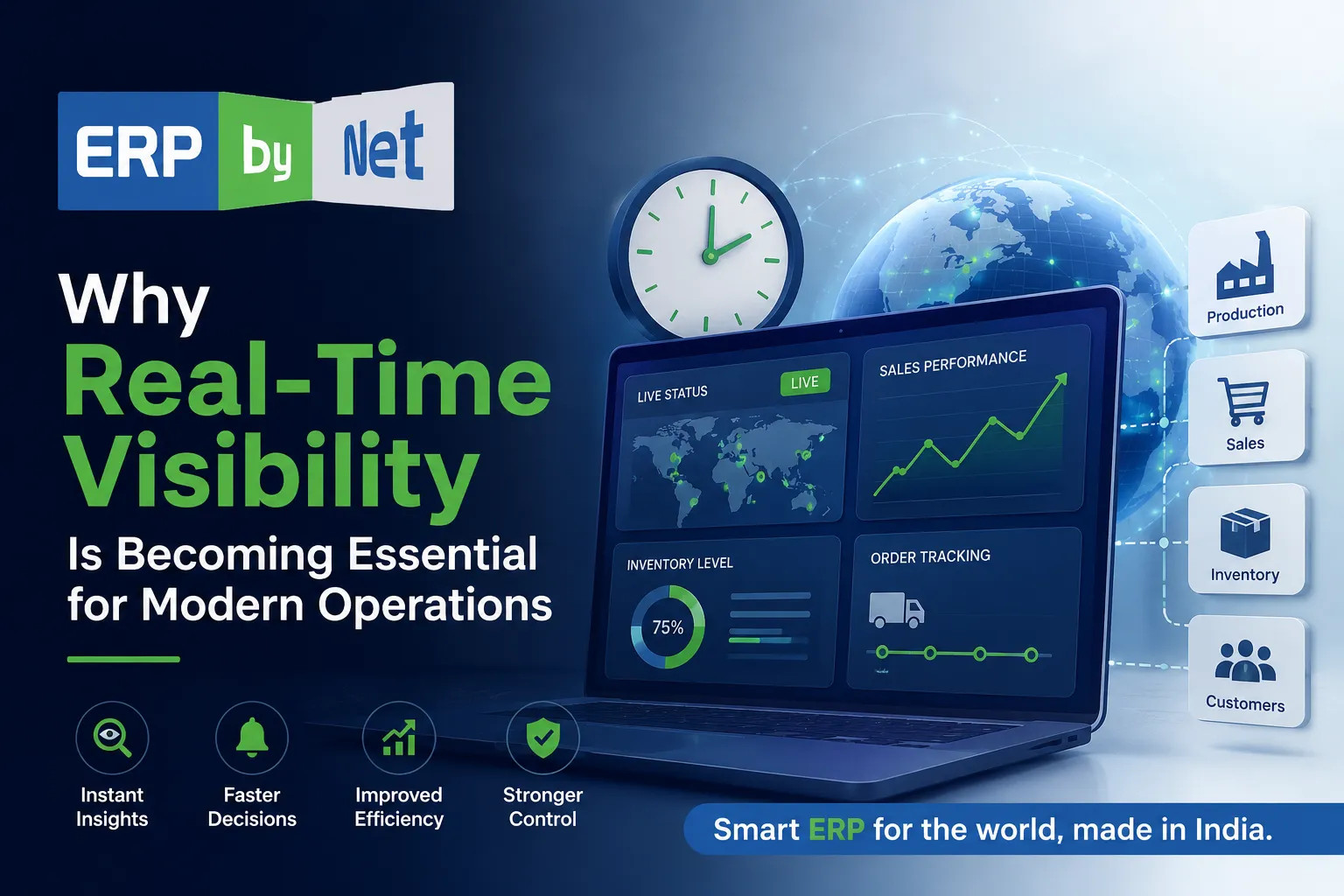
Why Real-Time Visibility Is Becoming Essential for Modern Operations

Key Takeaways

  • Real-time visibility helps businesses monitor operations instantly instead of relying on delayed reports and disconnected systems.
  • Modern ERP systems connect departments, warehouses, field teams, and management into one centralized operational ecosystem.
  • Live dashboards, alerts, and tracking systems help organizations detect delays, bottlenecks, and operational risks early.
  • Cloud-based ERP platforms improve coordination and decision-making across inventory, projects, maintenance, logistics, and service operations.
  • Businesses with real-time operational visibility respond faster, reduce inefficiencies, and scale with greater control and confidence.

What You’ll Learn

  • Why real-time visibility has become essential for modern business operations and execution management.
  • How ERP systems centralize operational data across departments, sites, warehouses, and service teams.
  • How live dashboards, alerts, and automated workflows improve operational efficiency and response time.
  • Why fragmented systems and manual reporting create delays, errors, and poor decision-making.
  • How ERPbyNet enables operational transparency through cloud-based monitoring, workflow automation, and real-time tracking.

Real Insights

  • Most operational problems begin with poor visibility — teams cannot fix issues they cannot see in real time.
  • Disconnected spreadsheets and isolated systems slow execution and create communication gaps between departments.
  • Real-time ERP systems replace reactive management with proactive control by providing instant operational insights.
  • Cloud-based visibility improves accountability and coordination across inventory, service, projects, and field operations.
  • The future of modern operations depends on live operational intelligence, automation, and centralized decision-making systems.

Modern businesses are operating in an environment where speed, coordination, and instant access to information directly impact customer satisfaction and business performance. Whether it is managing service complaints, coordinating field technicians, monitoring inventory, handling maintenance schedules, or tracking operational performance, businesses are expected to respond faster than ever before.

However, many organizations still rely on disconnected operational methods such as spreadsheets, WhatsApp groups, phone calls, manual reporting, and scattered software systems. As operations grow, these outdated processes create communication gaps, delayed responses, inventory confusion, missed service updates, and poor coordination between teams.

Today’s customers expect real-time service updates, faster issue resolution, and complete transparency. They no longer want to wait hours—or even days—for operational updates. Businesses that cannot provide instant visibility into their operations often struggle with delayed complaint handling, technician tracking issues, poor inventory management, and operational inefficiencies.

This is why real-time visibility is becoming one of the most important operational requirements for modern businesses. Real-time visibility helps organizations monitor complaints, technicians, inventory, maintenance schedules, service activities, and operational workflows instantly through a centralized ERP platform.

With advanced operational management solutions like ERPbyNet, businesses can gain complete operational visibility, improve response times, automate workflows, and manage operations more efficiently from a single centralized dashboard.

What Is Real-Time Visibility in Modern Operations?

Real-time visibility refers to the ability to access, monitor, and manage live operational data instantly across different business processes and departments. Instead of waiting for end-of-day reports or manually collecting updates from teams, businesses can view operational activities as they happen in real time.

In modern operations, real-time visibility enables businesses to track:

  • customer complaints
  • technician assignments
  • service request progress
  • inventory movement
  • spare part availability
  • maintenance schedules
  • AMC renewals
  • operational performance
  • field staff activity
  • pending service tasks

This level of operational transparency allows businesses to respond faster, make better decisions, and improve coordination between teams.

For example, a service manager using a real-time operations management system can instantly check:

  • which technician is assigned to a complaint
  • whether the complaint is pending or resolved
  • spare part availability
  • technician attendance
  • expected service completion time
  • service history of a customer

Without calling multiple people or checking multiple spreadsheets.

Real-time visibility eliminates operational blind spots and creates a centralized environment where businesses can manage operations more efficiently.

As modern businesses continue to grow and customer expectations continue to rise, real-time operational visibility is becoming essential for maintaining speed, accuracy, and operational control.

Read More: How ERP-Driven Asset Management Improves Efficiency, Accuracy, and ROI

Why Traditional Operational Methods Are No Longer Sustainable

Many businesses still operate using manual workflows and disconnected systems that were designed for slower operational environments. While these methods may have worked in the past, they are no longer sustainable for modern businesses managing large-scale operations, field teams, inventory, and customer service activities.

Traditional operational methods often rely on:

  • spreadsheets
  • manual reporting
  • WhatsApp communication
  • phone call coordination
  • paper-based service records
  • disconnected software systems

These systems create major operational challenges as businesses scale.

Delayed Communication Creates Operational Bottlenecks

One of the biggest problems with traditional operations is delayed communication. When teams rely on manual updates, important operational information often gets delayed, overlooked, or miscommunicated.

For example:

  • technicians may not receive complaint updates on time
  • inventory teams may not know spare stock availability
  • managers may struggle to monitor pending service tasks
  • complaints may remain unresolved for extended periods

These communication gaps create operational bottlenecks that slow down the entire workflow.

Without real-time operational visibility, businesses spend more time following up manually instead of focusing on operational efficiency and customer service.

Lack of Visibility Reduces Operational Control

Businesses that lack centralized operational visibility often struggle to maintain control over day-to-day operations.

Managers may face challenges such as:

  • inability to track technician activity
  • difficulty monitoring complaint status
  • no visibility into field operations
  • delayed maintenance updates
  • lack of inventory transparency
  • difficulty identifying operational delays

As operations become larger and more complex, these visibility problems increase significantly.

Without real-time operational dashboards, businesses operate reactively instead of proactively.

Instead of preventing operational issues early, teams only react after problems become critical.

Customer Expectations Have Changed Completely

Modern customers expect businesses to operate faster and more transparently than ever before.

Customers now expect:

  • instant service updates
  • faster complaint resolution
  • live communication
  • accurate operational information
  • better accountability

For service businesses, delayed responses and poor communication can damage customer trust very quickly.

Common customer frustrations include:

  • technicians arriving late
  • repeated breakdown complaints
  • lack of service updates
  • unresolved complaints
  • difficulty contacting service teams

Businesses that fail to provide operational transparency often lose customer confidence and long-term loyalty.

This is why modern businesses are shifting toward centralized real-time operations management systems.

How Real-Time Visibility Improves Modern Operations

How Real-Time Visibility Improves Modern Operations

Real-time visibility transforms the way businesses manage operations by improving communication, coordination, speed, and decision-making across the organization.

Businesses that implement real-time operational visibility systems gain significant operational advantages over competitors relying on traditional processes.

Faster Complaint Management & Service Resolution

Complaint handling becomes significantly more efficient when businesses can monitor complaints in real time.

With a centralized complaint management software system:

  • complaints are recorded instantly
  • technicians receive immediate task notifications
  • managers can track complaint progress live
  • pending complaints become visible instantly
  • service updates can be monitored centrally

This reduces:

  • complaint delays
  • repeated customer follow-ups
  • communication gaps
  • unresolved service requests

Real-time complaint visibility allows businesses to respond faster and improve customer satisfaction significantly.

For modern service businesses, faster complaint resolution directly impacts operational reputation and customer retention.

Live Technician Tracking Improves Field Operations

Managing field technicians without visibility often creates coordination problems and service delays.

Businesses commonly struggle with:

  • technicians becoming unreachable
  • delayed task assignments
  • lack of attendance monitoring
  • poor field coordination
  • limited visibility into job progress

With technician tracking software integrated into a real-time ERP system, businesses can:

  • assign technicians instantly
  • monitor technician activity live
  • track attendance
  • check job completion status
  • improve workforce accountability

Live technician visibility helps managers coordinate field operations more efficiently while reducing response delays.

For elevator service businesses, maintenance companies, and field service operations, technician tracking has become essential for operational efficiency.

Real-Time Inventory Visibility Reduces Operational Delays

Inventory visibility plays a critical role in modern operations, especially for businesses handling maintenance, repairs, and field services.

Without proper inventory tracking, businesses often experience:

  • spare part shortages
  • stock mismatches
  • delayed procurement
  • unnecessary inventory accumulation
  • delayed service completion

Real-time inventory management software helps businesses:

  • track inventory movement instantly
  • monitor stock levels live
  • identify low stock quickly
  • manage spare part availability
  • reduce inventory-related delays

This improves operational planning while helping businesses avoid unnecessary service interruptions.

For service-oriented industries, inventory visibility directly impacts operational speed and service quality.

Better AMC & Maintenance Management

Managing AMC contracts and maintenance schedules manually often leads to operational inefficiencies and missed service commitments.

Common problems include:

  • missed AMC renewals
  • delayed maintenance visits
  • forgotten preventive maintenance schedules
  • lack of maintenance history visibility

With real-time AMC management software, businesses can automate and centralize maintenance operations.

ERP-based maintenance management systems help businesses:

  • schedule preventive maintenance automatically
  • track maintenance history
  • monitor AMC expiry dates
  • generate automated service reminders
  • reduce equipment downtime

For elevator management companies and maintenance service providers, real-time maintenance visibility is essential for maintaining service quality and customer trust.

Centralized Operational Dashboards Improve Decision-Making

One of the biggest advantages of ERP-based real-time visibility is centralized operational monitoring.

A centralized operational dashboard allows businesses to monitor:

  • complaints
  • technician performance
  • field operations
  • inventory movement
  • AMC schedules
  • maintenance activities
  • operational KPIs
  • pending service requests

from one unified system.

This centralized visibility helps managers:

  • identify operational bottlenecks quickly
  • improve team coordination
  • reduce manual follow-ups
  • make faster operational decisions
  • monitor performance in real time

Businesses that rely on centralized operational dashboards operate more efficiently because decision-makers always have access to accurate live operational data.

Read More : Why Multi-Purpose ERP Software Is Becoming Essential for Modern Businesses

Before vs After Implementing Real-Time Visibility

Without Real-Time VisibilityWith ERPbyNet
Complaints handled manuallyCentralized complaint management
Technicians difficult to trackLive technician visibility
Inventory confusionReal-time inventory tracking
Missed AMC renewalsAutomated AMC reminders
Multiple spreadsheetsUnified operational dashboard
Delayed operational decisionsInstant operational insights
Poor communication between teamsConnected real-time operations
Repeated customer follow-upsFaster customer response

Industries That Need Real-Time Visibility the Most

Real-time operational visibility is becoming essential across multiple industries that depend on fast coordination, field operations, maintenance management, and inventory control.

Industries benefiting significantly include:

  • elevator service companies
  • field service businesses
  • maintenance management companies
  • manufacturing industries
  • logistics operations
  • facility management providers
  • inventory-driven businesses
  • multi-location service organizations

For elevator businesses specifically, real-time visibility helps manage:

  • breakdown complaints
  • technician coordination
  • spare part tracking
  • preventive maintenance
  • AMC renewals
  • service response times

This improves operational efficiency while delivering better customer experiences.

Signs Your Business Needs Real-Time Operational Visibility

Many businesses already experience operational inefficiencies caused by poor visibility without realizing the root cause.

Common warning signs include:

  • customers repeatedly calling for updates
  • delayed complaint resolution
  • technicians becoming difficult to track
  • inventory mismatches
  • missed maintenance schedules
  • lack of centralized operational control
  • excessive spreadsheet dependency
  • poor coordination between departments
  • delayed reporting
  • difficulty monitoring field operations

If your business faces these challenges regularly, implementing a real-time operational management system can significantly improve efficiency and control.

Read More: How ERP Reduces Fuel and Time Costs in Vending Machine Routes

How ERPbyNet Helps Businesses Achieve Real-Time Visibility

Modern businesses cannot afford delays, miscommunication, or lack of operational clarity. That’s exactly where ERPbyNet transforms the way organizations work. It brings every critical operation—complaints, technicians, inventory, AMC, and maintenance—into one unified, real-time ERP platform. Instead of switching between multiple tools or depending on manual updates, businesses get a single source of truth where every activity is visible as it happens. This creates faster decisions, smoother coordination, and complete operational control across the organization.

ERPbyNet is built with powerful, real-world operational modules that eliminate chaos and bring structure to daily workflows. It offers:

  • Complaint Management Software to track and resolve issues without delays
  • Technician Tracking Software to monitor field teams in real time
  • Field Service Management Tools for seamless on-site execution
  • Inventory Management Systems for accurate, live stock visibility
  • AMC Management Software to manage contracts and renewals efficiently
  • Maintenance Scheduling Tools for timely preventive maintenance
  • Centralized Operational Dashboards for complete business overview
  • Live Operational Monitoring for instant updates across all activities
  • Mobile Workforce Visibility for real-time field coordination
  • Automated Operational Workflows to reduce manual dependency

Each feature is designed to remove operational bottlenecks and improve speed at every level.

With ERPbyNet, businesses don’t just manage operations—they take full control of them. It helps reduce delays, improve team coordination, track service activities live, increase accountability, and deliver faster, more reliable customer service. In a competitive environment where every second matters, ERPbyNet ensures your business stays efficient, responsive, and always one step ahead.

The Future of Modern Operations Is Real-Time

Modern operations are evolving rapidly. Businesses that continue relying on delayed reporting and disconnected workflows will struggle to meet growing customer expectations.

The future of operational management is centered around:

  • live operational monitoring
  • workflow automation
  • centralized dashboards
  • real-time service coordination
  • data-driven decision-making

Businesses adopting real-time visibility systems gain a competitive advantage because they can respond faster, coordinate better, and operate more efficiently.

Real-time operational visibility is no longer just a technology upgrade. It is becoming a business necessity.

Organizations that invest in centralized ERP visibility systems today will be better prepared for the operational demands of the future.

Conclusion

If you are looking to improve efficiency, speed, and control across your business operations, ERPbyNet is the right partner to help you achieve true real-time visibility. In today’s fast-moving business environment, relying on manual processes, spreadsheets, and disconnected communication often leads to delays, confusion, and poor coordination between teams. ERPbyNet brings everything together in one centralized platform, allowing you to manage complaints, technicians, inventory, AMC schedules, maintenance activities, and field operations in real time. This helps your business eliminate operational gaps, improve decision-making, and ensure faster response to customer needs.

With ERPbyNet, you can track every activity as it happens, from complaint registration to technician assignment and job completion. Real-time dashboards and automated workflows ensure that your team stays aligned, informed, and productive at all times. This not only reduces operational inefficiencies but also enhances customer satisfaction by providing faster service, better transparency, and improved accountability across all operations.

For more information or to see how ERPbyNet can transform your operations, feel free to contact us today. Our team will help you understand the right solution for your business and guide you in implementing real-time operational visibility for better performance and growth.

FAQs

What is real-time visibility in operations?

Real-time visibility refers to the ability to monitor live operational data instantly across complaints, technicians, inventory, maintenance schedules, field operations, and business workflows through a centralized system.

Why is real-time visibility important for service businesses?

Real-time visibility helps service businesses improve response times, track technicians, monitor complaints, manage inventory efficiently, and provide faster customer service updates.

How does ERP software improve operational visibility?

ERP software centralizes operational data into one platform, allowing businesses to monitor workflows, complaints, technicians, maintenance schedules, inventory, and operational activities in real time.

Which industries benefit most from real-time operational visibility?

Industries such as elevator services, maintenance businesses, manufacturing, logistics, facility management, and field service operations benefit significantly from real-time visibility.

How does ERPbyNet help businesses manage operations?

ERPbyNet helps businesses manage complaints, technicians, inventory, AMC operations, maintenance schedules, field services, and operational workflows through centralized ERP-based operational visibility tools.

Can ERPbyNet track technicians in real time?

Yes, ERPbyNet provides real-time technician tracking, attendance monitoring, task management, and live field service coordination features.

How does real-time visibility improve customer service?

Real-time visibility helps businesses provide faster updates, resolve complaints more quickly, improve operational transparency, and reduce customer response delays.

Why are centralized operational dashboards important?

Centralized dashboards provide live operational insights, improve coordination between teams, reduce manual follow-ups, and help managers make faster and more accurate operational decisions.

Name
Verified by MonsterInsights