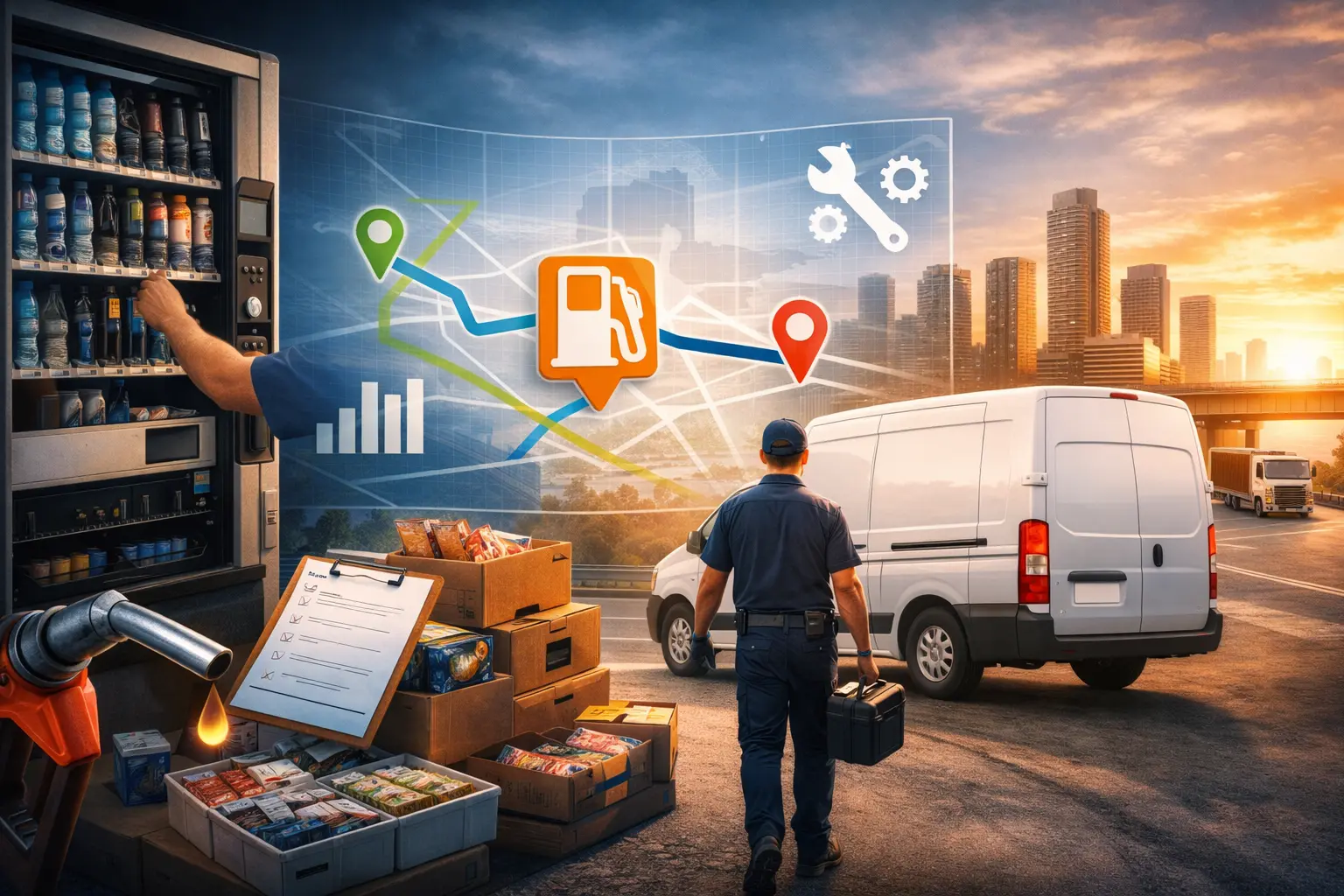
In the vending machine industry, operational efficiency is essential for maintaining profitability and long-term sustainability. Unlike traditional retail, vending businesses rely heavily on field operations, where technicians travel across multiple locations to restock machines, perform maintenance, and ensure uninterrupted service. These activities directly impact two major cost drivers—fuel consumption and time utilization. Even small inefficiencies in route planning, scheduling, or coordination can quickly lead to significant operational losses, especially when scaled across multiple routes and service points.
Despite these challenges, many businesses still depend on manual processes, fixed route plans, and disconnected systems, which limit visibility and reduce overall efficiency. This often results in unnecessary travel, higher fuel usage, and wasted technician hours. An integrated ERP solution like ERPbyNet addresses these issues by enabling intelligent route optimization, real-time tracking, and data-driven decision-making. By streamlining operations and improving planning accuracy, ERP helps vending businesses reduce costs, enhance productivity, and achieve more efficient route management.
Understanding Cost Drivers in Vending Route Operations

To fully appreciate the impact of ERP, it is important to break down the primary factors that contribute to high operational costs.
Inefficient Route Design
Routes that are not optimized based on geography and demand result in:
- Longer travel distances
- Increased fuel usage
- Reduced number of service points covered per day
In many cases, technicians travel back and forth between locations due to poor clustering, leading to unnecessary fuel consumption.
Over-Servicing and Under-Servicing
Without accurate consumption data:
- Machines may be serviced before they actually need refilling
- High-demand machines may run out of stock before the next scheduled visit
This imbalance leads to:
- Wasted trips
- Emergency visits
- Lost sales opportunities
Idle Time and Traffic Delays
A lack of real-time route optimization means technicians often:
- Spend time stuck in traffic
- Follow outdated routes
- Experience delays without alternative planning
Idle engines and delays contribute significantly to fuel wastage.
Disconnected Systems
When route planning, inventory management, and service tracking operate in silos:
- Decisions are made without complete data
- Communication gaps arise
- Duplicate or missed visits occur
This fragmentation increases both time and operational costs.
Reactive Maintenance Model
Breakdowns and urgent service calls disrupt planned routes. These unplanned trips are often longer, less efficient, and more expensive, further increasing fuel consumption and technician workload.
Read More : How ERP Improves Coordination Between Construction Teams
How ERPbyNet Reduces Fuel Costs in Detail
ERPbyNet introduces a structured and data-driven approach to route management. Its capabilities go beyond basic automation, focusing on continuous optimization and performance improvement.
Advanced Route Optimization Algorithms
ERPbyNet uses intelligent algorithms that analyze multiple variables simultaneously, including:
- Machine locations
- Service priorities
- Historical demand patterns
- Traffic data
- Technician availability
Based on this analysis, the system generates optimized routes that minimize travel distance while maximizing service efficiency.
This ensures that:
- Nearby machines are serviced in a single trip
- Redundant travel is eliminated
- Total kilometers traveled are reduced
Over time, this directly lowers fuel consumption and vehicle wear and tear.
Fuel Usage Monitoring and Control
ERPbyNet provides detailed visibility into fuel consumption patterns by tracking:
- Fuel usage per vehicle
- Fuel cost per route
- Idle time and engine usage
This level of insight allows businesses to identify inefficiencies such as:
- Vehicles consuming more fuel than expected
- Routes that are consistently underperforming
- Drivers with inefficient driving patterns
With this data, corrective actions can be taken to improve fuel efficiency across the fleet.
Route Consolidation and Trip Optimization
Instead of sending technicians on multiple small trips, ERPbyNet enables route consolidation by combining multiple service tasks into a single optimized trip.
This approach:
- Reduces the number of trips required
- Minimizes fuel consumption
- Improves technician productivity
By ensuring that each trip is fully optimized, businesses can significantly reduce operational costs.
How ERPbyNet Reduces Time Costs in Detail
Time optimization is equally important, as inefficient time usage directly affects labor costs and service capacity.
Demand-Driven Service Scheduling
ERPbyNet replaces static schedules with dynamic, demand-based scheduling. The system analyzes:
- Real-time stock levels
- Sales velocity of each machine
- Historical consumption trends
This allows the system to prioritize machines that require immediate attention while delaying unnecessary visits.
As a result:
- Technicians spend time only where it is needed
- Service frequency is optimized
- Unnecessary travel is eliminated
Real-Time Field Visibility
ERPbyNet provides live tracking of technicians and vehicles, enabling managers to monitor:
- Current location
- Route progress
- Task completion status
This visibility allows for immediate intervention in case of delays or disruptions. Managers can reroute technicians dynamically to avoid traffic or respond to urgent service needs.
This reduces downtime and ensures better time utilization.
Automated Route Assignment
Manual route planning often leads to inefficiencies and delays. ERPbyNet automates route assignment based on:
- Technician availability
- Skill requirements
- Location proximity
This ensures that the right technician is assigned to the right task at the right time, reducing travel time and improving overall efficiency.
Reduction of Administrative Time
ERPbyNet automates various back-office processes such as:
- Service reporting
- Inventory updates
- Documentation
Technicians no longer need to spend time on manual reporting, allowing them to focus more on field operations. This improves overall productivity and reduces time wastage.
Read More: ERP Security Best Practices for Sensitive Data
Integration of Inventory and Route Planning
One of the most powerful capabilities of ERPbyNet lies in its ability to seamlessly integrate inventory management with route planning. In traditional systems, these two functions operate separately, often leading to inefficiencies such as incomplete servicing, excess travel, or stock mismatches. ERPbyNet eliminates this disconnect by ensuring that inventory data directly informs route decisions.
With this integration, technicians are equipped with accurate, real-time information before and during their service routes, including:
- Required stock levels for each machine, based on current consumption and refill thresholds
- Inventory availability across warehouses or vehicles, ensuring proper stock allocation
- Product demand patterns, derived from historical and real-time sales data
This level of synchronization ensures that every service visit is fully optimized and purposeful. As a result:
- Machines are restocked efficiently in a single visit, reducing unnecessary follow-ups
- Repeat trips caused by insufficient or incorrect stock are eliminated
- Inventory movement becomes more structured and demand-driven, reducing both overstocking and stockouts
By aligning inventory decisions with route execution, ERPbyNet significantly reduces wasted travel time and fuel consumption while improving overall service efficiency.
Preventive Maintenance and Route Stability
Unplanned breakdowns are one of the biggest disruptions in route-based operations. They not only increase operational costs but also force technicians to deviate from planned routes, leading to delays and inefficiencies. ERPbyNet addresses this challenge through predictive and preventive maintenance capabilities.
By continuously analyzing machine performance, usage patterns, and service history, ERPbyNet enables businesses to schedule maintenance activities proactively rather than reactively.
This approach delivers several operational advantages:
- Reduction in unexpected machine breakdowns, minimizing service disruptions
- Elimination of emergency service trips, which are often unplanned and inefficient
- Better allocation of technician time, as maintenance is scheduled in advance
As a result, route planning becomes more stable and predictable. A well-structured and disruption-free route system allows businesses to maintain consistent efficiency, reduce last-minute changes, and improve overall operational control.
Long-Term Business Impact
The implementation of ERPbyNet delivers not just short-term cost savings but also long-term operational and strategic benefits. By optimizing routes, integrating inventory, and stabilizing service operations, businesses experience measurable improvements across multiple areas.
Key long-term impacts include:
- Reduced total travel distance, leading to lower fuel expenses and vehicle wear
- Lower fuel consumption, driven by optimized routing and fewer unnecessary trips
- Faster route completion times, enabling more service points to be covered in less time
- Improved technician productivity, as time is spent on high-value tasks rather than inefficiencies
- Reduction in operational inefficiencies, through automation and data-driven planning
- Enhanced service reliability, ensuring machines are consistently stocked and functional
These improvements collectively strengthen the overall efficiency of the business. Beyond cost reduction, ERPbyNet enables organizations to scale operations more effectively, maintain service quality, and improve profitability in a sustainable manner.
Why ERPbyNet is a Strategic Investment for Route-Based Businesses
ERPbyNet is not just a tool for automation; it is a comprehensive, enterprise-level solution built to transform and optimize route-based operations. In vending machine businesses, where efficiency depends on the coordination of routes, inventory, and field teams, relying on disconnected systems often leads to delays, higher costs, and limited visibility.
ERPbyNet eliminates these challenges by integrating all core operational functions into a single, unified platform. This centralized approach ensures that every part of the business works in sync, reducing manual effort and enabling faster, data-driven decision-making.
At its core, ERPbyNet combines multiple critical capabilities that work together to improve efficiency and control:
- Route Optimization:
Automatically plans the most efficient routes based on location, demand, and real-time conditions, helping reduce travel distance and fuel consumption. - Inventory Management:
Aligns stock levels with actual machine demand, ensuring technicians carry the right products and avoid unnecessary repeat visits. - Field Service Tracking:
Provides real-time visibility into technician activities, route progress, and service completion, enabling better coordination and faster response to changes. - Data Analytics and Insights:
Transforms operational data into actionable insights, helping businesses identify inefficiencies, monitor performance, and continuously improve processes.
By bringing these functions together, ERPbyNet removes operational silos and creates a seamless workflow across the entire business. Managers gain full visibility, technicians operate more efficiently, and decisions are backed by accurate, real-time data.
As a result, businesses are not only able to reduce operational costs but also improve service quality, enhance productivity, and scale operations with confidence. ERPbyNet enables organizations to move beyond basic automation and adopt a more strategic, efficient, and future-ready approach to managing their route-based operations.
Transform Your Vending Operations into Profit with Smarter Route Management
Rising fuel costs and increasing operational complexity are no longer challenges that can be managed with manual processes or disconnected systems. If your vending machine operations are still relying on outdated methods, you are likely absorbing unnecessary expenses, losing valuable time, and missing opportunities to improve profitability. This is the moment to move from reactive operations to a smarter, data-driven approach.
With ERPbyNet, route management is no longer a cost burden—it becomes a strategic advantage. By intelligently optimizing routes, streamlining scheduling, and providing real-time visibility into your field operations, ERPbyNet enables you to reduce fuel consumption, eliminate wasted technician hours, and make faster, more informed decisions. The result is a measurable improvement in both operational efficiency and overall business performance.
If you are experiencing high fuel expenses, inefficient routing, or underutilized field teams, now is the time to take control. ERPbyNet is designed to help you simplify complex operations, improve productivity, and drive sustainable cost savings across your vending network.
Take the next step toward operational excellence. Fill out the form below to schedule your personalized demo and see how ERPbyNet can help you streamline your routes, reduce costs, and turn everyday operations into measurable profit.
Frequently Asked Questions (FAQs)
How does ERP help reduce fuel costs in vending machine operations?
ERP systems like ERPbyNet reduce fuel costs by optimizing route planning and eliminating unnecessary travel. The system analyzes machine locations, demand patterns, and service priorities to create the most efficient routes. It also tracks fuel usage and identifies inefficient routes or driving patterns, allowing businesses to take corrective action. Over time, this leads to reduced travel distance, lower fuel consumption, and better fleet utilization.
Can ERP really improve route efficiency for vending machines?
Yes, ERP significantly improves route efficiency by replacing manual planning with data-driven optimization. ERPbyNet dynamically generates routes based on real-time and historical data, ensuring that technicians visit machines in the most logical sequence. This reduces travel time, minimizes backtracking, and increases the number of machines serviced per route.
What is demand-based servicing in vending machine management?
Demand-based servicing is an approach where machines are serviced based on actual usage data rather than fixed schedules. ERPbyNet tracks stock levels and consumption patterns to determine when a machine truly needs refilling. This prevents unnecessary visits to low-demand machines and ensures high-demand machines are serviced on time, reducing both fuel usage and wasted effort.
How does ERP reduce time wastage for field technicians?
ERP reduces time wastage by automating route planning, scheduling, and task assignments. ERPbyNet ensures that technicians receive optimized routes, clear instructions, and real-time updates. It also eliminates manual reporting and administrative tasks, allowing technicians to focus more on servicing machines rather than paperwork.
Does ERP help in real-time tracking of vending machine routes?
Yes, ERPbyNet provides real-time tracking of technicians and vehicles through GPS integration. Managers can monitor route progress, track delays, and make immediate adjustments if needed. This improves coordination, reduces downtime, and ensures better time management across field operations.
How does ERP improve inventory management in vending routes?
ERP integrates inventory data with route planning, ensuring that technicians carry the right products for each machine. ERPbyNet provides insights into stock levels, demand trends, and replenishment needs. This reduces the chances of understocking or overstocking and eliminates repeat visits caused by inventory shortages.
Can ERP reduce emergency service visits?
Yes, ERP reduces emergency visits through predictive and preventive maintenance. ERPbyNet monitors machine performance and service history to schedule maintenance before breakdowns occur. This minimizes unplanned trips, stabilizes routes, and reduces both fuel and time costs.
What kind of cost savings can businesses expect from ERP implementation?
While results may vary, businesses typically experience measurable improvements such as reduced fuel consumption, fewer unnecessary trips, improved technician productivity, and better route efficiency. ERPbyNet enables continuous optimization, which leads to long-term cost savings and improved operational performance.
Is ERP suitable for small and mid-sized vending machine businesses?
Yes, ERP solutions like ERPbyNet are scalable and suitable for businesses of all sizes. Small and mid-sized vending companies can benefit from improved route efficiency, better inventory control, and reduced operational costs without needing complex infrastructure.
How long does it take to see results after implementing ERPbyNet?
Businesses can start seeing improvements in route efficiency and operational visibility within a short period after implementation. As more data is collected and analyzed, ERPbyNet continues to optimize routes and processes, leading to greater cost savings over time.
Does ERP require major changes in existing vending operations?
ERP implementation does require process alignment, but ERPbyNet is designed to integrate smoothly with existing workflows. It enhances current operations by automating tasks and improving visibility rather than completely disrupting established processes.
How does ERP improve overall profitability in vending machine businesses?
ERP improves profitability by reducing operational costs such as fuel and labor, while also increasing efficiency and service quality. With ERPbyNet, businesses can optimize routes, reduce downtime, improve inventory management, and make better decisions based on real-time data, leading to higher margins and sustainable growth.