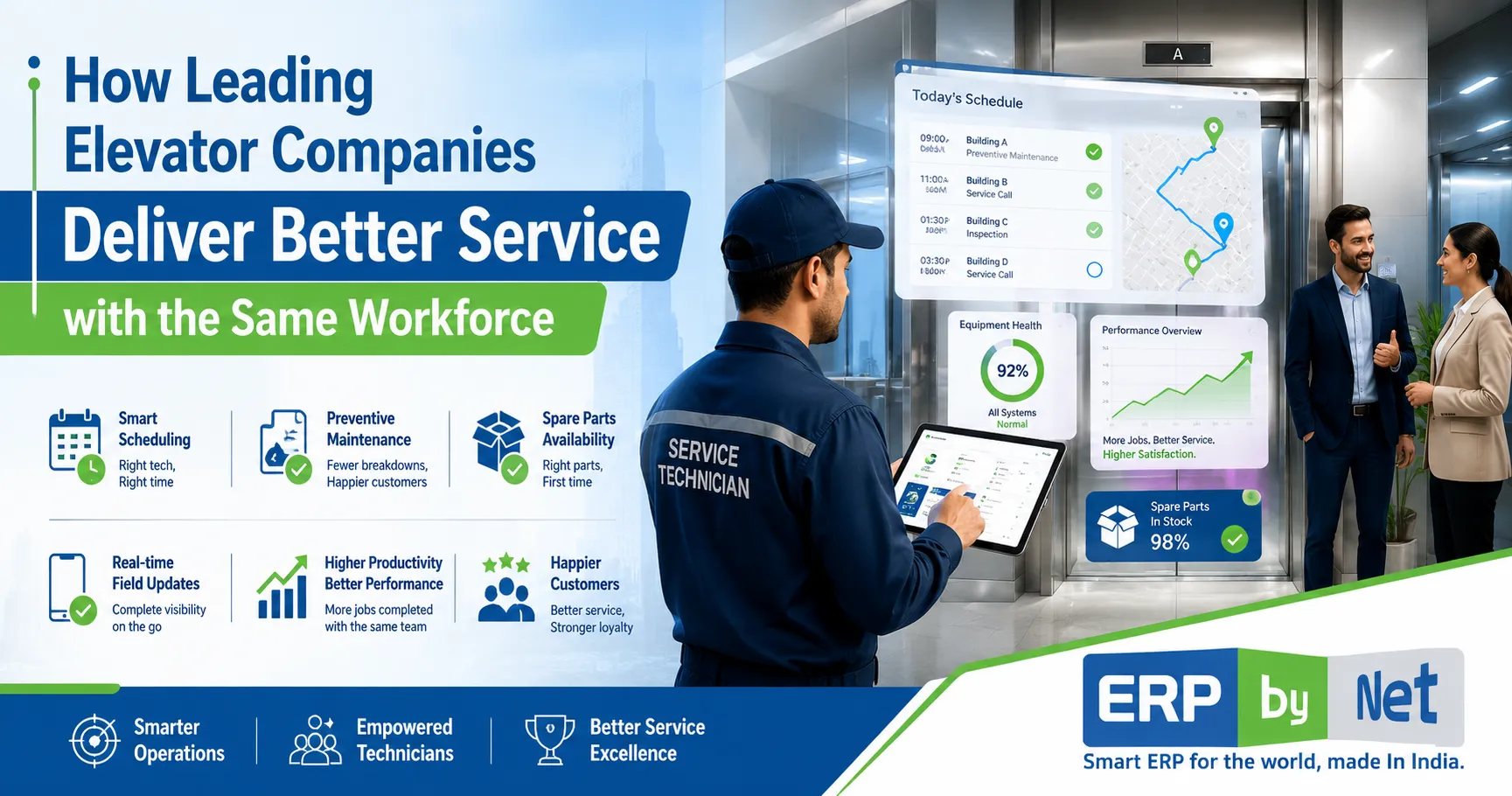
How Leading Elevator Companies Deliver Better Service with the Same Workforce
Key Takeaways
- Leading elevator companies increase service capacity without hiring more technicians by optimizing scheduling, workflows, and field operations.
- Real-time technician visibility reduces travel time and idle hours, allowing more service calls to be completed each day.
- Digital access to service history and spare parts information improves first-time fix rates and minimizes repeat visits.
- Integrated ERP connects service, AMC, inventory, finance, and customer management into one centralized platform.
- Smarter operations improve customer satisfaction, technician productivity, and long-term business growth without expanding the workforce.
What You’ll Learn
- How successful elevator companies handle more service requests with the same workforce.
- Why smart scheduling, technician coordination, and preventive maintenance increase operational efficiency.
- How ERP eliminates manual processes and disconnected systems that slow service delivery.
- The importance of real-time visibility into technicians, inventory, and service performance.
- How ERPbyNet helps elevator businesses improve productivity without increasing headcount.
Real Insights
- The most productive elevator companies don’t necessarily employ more technicians—they manage them more efficiently.
- Many lost service hours result from poor scheduling, incomplete job information, and unavailable spare parts, not technician performance.
- Centralized ERP enables managers to monitor workloads, response times, and field activities in real time.
- Connected departments reduce communication gaps, helping service, inventory, and finance teams work together seamlessly.
- Businesses that digitize service operations are better positioned to scale while maintaining consistent service quality.
The elevator industry is facing a challenge that almost every service-focused business recognizes: customer expectations continue to rise while skilled technicians remain difficult to find.
Building owners expect faster response times. Facility managers demand proactive maintenance. Service Level Agreements (SLAs) are becoming stricter, and unplanned breakdowns can quickly damage customer trust.
For many elevator companies, the first instinct is to hire more technicians. While expanding the workforce may seem like the obvious solution, it is often the most expensive—and not always the most effective—approach.
Interestingly, many of the industry’s top-performing companies are achieving something different. Instead of continuously increasing headcount, they are delivering more maintenance visits, resolving service calls faster, reducing repeat breakdowns, and improving customer satisfaction with nearly the same workforce.
So, what are they doing differently?
The answer lies in operational efficiency rather than workforce expansion.
This article explores the practical strategies leading elevator companies use to improve service productivity, reduce operational bottlenecks, and create a scalable service organization. You’ll also discover why integrated business systems have become one of the biggest competitive advantages in the modern elevator industry.
The Real Challenge Isn’t a Lack of Technicians
Across the elevator industry, companies commonly face challenges such as:
- Increasing numbers of installed elevators under maintenance
- Rising customer expectations for faster service
- Difficulty recruiting experienced field technicians
- Higher travel costs
- Delays caused by unavailable spare parts
- Growing administrative workload
- Multiple disconnected software systems
- Increasing compliance requirements
Many organizations interpret these issues as a staffing problem.
In reality, they’re often productivity problems.
A technician spending two hours driving across the city due to poor scheduling isn’t creating value.
A service engineer waiting for unavailable spare parts isn’t repairing elevators.
A supervisor manually assigning jobs through phone calls and spreadsheets isn’t optimizing workforce utilization.
In many businesses, technicians spend a significant portion of their working day on activities that don’t involve actual maintenance or repairs.
Reducing this operational waste can dramatically increase service capacity without hiring additional employees.
Why Hiring More Technicians Isn’t Always the Best Solution

Recruiting experienced elevator technicians has become increasingly difficult.
Beyond recruitment costs, companies must also invest in:
- Training
- Certifications
- Safety compliance
- Equipment
- Vehicles
- Travel expenses
- Payroll
- Ongoing skill development
Even after making these investments, inefficient internal processes can continue limiting productivity.
Consider this example.
Company A
- 25 technicians
- Manual scheduling
- Paper-based service reports
- Inventory managed separately
- Procurement disconnected from service
- Customer history stored across multiple systems
Result:
- Longer response times
- Frequent repeat visits
- High overtime costs
- Lower technician utilization
Company B
- 25 technicians
- Intelligent scheduling
- Mobile field applications
- Real-time spare parts visibility
- Automated maintenance planning
- Connected service operations
Result:
- More jobs completed each day
- Faster first-time fixes
- Lower operating costs
- Higher customer satisfaction
Both companies employ the same number of technicians.
The difference lies in how effectively they use them.
What Leading Elevator Companies Do Differently
Successful elevator service organizations don’t rely on harder work—they rely on smarter operations.
Instead of solving isolated problems, they optimize the complete service lifecycle.
From receiving a complaint to dispatching technicians, managing spare parts, recording work completed, renewing Annual Maintenance Contracts (AMCs), and analyzing performance, every step is connected.
Let’s examine the strategies that make this possible.
Read More: The Hidden Relationship Between Inventory and Customer Satisfaction
Strategy #1: Eliminate Time Lost in Manual Job Scheduling
Why Scheduling Has Become a Hidden Productivity Killer
Every service request requires decisions:
- Which technician should be assigned?
- Who has the necessary skills?
- Who is closest to the customer?
- Who has the required certifications?
- Which technician already has similar jobs nearby?
- Are spare parts available before dispatch?
When scheduling relies on spreadsheets, WhatsApp messages, phone calls, or whiteboards, valuable time is lost before a technician even begins traveling.
Poor scheduling often results in:
- Multiple technicians visiting the same area separately
- Longer travel distances
- Missed appointments
- Uneven workload distribution
- Increased fuel costs
- Customer delays
Over time, these inefficiencies compound into thousands of lost productive hours.
How Industry Leaders Improve Scheduling
High-performing elevator companies automate scheduling based on operational priorities rather than manual decisions.
Instead of simply assigning the next available technician, they consider:
- Technician expertise
- Geographic proximity
- Job priority
- Customer SLA commitments
- Current workload
- Planned maintenance schedules
- Emergency service requests
This enables dispatchers to manage larger service volumes while reducing administrative effort.
The result isn’t just faster scheduling—it creates more productive hours for the entire workforce.
Strategy #2: Give Field Technicians Complete Service Visibility
Information Delays Create Service Delays
A technician arriving on-site without the right information creates unnecessary problems.
They may need to:
- Call the office
- Request customer history
- Confirm warranty details
- Check previous repairs
- Verify maintenance records
- Ask whether replacement parts are available
Each interruption increases repair time.
In some cases, technicians must revisit the same site because they lacked the necessary information during the initial visit.
These repeat visits increase costs while frustrating customers.
What Leading Companies Do Instead
Modern elevator service organizations ensure technicians have immediate access to:
- Complete service history
- Installation details
- Previous complaints
- Maintenance checklists
- Equipment specifications
- Warranty information
- Customer notes
- Spare part availability
- Digital service documentation
When technicians arrive prepared, they diagnose issues more quickly and resolve them with greater confidence.
This significantly improves first-time fix rates while reducing administrative back-and-forth.
Strategy #3: Prevent Spare Parts from Becoming Service Bottlenecks
The Hidden Cost of Inventory Uncertainty
Many elevator service delays have little to do with technician skills.
The real issue is missing inventory.
A technician may identify the fault within minutes, only to discover that the required spare part:
- Isn’t available
- Is stored at another warehouse
- Was reserved for another project
- Hasn’t been ordered yet
- Has inaccurate stock records
The service visit ends without resolving the issue.
Another visit must be scheduled later.
The customer experiences unnecessary downtime.
The technician’s productivity drops despite performing their job correctly.
How Leading Companies Manage Spare Parts
Successful organizations connect inventory directly with service operations.
Before assigning work, they know:
- Which spare parts are required
- Where inventory is located
- Expected delivery timelines
- Alternative compatible components
- Current purchase orders
- Warehouse availability
Instead of discovering shortages at the customer site, they resolve inventory issues beforehand.
This reduces repeat visits while increasing technician productivity.
More importantly, it improves customer confidence because repairs are completed faster.
Strategy #4: Shift from Reactive Repairs to Preventive Maintenance
Emergency Service Is the Most Expensive Service
Many companies spend most of their resources responding to breakdowns.
Unfortunately, emergency repairs often involve:
- Higher travel costs
- Customer dissatisfaction
- Overtime expenses
- Technician schedule disruptions
- SLA penalties
- Increased operational pressure
The more emergencies occur, the less time technicians have for planned maintenance.
Eventually, preventive maintenance gets delayed, creating even more emergency breakdowns.
It’s a costly cycle.
How Leading Elevator Companies Break the Cycle
Rather than waiting for failures, high-performing companies prioritize preventive maintenance based on:
- Service intervals
- Equipment age
- Usage patterns
- Maintenance history
- Inspection findings
- Compliance schedules
Planned maintenance helps identify worn components before they fail, reducing emergency calls and allowing technicians to work on structured schedules instead of constantly reacting to unexpected issues.
The long-term result is greater equipment reliability, more predictable workloads, and improved customer satisfaction.
Operational Excellence Is Built on Connected Processes
Although these four strategies may seem independent, they are closely connected.
Efficient scheduling depends on technician availability, service history, and customer priorities.
Successful preventive maintenance relies on accurate maintenance records and timely planning.
First-time fixes depend on technicians having the right information and the right spare parts before arriving on-site.
When these processes operate in isolation, productivity suffers. When they work together, the same workforce can accomplish significantly more with less effort.
This is one of the defining characteristics of leading elevator companies: they don’t simply optimize individual tasks—they build connected service operations where information flows seamlessly across departments.
Strategy #5: Standardize Every Service Visit
One of the biggest differences between average-performing elevator companies and industry leaders is consistency.
When service quality depends entirely on individual technician experience, results become unpredictable.
Some technicians follow every inspection step carefully. Others may skip non-critical checks to save time, especially during busy periods. Over time, these inconsistencies can lead to recurring faults, customer complaints, and safety concerns.
Why Standardization Matters
A standardized service process ensures that every technician follows the same best practices regardless of experience.
This includes:
- Equipment inspection checklists
- Safety verification procedures
- Lubrication schedules
- Component testing
- Photo documentation
- Digital customer signatures
- Compliance records
Instead of relying on memory or handwritten notes, technicians complete structured inspections that become part of the equipment’s service history.
The result is higher service quality, fewer missed inspection points, and improved regulatory compliance.
Strategy #6: Reduce Administrative Work for Technicians
Every minute spent filling out paperwork is a minute not spent servicing elevators.
Many organizations still require technicians to:
- Complete paper service reports
- Call the office for updates
- Submit handwritten timesheets
- Prepare manual expense reports
- Record travel details separately
- Return to the office to submit documents
These administrative tasks consume valuable hours every week.
Digital Field Operations Improve Productivity
Leading elevator companies simplify these processes using mobile technology.
Technicians can:
- Receive service requests instantly
- Update job status in real time
- Capture photographs
- Record customer approvals digitally
- Generate service reports on-site
- Log travel and working hours
- Update equipment condition
- Request spare parts immediately
Instead of spending evenings completing paperwork, technicians finish documentation while still at the customer location.
This improves productivity while giving management real-time visibility into ongoing service operations.
Strategy #7: Use Data to Improve Decisions Instead of Guesswork
Many service organizations collect large amounts of data but rarely use it effectively.
Information remains scattered across spreadsheets, accounting software, service applications, and email conversations.
Without meaningful insights, management often relies on assumptions.
Questions such as these become difficult to answer:
- Which technicians complete the most jobs successfully?
- Which elevators generate the highest maintenance costs?
- Which customers require repeated emergency visits?
- Which spare parts fail most frequently?
- Which AMCs are least profitable?
- Where are service delays occurring?
Without accurate reporting, operational improvements become reactive rather than strategic.
High-Performing Companies Measure Everything
Leading organizations continuously monitor key performance indicators (KPIs), including:
Technician Productivity
- Jobs completed per day
- Average response time
- First-time fix rate
- Travel hours
- Utilization percentage
Customer Service Metrics
- Complaint resolution time
- SLA compliance
- Customer satisfaction
- Repeat service requests
Operational Performance
- Preventive vs. breakdown maintenance ratio
- Spare parts consumption
- Inventory turnover
- Maintenance backlog
These insights help management identify trends before they become costly problems.
Instead of asking, “What went wrong?” they begin asking, “How can we prevent it?”
Strategy #8: Automate Annual Maintenance Contract (AMC) Management
AMCs represent a significant source of recurring revenue for elevator companies.
Yet many businesses still manage renewals manually.
Sales teams rely on spreadsheets to track renewal dates.
Follow-up reminders are missed.
Proposals are delayed.
Customers receive renewal quotations after contracts have already expired.
Every missed renewal represents lost revenue.
How Leading Elevator Companies Protect Recurring Revenue
Rather than depending on manual tracking, successful organizations automate the entire AMC lifecycle.
This includes:
- Contract reminders
- Renewal notifications
- Automated proposal generation
- Customer communication
- Service scheduling
- Billing
- Contract performance tracking
Automation ensures that no contract is forgotten while allowing service teams to focus on delivering value instead of managing paperwork.
The result is stronger customer retention and more predictable revenue.
Strategy #9: Connect Service with Inventory, Procurement, and Finance
Many elevator companies operate separate systems for:
- Customer management
- Service operations
- Inventory
- Procurement
- Accounting
- Payroll
Each department maintains its own records.
Information must be transferred manually between systems.
This creates delays, duplicate work, and frequent errors.
The Cost of Disconnected Departments
Consider a common service scenario.
A technician identifies a faulty drive unit during maintenance.
The service department raises a request.
The procurement team doesn’t see it immediately.
Inventory records are outdated.
The purchase order is delayed.
Finance hasn’t approved the supplier payment.
The replacement part arrives late.
The customer waits several more days.
Although every department completed its own task, the overall customer experience suffers.
Connected Operations Deliver Faster Service
Leading companies remove these barriers by connecting every department into a single operational workflow.
Instead of isolated systems:
- Service requests automatically generate spare parts requirements.
- Inventory updates instantly after material consumption.
- Procurement receives purchase requirements immediately.
- Finance tracks costs in real time.
- Management monitors the complete service lifecycle from one platform.
This eliminates unnecessary communication delays while significantly improving operational efficiency.
Read More: How Much Revenue Are Elevator Companies Losing Due to Poor Scheduling?
The Common Thread Behind High-Performing Elevator Companies
Although the previous strategies cover different areas of the business, they all have one thing in common.
They depend on connected information.
Scheduling becomes smarter when technician availability, customer priority, and service history are visible together.
Inventory planning becomes more accurate when maintenance schedules and spare parts consumption are linked.
Customer service improves when technicians have complete equipment history before arriving on-site.
Finance gains better cost visibility when every service activity automatically updates project and operational expenses.
Without connected data, every department optimizes only its own work.
With connected data, the entire organization works toward the same objective: delivering faster, more reliable service.
Why Spreadsheets and Multiple Software Systems Eventually Limit Growth
Many elevator companies begin with separate tools because they solve immediate problems.
One application manages accounting.
Another handles inventory.
Service requests are tracked in spreadsheets.
Customer communication happens through email and messaging apps.
Initially, this seems manageable.
However, as the customer base grows, these disconnected systems create increasing operational complexity.
Common challenges include:
- Duplicate data entry
- Conflicting customer information
- Delayed reporting
- Inventory inaccuracies
- Missed maintenance schedules
- Manual coordination between departments
- Limited visibility into business performance
Eventually, growth slows—not because demand decreases, but because internal processes cannot scale efficiently.
The Role of Integrated ERP in Modern Elevator Service Operations
The most successful elevator companies no longer view service management as an isolated function.
Instead, they treat it as part of a connected business ecosystem.
Every service activity influences inventory, procurement, finance, customer relationships, workforce planning, and future maintenance schedules.
Managing these processes through disconnected software makes continuous improvement increasingly difficult.
This is where an industry-focused ERP platform creates measurable value.
Rather than replacing individual processes, it connects them into one unified system where information flows automatically between departments.
For elevator businesses, this means:
- Service teams work with complete customer and equipment history.
- Spare parts availability is visible before technicians are dispatched.
- AMC renewals are tracked automatically.
- Inventory, procurement, and finance stay synchronized.
- Managers gain real-time operational dashboards instead of waiting for manual reports.
- Leadership can make faster decisions based on accurate business data rather than assumptions.
ERPbyNet has been designed specifically with project-based engineering and elevator businesses in mind. Instead of offering generic business software, it connects field service, AMC management, inventory, procurement, finance, projects, and customer operations into a single platform, helping companies improve service delivery without proportionally increasing their workforce.
Better Service Isn’t Just Good for Customers—It’s Good for Business
When elevator companies improve operational efficiency, the benefits extend far beyond faster service calls.
Every improvement made in scheduling, inventory management, preventive maintenance, and workforce productivity contributes directly to the company’s financial performance.
Instead of investing heavily in expanding the workforce, businesses begin generating more value from the resources they already have.
The results become measurable across every department.
Higher Technician Productivity
When technicians spend less time waiting for information, searching for spare parts, or traveling unnecessarily, they can complete more productive work during the same working hours.
This enables businesses to:
- Complete more service calls per technician
- Increase preventive maintenance coverage
- Reduce overtime expenses
- Improve workforce utilization
- Handle business growth without immediately hiring additional staff
Improved Customer Satisfaction
Customers rarely judge service providers only by technical expertise.
They value reliability, communication, and speed.
An organized service operation helps businesses deliver:
- Faster complaint resolution
- Accurate service scheduling
- Better communication
- Higher first-time fix rates
- Consistent preventive maintenance
- Reduced equipment downtime
Satisfied customers are also more likely to renew Annual Maintenance Contracts (AMCs), recommend your services, and trust your company with modernization and installation projects.
Better Financial Control
Disconnected operations often make it difficult to understand the actual cost of delivering services.
Without accurate cost visibility, companies struggle to answer important business questions such as:
- Which maintenance contracts are profitable?
- Which customers require excessive service visits?
- Which spare parts generate the highest expenses?
- Which technicians require additional training?
- Where is operational waste occurring?
Connected business systems provide management with real-time financial visibility, helping them make informed decisions rather than relying on assumptions.
Stronger Competitive Advantage
Today’s elevator industry is becoming increasingly competitive.
Customers compare vendors based on:
- Response times
- Service quality
- Maintenance reliability
- Communication
- Digital documentation
- Preventive maintenance capabilities
- Long-term service performance
Companies that operate efficiently are naturally able to provide a better customer experience while maintaining healthy profit margins.
Operational excellence becomes a competitive advantage that is difficult for competitors to replicate.
Why Integrated Operations Matter More Than Individual Software
Many businesses already use software.
The problem isn’t the absence of technology.
The problem is that different departments often use different systems that don’t communicate with each other.
For example:
- Customer complaints may be managed in one application.
- Inventory may be tracked somewhere else.
- Accounting may use separate software.
- Purchase requests might be handled through spreadsheets.
- Service reports may still be maintained manually.
Each system performs its own task.
However, the business itself remains disconnected.
This lack of integration creates delays, duplicate work, inconsistent information, and poor decision-making.
Modern elevator companies are moving away from isolated software tools toward connected business platforms where every department works with the same real-time data.
How ERPbyNet Helps Elevator Companies Deliver Better Service

Improving service quality isn’t about replacing experienced technicians.
It’s about giving them the right information, tools, and processes to perform at their best.
ERPbyNet has been developed specifically for project-based engineering businesses and the elevator industry, bringing together every critical business function into a single integrated platform.
Instead of switching between multiple systems, your teams work from one centralized source of information.
Centralized Service Management
ERPbyNet helps service teams manage the complete service lifecycle, including:
- Complaint registration
- Service request allocation
- Technician scheduling
- Job tracking
- Digital service reports
- Customer communication
- Service history
- Equipment records
Every service activity is recorded, tracked, and easily accessible whenever needed.
Intelligent AMC Management
Recurring maintenance contracts are one of the most valuable revenue streams for elevator companies.
ERPbyNet simplifies AMC operations by helping businesses:
- Track contract validity
- Schedule preventive maintenance automatically
- Generate renewal proposals
- Monitor SLA compliance
- Record maintenance history
- Improve customer retention
This reduces administrative effort while ensuring that valuable renewal opportunities are never overlooked.
Connected Inventory and Spare Parts Management
Service efficiency depends heavily on spare parts availability.
ERPbyNet connects inventory directly with field service operations, helping businesses:
- Monitor stock levels in real time
- Reserve materials for service jobs
- Manage warehouse inventory
- Generate purchase requirements automatically
- Reduce emergency procurement
- Improve spare parts planning
Technicians arrive better prepared, increasing first-time fix rates and reducing unnecessary repeat visits.
Better Decision-Making Through Real-Time Insights
Operational improvements become sustainable only when management has complete visibility into business performance.
ERPbyNet provides actionable dashboards and reports that help monitor:
Service Performance
- Response time
- Complaint resolution
- Technician productivity
- Pending service requests
- SLA compliance
Inventory Performance
- Spare parts consumption
- Stock availability
- Material movement
- Procurement status
Business Performance
- AMC renewals
- Revenue trends
- Project profitability
- Service costs
- Operational efficiency
These insights help leadership identify improvement opportunities before they become operational challenges.
The Future of Elevator Service Belongs to Connected Businesses
The elevator industry is changing rapidly.
Customer expectations continue to grow.
Competition is becoming stronger.
Equipment is becoming smarter.
Workforces remain difficult to expand.
In this environment, sustainable growth will not come from simply hiring more technicians.
It will come from enabling existing teams to work more efficiently through better processes, connected data, and intelligent business systems.
Leading elevator companies understand this shift.
Instead of asking:
“How can we hire more technicians?”
They ask:
“How can we help our current technicians accomplish more?”
That mindset creates long-term operational excellence.
Conclusion
Delivering better elevator service with the same workforce isn’t about expecting employees to work harder.
It’s about removing the inefficiencies that prevent them from performing at their full potential.
When scheduling is optimized, spare parts are available, preventive maintenance is planned, service history is accessible, and every department works from connected data, businesses naturally become more productive.
The result is faster response times, improved customer satisfaction, stronger financial performance, and the ability to scale operations without proportionally increasing workforce costs.
For elevator companies looking to modernize operations, improve service efficiency, and build a connected business, ERPbyNet provides an integrated platform designed specifically for the industry’s operational needs.
Rather than managing service, inventory, procurement, finance, projects, and AMC operations through separate systems, ERPbyNet brings everything together—helping businesses transform operational complexity into a competitive advantage.
Ready to Improve Service Without Expanding Your Workforce?
The most successful elevator companies aren’t simply adding more technicians—they’re building smarter operations.
If your business is looking to improve technician productivity, strengthen AMC management, optimize spare parts planning, and gain complete visibility across service, inventory, procurement, projects, and finance, ERPbyNet can help you build a more connected and efficient operation.
Discover how ERPbyNet helps elevator companies deliver exceptional service while maximizing the productivity of every technician.
Frequently Asked Questions
What is the biggest challenge affecting elevator service productivity?
The biggest challenge is often operational inefficiency rather than a shortage of technicians. Poor scheduling, disconnected systems, inventory delays, and manual processes reduce the number of productive service hours available each day.
How can elevator companies improve service without hiring more technicians?
Businesses can increase productivity by optimizing technician scheduling, automating preventive maintenance, improving spare parts availability, reducing paperwork, and connecting service operations with inventory, procurement, finance, and customer management.
Why is preventive maintenance more effective than reactive maintenance?
Preventive maintenance identifies potential issues before they become major failures. This reduces emergency breakdowns, lowers repair costs, improves equipment reliability, and allows technicians to work on planned schedules instead of constantly responding to urgent service requests.
Why is integrated ERP important for elevator service companies?
An integrated ERP system connects every department—including service, inventory, procurement, finance, projects, and customer management—into one platform. This improves collaboration, reduces manual work, provides real-time visibility, and enables faster, more informed decision-making.
How does ERPbyNet help elevator companies improve service efficiency?
ERPbyNet helps elevator businesses streamline complaint management, technician scheduling, AMC management, preventive maintenance, spare parts planning, inventory control, procurement, project management, and financial operations within a single integrated platform. This enables companies to deliver faster, more reliable service while making better use of their existing workforce.