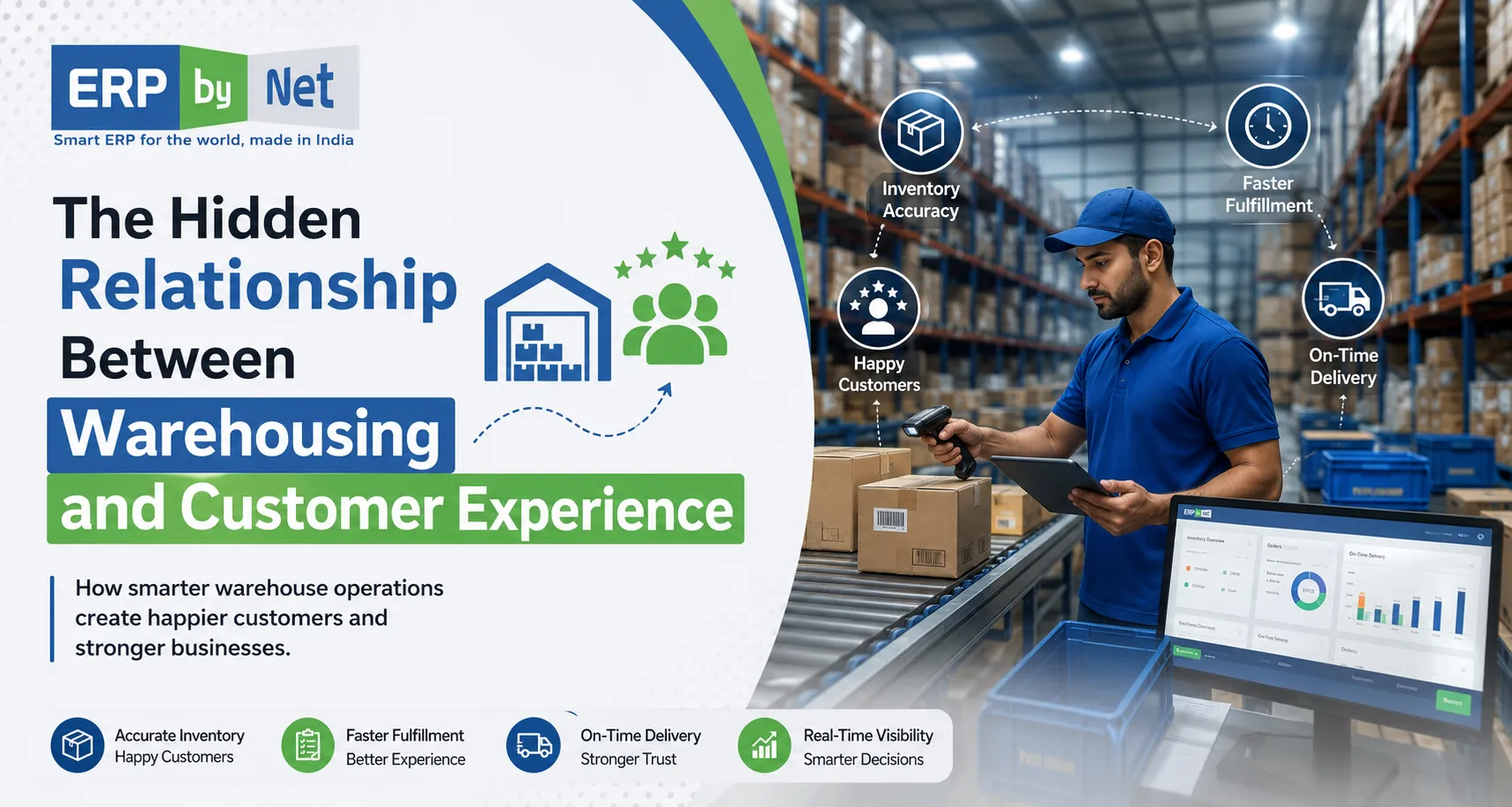
The Hidden Relationship Between Warehousing and Customer Experience
Key Takeaways
- Warehouse operations directly affect customer satisfaction through order accuracy and delivery speed.
- Inventory visibility reduces stockouts and shipping delays, creating a better customer experience.
- Warehouse errors lead to late deliveries and incorrect orders, reducing customer trust.
- Integrated ERP connects warehousing with sales, procurement, and inventory for smoother operations.
- Efficient warehouse management improves customer loyalty while reducing operational costs.
What You’ll Learn
- How warehousing influences customer experience.
- Why inventory accuracy is critical for timely order fulfillment.
- How ERP improves warehouse visibility and operational efficiency.
- The connection between warehouse performance and customer retention.
- How ERPbyNet helps optimize warehouse operations with real-time inventory and workflow management.
Real Insights
- Customers experience warehouse performance through fast, accurate deliveries.
- Most delivery issues begin with poor warehouse processes, not transportation.
- Real-time warehouse data helps prevent fulfillment issues before they affect customers.
- Connected warehouse operations improve collaboration across departments.
- Better warehouse management leads to better customer experiences and stronger business growth.
When businesses think about customer experience (CX), they often focus on responsive customer support, personalized marketing, or fast delivery. While these elements are important, there’s a critical factor working behind the scenes that many organizations overlook—warehouse operations.
Every order confirmation, on-time delivery, accurate shipment, and successful installation begins inside the warehouse. Whether you’re a manufacturer, engineering company, elevator service provider, or project-based business, your warehouse directly influences how customers perceive your brand. A single inventory mismatch or delayed dispatch can quickly turn a satisfied customer into a frustrated one.
Unfortunately, many companies still rely on disconnected spreadsheets, manual inventory updates, and paper-based warehouse processes. These outdated methods create stock inaccuracies, picking errors, project delays, and service disruptions that eventually impact customer satisfaction and business growth.
Modern ERP-driven warehouse management changes this equation. By integrating inventory, procurement, production, service, finance, and customer information into a single platform, businesses gain complete visibility over warehouse operations while delivering faster, more reliable customer experiences.
In this article, we’ll explore the often-overlooked relationship between warehousing and customer experience, the hidden operational challenges that affect customer satisfaction, and how ERP-powered warehouse management helps businesses build stronger customer trust and long-term profitability.
Warehousing Is More Than Storage—It’s a Customer Experience Function
Many businesses still view warehouses as places to store raw materials or finished goods until they’re needed. In reality, a warehouse is the operational backbone that supports every customer promise your business makes.
Consider the typical customer journey:
- A sales team confirms product availability.
- Procurement plans material requirements.
- Warehouse staff reserve inventory.
- Production begins manufacturing.
- Quality checks are completed.
- Products are dispatched.
- Installation or delivery teams execute the final stage.
Every one of these steps depends on accurate warehouse information.
If inventory records are incorrect, production may stop unexpectedly. If materials are misplaced, dispatch gets delayed. If spare parts are unavailable, service technicians cannot complete maintenance visits. These warehouse issues eventually become customer complaints—even though customers never see what happened behind the scenes.
The warehouse may be invisible to customers, but its performance is reflected in every interaction they have with your business.
Read More: Why Clean ERP Data Is the First Step Toward AI Success
Why Customers Feel the Impact of Warehouse Operations Without Ever Seeing Them
Customers rarely visit your warehouse, but they experience its efficiency—or inefficiency—through every order they place.
Imagine a customer ordering an elevator component for an urgent project. Your sales representative confirms that the item is available. However, when the warehouse team begins picking the order, they discover the inventory record is inaccurate. The item was already allocated to another project, but the inventory system was never updated.
The result?
- Delivery is postponed.
- Installation schedules are disrupted.
- Project deadlines slip.
- The customer loses confidence.
- Your support team spends hours explaining the delay.
From the customer’s perspective, your company failed to deliver. They don’t know the issue started with warehouse visibility—they only remember the poor experience.
This scenario isn’t unique to the elevator industry. Manufacturers, engineering firms, water treatment companies, boiler manufacturers, and project-based organizations face similar challenges every day when warehouse processes are disconnected from business operations.
The Hidden Warehouse Problems That Damage Customer Experience

Below are some of the most common warehouse challenges that negatively affect customer satisfaction.
Inaccurate Inventory Records
Inventory discrepancies are among the biggest causes of customer dissatisfaction.
When warehouse records don’t reflect actual stock levels, businesses may:
- Accept orders they cannot fulfill.
- Delay customer deliveries.
- Purchase emergency materials at higher costs.
- Interrupt production schedules.
- Miss project deadlines.
Accurate inventory isn’t just an operational metric—it directly influences customer trust.
Slow Order Picking
As businesses grow, manual warehouse operations become increasingly difficult to manage.
Employees spend valuable time:
- Searching for materials.
- Verifying stock manually.
- Identifying storage locations.
- Correcting inventory mistakes.
- Updating spreadsheets after dispatch.
These inefficiencies increase order processing time and delay customer deliveries.
Poor Warehouse Visibility
Many organizations operate separate systems for sales, purchasing, production, service, and inventory.
Without real-time visibility:
- Sales teams cannot confidently promise delivery dates.
- Procurement orders unnecessary materials.
- Project managers lack inventory updates.
- Service teams don’t know spare parts availability.
Disconnected information creates uncertainty across the organization and affects the customer experience.
Stockouts During Critical Customer Orders
Running out of inventory at the wrong time can have serious consequences.
For example:
An elevator maintenance company receives an emergency breakdown request from a premium AMC customer.
The technician reaches the site only to discover the required spare part isn’t available.
The consequences include:
- Extended equipment downtime.
- SLA violations.
- Customer frustration.
- Higher emergency procurement costs.
- Reduced contract renewal opportunities.
A warehouse issue has now become a customer relationship issue.
Picking and Packing Errors
Incorrect product dispatches create multiple operational problems:
- Reverse logistics costs.
- Additional transportation expenses.
- Customer complaints.
- Delayed installations.
- Reduced customer confidence.
Even a small picking error can trigger a chain reaction of operational inefficiencies.
How Warehouse Performance Directly Influences Customer Satisfaction
Customer satisfaction isn’t determined only by product quality. Operational excellence plays an equally important role.
Here’s how warehouse performance affects the overall customer experience:
| Warehouse Performance | Customer Experience |
|---|---|
| Accurate inventory | Reliable product availability |
| Fast picking | Faster order fulfillment |
| Organized warehouse | Fewer shipping mistakes |
| Real-time stock visibility | Transparent communication |
| Efficient dispatch | On-time delivery |
| Spare parts availability | Faster service resolution |
| Barcode-enabled operations | Higher order accuracy |
| Automated inventory updates | Fewer customer complaints |
Every improvement inside the warehouse creates a positive experience outside the warehouse.
Why Traditional Warehouse Management No Longer Meets Customer Expectations
Customer expectations have changed dramatically over the past decade.
Today’s customers expect:
- Real-time order updates.
- Accurate delivery commitments.
- Faster response times.
- Immediate service support.
- Minimal delays.
- Transparent communication.
Unfortunately, traditional warehouse practices struggle to meet these expectations.
Businesses still relying on spreadsheets, manual stock counts, paper-based inventory records, or disconnected software face increasing operational risks, including:
- Duplicate inventory entries.
- Lost materials.
- Incorrect stock allocations.
- Delayed purchase decisions.
- Manual reporting.
- Human errors.
- Poor forecasting.
As order volumes increase, these challenges become even more difficult to manage.
The result isn’t just operational inefficiency—it directly affects customer retention, brand reputation, and profitability.
Read More: How to Choose the Right ERP for Project-Based Businesses
The Warehouse-Customer Experience Connection in Project-Based Industries
For project-based businesses, warehouse management is even more critical because every project depends on the timely availability of materials, components, and equipment.
Consider industries such as:
- Elevator & Escalator Companies
- Engineering Companies
- Boiler Manufacturers
- Water Treatment Plants
- Automated Car Parking System Providers
- Made-to-Order Manufacturers
- Industrial Equipment Suppliers
Unlike retail businesses, these organizations cannot simply replace missing inventory with another product. A single unavailable component can delay an entire project, postpone site installation, and increase labor costs.
For example, an elevator installation project may require:
- Control panels
- Rails
- Doors
- Machine components
- Electrical accessories
- Safety devices
- Fasteners and hardware
If even one critical component is unavailable or incorrectly allocated, the installation team cannot proceed. This results in idle manpower, project delays, dissatisfied clients, and increased operational expenses.
Warehouse efficiency, therefore, becomes a key driver of customer satisfaction, project profitability, and long-term business success.
Why ERP Is Becoming the Foundation of Modern Warehouse Management
As businesses scale, warehouse operations can no longer function in isolation. Inventory decisions affect procurement, production, sales, finance, field service, and ultimately the customer experience.
An integrated ERP platform connects these departments through a single source of truth. Instead of relying on multiple spreadsheets or disconnected software, every team works with real-time warehouse data.
With an ERP-driven warehouse management system, businesses can:
- Monitor inventory levels across multiple locations in real time.
- Reserve stock automatically for confirmed customer orders and projects.
- Track material movements from procurement to dispatch.
- Reduce manual inventory errors with barcode-enabled processes.
- Improve coordination between warehouse, production, and field service teams.
- Provide accurate delivery commitments based on live inventory availability.
For companies managing complex projects or long-term service contracts, this visibility is essential. It ensures that the right materials are available at the right place and time, helping businesses deliver a consistent customer experience while improving operational efficiency.
Inventory Accuracy: The Foundation of Customer Trust
Inventory accuracy is one of the most important indicators of warehouse performance, yet it’s often overlooked until it begins affecting customers. Every sales commitment, production schedule, and service request depends on knowing exactly what is available in stock.
When inventory records are inaccurate, businesses face a chain reaction of operational challenges. Sales teams may promise products that are unavailable, procurement teams may purchase unnecessary materials, production lines may stop due to missing components, and field technicians may arrive at customer sites without the required spare parts.
For customers, these internal issues translate into delayed deliveries, postponed installations, and reduced confidence in your business.
Improving inventory accuracy means customers receive exactly what they ordered, when they expect it. It also enables businesses to provide reliable delivery commitments, reduce emergency purchases, and improve overall operational efficiency.
An ERP-driven warehouse management system keeps inventory synchronized across purchasing, production, sales, finance, and field service, ensuring every department works with the same real-time information.
How Barcode Technology Eliminates Warehouse Errors
Manual inventory updates increase the likelihood of human error. Incorrect stock entries, duplicate records, misplaced materials, and inaccurate dispatches can all originate from manual warehouse processes.
Barcode-enabled warehouse management significantly improves accuracy by capturing inventory movements instantly.
Instead of recording transactions on paper or updating spreadsheets later, warehouse staff can scan items during:
- Goods receipt
- Material transfers
- Production issues
- Stock returns
- Picking
- Packing
- Dispatch
- Physical stock verification
This creates real-time inventory visibility across the organization.
Benefits of Barcode-Based Warehouse Management
| Traditional Warehouse | Barcode-Enabled Warehouse |
|---|---|
| Manual stock updates | Instant inventory updates |
| Higher human errors | Improved accuracy |
| Slow stock verification | Faster inventory audits |
| Difficult material tracking | End-to-end traceability |
| Delayed reporting | Real-time reporting |
| Time-consuming picking | Faster order fulfillment |
For project-based industries where thousands of components move between warehouses and job sites, barcode technology reduces operational delays while improving customer satisfaction.
Read More: ERP Myths That Are Secretly Stopping Businesses from Scaling
Warehouse KPIs That Directly Influence Customer Experience
Many businesses measure warehouse success only by inventory value or storage capacity. While these metrics are important, they don’t fully reflect how warehouse operations affect customers.
The most effective organizations track warehouse performance using customer-focused KPIs.
Order Accuracy Rate
This measures how often customers receive the correct products in the correct quantities.
Higher order accuracy means:
- Fewer customer complaints
- Reduced product returns
- Lower reverse logistics costs
- Increased customer trust
Inventory Accuracy
This compares physical inventory with system records.
High inventory accuracy helps businesses:
- Prevent stockouts
- Improve production planning
- Reduce emergency purchasing
- Provide reliable delivery commitments
Order Fulfillment Time
This measures the time required to process an order from confirmation to dispatch.
Reducing fulfillment time improves:
- Customer satisfaction
- Delivery performance
- Project timelines
- Competitive advantage
Perfect Order Rate
A perfect order is delivered:
- On time
- Without damage
- With correct documentation
- In the correct quantity
Improving this KPI directly enhances customer experience.
Spare Parts Availability
For service-oriented businesses such as elevator maintenance companies, spare parts availability is critical.
When technicians have immediate access to required components:
- First-time fix rates improve.
- Equipment downtime decreases.
- SLA compliance increases.
- Customer confidence grows.
Why Real-Time Warehouse Visibility Matters
Warehouse visibility is no longer a luxury—it’s a business necessity.
Without live inventory data, different departments often operate using outdated information.
For example:
- Sales confirms an order using yesterday’s stock report.
- Procurement purchases materials already available in another warehouse.
- Production waits for components that were never reserved.
- Service engineers travel to customer sites without required spare parts.
These issues create delays, increase costs, and negatively affect customer relationships.
Real-time warehouse visibility provides every department with accurate inventory information, enabling faster and more informed decisions.
AI Is Transforming Warehouse Management
Artificial Intelligence is changing how businesses manage warehouse operations by moving from reactive inventory management to predictive decision-making.
Instead of simply recording stock movements, AI analyzes historical trends, demand patterns, service histories, and procurement cycles to help businesses anticipate future inventory needs.
Some practical AI capabilities include:
Demand Forecasting
AI predicts future inventory requirements based on:
- Seasonal demand
- Historical sales
- Project pipelines
- AMC schedules
- Customer purchasing behavior
This reduces both stock shortages and excess inventory.
Predictive Inventory Planning
AI can identify items likely to become unavailable before they cause operational disruptions.
Businesses can:
- Reorder critical components earlier.
- Prevent production delays.
- Maintain service continuity.
- Improve customer satisfaction.
Intelligent Replenishment
Instead of relying on fixed reorder levels, AI recommends optimal replenishment quantities based on:
- Supplier lead times
- Consumption trends
- Project schedules
- Service demand
This reduces unnecessary inventory investment while maintaining product availability.
Warehouse Productivity Analysis
AI also identifies operational bottlenecks by analyzing:
- Picking efficiency
- Warehouse congestion
- Material movement frequency
- Employee productivity
- Inventory turnover
Managers gain actionable insights for continuous warehouse improvement.
How ERPbyNet Connects Warehousing with Customer Experience

Modern warehouse management requires more than inventory tracking. It requires seamless collaboration across every business function.
ERPbyNet integrates warehouse operations with sales, procurement, production, finance, project management, and field service, creating a connected business ecosystem.
Instead of operating in isolated departments, every team works from the same live data.
Real-Time Inventory Visibility
ERPbyNet enables businesses to:
- Track inventory across multiple warehouses.
- Monitor stock availability in real time.
- Reserve materials for confirmed orders and projects.
- Reduce duplicate inventory records.
This helps sales teams make accurate commitments while ensuring customers receive realistic delivery timelines.
Material Planning with MRP
ERPbyNet’s Material Requirements Planning (MRP) capabilities ensure materials are available before production or installation begins.
Benefits include:
- Reduced material shortages
- Better procurement planning
- Improved project execution
- Lower inventory carrying costs
Barcode-Driven Warehouse Operations
By integrating barcode scanning into warehouse workflows, ERPbyNet helps organizations:
- Improve inventory accuracy
- Speed up stock movements
- Reduce picking errors
- Simplify stock verification
- Increase warehouse productivity
Project-Based Inventory Management
For engineering and project-driven businesses, ERPbyNet provides better control over material allocation.
Companies can:
- Reserve inventory for specific projects.
- Track material consumption.
- Monitor project-specific stock.
- Prevent unauthorized inventory usage.
This improves project delivery while reducing customer delays.
Integrated Field Service Management
Warehouse management doesn’t end when products leave the warehouse.
ERPbyNet connects inventory with field service operations, allowing technicians to check spare parts availability before visiting customer sites.
This enables:
- Faster repairs
- Higher first-time fix rates
- Reduced equipment downtime
- Better AMC performance
- Improved customer satisfaction
Real-World Example: How Warehouse Visibility Improves Elevator Customer Experience
Imagine an elevator maintenance company responsible for servicing hundreds of buildings under Annual Maintenance Contracts (AMCs).
A customer reports an elevator breakdown requiring an emergency controller replacement.
Without an Integrated ERP
- Customer service logs the complaint.
- The technician visits the site.
- The required spare part is unavailable.
- Warehouse staff manually check inventory.
- Procurement begins an urgent purchase.
- The customer waits several days.
The result is increased downtime, SLA breaches, and customer dissatisfaction.
With ERPbyNet
The service request automatically checks spare part availability.
The system:
- Identifies the nearest warehouse with available stock.
- Reserves the required component.
- Assigns it to the technician.
- Updates inventory instantly.
- Tracks material consumption.
- Records service completion.
The technician arrives prepared, completes the repair during the first visit, and restores elevator operations quickly.
The customer experiences faster service, while the company improves operational efficiency and strengthens long-term customer relationships.
Common Warehouse Mistakes That Cost Businesses Customers
Many customer complaints originate from avoidable warehouse issues.
Common mistakes include:
- Manual inventory management
- Delayed stock updates
- Poor warehouse organization
- Duplicate inventory records
- Lack of barcode systems
- No inventory reservation process
- Weak procurement planning
- Inaccurate demand forecasting
- Disconnected warehouse and service teams
- Limited visibility across multiple warehouse locations
Addressing these issues improves not only warehouse performance but also customer loyalty and business profitability.
Best Practices for Building a Customer-Centric Warehouse
Organizations looking to improve customer experience should focus on creating warehouse processes that support speed, accuracy, and visibility.
Some proven best practices include:
- Maintain real-time inventory records across all locations.
- Implement barcode-based inventory tracking.
- Integrate warehouse operations with ERP.
- Automate inventory replenishment using demand forecasts.
- Monitor warehouse KPIs regularly.
- Reserve inventory for projects and customer orders.
- Improve collaboration between warehouse, sales, procurement, and service teams.
- Conduct regular cycle counts instead of relying only on annual stock audits.
- Analyze inventory trends to optimize stocking levels.
- Use AI-driven insights to anticipate future inventory requirements.
By treating the warehouse as a strategic customer experience function rather than just a storage facility, businesses can reduce operational inefficiencies, improve delivery performance, and build stronger, longer-lasting customer relationships.
Why Businesses Can No Longer Treat Warehousing as a Back-Office Function
In today’s competitive business environment, customers expect speed, transparency, and reliability. They want accurate delivery commitments, timely installations, quick service responses, and consistent communication throughout the order lifecycle.
Meeting these expectations is impossible without an efficient warehouse.
Every delayed shipment, missing component, incorrect dispatch, or unavailable spare part creates a ripple effect across the organization. What begins as a warehouse issue soon becomes a customer service issue, a sales challenge, and ultimately a threat to customer loyalty.
Forward-thinking businesses are shifting their perspective. Instead of viewing warehousing as a cost center, they recognize it as a strategic function that directly influences customer satisfaction, operational excellence, and long-term growth.
Future-Proof Your Warehouse with ERPbyNet
As businesses expand, warehouse operations become more complex. Managing multiple warehouses, thousands of SKUs, project-based inventory, field service requirements, and procurement activities through spreadsheets or disconnected systems is no longer sustainable.
ERPbyNet is designed to help project-driven and engineering businesses transform warehouse operations into a competitive advantage.
With ERPbyNet, organizations can:
- Gain real-time visibility across multiple warehouses.
- Improve inventory accuracy with barcode-enabled tracking.
- Automate material planning through integrated MRP.
- Reserve inventory for projects and customer orders.
- Track inventory movements from procurement to dispatch.
- Optimize spare parts management for field service teams.
- Connect warehouse operations with finance, CRM, procurement, production, and service management.
- Reduce manual processes through workflow automation.
- Improve decision-making with real-time dashboards and business insights.
- Lay the foundation for AI-powered inventory planning and operational intelligence.
Whether you’re managing elevator installations, manufacturing projects, engineering contracts, or long-term Annual Maintenance Contracts (AMCs), ERPbyNet provides the visibility and control needed to deliver exceptional customer experiences while improving operational efficiency.
Investing in warehouse optimization isn’t just about managing inventory—it’s about delivering on every promise your business makes to its customers.
Ready to Transform Your Warehouse into a Customer Experience Advantage?
The relationship between warehousing and customer experience is stronger than many businesses realize. Customers may never step inside your warehouse, but they experience its performance every time they place an order, request a service, or rely on your business to meet a deadline.
Accurate inventory, efficient warehouse processes, timely dispatch, and seamless coordination across departments are no longer operational advantages—they are customer expectations.
Organizations that continue relying on manual processes and disconnected systems risk higher operational costs, delayed deliveries, dissatisfied customers, and lost business opportunities.
On the other hand, businesses that embrace integrated ERP-driven warehouse management gain the visibility, automation, and intelligence needed to consistently deliver outstanding customer experiences.
By combining real-time inventory management, barcode-enabled warehouse operations, Material Requirements Planning (MRP), project management, and field service integration, ERPbyNet helps organizations transform warehouse operations from a hidden cost center into a strategic driver of customer satisfaction and business growth.
The warehouse may operate behind the scenes, but its impact is visible in every successful delivery, every completed project, and every satisfied customer.
If your business is still managing inventory through spreadsheets, disconnected software, or manual processes, now is the time to modernize your operations.
ERPbyNet empowers engineering companies, elevator businesses, manufacturers, and project-based organizations with an integrated ERP platform that connects warehousing, inventory, procurement, production, finance, project management, and field service—all in one system.
Discover how ERPbyNet can help you improve warehouse efficiency, reduce operational costs, and deliver exceptional customer experiences.
FAQs
Can warehouse management really improve customer experience?
Yes. Warehouse management directly impacts customer experience by ensuring accurate inventory, faster order processing, and timely deliveries. Efficient warehouse operations reduce shipping errors, prevent stockouts, and help businesses meet customer expectations, resulting in higher satisfaction and long-term customer loyalty.
Why is inventory accuracy important for customer satisfaction?
Inventory accuracy ensures products are available when customers need them. It helps businesses avoid stock shortages, reduce order cancellations, improve delivery reliability, and maintain customer trust while supporting smooth production and service operations.
How does ERP improve warehouse management?
ERP improves warehouse management by connecting inventory, procurement, production, sales, and finance on a single platform. This provides real-time inventory visibility, automates warehouse processes, improves material planning, and enables faster, more accurate business decisions.
What role does barcode technology play in warehouse operations?
Barcode technology automates inventory tracking by recording every stock movement in real time. It reduces manual errors, improves inventory accuracy, speeds up picking and dispatch, and enhances overall warehouse efficiency.
How does AI help modern warehouses?
AI helps modern warehouses by forecasting inventory demand, predicting stock shortages, optimizing replenishment, and identifying inventory trends. These insights enable businesses to make proactive decisions, improve warehouse efficiency, and deliver a better customer experience.
Which industries benefit the most from ERP-based warehouse management?
ERP-based warehouse management benefits industries such as elevator and escalator companies, engineering firms, manufacturers, project-based businesses, water treatment plants, boiler manufacturers, automated car parking system providers, and field service organizations. These industries rely on accurate inventory, efficient material management, and real-time operational visibility.
How does ERPbyNet help improve warehouse efficiency?
ERPbyNet improves warehouse efficiency by integrating inventory management, MRP, procurement, project management, finance, and field service into one platform. With real-time inventory visibility, barcode-enabled tracking, and automated workflows, it helps businesses reduce warehouse errors, improve operational efficiency, and enhance customer experience.