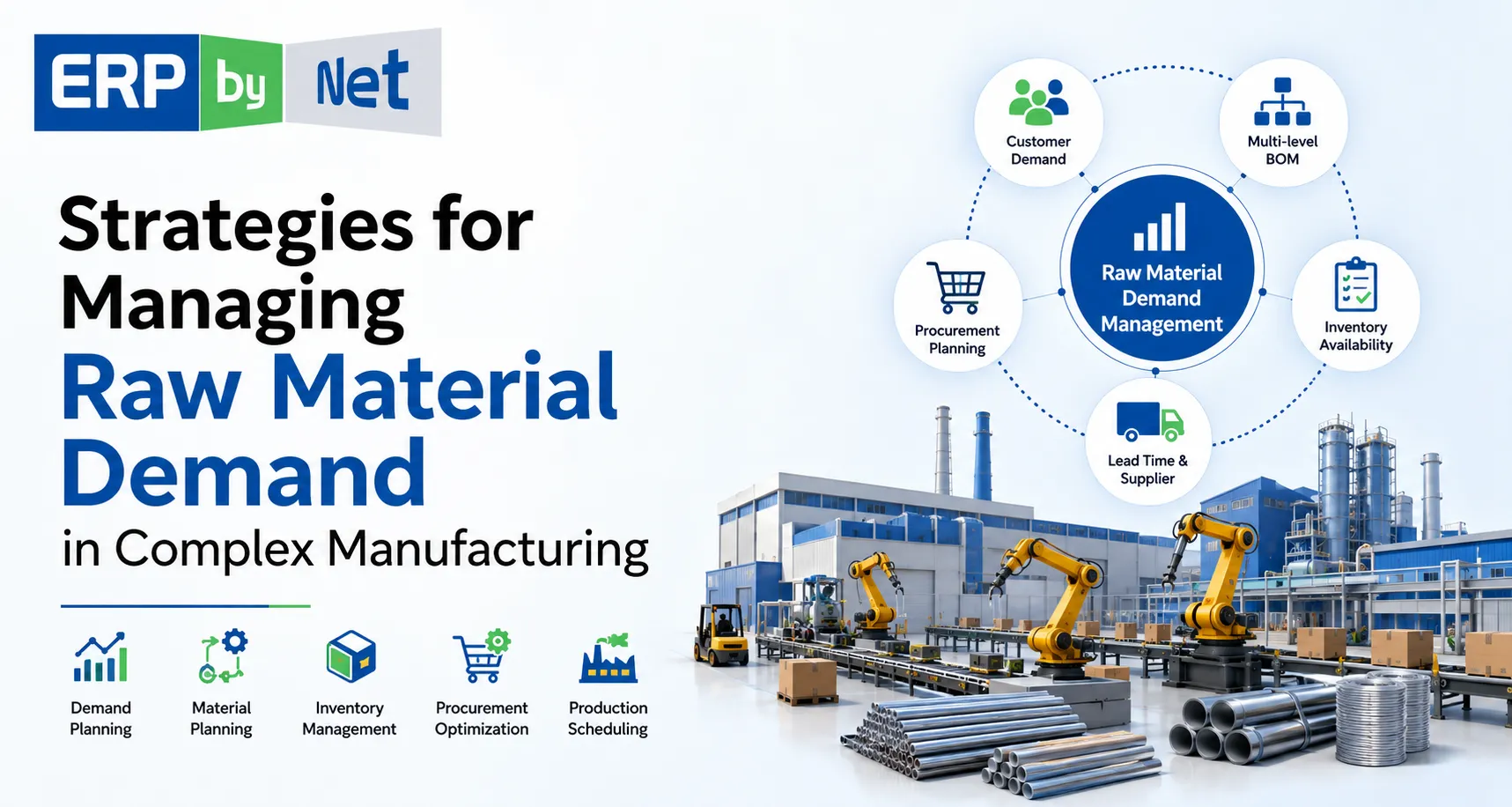
Strategies for Managing Raw Material Demand in Complex Manufacturing
Key Takeaways
- Complex manufacturing needs accurate material demand planning to avoid shortages and excess inventory.
- Demand, BOMs, inventory, procurement, and production must work together for accurate planning.
- Net material requirements are more useful than gross requirements because available and allocated stock must be considered.
- Lead times, material criticality, and safety stock help determine when and how much to procure.
- ERP-based planning helps manufacturers move from reactive purchasing to proactive material management.
What You’ll Learn
- How to plan raw materials using actual demand and production requirements.
- Why accurate multi-level BOMs are important for material planning.
- How to calculate net material requirements using inventory and expected receipts.
- How lead time, safety stock, and material criticality affect procurement decisions.
- How ERPbyNet and AceMRP connect demand, inventory, procurement, and production planning.
Real Insights
- Buying more material is not the solution; manufacturers need to know what is required and when.
- Incorrect BOMs can cause incorrect purchasing, shortages, excess inventory, and production delays.
- Inventory accuracy directly affects material planning and production readiness.
- Changing customer orders can quickly change material requirements, making continuous planning important.
- Better material planning means having the right material at the right time without tying up unnecessary working capital.
Raw material demand is rarely as simple as knowing how much material was consumed last month. In complex manufacturing, a single customer order can trigger requirements across multiple products, subassemblies, components, suppliers, warehouses, and production stages.
A change in one order can create a chain reaction:
Customer demand → Product configuration → BOM → Material requirement → Inventory availability → Procurement → Production → Delivery
When these activities are managed through spreadsheets, disconnected applications, or manual coordination, manufacturers can face two problems at the same time: material shortages that disrupt production and excess inventory that locks up working capital.
The real challenge is therefore not simply purchasing more material. It is managing raw material demand with enough visibility to know what is required, when it is required, what is already available, and what action needs to happen next.
An integrated ERP platform can help manufacturers connect sales, engineering, material planning, inventory, procurement, production, projects, and finance in one operational flow. ERPbyNet, for example, brings these functions together for manufacturing, engineering, elevator, and project-based businesses.
Why Raw Material Demand Becomes Difficult in Complex Manufacturing

Complex manufacturing environments often deal with multi-level BOMs, product variants, make-to-order requirements, engineering changes, long-lead components, supplier dependencies, and changing customer schedules.
Consider a manufacturer receiving an order for 100 customized units.
The requirement may not stop at 100 finished products. Each product could require:
- Multiple assemblies
- Hundreds of components
- Different grades of raw materials
- Purchased parts
- Subassemblies
- Special long-lead components
- Materials already allocated to other orders
If the customer later increases the order from 100 to 150 units, the material requirement changes as well.
This is why material planning should not operate as an isolated purchasing activity. It needs to be connected with demand, engineering, inventory, procurement, production, projects, and finance.
1. Start With Actual Demand, Not Just Historical Consumption
Historical consumption is useful, but it should not be the only basis for raw material planning.
A manufacturer should consider multiple sources of demand, including:
- Confirmed sales orders
- Open customer orders
- Production requirements
- Forecast demand
- Project requirements
- Reorder requirements
- Existing commitments
- Service and replacement requirements
For project-based and engineered manufacturing, this becomes even more important because demand can originate from a specific project rather than a standard production forecast.
SalesPundit can support the front end of this flow by managing leads, quotations, tender workflows, pricing, approvals, and sales activities. Once commercial requirements become actual orders, those requirements can contribute to downstream planning instead of remaining isolated in the sales department.
The objective is simple:
The material plan should reflect what the business is actually committed to producing.
2. Keep Multi-Level BOMs Accurate
A material planning system is only as reliable as the product information behind it.
If the BOM is inaccurate, the resulting material requirement can also be inaccurate.
For example:
Incorrect BOM → Incorrect material requirement → Incorrect procurement → Production disruption
Complex manufacturers may have several levels between the finished product and the raw material. A change to an assembly can therefore affect dozens or hundreds of downstream items.
A strong ERP environment should provide a controlled connection between product definitions, engineering requirements, BOMs, inventory, and material planning.
ERPbyNet’s PDS and DrawGenie capabilities can support complex product definition and engineering workflows, while AceMRP handles material planning and inventory-related requirements. This creates a stronger connection between what is being engineered and what needs to be purchased or produced.
3. Calculate Net Material Requirements
One of the biggest mistakes in material planning is treating the gross requirement as the purchase requirement.
Suppose production requires 1,000 units of a component.
That does not automatically mean procurement needs to purchase 1,000 units.
The system should consider:
Gross Requirement − Available Inventory − Allocated Stock − Expected Receipts = Net Requirement
This distinction is critical.
Without netting demand against inventory and expected receipts, manufacturers may purchase materials they already have while simultaneously overlooking materials that are genuinely short.
AceMRP is designed to connect material planning, inventory management, warehouse operations, procurement, and manufacturing coordination, helping planners work from a more connected view of requirements and availability.
4. Plan Materials According to Lead Time
A material required on the production floor on 30 September may need to be ordered weeks or months earlier.
Planning therefore needs to work backward from the requirement date.
Production requirement date
↓
Material availability date
↓
Procurement processing time
↓
Supplier lead time
↓
Purchase decision
This becomes particularly important for:
- Imported components
- Special-grade materials
- Customized components
- Single-source items
- Long-lead electrical or mechanical parts
- Materials with uncertain supplier availability
ERPbyNet’s MRP positioning specifically supports planning approaches for just-in-time items, long-lead materials, and materials that should be produced or procured in bulk.
The goal is not simply to identify shortages. It is to identify them early enough to do something about them.
Read More: Why Modern AMC Management Needs More Than Renewal Reminders
5. Classify Materials by Risk and Criticality
Not every raw material should be managed using the same planning rules.
A low-cost, easily available item does not carry the same business risk as a critical component with a 12-week supplier lead time.
Manufacturers can classify materials according to:
- Criticality
- Cost
- Lead time
- Supplier dependency
- Demand variability
- Availability
- Substitution options
- Production impact
For example:
Long lead time + high criticality + single supplier = high planning risk
This classification helps planners focus attention where a shortage can cause the greatest operational impact.
Instead of asking, “Which materials need replenishment?”, the better question is:
“Which material shortage could stop or delay production?”
That shift makes material planning much more strategic.
6. Use Safety Stock Intelligently
Safety stock can protect production from uncertainty, but simply increasing safety stock is not a sustainable strategy.
Too little safety stock can result in stockouts.
Too much safety stock can result in:
- Higher carrying costs
- Excess working capital
- Warehouse congestion
- Obsolescence
- Poor inventory turnover
Safety stock decisions should therefore consider demand variability, supplier reliability, lead time, material criticality, and historical consumption.
An ERP system can make this process more practical by giving planners visibility into current stock, upcoming requirements, purchase orders, and material movements.
The objective is not maximum inventory.
The objective is appropriate inventory for the level of uncertainty and business risk.
7. Recalculate Demand When Customer Requirements Change
Complex manufacturing rarely follows a perfectly stable plan.
A customer may change:
100 units → 150 units
A project may be accelerated.
An engineering team may modify a component.
A supplier may delay a critical part.
A production schedule may move.
Each change can affect downstream material requirements.
This is where spreadsheet-based planning becomes difficult. A planner may have to manually identify which BOMs, inventory records, purchase orders, and production requirements need to be updated.
An integrated ERP environment can provide a connected view of these changes.
With ERPbyNet, SalesPundit, PDS, AceMRP, eProduction, inventory, procurement, and project-related functions can participate in a connected operational workflow.
This helps move planning from a static monthly exercise toward continuous demand management.
8. Connect Material Planning With Procurement
MRP becomes valuable only when its output leads to action.
A typical flow should look like:
Demand
↓
BOM Explosion
↓
Gross Requirement
↓
Inventory & Expected Receipts
↓
Net Requirement
↓
Planned Procurement / Production
↓
Purchase Order / Production Order
↓
Material Receipt
↓
Production
If procurement operates separately from MRP, planners may still need to communicate requirements manually.
This creates opportunities for:
- Duplicate purchasing
- Delayed orders
- Incorrect quantities
- Missed requirements
- Poor supplier visibility
- Emergency procurement
AceMRP brings material planning together with procurement, inventory, warehouse operations, and manufacturing coordination, supporting a more connected material flow.
9. Connect Warehouse Accuracy With Demand Planning
Even the best demand calculation becomes unreliable if the inventory data is wrong.
Imagine the ERP shows 500 components available, but only 320 are physically usable.
The planning system may conclude that there is enough material.
Production will discover otherwise.
That is why inventory accuracy is part of demand management, not a separate warehouse concern.
Barcode-enabled processes can help reduce picking and inventory errors. ERPbyNet’s AcePickerMate allows warehouse users to scan items from pick lists and supports controlled picking and unpicking through a mobile application.
The result is a stronger connection between:
System inventory → Physical inventory → Material availability → Production readiness
10. Connect Material Demand With Project and Site Requirements
For project-based manufacturers, raw material demand may be directly connected to project schedules.
An elevator manufacturer, engineering company, fabrication business, or equipment manufacturer may need materials for several projects simultaneously.
A material may be:
- Required for Project A
- Reserved for Project B
- In transit for Project C
- Available in the warehouse
- Delayed from a supplier
Without project-level visibility, the same inventory can easily be considered available for multiple requirements.
AceSiteManager provides project execution visibility around installation schedules, activities, budgets, and site operations, while SiteApp supports project and installation activity updates from the field.
This creates an important planning advantage:
Material availability can be considered alongside project timelines rather than in isolation.
From Material Planning to Production Readiness
Raw material demand management should ultimately answer one practical question:
Will the required material be available when production needs it?
That requires coordination between planning and production.
eProduction can support production workflows, scheduling, work-center operations, labour tracking, and manufacturing visibility, while AceMRP focuses on material planning and inventory coordination.
Together, these processes help organizations identify whether a production schedule is actually supported by material availability.
Instead of discovering a shortage when production starts, planners can identify potential constraints earlier.
The Financial Impact of Better Raw Material Planning
Material planning is not only an operations issue.
It directly affects financial performance.
Excess inventory ties up cash.
Emergency purchases can increase procurement costs.
Production delays can affect delivery commitments.
Unused or obsolete materials can create write-offs.
Incorrect material consumption can distort product costing.
This is why material planning should ultimately connect with finance.
AceFinance integrates financial operations with ERPbyNet applications including AceMRP, helping inventory and manufacturing transactions flow into financial records. It supports areas such as accounts payable, accounts receivable, general ledger, fixed assets, reporting, and financial management.
This creates a more complete business picture:
Material decision → Inventory movement → Production cost → Financial impact
For management, that visibility is more valuable than a standalone inventory report.
Read More: The Hidden Relationship Between Warehousing and Customer Experience
What Manufacturers Should Look for in an ERP for Raw Material Demand Management
When evaluating manufacturing ERP software, companies should look beyond the question:
“Does the ERP have MRP?”
Instead, evaluate whether the system can connect the entire decision chain.
Look for capabilities such as:
- Demand and order integration
- Multi-level BOM management
- Material requirement calculation
- Inventory availability
- Safety stock management
- Lead-time planning
- Procurement workflows
- Production planning
- Warehouse control
- Barcode-based inventory processes
- Project material visibility
- Engineering change management
- Cost and financial integration
- Real-time reporting
- Mobile operational access
The most valuable system is not necessarily the one with the longest feature list.
It is the one that connects the decisions that determine whether material will be available when and where it is needed.
How ERPbyNet Supports Connected Material Demand Management

ERPbyNet is built around the needs of operationally complex businesses, including manufacturing, engineering, elevator, project-based, and service organizations. Its platform connects sales, projects, manufacturing, inventory, service, technicians, and finance.
For raw material demand management, different modules can contribute at different stages of the workflow:
SalesPundit helps capture and manage customer demand, quotations, pricing, and sales workflows.
PDS and DrawGenie support complex product definition and engineering requirements where product configuration can influence material requirements.
AceMRP provides the core material planning, inventory, procurement, warehouse, and manufacturing coordination layer.
eProduction connects material availability with production workflows, scheduling, work centers, and manufacturing execution.
AcePickerMate strengthens warehouse accuracy through barcode-based picking.
AceSiteManager and SiteApp help connect project execution and site requirements with operational planning.
AceService, MyAceService, and SmartTechnician become relevant when service operations generate requirements for replacement parts, maintenance materials, or field consumption. ERPbyNet provides service management, mobile service, and technician capabilities as part of its wider platform.
AceFinance connects inventory and manufacturing transactions with financial management, helping management understand the financial consequences of material decisions.
This integrated approach matters because raw material demand does not originate in the warehouse alone.
It can originate from sales, engineering, projects, production, or service.
Moving From Reactive Purchasing to Proactive Material Planning
The traditional approach to material shortages often looks like this:
Shortage discovered → Emergency purchase → Supplier follow-up → Production delay → Higher cost
A connected approach looks different:
Demand captured → BOM evaluated → Requirements calculated → Inventory checked → Shortages identified → Procurement planned → Material received → Production executed
That difference can have a direct effect on operational control.
The objective is not to eliminate every uncertainty. Manufacturing will always involve changing customer requirements, supplier variations, engineering changes, and demand fluctuations.
The objective is to make those changes visible early enough to respond intelligently.
Final Thoughts
Managing raw material demand in complex manufacturing requires more than maintaining inventory levels.
Manufacturers need to understand what is required, why it is required, when it is required, what is already available, what is committed elsewhere, what is on order, and what could become a production constraint.
That requires a connected flow between demand, engineering, BOMs, MRP, inventory, procurement, production, projects, warehouse operations, service, and finance.
An integrated manufacturing ERP can turn these disconnected activities into one continuous planning process.
ERPbyNet is designed to bring these operational functions together for manufacturing, engineering, elevator, and project-based businesses, helping organizations improve material planning, inventory visibility, procurement coordination, production control, project execution, and financial visibility.
The goal of better raw material planning is not simply to buy the right quantity. It is to make sure the right material is available at the right time, for the right requirement, without unnecessarily tying up business capital.
When demand, inventory, procurement, production, projects, and finance work from the same connected information, manufacturers can move from reactive purchasing to proactive material planning—and from material uncertainty to greater operational control.
Frequently Asked Questions
What is raw material demand management in manufacturing?
Raw material demand management is the process of determining what materials are needed, how much is required, when they are needed, and whether available or incoming inventory can support production requirements.
Why is raw material planning difficult in complex manufacturing?
Complex manufacturing often involves multi-level BOMs, customized products, changing customer orders, long supplier lead times, multiple production stages, and project-specific requirements. These factors can make material demand change frequently.
How does ERP help manage raw material demand?
An ERP system connects demand, BOMs, inventory, MRP, procurement, production, projects, and finance. This helps manufacturers calculate material requirements, identify potential shortages, and plan procurement more effectively.
What is the role of MRP in raw material planning?
MRP calculates material requirements based on demand, BOMs, inventory, production schedules, safety stock, and lead times. It helps determine what needs to be purchased or produced and when.
How can manufacturers reduce raw material shortages?
Manufacturers can reduce shortages by maintaining accurate BOMs, monitoring inventory levels, considering supplier lead times, maintaining appropriate safety stock, and using MRP to identify upcoming material requirements before production is affected.
How can ERP help prevent excess raw material inventory?
ERP can compare upcoming demand with available inventory, allocated stock, expected receipts, and production requirements. This helps manufacturers avoid unnecessary purchases and reduce excess inventory.
Why are accurate BOMs important for material planning?
BOM accuracy directly affects material requirements. An incorrect BOM can result in wrong purchasing quantities, material shortages, excess inventory, and production delays.
Can ERP handle changes in customer demand?
Yes. An integrated ERP can help update material requirements when customer orders, quantities, product configurations, or production schedules change, allowing planners to understand their impact on procurement and production.
What should manufacturers look for in ERP software for raw material planning?
Manufacturers should consider MRP, multi-level BOM management, inventory visibility, demand planning, procurement automation, lead-time management, safety stock, production planning, warehouse management, barcode capabilities, project integration, and financial management.
How does ERPbyNet support raw material demand management?
ERPbyNet connects sales, engineering, MRP, inventory, procurement, production, warehouse, project, service, and finance processes. Its AceMRP module supports material planning and inventory management, while other ERPbyNet modules help connect demand, engineering, production, projects, warehouse operations, service, and financial activities.

COO & Founder Member, XECOM | ERP & Technology Expert
Ganesh Limaye is a technology and business leader with 30+ years of experience in ERP, service management, project-based operations, and business process automation. He specializes in helping elevator, engineering, and service-driven businesses improve operational visibility, productivity, customer service, and business growth.