Why Elevator Companies Struggle to Track AMC Contracts
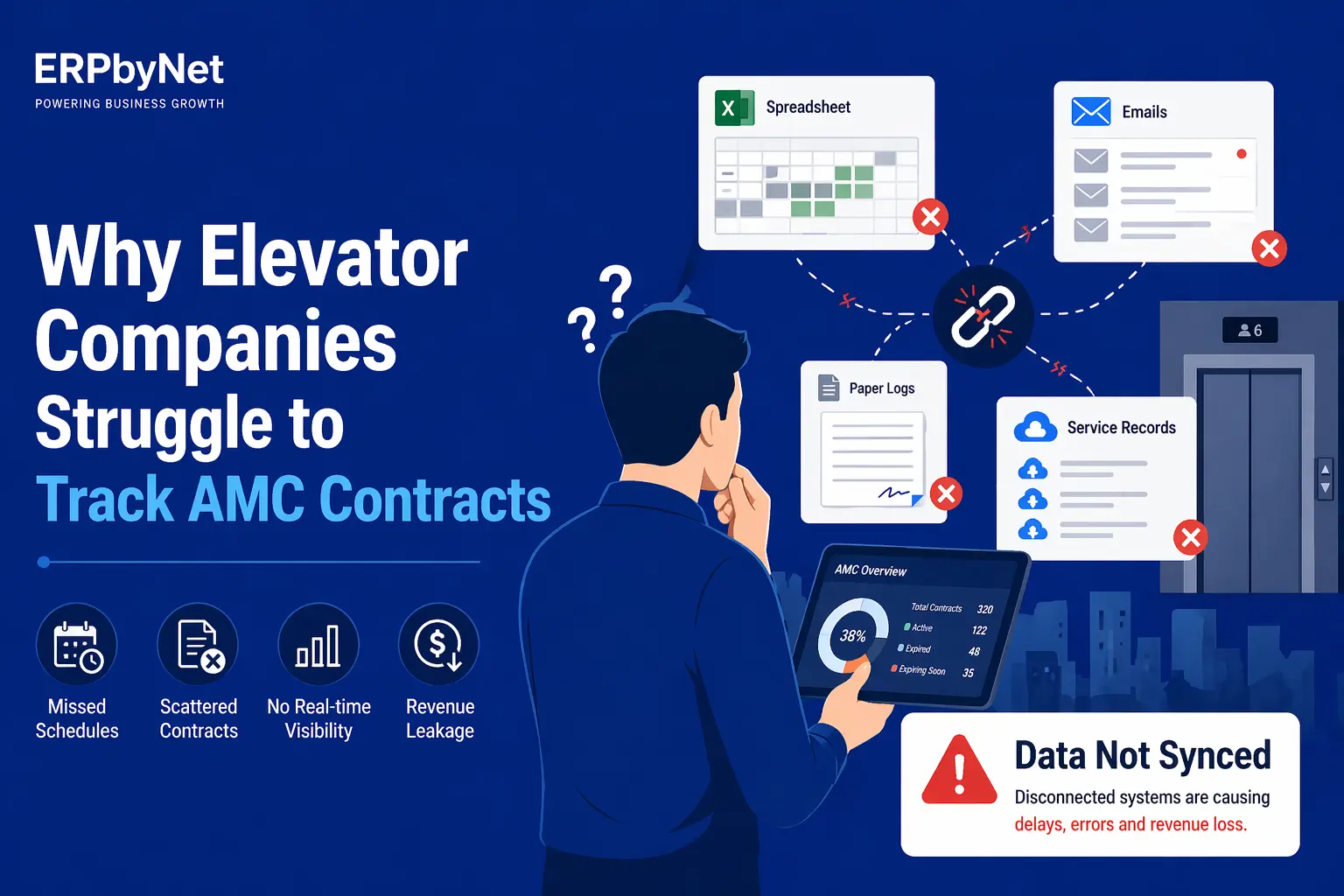
In the elevator industry, AMC contract are not just operational documents—they are long-term service commitments that directly impact safety, uptime, and customer trust. Yet, many elevator companies still rely on manual systems such as spreadsheets, paper logs, and disconnected tools to manage these contracts.
As service portfolios expand, this approach becomes increasingly inefficient. Teams struggle with scattered data, missed maintenance schedules, and lack of real-time visibility. What once worked for a small operation quickly turns into a bottleneck for growth.
Modern elevator businesses are now recognizing the need to shift from reactive, manual processes to automated and integrated systems. This is where ERP solutions like ERPbyNet play a transformative role—bringing structure, visibility, and control to AMC management.
What Lift AMC Really Means and Why It Is Operationally Critical
An Annual Maintenance Contract (AMC) is a formal agreement between an elevator service provider and a client to ensure periodic inspection, servicing, and repair of elevator systems.
Beyond being a routine service agreement, AMC plays a crucial role in maintaining operational excellence.
Why AMC Matters Across Stakeholders
For Safety and Compliance
- Ensures elevators meet regulatory and safety standards
- Reduces risks of accidents and system failures
For Equipment Performance
- Prevents major breakdowns through regular servicing
- Extends the lifecycle of critical components
For Business Continuity
- Minimizes downtime in residential and commercial buildings
- Ensures uninterrupted vertical mobility
For Service Providers
- Creates recurring revenue streams
- Strengthens long-term customer relationships
AMC is not just maintenance—it is a structured service ecosystem that demands accuracy, consistency, and proactive management.
Read More : How ERP-Driven Asset Management Improves Efficiency, Accuracy, and ROI
Why Manual AMC Management Fails in Scaling Elevator Businesses
Manual systems often appear manageable in the early stages, but as operations grow, their limitations become evident.
Core Operational Challenges
Fragmented Data Environment
Information is stored across multiple platforms—Excel sheets, emails, and physical documents—making it difficult to access accurate, real-time insights.
Missed Preventive Maintenance Schedules
Without automated tracking, scheduled services are often delayed or overlooked, increasing the risk of breakdowns.
Inefficient Workforce Allocation
Manual technician assignment leads to:
- Overloaded teams
- Poor route planning
- Increased response times
Lack of Contract Visibility
Tracking contract status, expiry dates, and service history becomes inconsistent and error-prone.
Revenue Leakage and Billing Gaps
- Missed invoicing cycles
- Untracked service visits
- Incomplete contract renewals
These inefficiencies collectively reduce operational control and impact profitability.
Moving Beyond Spreadsheets: What AMC Automation Actually Delivers
AMC automation introduces digital workflows to replace manual tracking and scheduling.
Key Capabilities of AMC Automation Tools
- Automated scheduling of preventive maintenance
- Alerts and reminders for upcoming tasks
- Digital storage of contracts and service records
- Basic reporting for service tracking
Where Automation Falls Short
While automation tools improve efficiency, they often lack integration with other business functions. This creates isolated systems that cannot provide a complete operational view.
For example:
- Service teams operate separately from finance
- Inventory is not linked to maintenance tasks
- Billing is disconnected from actual service delivery
This is where businesses hit the ceiling of automation and need a more comprehensive solution.
How ERP Systems Bring Complete Control to AMC Operations
An ERP system connects all operational processes into a unified platform, enabling seamless AMC management across departments.
How ERP Transforms AMC Management
Centralized Data and Operations
All AMC-related data—contracts, schedules, service history—is stored in one system.
Integrated Business Functions
- Service management for scheduling and tracking
- Inventory management for spare parts availability
- Finance and billing for accurate invoicing
Real-Time Decision Making
Managers gain access to live dashboards, enabling proactive decisions and better control.
Scalable Infrastructure
ERP systems like ERPbyNet are built to support growing service operations without increasing complexity.
Read More : How ERP Reduces Fuel and Time Costs in Vending Machine Routes
A Clear Comparison: Manual Systems vs Automation vs ERP-Based AMC
| Feature | Manual System | Basic Automation | ERP-Based System |
| Data Visibility | Limited and scattered | Partially centralized | Fully centralized and real-time |
| Preventive Maintenance | Irregular and error-prone | Scheduled but isolated | Fully optimized and integrated |
| System Integration | None | Limited | End-to-end integration |
| Scalability | Restricted | Moderate | High and flexible |
| Revenue Tracking | Inconsistent | Partially tracked | Accurate and automated |
This comparison highlights a critical insight: automation improves processes, but ERP transforms the entire operation.
Real Business Benefits of ERP-Driven AMC Management
Adopting ERP for AMC management creates measurable improvements across operations.
Operational Benefits
- No missed maintenance schedules due to automation
- Faster technician deployment and improved response times
- Standardized workflows across teams
Financial Benefits
- Accurate and timely billing
- Reduced revenue leakage
- Better financial forecasting
Customer-Centric Benefits
- Consistent service delivery
- Improved communication and transparency
- Higher customer satisfaction and retention
Strategic Benefits
- Data-driven decision-making
- Ability to scale operations efficiently
- Stronger competitive positioning
Inside the Workflow: How ERP-Based AMC Management Functions in Practice
ERP systems streamline the complete lifecycle of AMC management.
Typical Workflow
Contract Creation and Digital Storage
All AMC details are recorded in a centralized system for easy access.
Automated Preventive Maintenance Scheduling
System-generated schedules ensure timely service delivery.
Smart Technician Assignment
Tasks are assigned based on:
- Availability
- Skill set
- Location proximity
Real-Time Alerts and Notifications
Teams receive reminders for upcoming tasks and renewals.
Service Execution and Logging
Technicians update job status instantly, ensuring transparency.
Renewal Tracking and Automation
Contracts nearing expiration are flagged, reducing missed renewals.
The Hidden Costs and Risks of Continuing Without AMC Automation
Failing to modernize AMC management has serious business consequences.
Key Risks
- Operational inefficiencies that increase over time
- Higher downtime due to missed maintenance
- Declining customer trust and satisfaction
- Loss of recurring revenue from missed renewals
- Inability to scale operations effectively
In a competitive and service-driven industry, these risks can significantly hinder growth.
Real-World Scenario: From Manual Chaos to ERP-Driven Efficiency
Consider a mid-sized elevator company handling hundreds of AMC contracts.
Challenges with Manual Systems
- Service schedules maintained in spreadsheets
- Frequent delays in maintenance visits
- No centralized visibility into contracts
- Revenue losses due to missed billing
Transformation After ERP Implementation
Improved Efficiency
- Automated scheduling eliminates missed services
Better Cost Control
- Optimized technician allocation reduces operational expenses
Enhanced Service Quality
- Faster response times and better job tracking
The company transitions from reactive operations to a proactive, scalable service model.
The Future of AMC Management in Elevator Businesses
AMC management is rapidly evolving with advancements in technology.
Emerging Trends
Predictive Maintenance
Using data analytics to identify issues before they occur.
IoT-Enabled Elevators
Real-time data from connected systems improves service accuracy.
Proactive Service Models
Shifting from reactive repairs to preventive strategies.
Digital-First Operations
Increasing reliance on integrated ERP platforms for complete control.
Businesses that adopt these trends early will gain a significant competitive advantage.
Conclusion
Elevator companies can no longer rely on manual systems to manage AMC contracts in an increasingly competitive and service-driven market. The challenges—ranging from missed maintenance schedules and poor contract visibility to revenue leakage and inefficient resource allocation—are not just operational issues; they directly impact customer trust and long-term business growth. As service demands increase, the gap between manual processes and efficient execution only widens, making it essential for businesses to adopt a more structured and scalable approach.
This is where ERP-driven AMC management becomes a strategic necessity rather than an option. By integrating service operations, contract tracking, inventory, and billing into a single platform, solutions like ERPbyNet enable elevator companies to gain complete control, improve service quality, and unlock consistent revenue streams. If your business is still struggling with AMC tracking, now is the time to make the shift. Schedule a demo with ERPbyNet today and take the first step toward smarter, more efficient, and future-ready elevator service management.
FAQs
What is the best way to manage elevator AMC contracts efficiently?
The most effective way is to use an ERP-based system that centralizes contract data, automates maintenance scheduling, and provides real-time visibility across operations.
Why is manual AMC tracking not reliable for elevator companies?
Manual tracking often leads to missed schedules, scattered data, and billing errors, making it difficult to maintain service quality and operational control.
How can elevator companies reduce missed maintenance schedules?
By implementing automated scheduling and reminder systems through ERP, companies can ensure all preventive maintenance tasks are completed on time.
What are the key benefits of using ERP for elevator service management?
ERP improves efficiency, enhances contract visibility, ensures accurate billing, optimizes technician allocation, and helps businesses scale smoothly.
How does ERPbyNet help in managing AMC contracts?
ERPbyNet provides a complete solution for AMC management by automating scheduling, tracking contracts and renewals, improving service efficiency, and eliminating revenue leakage through an integrated platform.