Managing projects successfully requires more than just meeting deadlines. Project-based businesses must control costs, allocate resources effectively, manage procurement, track profitability, and maintain visibility across multiple projects. As organizations grow, relying on spreadsheets and disconnected software tools often leads to inefficiencies, data silos, and reduced operational control.
This is where Enterprise Resource Planning (ERP) software becomes essential. However, selecting the right ERP system can be challenging. With countless vendors and features available, businesses often struggle to identify the solution that best fits their unique requirements.
This ERP selection checklist is designed specifically for project-based businesses to help decision-makers evaluate ERP solutions strategically and choose a platform that supports long-term growth and operational efficiency.
Why Project-Based Businesses Need a Specialized ERP Selection Strategy
Project-based businesses operate differently from traditional manufacturing, retail, or distribution companies. Every project has its own budget, timeline, resource requirements, procurement needs, and profitability goals. As a result, selecting an ERP system requires a different approach than choosing software for a standard operational business.
Organizations involved in engineering, EPC contracting, construction, industrial services, elevator maintenance, and custom manufacturing must manage multiple moving parts simultaneously. Without the right ERP solution, tracking project performance, controlling costs, and maintaining operational visibility become increasingly difficult as the business grows.
Key Challenges Faced by Project-Based Businesses
Project-driven organizations typically need to manage:
Multiple projects at various stages of execution
Project budgeting and cost control
Resource scheduling and workforce utilization
Procurement linked to project requirements
Progress billing and milestone invoicing
Service and maintenance operations
Project profitability and performance reporting
Because of these complexities, businesses require an ERP system that provides real-time visibility across projects while integrating financials, procurement, inventory, and service management.
Risks of Choosing a Generic ERP System
Many organizations select ERP software based on general functionality without evaluating whether it supports project-centric workflows.
This often leads to:
Limited project visibility
Inaccurate job costing
Resource allocation conflicts
Delayed reporting
Manual data entry across departments
Difficulty scaling operations
A project-based ERP should provide end-to-end control over the entire project lifecycle, from planning and procurement to execution, billing, and post-project analysis.
How to Prepare Before Evaluating ERP Vendors
ERP selection should begin long before vendor demonstrations and pricing discussions. Proper preparation helps businesses identify the right solution while reducing implementation risks.
Define Your ERP Implementation Goals
Before comparing ERP systems, identify the business outcomes you want to achieve.
Consider questions such as:
What operational challenges are slowing growth?
Which manual processes create inefficiencies?
What information is difficult to access today?
Which departments require greater visibility?
What are the company’s long-term growth objectives?
Clearly defined goals create a framework for evaluating ERP solutions effectively.
Identify Stakeholders Across Departments
ERP software impacts nearly every department within a business. Involving stakeholders early helps ensure all requirements are captured.
Key stakeholders may include:
Business owners
Finance teams
Project managers
Procurement departments
Service managers
Operations leaders
IT administrators
Their input provides valuable insights into process bottlenecks and improvement opportunities.
Map Your Existing Business Processes
Document how your organization currently handles:
Project planning
Resource allocation
Procurement workflows
Inventory management
Financial processes
Service management
Understanding existing workflows helps identify gaps that the ERP system should address.
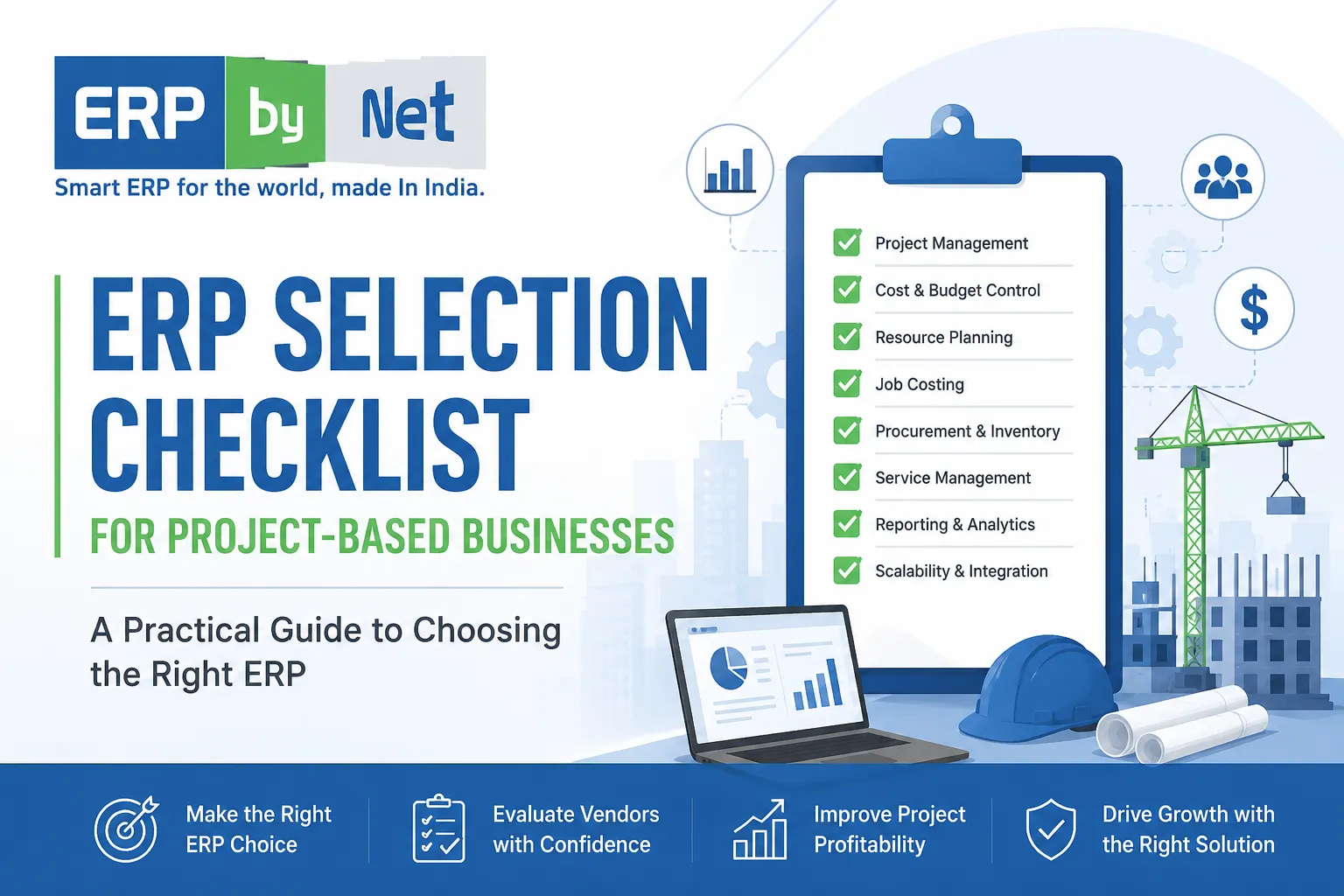
ERP Selection Checklist for Project-Based Businesses
Selecting the right ERP system requires a thorough evaluation of business processes, project requirements, financial controls, resource management capabilities, and future growth needs. Project-based organizations should assess every ERP solution against key operational areas to ensure it can support the complete project lifecycle while improving visibility, efficiency, and profitability.
Project Management and Project Control Features
Project management functionality is one of the most important factors when evaluating ERP software for project-based businesses. The ERP should provide comprehensive tools to plan, monitor, and control projects from initiation through completion.
Project Planning and Scheduling
Effective project planning lays the foundation for successful project execution. An ERP system should enable organizations to create detailed project schedules, define milestones, assign responsibilities, and monitor progress throughout the project lifecycle.
Key capabilities include:
Project schedule creation and management
Milestone and deliverable planning
Task assignment and responsibility tracking
Real-time project progress monitoring
Deadline tracking and automated alerts
Project status visibility across teams
Strong planning and scheduling functionality improves collaboration, accountability, and project delivery performance.
Project Budgeting and Cost Management
Maintaining control over project costs is essential for protecting profitability and ensuring projects remain financially viable.
An ERP system should support:
Budget creation and approval workflows
Project-wise budget allocation
Real-time expense monitoring
Budget versus actual cost analysis
Cost forecasting and variance tracking
Financial alerts for budget overruns
These capabilities help organizations monitor spending, reduce financial risks, and maintain control throughout project execution.
Project Profitability Tracking
Project profitability should be visible at every stage of execution. An ERP solution should provide accurate financial insights that help management evaluate project performance and business growth opportunities.
Essential profitability metrics include:
Project revenue tracking
Direct project costs
Indirect project expenses
Gross profit margin analysis
Profitability trends across projects
Customer and project-level profitability reports
Access to real-time profitability data supports better project selection, pricing decisions, and resource allocation.
Resource Planning and Workforce Management
Efficient resource utilization directly impacts project success, operational efficiency, and profitability. A project-based ERP should help organizations maximize workforce productivity while preventing resource shortages and scheduling conflicts.
Resource Scheduling and Allocation
The ERP should provide tools for managing workforce assignments and ensuring resources are allocated effectively across multiple projects.
Important capabilities include:
Employee assignment management
Skill-based resource allocation
Workforce scheduling
Resource availability tracking
Multi-project resource planning
Workload balancing
These features help organizations optimize workforce utilization while reducing project delays caused by resource constraints.
Capacity Planning and Utilization Tracking
Long-term resource planning is essential for supporting business growth and improving project delivery.
Financial visibility is critical for managing project performance and maintaining profitability. A project-focused ERP should provide comprehensive financial management and cost tracking capabilities.
Job Costing and Cost Allocation
Accurate job costing enables businesses to understand the true cost of project execution and improve pricing strategies.
Project-based businesses often require flexible billing structures to accommodate different customer agreements and project requirements.
The ERP should support:
Progress billing
Milestone invoicing
Contract billing
Time-and-material billing
Recurring billing arrangements
Revenue recognition management
Flexible billing processes improve cash flow management and customer satisfaction.
Financial Reporting and Performance Analysis
Business leaders require accurate financial information to evaluate project performance and organizational health.
The ERP should provide:
Project financial summaries
Cost analysis reports
Revenue performance reports
Budget tracking reports
Cash flow dashboards
Profitability analysis reports
Real-time financial insights enable faster and more informed business decisions.
Procurement and Inventory Management Capabilities
Project success often depends on having the right materials available at the right time. Procurement and inventory management functionality should provide visibility and control over purchasing and material usage.
Procurement Management
An ERP system should streamline procurement activities while improving supplier management and purchasing efficiency.
Key capabilities include:
Purchase requisition management
Purchase order processing
Vendor evaluation and selection
Approval workflow automation
Supplier performance monitoring
Procurement reporting and analytics
These features help reduce procurement delays and improve purchasing control.
Inventory Visibility and Material Tracking
Inventory management functionality should provide complete visibility into stock levels, material consumption, and inventory movement.
The ERP should support:
Real-time inventory visibility
Inventory valuation
Project-wise material tracking
Multi-location inventory management
Warehouse management
Stock replenishment planning
Effective inventory control reduces waste, prevents shortages, and improves project efficiency.
Service Management and Maintenance Operations
Many project-based organizations provide ongoing maintenance and after-sales services. The ERP should support service operations alongside project management activities.
Service Ticket Management
Efficient service management helps improve customer satisfaction and operational responsiveness.
The ERP should provide:
Service request creation
Technician assignment
Complaint management
Resolution tracking
Service scheduling
Performance monitoring
These capabilities improve service quality and response times.
AMC and Contract Management
For organizations offering maintenance services, contract management functionality is essential.
The ERP should manage:
Annual Maintenance Contracts (AMCs)
Preventive maintenance schedules
Contract renewals
Warranty tracking
SLA monitoring
Service history management
These features support consistent service delivery and customer retention.
Reporting, Dashboards, and Business Intelligence
Data-driven decision-making is essential for improving operational performance and supporting business growth.
Real-Time Business Dashboards
Modern ERP systems should provide interactive dashboards that offer immediate visibility into business performance.
Key dashboard metrics include:
Project status
Resource utilization
Budget consumption
Revenue performance
Service metrics
Procurement activities
Real-time dashboards enable management teams to identify issues and respond proactively.
Advanced Reporting and Analytics
Advanced reporting tools help organizations analyze performance trends and improve strategic planning.
The ERP should support:
Project profitability reports
Resource utilization reports
Procurement analytics
Financial performance reports
Service management reports
Executive management dashboards
Comprehensive reporting improves visibility and supports better decision-making.
ERP Integration and Scalability Requirements
An ERP investment should support both current operational needs and future business growth.
Third-Party Software Integrations
Seamless integrations improve data accuracy and eliminate manual processes.
Evaluate whether the ERP can integrate with:
CRM software
Accounting applications
Payroll systems
HR platforms
Business intelligence tools
Banking systems
Integrated systems create a unified business environment and improve operational efficiency.
Long-Term Scalability
As businesses grow, ERP requirements evolve. The selected ERP solution should be capable of supporting increasing operational complexity.
The ERP should accommodate:
Business expansion
Multiple branches and locations
Higher project volumes
Additional users
New departments
Evolving business processes
A scalable ERP platform helps protect technology investments while supporting long-term growth and operational excellence.
Selecting an ERP system is one of the most important decisions a project-based business can make. The right ERP improves visibility, enhances collaboration, streamlines operations, and helps organizations manage projects more profitably.
By following a structured ERP selection checklist, businesses can avoid common mistakes, evaluate vendors effectively, and choose a solution that aligns with their operational requirements and growth objectives.
For organizations seeking a unified platform to manage projects, finances, resources, procurement, inventory, and service operations, ERPbyNet provides the capabilities needed to drive efficiency and support sustainable business growth.
Frequently Asked Questions
What is an ERP selection checklist?
An ERP selection checklist is a structured framework used to evaluate ERP software based on business requirements, functionality, scalability, support, and implementation considerations.
Why do project-based businesses need specialized ERP software?
Project-based businesses require features such as project management, job costing, resource planning, project profitability tracking, and service management that generic ERP systems may not provide effectively.
What features should a project-based ERP include?
Key features include project planning, budgeting, resource management, job costing, procurement, inventory management, billing, reporting, and service management.
How long does ERP implementation typically take?
Implementation timelines vary depending on business size, complexity, customization requirements, and user training needs. Most ERP projects take several months to complete.
How can ERPbyNet help project-based organizations improve project profitability?
ERPbyNet provides real-time visibility into project costs, budgets, resources, procurement, and financial performance, enabling businesses to make data-driven decisions and improve project profitability.
Project-based businesses require specialized ERP capabilities to manage projects, costs, resources, procurement, and profitability effectively.
Choosing the wrong ERP can create operational bottlenecks and limit future business growth.
Project visibility, cost control, and resource planning are critical factors when evaluating ERP solutions.
Industry-specific ERP systems provide better alignment with project workflows than generic business software.
The right ERP supports scalability and profitability by connecting every project-related process on a single platform.
What You’ll Learn
How to identify the key ERP requirements for project-based businesses.
Why project costing and budget tracking are essential ERP selection criteria.
How ERP improves procurement, inventory, and resource management across projects.
Common mistakes businesses make when selecting an ERP system.
How ERPbyNet helps engineering, EPC, contract manufacturing, and elevator companies manage projects more efficiently.
Real Insights
Many project-based companies outgrow generic accounting software as project complexity and operational demands increase.
Cost overruns often occur because project data is scattered across multiple systems and spreadsheets.
Real-time project visibility enables faster decision-making and improves project profitability.
Successful ERP implementations focus on business processes rather than software features alone.
The best ERP investment is one that grows with your business, supporting both current operations and future expansion.
For project-based businesses, growth often brings operational complexity. What starts as a manageable workflow involving a few projects can quickly become difficult to control as the number of customers, project sites, employees, suppliers, and service commitments increases.
Many organizations initially manage operations using spreadsheets, emails, accounting software, and standalone project management tools. While these systems may work during the early stages of business growth, they often create information silos that make it difficult to maintain visibility across departments.
As projects become larger and more complex, management teams face challenges such as delayed project execution, poor resource allocation, inventory shortages, inaccurate project costing, and limited visibility into profitability. These challenges not only affect operational efficiency but also directly impact customer satisfaction and business growth.
This is where Enterprise Resource Planning (ERP) software becomes essential.
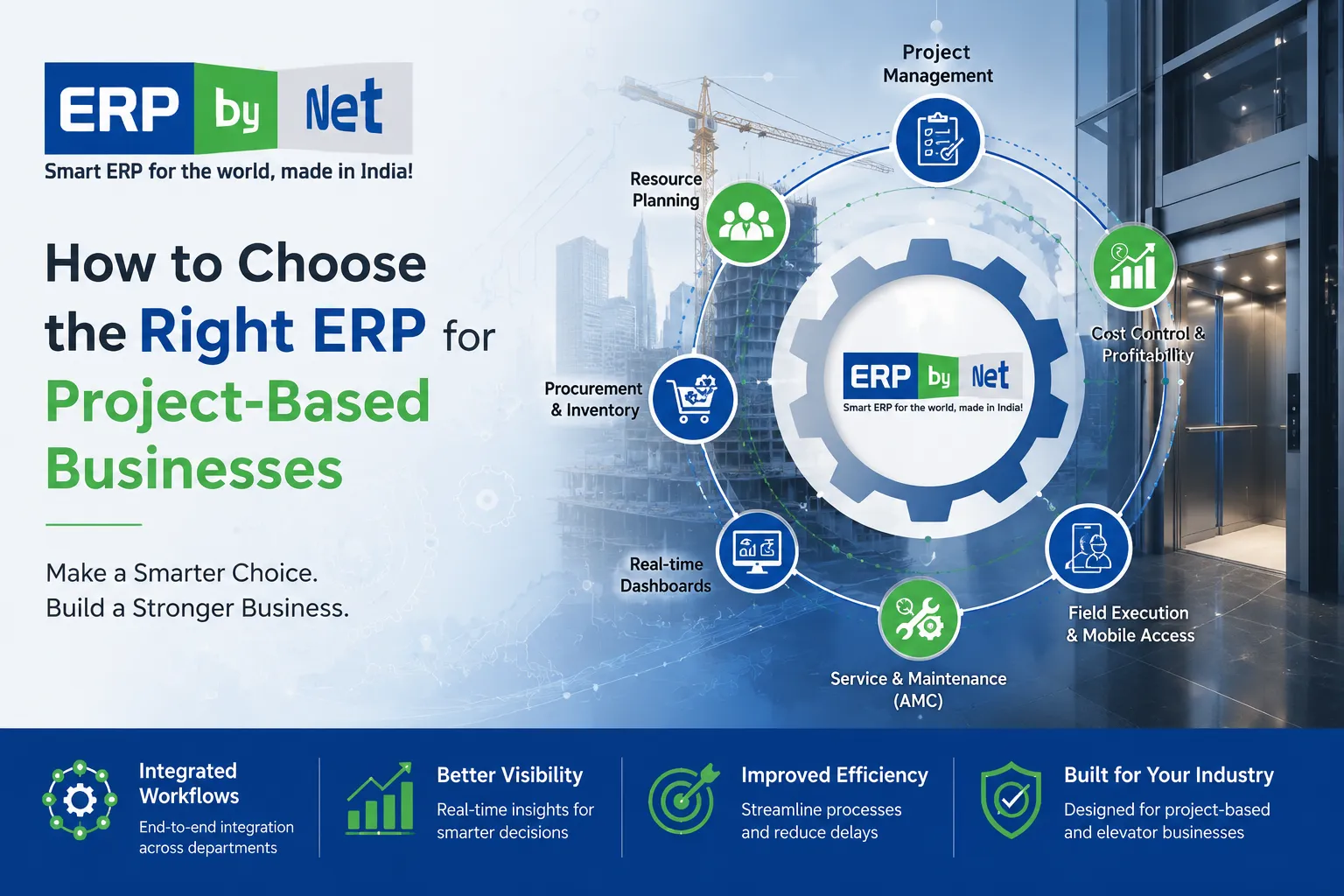
An ERP for Project-Based Businesses serves as the operational backbone of a business by connecting sales, project management, procurement, inventory, finance, customer service, and reporting into a single platform. However, selecting the right ERP requires careful evaluation. Not every ERP system is designed to handle the unique demands of project-driven organizations.
This guide explains the key factors businesses should evaluate before investing in an ERP solution and how to identify a system that can support long-term growth.
Why Project-Based Businesses Have Different ERP Requirements
Not all ERP systems are designed to support the way project-based businesses operate. One of the biggest mistakes organizations make during ERP evaluation is assuming that a solution built for manufacturing, retail, or distribution will automatically meet the needs of a project-driven business.
The reality is that project-based organizations operate in a far more dynamic and complex environment. Unlike businesses that follow repetitive processes and standardized workflows, every project comes with its own scope, timeline, budget, resource requirements, customer expectations, and profitability targets. Managing these moving parts effectively requires a completely different approach to planning, execution, and performance tracking.
Industries such as elevator installation, engineering, EPC contracting, infrastructure development, industrial services, and construction rely heavily on project execution for revenue and profitability. Success depends on having complete visibility and control over every stage of the project lifecycle—from the initial inquiry and quotation to procurement, execution, billing, and post-project service.
A project-based business must continuously coordinate multiple business functions, including:
Sales and quotation management
Project planning and scheduling
Resource allocation and workforce management
Procurement and vendor coordination
Inventory and material tracking
Site execution and progress monitoring
Project costing and financial control
Customer communication and service management
When these processes operate through separate systems or manual workflows, businesses often struggle with project delays, cost overruns, resource conflicts, and limited visibility into project performance.
This is why project-based businesses need an ERP that goes beyond traditional transaction management. The right ERP should act as a centralized platform that connects projects, resources, inventory, procurement, finance, and service operations. It should provide real-time insights into project progress, costs, profitability, and resource utilization, enabling teams to make faster and more informed decisions.
Ultimately, a project-focused ERP is not just about managing business processes—it’s about gaining the control, visibility, and operational efficiency needed to deliver projects successfully and scale the business with confidence.
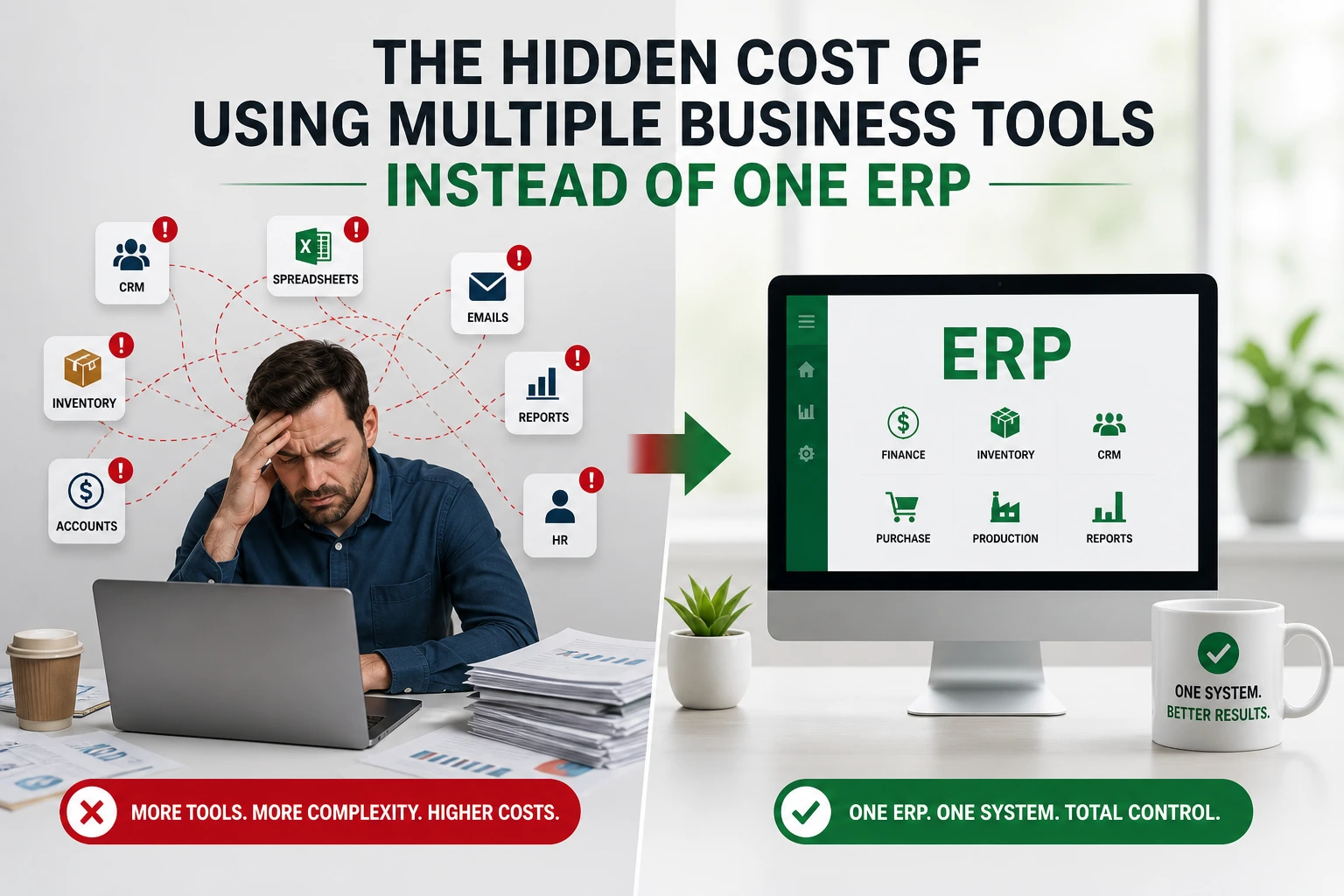
The Hidden Cost of Disconnected Systems
Many businesses do not realize the true cost of disconnected systems until operational inefficiencies begin affecting project timelines, profitability, and customer satisfaction. In the early stages of growth, separate tools and spreadsheets may appear manageable. However, as project volumes increase, these disconnected processes often become one of the biggest barriers to efficiency and scalability.
In many organizations, customer information is stored in a CRM, financial data resides in accounting software, project schedules are managed through spreadsheets, inventory is tracked separately, and service records are maintained in another system. While each department may perform its role effectively, the lack of integration creates information silos that make collaboration and decision-making increasingly difficult.
For example, a sales team may secure a new project and commit to a delivery timeline without complete visibility into material availability or resource capacity. Procurement teams may only discover shortages after the project begins, resulting in delayed purchases, project disruptions, increased costs, and missed deadlines. These challenges are not caused by poor planning—they are often the direct result of fragmented information spread across multiple systems.
As businesses grow, disconnected systems commonly lead to:
Duplicate data entry and manual work
Communication gaps between departments
Delayed reporting and slower decision-making
Inventory shortages and procurement bottlenecks
Resource allocation conflicts
Limited visibility into project costs and profitability
Increased operational risk and project delays
Perhaps the greatest challenge is the lack of real-time visibility. When critical business information is spread across multiple applications, management teams spend valuable time collecting and verifying data instead of making strategic decisions. By the time reports are compiled, the information may already be outdated.
An integrated ERP eliminates these silos by creating a single source of truth across the organization. Sales, projects, inventory, procurement, finance, and service teams can work from the same real-time data, ensuring better coordination, faster decision-making, and greater operational control.
For project-based businesses, this level of integration is no longer a competitive advantage—it’s a necessity. Organizations that continue relying on disconnected systems often struggle to scale efficiently, while those with an integrated ERP are better positioned to improve project execution, control costs, and drive sustainable growth.
Before ERP vs After ERP: What Business Transformation Really Looks Like
When evaluating ERP software, many organizations focus on features, dashboards, and technical capabilities. While these factors are important, the real value of an ERP system lies in how it transforms business operations. The goal is not simply to replace spreadsheets or automate tasks—it is to create a more connected, efficient, and scalable organization.
In many project-based businesses, teams work across multiple systems to manage projects, inventory, procurement, finance, and service operations. As project volumes increase, this fragmented approach often leads to delays, communication gaps, and limited visibility into business performance.
The difference between operating with and without an integrated ERP can be significant.
Before ERP
After ERP
Project information is spread across multiple systems
All departments work from a single platform
Teams rely on manual updates and spreadsheets
Real-time information is available instantly
Reporting takes hours or days to compile
Reports and dashboards are available on demand
Resource planning is reactive
Resource allocation becomes proactive
Inventory and projects operate separately
Inventory, procurement, and projects are connected
Cost tracking is often delayed
Project profitability can be monitored in real time
Decision-making depends on manual reports
Leaders gain immediate operational insights
Without an ERP, management teams often spend valuable time gathering information from different departments before making decisions. With an integrated ERP, information flows automatically between teams, enabling faster responses, better planning, and stronger operational control.
Perhaps the most important transformation is the shift from reactive management to proactive decision-making. Instead of identifying problems after they occur, businesses gain the visibility needed to prevent issues before they impact project timelines, profitability, or customer satisfaction.
Focus on Business Workflows, Not Just Features
One of the most common mistakes businesses make during ERP evaluation is focusing entirely on software features. During demonstrations, vendors often highlight dashboards, reports, analytics, and automation capabilities. While these features may look impressive, they do not necessarily determine whether the ERP will support your day-to-day operations.
The most important question to ask is:
Does this ERP support the way our business actually works?
For project-based organizations, workflows are at the center of every operation. Projects involve multiple departments working together, and information must move seamlessly from one stage to the next.
A typical project lifecycle may look like this:
Lead Generation → Site Survey → Quotation → Project Planning → Procurement → Inventory Allocation → Installation → Billing → Handover → Service & AMC Management
When these processes are managed through separate systems, businesses often experience:
Communication gaps between departments
Duplicate data entry
Delayed approvals
Limited project visibility
Cost tracking challenges
Slower customer response times
A well-designed ERP connects the entire workflow into a single process. This ensures that sales teams, project managers, procurement teams, finance departments, and service teams are all working with the same information.
When evaluating ERP solutions, ask vendors to demonstrate complete business workflows such as:
Lead-to-project conversion
Project planning and execution
Procurement and purchasing processes
Inventory allocation
Resource management
Project billing and invoicing
Service and maintenance management
An ERP that supports your complete business process will deliver significantly more value than one that simply offers a long list of features.
Real-Time Project Cost Tracking Should Be Non-Negotiable
For project-based businesses, profitability is determined by how effectively costs are controlled throughout project execution. Unfortunately, many organizations only gain visibility into project expenses after the work has been completed.
By that stage, there is little opportunity to recover lost margins.
A project-focused ERP should provide real-time visibility into project performance, allowing management teams to monitor costs as they occur rather than after the fact.
Key areas that should be tracked include:
Labor costs
Material consumption
Vendor invoices
Subcontractor expenses
Transportation and logistics costs
Equipment utilization
Budget versus actual spending
Consider a project that was estimated to generate a healthy profit margin. During execution:
Material prices increase unexpectedly
Additional labor is required
Procurement delays create overtime costs
Site conditions increase project expenses
Without real-time cost tracking, these issues may only become visible during project closure. By then, profitability has already been affected.
With an ERP, management teams can identify cost variances early and take corrective action such as:
Adjusting procurement strategies
Reallocating resources
Revising project schedules
Improving budget controls
The result is stronger financial control, improved forecasting accuracy, and fewer surprises at project completion.
Resource Planning Is a Competitive Advantage
Many project delays occur despite having skilled employees and sufficient manpower. The issue is often not a shortage of resources but a lack of visibility into how those resources are allocated.
As businesses grow, managing engineers, technicians, supervisors, project managers, and service teams becomes increasingly complex. Without proper planning, organizations frequently face scheduling conflicts, resource shortages, and uneven workloads.
A project-based ERP provides complete visibility into workforce availability and utilization.
Management teams should be able to answer questions such as:
Which employees are available next week?
Which projects require additional resources?
Are specific teams overloaded?
Where are resource bottlenecks occurring?
What workforce requirements are expected in the coming months?
With this visibility, organizations can plan proactively rather than reactively.
Benefits of effective resource planning include:
Improved workforce productivity
Reduced project delays
Better workload distribution
Increased employee utilization
Higher customer satisfaction
Greater scalability
Organizations that manage resources effectively can often complete more projects without significantly increasing headcount, creating a clear competitive advantage.
Inventory and Procurement Must Be Connected to Projects
For project-based businesses, materials often represent one of the largest project costs. Yet inventory and procurement are frequently managed separately from project execution, creating challenges that directly impact schedules and profitability.
A common scenario involves a project being approved and scheduled before material availability has been verified. Installation teams are ready to begin work, only to discover that critical components are unavailable.
This often leads to:
Emergency purchase orders
Supplier delays
Project rescheduling
Increased procurement costs
Missed customer commitments
An integrated ERP eliminates these challenges by connecting project planning, inventory management, and procurement activities within a single system.
This provides visibility into:
Project & Procurement Visibility
Material requirements by project
Current inventory availability
Purchase requisitions and approvals
Supplier performance
Expected delivery schedules
Material consumption tracking
Instead of reacting to shortages after they occur, businesses can plan inventory and procurement based on actual project demand.
The benefits include:
Reduced project delays
Improved inventory accuracy
Better procurement planning
Lower inventory carrying costs
Increased project profitability
For industries such as elevator installation, engineering, EPC contracting, and construction, this level of integration is essential for maintaining project schedules, controlling costs, and ensuring successful project delivery.
Mobile Access Is Essential for Modern Project Execution
Modern project execution no longer happens from a single office location. Project managers, engineers, technicians, supervisors, and service teams spend a significant amount of time at customer sites, warehouses, manufacturing facilities, and project locations. In such environments, relying solely on office-based systems can create communication delays, reduce visibility, and slow decision-making.
This is why mobile accessibility has become a critical ERP requirement rather than an optional feature. A modern ERP should enable field teams to access and update information in real time, regardless of their location.
With mobile-enabled ERP software, field personnel can:
Update project progress instantly
Record site activities and work completed
Mark attendance and workforce availability
Upload photographs, documents, and inspection reports
Report material consumption from the site
Access project drawings and customer information
Generate service reports
Capture customer approvals digitally
The biggest advantage of mobile ERP is real-time visibility. Instead of waiting for daily reports or weekly review meetings, management teams can monitor project activities as they happen. This improves accountability, reduces paperwork, and enables faster decision-making.
For businesses managing multiple projects across different locations, mobile accessibility helps improve operational efficiency, project control, and customer responsiveness.
Industry-Specific ERP vs Generic ERP: Which One Delivers Better Results?
One of the most important decisions during ERP selection is choosing between a generic ERP platform and an industry-specific solution. While generic ERP systems often promise flexibility and broad functionality, they may not always align with the unique workflows of project-based businesses.
The difference becomes clear when comparing both approaches.
Generic ERP
Industry-Specific ERP
Designed for multiple industries
Designed around industry workflows
Requires significant customization
Minimal customization required
Longer implementation timelines
Faster deployment
Higher implementation costs
Lower total cost of ownership
Complex upgrades due to customizations
Easier maintenance and upgrades
Greater reliance on consultants
Faster user adoption
Generic reporting and workflows
Industry-focused processes and reports
For example, an elevator company manages much more than inventory and accounting. It must coordinate site surveys, quotations, project planning, procurement, installation activities, modernization projects, breakdown services, annual maintenance contracts (AMC), technician scheduling, and spare parts management.
A generic ERP often requires extensive customization to support these processes. In contrast, an industry-specific ERP is built around these workflows from the start, allowing businesses to achieve faster implementation, improved operational efficiency, and quicker ROI.
When evaluating ERP solutions, business leaders should ask not only what the software can do today but also how much effort, time, and investment will be required to make it fit their business tomorrow.
ERP demonstrations are often designed to impress prospective buyers. However, attractive dashboards and polished presentations do not necessarily indicate that the software is the right fit for your business.
Recognizing potential warning signs early can help prevent costly implementation mistakes and reduce project risk.
1. The Demo Focuses More on Dashboards Than Workflows
Dashboards provide visibility, but they are not the business process itself. If most of the demonstration revolves around charts, reports, and analytics without showing how projects actually move through the system, the vendor may be prioritizing presentation over functionality.
Ask the vendor to demonstrate a complete project lifecycle—from inquiry to project completion.
2. Real Business Processes Are Not Demonstrated
An ERP should support end-to-end business operations, not isolated activities.
Request demonstrations of:
Lead and quotation management
Project planning and execution
Procurement workflows
Inventory allocation
Billing and invoicing
Service and maintenance management
If these workflows cannot be demonstrated clearly, the software may not align with your operational requirements.
3. Excessive Customization Is Suggested
Customization should address unique business needs, not basic operational requirements.
Be cautious when vendors frequently respond with:
“We can customize that.”
“We can build that later.”
“That will require additional development.”
These responses may indicate that essential functionality is not available within the standard product.
4. Project Cost Tracking Is Limited
For project-based businesses, profitability depends on accurate cost visibility.
The ERP should clearly demonstrate:
Budget tracking
Actual cost monitoring
Project profitability reporting
Cost variance analysis
Without these capabilities, controlling project margins becomes difficult.
5. Inventory and Projects Operate Independently
Projects and materials should be tightly connected. If inventory management functions separately from project execution, businesses may continue experiencing procurement delays, stock shortages, and scheduling issues even after implementation.
6. Mobile Functionality Is Weak
Field teams are a critical part of project execution. Limited mobile access can create communication gaps, delayed reporting, and reduced visibility into site activities.
Ensure the ERP supports real-time updates from project locations and service teams.
7. Implementation Expectations Are Unclear
A reliable ERP partner should provide a well-defined implementation roadmap.
Key areas that should be clearly explained include:
Project phases and milestones
Expected implementation timeline
Data migration strategy
User training plans
Post-implementation support
Successful ERP implementation depends as much on planning and execution as it does on the software itself. If a vendor cannot clearly explain how the implementation will be managed, it may indicate future project risks.
Before making a final decision, evaluate not only the software but also the vendor’s understanding of your industry, business processes, and long-term growth objectives.
Common ERP Selection Mistakes Businesses Should Avoid
Selecting an ERP is a major business decision, yet many implementation challenges can be traced back to mistakes made during the evaluation stage rather than the implementation itself. Choosing the wrong ERP can lead to operational disruptions, higher costs, poor user adoption, and limited return on investment. Understanding these common mistakes can help businesses make a more informed decision and improve the chances of a successful ERP implementation.
1. Choosing an ERP Based Solely on Price
Budget is an important consideration, but selecting an ERP based purely on cost can be a costly mistake. A lower-priced solution that fails to support critical business processes often results in additional customization, operational inefficiencies, and future system replacements.
Instead of asking, “Which ERP costs less?”, businesses should ask:
Which ERP delivers the best long-term value?
Which solution aligns with our business processes?
Which system can support future growth?
The true cost of an ERP extends beyond licensing fees and includes implementation, training, maintenance, scalability, and operational efficiency.
2. Focusing Only on Current Business Needs
Many organizations evaluate ERP software based only on today’s challenges without considering future growth.
However, ERP is a long-term investment that should support the business for years to come. As organizations grow, their requirements evolve, and the ERP must be capable of scaling alongside them.
Consider whether the ERP can support:
Current Needs
Future Requirements
Existing users
Additional employees and departments
Single location operations
Multi-location management
Current project volume
Increased project complexity and workload
Basic reporting
Advanced analytics and dashboards
Existing services
New business lines and offerings
Choosing an ERP with scalability in mind helps avoid costly migrations and upgrades in the future.
3. Ignoring User Adoption and Ease of Use
Even the most powerful ERP system will fail to deliver results if employees find it difficult to use.
ERP success depends heavily on user adoption. If teams continue relying on spreadsheets or manual processes because the system feels complicated, the organization will struggle to realize the full value of its investment.
Before making a decision, evaluate:
User interface and ease of navigation
Learning curve for employees
Mobile accessibility
Training requirements
Employee acceptance and engagement
An ERP should simplify work, not create additional complexity.
4. Underestimating Implementation Requirements
Many businesses assume ERP implementation is simply a software installation. In reality, it is a business transformation project that requires careful planning and coordination.
A successful implementation typically involves:
Business process evaluation
Data migration and validation
System configuration
User training
Change management
Testing and go-live support
Organizations that underestimate these requirements often experience delays, budget overruns, and user resistance. Understanding the implementation effort upfront helps set realistic expectations and improves project success.
5. Selecting Software Before Defining Business Processes
One of the most common ERP selection mistakes is evaluating software before fully understanding internal workflows and operational challenges.
Before engaging with ERP vendors, businesses should clearly document:
Existing business processes
Operational bottlenecks
Project management challenges
Reporting requirements
Future business goals
This preparation enables organizations to evaluate ERP solutions based on actual business needs rather than marketing presentations or feature lists.
Ultimately, the best ERP is not necessarily the one with the most features—it’s the one that aligns most closely with your business processes, growth plans, and operational objectives.
Questions Every Business Should Ask ERP Vendors
Choosing an ERP partner requires more than reviewing product brochures and watching demonstrations. The quality of the questions asked during the evaluation process often determines the quality of the final decision.
Rather than focusing exclusively on features, organizations should evaluate how well the ERP supports their business model, project workflows, and long-term objectives.
Business & Industry Fit
Understanding the vendor’s industry experience is essential, especially for project-based businesses.
Ask questions such as:
Which industries do you primarily serve?
Do you have experience with project-based businesses?
Can you provide examples of similar implementations?
What industry-specific workflows are available out of the box?
A vendor that understands your industry can often deliver faster implementation and better business outcomes.
Project Management & Profitability
Project visibility and profitability are critical for project-driven organizations.
Ask:
How are projects planned, scheduled, and tracked?
Can project profitability be monitored in real time?
How does the ERP track project budgets and actual costs?
Can project performance be analyzed at different stages?
These capabilities help businesses maintain control over project execution and profitability.
Inventory & Procurement Management
Inventory and procurement should be closely connected to project activities.
Key questions include:
How are material requirements linked to projects?
Can inventory be reserved for specific projects?
How are purchase requisitions and approvals managed?
Does the ERP provide supplier performance tracking?
Strong integration between projects, inventory, and procurement can significantly improve efficiency and reduce delays.
Resource Planning & Workforce Management
For project-based organizations, workforce planning is essential.
Ask vendors:
How are employees assigned to projects?
Can resource utilization be monitored in real time?
Are workload balancing and forecasting tools available?
Can future resource requirements be planned?
These capabilities help improve productivity and ensure optimal resource utilization.
Mobile Accessibility & Field Operations
Modern projects often involve teams working across multiple locations.
Important questions include:
What ERP functions are available through mobile devices?
Can field teams update project information in real time?
Does the mobile application support offline access?
Can technicians upload documents, photos, and service reports from the field?
Mobile accessibility is increasingly essential for improving project visibility and operational responsiveness.
Implementation, Training & Support
The ERP software is only one part of the equation. The vendor’s implementation and support capabilities are equally important.
Ask:
What does the implementation process involve?
What is the expected deployment timeline?
What training programs are included?
How is data migration handled?
What ongoing support services are available after go-live?
Clear answers to these questions provide valuable insight into the vendor’s ability to support a successful implementation.
The more thoroughly businesses evaluate ERP vendors, the greater the likelihood of selecting a solution that supports operational efficiency, project profitability, and long-term business growth.
Why ERP Selection Is a Long-Term Strategic Investment
Many businesses begin their ERP search by comparing software features, pricing, and implementation costs. While these factors are important, ERP selection should be viewed as a long-term business decision rather than simply a software purchase. The right ERP becomes the operational foundation of the organization, influencing how projects are managed, resources are allocated, inventory is controlled, financial performance is monitored, and customer commitments are delivered.
As project-based businesses grow, operational complexity naturally increases. More projects, larger teams, additional suppliers, expanding service offerings, and higher customer expectations create challenges that manual processes and disconnected systems often struggle to support. An ERP that meets today’s requirements may become a limitation tomorrow if it cannot scale alongside business growth.
For this reason, organizations should evaluate ERP solutions based on their ability to support future objectives such as:
Business expansion and increased project volume
Workforce growth and resource management
Multi-location operations
Enhanced customer service
Advanced reporting and business analytics
Another important consideration is process standardization. As companies grow, different departments often develop their own ways of working, resulting in communication gaps, inconsistent processes, duplicate data, and operational inefficiencies. A well-implemented ERP creates a unified framework that connects teams through standardized workflows, shared information, and common business objectives. This consistency becomes increasingly valuable as the organization scales.
Perhaps the greatest advantage of an ERP system is the visibility it provides. Instead of relying on spreadsheets, manually compiled reports, or fragmented information from multiple systems, decision-makers gain real-time insights into project performance, inventory availability, resource utilization, procurement activities, and financial health. This enables faster and more informed decision-making while helping businesses remain agile in a competitive environment.
Ultimately, ERP is not just an investment in technology—it’s an investment in operational efficiency, scalability, and long-term growth. Organizations that take a strategic approach to ERP selection are better positioned to improve performance, maintain control as they expand, and build a strong foundation for sustainable success.
How ERPbyNet Supports Project-Based Businesses
For project-based organizations, success depends on maintaining control over projects, resources, inventory, procurement activities, service operations, and profitability.
Managing these functions through disconnected systems often creates operational inefficiencies that limit growth and reduce visibility.
ERPbyNet has been designed specifically to address these challenges by providing a unified platform for managing the complete project lifecycle.
Rather than treating projects, inventory, procurement, finance, and service operations as separate activities, ERPbyNet connects them into a single system that enables departments to work together more effectively.
Businesses can manage:
Customer inquiries and sales opportunities
Site surveys and quotations
Project planning and execution
Procurement and vendor management
Inventory and material tracking
Resource allocation
Installation activities
Financial management
Annual maintenance contracts
Breakdown service operations
Management reporting and analytics
This integrated approach provides greater visibility across the organization while reducing manual work and improving operational efficiency.
For industries such as elevator manufacturing, elevator installation, modernization projects, engineering services, and project-based contracting businesses, having access to real-time operational data can significantly improve decision-making and project control.
Instead of relying on multiple systems and spreadsheets, teams can work from a centralized platform that provides accurate information throughout the project lifecycle.
The result is improved coordination, better cost control, stronger project visibility, and greater confidence in business decisions.
Final Thoughts
Choosing the right ERP can have a significant impact on how efficiently your business manages projects, controls costs, utilizes resources, and scales for future growth. The right solution should do more than automate processes—it should provide complete visibility across your operations, improve decision-making, and help you deliver projects more profitably and consistently.
If you’re evaluating ERP solutions for your project-based business, it’s important to choose a platform that aligns with your workflows, industry requirements, and long-term business goals.
Ready to explore how ERP can transform your operations? Schedule a free consultation with the ERPbyNet team to discuss your business challenges, evaluate your current processes, and discover how a project-focused ERP solution can help improve project visibility, operational efficiency, and profitability.
Frequently Asked Questions (FAQs)
What is ERP software for project-based businesses?
ERP software for project-based businesses is a centralized system that helps organizations manage projects, resources, inventory, procurement, finance, and customer relationships from a single platform. It provides better visibility and control over project execution while improving collaboration across departments.
Why do project-based businesses need an ERP system?
As project volumes grow, managing operations through spreadsheets and disconnected software becomes inefficient. An ERP system streamlines processes, improves project tracking, enhances resource utilization, and helps businesses maintain control over costs, timelines, and profitability.
How is a project-based ERP different from a traditional ERP?
A project-based ERP is specifically designed to manage projects, budgets, resources, and project profitability. Unlike traditional ERP systems that focus on repetitive operations, it supports project planning, execution, cost tracking, and project lifecycle management.
What features should I look for in a project-based ERP?
Key features include project management, resource planning, inventory management, procurement, project cost tracking, profitability analysis, reporting dashboards, mobile accessibility, and integration between departments. Industry-specific functionality is also important.
Can ERP help improve project profitability?
Yes. ERP software provides real-time visibility into project costs, labor expenses, material usage, and budgets. This helps businesses identify cost overruns early, improve financial control, and increase overall project profitability.
How does ERP improve project visibility?
ERP provides a centralized view of project progress, milestones, budgets, resources, and financial performance. Managers can access real-time information and make faster, more informed decisions throughout the project lifecycle.
Can ERP manage multiple projects simultaneously?
Yes. Modern ERP systems are designed to handle multiple projects at the same time. Businesses can monitor project schedules, resource allocation, costs, and profitability across all active projects from a single platform.
Why is inventory integration important in project-based ERP?
Inventory integration ensures materials are available when required for project execution. It helps prevent stock shortages, reduces procurement delays, improves material tracking, and supports better project planning and cost control.
Should I choose a generic ERP or an industry-specific ERP?
An industry-specific ERP is often the better choice because it is built around the unique workflows and challenges of your business. It typically requires less customization, offers faster implementation, and delivers greater operational value.
Why is ERPbyNet a good choice for project-based businesses?
ERPbyNet helps businesses manage the complete project lifecycle, from lead management and quotations to project execution, inventory control, AMC management, and service operations. Its integrated approach improves visibility, efficiency, and profitability while supporting long-term business growth.
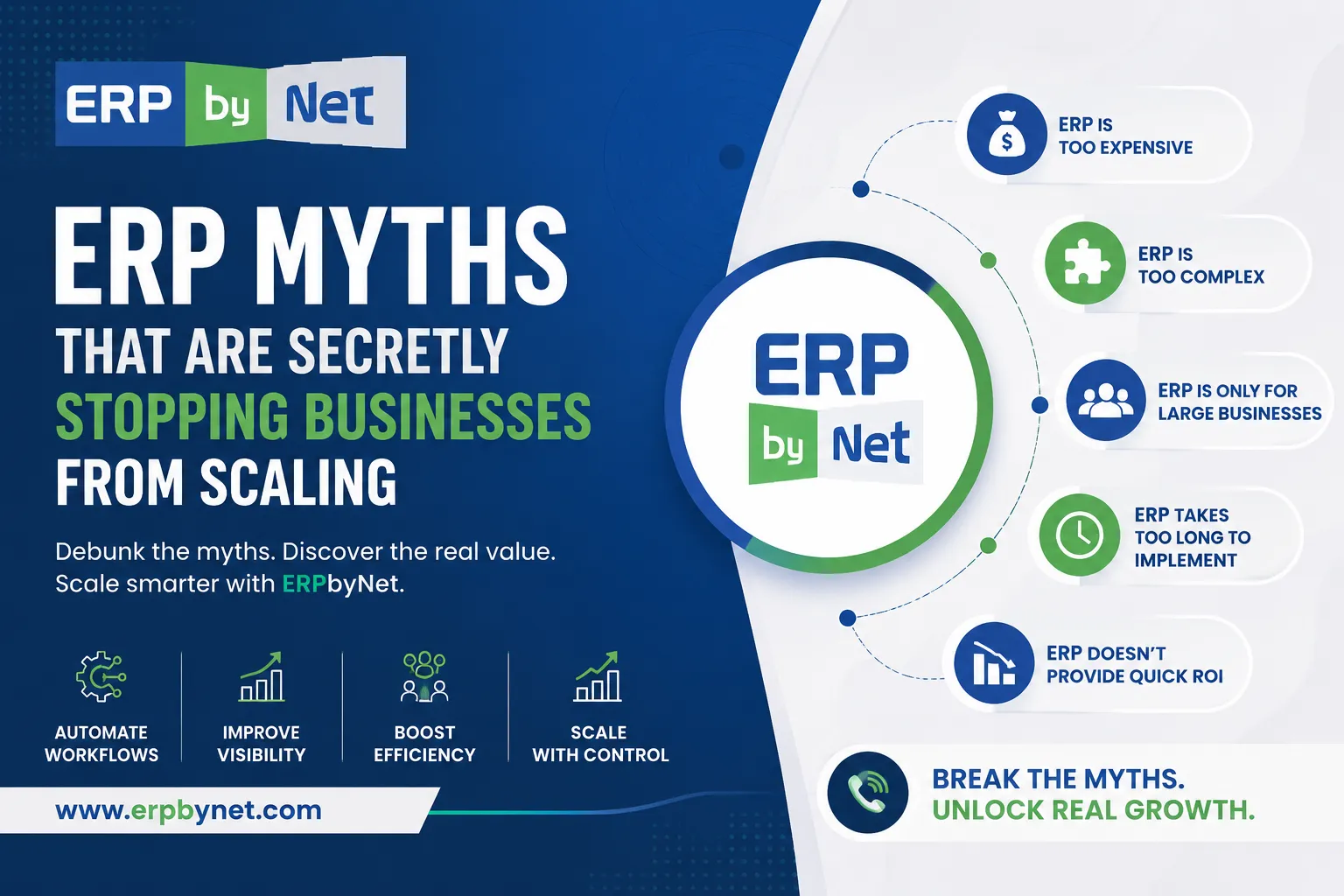
Many businesses delay ERP adoption because of common myths that no longer reflect modern ERP capabilities.
ERP is not just for large enterprises; small and mid-sized businesses can benefit significantly from automation and centralized operations.
Modern cloud ERP solutions are affordable and scalable, making implementation easier than ever before.
Manual processes and disconnected systems often become the biggest barriers to business growth.
Businesses that overcome ERP misconceptions gain better visibility, efficiency, and long-term scalability.
What You’ll Learn
The most common ERP myths that prevent businesses from scaling.
Why spreadsheets and disconnected software tools create operational bottlenecks.
How modern ERP systems streamline workflows across departments.
Why ERP implementation is no longer as costly or complex as many businesses assume.
How ERPbyNet helps growing businesses automate operations and scale with confidence.
Real Insights
The cost of avoiding ERP is often higher than implementing it, especially when inefficiencies grow with business expansion.
Businesses relying on manual coordination frequently face delays, errors, and limited operational visibility.
Cloud-based ERP solutions provide faster deployment and easier adoption than traditional on-premise systems.
Scalable businesses need centralized data and real-time reporting to make informed decisions.
Successful growth starts with eliminating operational myths and embracing technology that supports long-term expansion.
Businesses today are under constant pressure to grow faster, improve customer experience, reduce operational delays, and maintain complete visibility across departments. Whether it is a service business, maintenance company, distributor, or operational enterprise, modern growth depends heavily on how efficiently workflows are managed internally.
However, many businesses still operate using disconnected systems such as spreadsheets, manual approvals, WhatsApp coordination, paper records, and scattered reporting tools. While these methods may seem manageable initially, they gradually become one of the biggest obstacles preventing businesses from scaling efficiently.
One major reason behind this problem is the continued belief in outdated ERP myths.
Even today, many organizations assume ERP software is:
too expensive for growing businesses,
only useful for large enterprises,
difficult to implement,
overly complicated for employees,
or unnecessary for service operations.
Because of these misconceptions, businesses continue depending on manual operational systems long after they have outgrown them.
The result is increasing operational confusion, slower decision-making, reporting delays, workflow bottlenecks, poor coordination, and limited visibility across teams.
Modern ERP platforms like ERPbyNet are helping businesses replace disconnected operational structures with centralized systems that improve visibility, automate workflows, and support long-term scalable growth.
In this blog, we will break down some of the biggest ERP myths that stop businesses from scaling and explain why modern operational visibility has become essential for sustainable business growth.
Why Businesses Struggle to Scale Without ERP
Image Source: ChatGPT
Many companies believe scaling challenges are caused by market competition, staffing limitations, or business expansion pressure.
In reality, operational inefficiency is often one of the biggest hidden reasons businesses struggle during growth phases.
In the early stages of a business, manual coordination usually works because operations are relatively simple. Teams are smaller, approvals are fewer, and communication happens directly between employees.
But as the business grows, operational complexity increases rapidly.
Businesses begin managing:
larger teams,
more customer requests,
higher inventory movement,
multiple service workflows,
technician coordination,
branch operations,
approvals,
and reporting requirements.
Without centralized systems, these growing workflows become difficult to control efficiently.
Departments begin operating independently, information gets scattered across different tools, and managers lose real-time visibility into daily operations.
This eventually creates operational silos that slow productivity and impact customer experience.
Common Operational Problems Businesses Face Without ERP
Over time, these operational gaps begin affecting:
customer satisfaction,
team productivity,
operational efficiency,
and overall business scalability.
This is where ERP systems become critical.
ERP is no longer just software for accounting or manufacturing. Modern ERP acts as a centralized operational system that connects departments, automates workflows, and improves business visibility in real time.
One of the most outdated misconceptions about ERP systems is that they are designed only for multinational corporations or massive manufacturing companies.
This belief prevents many growing businesses from modernizing operations early enough.
Years ago, ERP systems were indeed expensive and infrastructure-heavy. Businesses needed dedicated servers, large IT teams, and long implementation cycles.
Modern ERP systems are completely different.
Today’s cloud-based ERP platforms are designed specifically for:
growing businesses,
service companies,
field service organizations,
maintenance businesses,
distributors,
AMC providers,
and multi-location operations.
Modern ERP systems are modular and scalable, which means businesses can start small and expand gradually based on operational requirements.
For example, a service business may initially implement ERP for:
complaint management,
technician tracking,
and attendance monitoring.
Later, the same business can expand into:
inventory management,
maintenance scheduling,
AMC management,
customer communication,
and reporting automation.
This flexibility makes ERP practical even for medium-sized businesses.
Traditional ERP vs Modern ERP
Traditional ERP
Modern ERP
High upfront investment
Flexible subscription models
Complex infrastructure
Cloud-based deployment
Long implementation cycles
Faster phased implementation
Heavy IT dependency
User-friendly systems
Limited flexibility
Scalable modular structure
The reality is that smaller growing businesses often need ERP earlier because operational inefficiencies affect them faster during expansion.
Without centralized operational visibility, businesses eventually become dependent on:
manual coordination,
employee memory,
scattered spreadsheets,
and disconnected communication.
This creates operational instability that limits scalability.
Myth 2: Spreadsheets Are Enough to Manage Operations
Many businesses continue relying heavily on spreadsheets because they initially seem simple and cost-effective.
However, spreadsheets are not designed to manage growing operational ecosystems.
As businesses expand, spreadsheets slowly become one of the largest sources of operational inefficiency.
Different departments often maintain separate sheets for:
inventory,
attendance,
complaints,
service schedules,
approvals,
reporting,
and customer updates.
Because these systems operate independently, information becomes fragmented across the organization.
Managers often struggle with:
outdated reports,
version confusion,
duplicate entries,
delayed updates,
and inconsistent operational visibility.
This becomes especially problematic for service and maintenance businesses where workflows are highly dynamic.
For example, businesses managing field technicians manually often face challenges such as:
delayed technician allocation,
missed service requests,
inventory mismatch,
poor complaint tracking,
and delayed reporting.
Employees spend large amounts of time coordinating information manually instead of improving productivity.
What Happens When Businesses Depend Too Much on Spreadsheets
Operational Visibility Becomes Limited
Managers cannot access real-time operational insights because information is scattered across multiple files and departments.
Reporting Becomes Slow
Teams spend hours preparing reports manually, reducing decision-making speed.
Human Errors Increase
Manual data entry creates duplication, missing information, and inaccurate reporting.
Workflow Coordination Weakens
Departments struggle to stay aligned because updates are not centralized.
Scaling Becomes Difficult
As operational complexity increases, manual systems become increasingly difficult to manage.
ERP systems solve these problems by centralizing workflows into one connected operational platform.
With ERPbyNet, businesses can manage:
complaint workflows,
technician coordination,
inventory movement,
maintenance scheduling,
attendance tracking,
customer management,
and operational reporting
through one centralized system.
This improves operational clarity while reducing dependency on scattered manual systems.
One of the biggest misconceptions about ERP is that implementation cost is too high for growing businesses.
However, many companies fail to calculate the actual cost of operational inefficiency.
Businesses operating without centralized systems often experience hidden losses such as:
duplicate work,
reporting delays,
inventory leakage,
missed follow-ups,
technician inefficiency,
delayed approvals,
and poor workflow coordination.
These inefficiencies silently increase operational expenses over time.
For example, businesses managing AMC operations manually may lose revenue because renewal tracking becomes inconsistent. Service businesses may experience customer dissatisfaction due to delayed complaint handling or poor technician visibility.
These operational losses accumulate gradually and often become much more expensive than ERP implementation itself.
Hidden Cost of Manual Operations
Manual Operational Problem
Business Impact
Delayed reporting
Slower decision-making
Inventory mismatch
Financial loss and stock issues
Missed service requests
Poor customer experience
Manual approvals
Workflow bottlenecks
Disconnected communication
Operational confusion
Technician inefficiency
Reduced productivity
Poor visibility
Limited operational control
Modern ERP systems are also significantly more affordable than traditional ERP platforms because:
cloud deployment reduces infrastructure costs,
subscription models reduce upfront investment,
and phased implementation reduces operational risk.
ERP should not be viewed simply as software expenditure.
It should be viewed as an operational investment that improves visibility, productivity, workflow efficiency, and long-term scalability.
Myth 4: ERP Systems Are Too Complicated for Employees
Many businesses fear employees may struggle to adapt to ERP systems.
However, most organizations are already operating within highly complicated manual environments without realizing it.
Employees often work across:
spreadsheets,
WhatsApp groups,
email threads,
manual approvals,
repeated reporting,
and disconnected software tools.
This creates operational confusion that reduces efficiency and increases dependency on manual coordination.
Modern ERP systems are designed specifically to simplify workflows by centralizing operational information into one structured platform.
Instead of searching through multiple systems, employees can access:
customer details,
complaint status,
inventory visibility,
technician schedules,
service reports,
approvals,
and operational dashboards
through a single interface.
This improves:
workflow clarity,
coordination speed,
operational transparency,
and accountability across departments.
ERP systems are not designed to complicate operations.
They are designed to remove unnecessary operational friction that businesses experience during growth.
Before ERP vs After ERP: The Transformation Businesses Experience
As businesses grow, manual processes and disconnected systems often struggle to keep pace with increasing operational demands. This leads to inefficiencies, communication gaps, and limited visibility across departments. Implementing an ERP system transforms these challenges into streamlined, automated workflows that support sustainable growth.
Before ERP Implementation
After ERP Implementation
Customer complaints are tracked manually, causing delays and missed follow-ups.
Complaints are logged, assigned, and tracked automatically for faster resolution.
Inventory information is scattered across spreadsheets, leading to stock discrepancies.
Real-time inventory visibility ensures accurate stock management and better planning.
Technician assignments rely on calls and manual coordination.
Technician scheduling and tracking are automated with real-time status updates.
Customer communication is fragmented across emails, calls, and messages.
All customer interactions are centralized for better service management.
Automated reports provide instant access to accurate business insights.
Approval processes are slow and difficult to monitor.
Digital workflows streamline approvals and improve accountability.
Departments operate independently, creating information silos.
Connected workflows improve collaboration and information sharing across teams.
Management lacks real-time visibility into operations.
Live dashboards provide complete operational visibility and performance tracking.
The Result: A More Scalable Business
With ERP in place, businesses gain centralized control over their operations, allowing teams to work more efficiently and make better decisions based on real-time data. Instead of spending time managing operational bottlenecks, organizations can focus on improving customer satisfaction, increasing productivity, and driving business growth.
This shift from manual coordination to automated workflow management enables businesses to scale with greater efficiency, visibility, and control while reducing operational complexity.
How ERPbyNet Helps Businesses Scale Efficiently
Image Source: ChatGPT
ERPbyNet helps growing businesses move from disconnected manual processes to a fully centralized and automated ERP system. As operations expand, managing teams, customers, inventory, and services becomes complex. ERPbyNet simplifies this by bringing everything into one platform with real-time visibility and control.
Instead of relying on spreadsheets, WhatsApp, and separate tools, businesses get one connected system where every workflow is trackable, measurable, and easy to manage.
ERPbyNet supports key business operations such as:
Complaint Management: Centralized logging, tracking, and faster resolution of customer issues.
Technician Tracking: Real-time monitoring of field staff, job allocation, and task progress.
Maintenance Workflows: Timely scheduling and execution of preventive maintenance tasks.
Inventory Operations: Accurate stock tracking and real-time inventory visibility.
Attendance Systems: Automated tracking for employees and field teams.
AMC Management: Efficient tracking of contracts, renewals, and service schedules.
Operational Dashboards: Real-time insights for faster decision-making.
Reporting Automation: Instant, accurate business reports without manual effort.
By connecting all operations in one system, ERPbyNet removes manual coordination and improves overall efficiency across departments.
This leads to better workflow speed, improved visibility, stronger coordination, and reduced operational delays. As businesses grow, ERPbyNet ensures scaling remains smooth, structured, and fully controlled without operational chaos.
Final Thoughts
ERP myths continue to stop many businesses from modernizing operations, even as operational complexity keeps increasing across industries. What begins as manageable manual work eventually turns into disconnected workflows, delayed communication, and reduced visibility across teams.
The reality is that manual systems create limitations in productivity, reporting speed, customer experience, and overall workflow efficiency. As businesses grow, these issues become harder to manage without a centralized system.
Modern ERP systems are now scalable, flexible, cloud-based, user-friendly, and easier to implement than ever before. They help businesses bring structure and automation into daily operations.
Businesses that adopt ERP early gain a clear advantage by scaling efficiently without losing control or visibility.
ERP solutions like ERPbyNet help businesses move from manual processes to centralized, growth-focused systems that support long-term success.
If you’re ready to improve operational efficiency, contact us today to get started with ERPbyNet.
Frequently Asked Questions (FAQs)
Why do businesses delay ERP implementation?
Many businesses delay ERP implementation because they assume it is expensive, complex, or only meant for large enterprises. However, as operations grow, manual processes and disconnected systems start creating delays, inefficiencies, and poor visibility that slow down overall business growth.
Is ERP only useful for manufacturing companies?
No, ERP is widely used across service industries, maintenance companies, retail, logistics, healthcare, distributors, and field service businesses. It helps organizations centralize operations, automate workflows, and improve visibility across all departments.
How does ERP help businesses scale?
ERP supports business growth by centralizing workflows, automating repetitive tasks, and providing real-time operational visibility. This helps businesses manage increasing workloads, teams, and complex operations without losing control or efficiency.
Are spreadsheets enough for managing growing operations?
Spreadsheets may work in the early stages, but they quickly become inefficient as businesses grow. They often lead to duplicate data, reporting delays, version confusion, and disconnected workflows that reduce accuracy and operational control.
Is cloud ERP affordable for medium-sized businesses?
Yes, cloud ERP is affordable because it reduces infrastructure costs and offers flexible subscription-based pricing. Businesses can also implement modules gradually based on their operational needs, making it easier to adopt without heavy upfront investment.
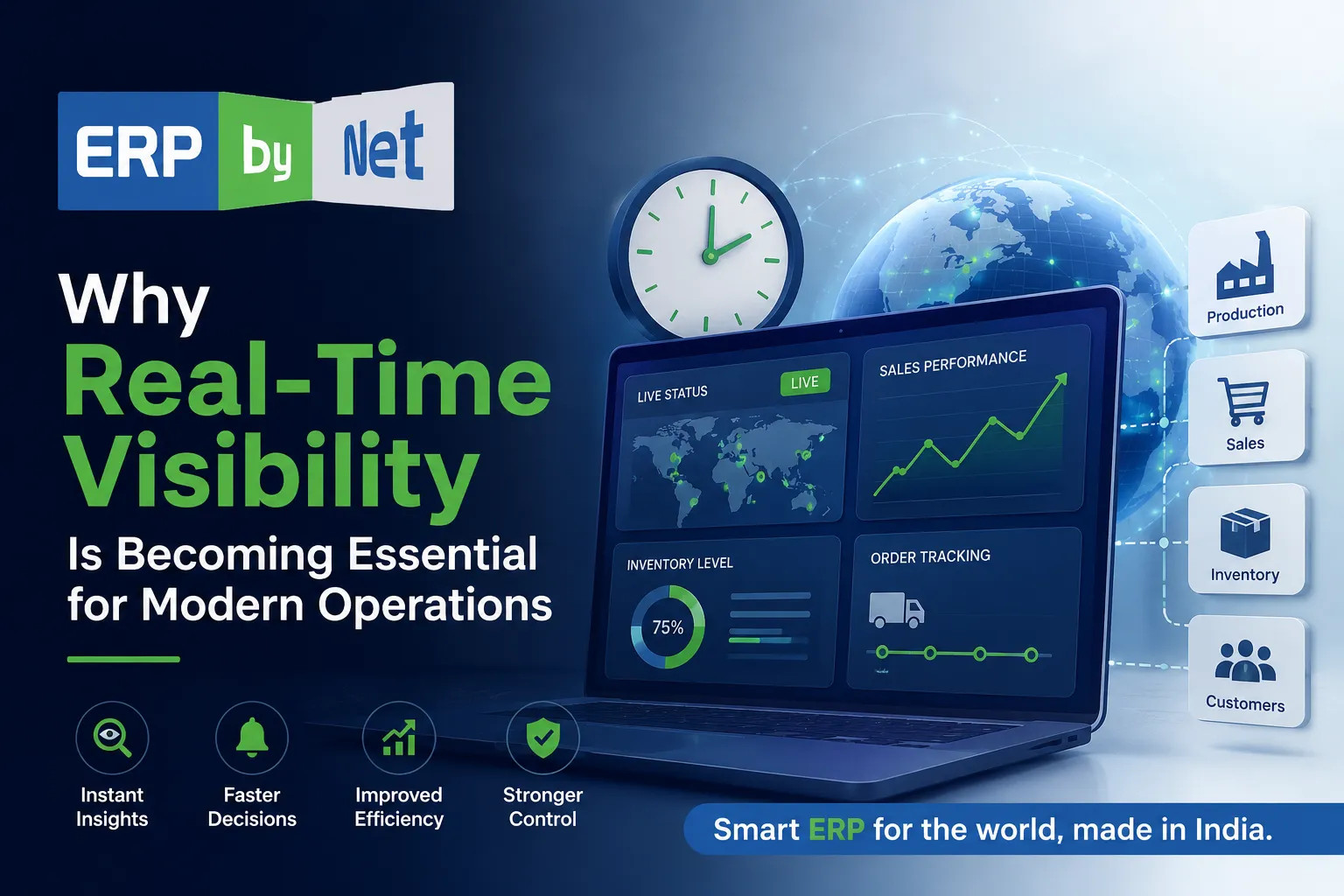
Real-time visibility helps businesses monitor operations instantly instead of relying on delayed reports and disconnected systems.
Modern ERP systems connect departments, warehouses, field teams, and management into one centralized operational ecosystem.
Live dashboards, alerts, and tracking systems help organizations detect delays, bottlenecks, and operational risks early.
Cloud-based ERP platforms improve coordination and decision-making across inventory, projects, maintenance, logistics, and service operations.
Businesses with real-time operational visibility respond faster, reduce inefficiencies, and scale with greater control and confidence.
What You’ll Learn
Why real-time visibility has become essential for modern business operations and execution management.
How ERP systems centralize operational data across departments, sites, warehouses, and service teams.
How live dashboards, alerts, and automated workflows improve operational efficiency and response time.
Why fragmented systems and manual reporting create delays, errors, and poor decision-making.
How ERPbyNet enables operational transparency through cloud-based monitoring, workflow automation, and real-time tracking.
Real Insights
Most operational problems begin with poor visibility — teams cannot fix issues they cannot see in real time.
Disconnected spreadsheets and isolated systems slow execution and create communication gaps between departments.
Real-time ERP systems replace reactive management with proactive control by providing instant operational insights.
Cloud-based visibility improves accountability and coordination across inventory, service, projects, and field operations.
The future of modern operations depends on live operational intelligence, automation, and centralized decision-making systems.
Modern businesses are operating in an environment where speed, coordination, and instant access to information directly impact customer satisfaction and business performance. Whether it is managing service complaints, coordinating field technicians, monitoring inventory, handling maintenance schedules, or tracking operational performance, businesses are expected to respond faster than ever before.
However, many organizations still rely on disconnected operational methods such as spreadsheets, WhatsApp groups, phone calls, manual reporting, and scattered software systems. As operations grow, these outdated processes create communication gaps, delayed responses, inventory confusion, missed service updates, and poor coordination between teams.
Today’s customers expect real-time service updates, faster issue resolution, and complete transparency. They no longer want to wait hours—or even days—for operational updates. Businesses that cannot provide instant visibility into their operations often struggle with delayed complaint handling, technician tracking issues, poor inventory management, and operational inefficiencies.
This is why real-time visibility is becoming one of the most important operational requirements for modern businesses. Real-time visibility helps organizations monitor complaints, technicians, inventory, maintenance schedules, service activities, and operational workflows instantly through a centralized ERP platform.
With advanced operational management solutions like ERPbyNet, businesses can gain complete operational visibility, improve response times, automate workflows, and manage operations more efficiently from a single centralized dashboard.
What Is Real-Time Visibility in Modern Operations?
Real-time visibility refers to the ability to access, monitor, and manage live operational data instantly across different business processes and departments. Instead of waiting for end-of-day reports or manually collecting updates from teams, businesses can view operational activities as they happen in real time.
In modern operations, real-time visibility enables businesses to track:
customer complaints
technician assignments
service request progress
inventory movement
spare part availability
maintenance schedules
AMC renewals
operational performance
field staff activity
pending service tasks
This level of operational transparency allows businesses to respond faster, make better decisions, and improve coordination between teams.
For example, a service manager using a real-time operations management system can instantly check:
which technician is assigned to a complaint
whether the complaint is pending or resolved
spare part availability
technician attendance
expected service completion time
service history of a customer
Without calling multiple people or checking multiple spreadsheets.
Real-time visibility eliminates operational blind spots and creates a centralized environment where businesses can manage operations more efficiently.
As modern businesses continue to grow and customer expectations continue to rise, real-time operational visibility is becoming essential for maintaining speed, accuracy, and operational control.
Why Traditional Operational Methods Are No Longer Sustainable
Many businesses still operate using manual workflows and disconnected systems that were designed for slower operational environments. While these methods may have worked in the past, they are no longer sustainable for modern businesses managing large-scale operations, field teams, inventory, and customer service activities.
Traditional operational methods often rely on:
spreadsheets
manual reporting
WhatsApp communication
phone call coordination
paper-based service records
disconnected software systems
These systems create major operational challenges as businesses scale.
Delayed Communication Creates Operational Bottlenecks
One of the biggest problems with traditional operations is delayed communication. When teams rely on manual updates, important operational information often gets delayed, overlooked, or miscommunicated.
For example:
technicians may not receive complaint updates on time
inventory teams may not know spare stock availability
managers may struggle to monitor pending service tasks
complaints may remain unresolved for extended periods
These communication gaps create operational bottlenecks that slow down the entire workflow.
Without real-time operational visibility, businesses spend more time following up manually instead of focusing on operational efficiency and customer service.
Lack of Visibility Reduces Operational Control
Businesses that lack centralized operational visibility often struggle to maintain control over day-to-day operations.
Managers may face challenges such as:
inability to track technician activity
difficulty monitoring complaint status
no visibility into field operations
delayed maintenance updates
lack of inventory transparency
difficulty identifying operational delays
As operations become larger and more complex, these visibility problems increase significantly.
Without real-time operational dashboards, businesses operate reactively instead of proactively.
Instead of preventing operational issues early, teams only react after problems become critical.
Customer Expectations Have Changed Completely
Modern customers expect businesses to operate faster and more transparently than ever before.
Customers now expect:
instant service updates
faster complaint resolution
live communication
accurate operational information
better accountability
For service businesses, delayed responses and poor communication can damage customer trust very quickly.
Common customer frustrations include:
technicians arriving late
repeated breakdown complaints
lack of service updates
unresolved complaints
difficulty contacting service teams
Businesses that fail to provide operational transparency often lose customer confidence and long-term loyalty.
This is why modern businesses are shifting toward centralized real-time operations management systems.
How Real-Time Visibility Improves Modern Operations
Real-time visibility transforms the way businesses manage operations by improving communication, coordination, speed, and decision-making across the organization.
Businesses that implement real-time operational visibility systems gain significant operational advantages over competitors relying on traditional processes.
Faster Complaint Management & Service Resolution
Complaint handling becomes significantly more efficient when businesses can monitor complaints in real time.
With a centralized complaint management software system:
complaints are recorded instantly
technicians receive immediate task notifications
managers can track complaint progress live
pending complaints become visible instantly
service updates can be monitored centrally
This reduces:
complaint delays
repeated customer follow-ups
communication gaps
unresolved service requests
Real-time complaint visibility allows businesses to respond faster and improve customer satisfaction significantly.
For modern service businesses, faster complaint resolution directly impacts operational reputation and customer retention.
Live Technician Tracking Improves Field Operations
Managing field technicians without visibility often creates coordination problems and service delays.
Businesses commonly struggle with:
technicians becoming unreachable
delayed task assignments
lack of attendance monitoring
poor field coordination
limited visibility into job progress
With technician tracking software integrated into a real-time ERP system, businesses can:
assign technicians instantly
monitor technician activity live
track attendance
check job completion status
improve workforce accountability
Live technician visibility helps managers coordinate field operations more efficiently while reducing response delays.
For elevator service businesses, maintenance companies, and field service operations, technician tracking has become essential for operational efficiency.
This improves operational planning while helping businesses avoid unnecessary service interruptions.
For service-oriented industries, inventory visibility directly impacts operational speed and service quality.
Better AMC & Maintenance Management
Managing AMC contracts and maintenance schedules manually often leads to operational inefficiencies and missed service commitments.
Common problems include:
missed AMC renewals
delayed maintenance visits
forgotten preventive maintenance schedules
lack of maintenance history visibility
With real-time AMC management software, businesses can automate and centralize maintenance operations.
ERP-based maintenance management systems help businesses:
schedule preventive maintenance automatically
track maintenance history
monitor AMC expiry dates
generate automated service reminders
reduce equipment downtime
For elevator management companies and maintenance service providers, real-time maintenance visibility is essential for maintaining service quality and customer trust.
One of the biggest advantages of ERP-based real-time visibility is centralized operational monitoring.
A centralized operational dashboard allows businesses to monitor:
complaints
technician performance
field operations
inventory movement
AMC schedules
maintenance activities
operational KPIs
pending service requests
from one unified system.
This centralized visibility helps managers:
identify operational bottlenecks quickly
improve team coordination
reduce manual follow-ups
make faster operational decisions
monitor performance in real time
Businesses that rely on centralized operational dashboards operate more efficiently because decision-makers always have access to accurate live operational data.
Industries That Need Real-Time Visibility the Most
Real-time operational visibility is becoming essential across multiple industries that depend on fast coordination, field operations, maintenance management, and inventory control.
Industries benefiting significantly include:
elevator service companies
field service businesses
maintenance management companies
manufacturing industries
logistics operations
facility management providers
inventory-driven businesses
multi-location service organizations
For elevator businesses specifically, real-time visibility helps manage:
breakdown complaints
technician coordination
spare part tracking
preventive maintenance
AMC renewals
service response times
This improves operational efficiency while delivering better customer experiences.
Signs Your Business Needs Real-Time Operational Visibility
Many businesses already experience operational inefficiencies caused by poor visibility without realizing the root cause.
Common warning signs include:
customers repeatedly calling for updates
delayed complaint resolution
technicians becoming difficult to track
inventory mismatches
missed maintenance schedules
lack of centralized operational control
excessive spreadsheet dependency
poor coordination between departments
delayed reporting
difficulty monitoring field operations
If your business faces these challenges regularly, implementing a real-time operational management system can significantly improve efficiency and control.
How ERPbyNet Helps Businesses Achieve Real-Time Visibility
Modern businesses cannot afford delays, miscommunication, or lack of operational clarity. That’s exactly where ERPbyNet transforms the way organizations work. It brings every critical operation—complaints, technicians, inventory, AMC, and maintenance—into one unified, real-time ERP platform. Instead of switching between multiple tools or depending on manual updates, businesses get a single source of truth where every activity is visible as it happens. This creates faster decisions, smoother coordination, and complete operational control across the organization.
ERPbyNet is built with powerful, real-world operational modules that eliminate chaos and bring structure to daily workflows. It offers:
Complaint Management Software to track and resolve issues without delays
Technician Tracking Software to monitor field teams in real time
Field Service Management Tools for seamless on-site execution
AMC Management Software to manage contracts and renewals efficiently
Maintenance Scheduling Tools for timely preventive maintenance
Centralized Operational Dashboards for complete business overview
Live Operational Monitoring for instant updates across all activities
Mobile Workforce Visibility for real-time field coordination
Automated Operational Workflows to reduce manual dependency
Each feature is designed to remove operational bottlenecks and improve speed at every level.
With ERPbyNet, businesses don’t just manage operations—they take full control of them. It helps reduce delays, improve team coordination, track service activities live, increase accountability, and deliver faster, more reliable customer service. In a competitive environment where every second matters, ERPbyNet ensures your business stays efficient, responsive, and always one step ahead.
The Future of Modern Operations Is Real-Time
Modern operations are evolving rapidly. Businesses that continue relying on delayed reporting and disconnected workflows will struggle to meet growing customer expectations.
The future of operational management is centered around:
live operational monitoring
workflow automation
centralized dashboards
real-time service coordination
data-driven decision-making
Businesses adopting real-time visibility systems gain a competitive advantage because they can respond faster, coordinate better, and operate more efficiently.
Real-time operational visibility is no longer just a technology upgrade. It is becoming a business necessity.
Organizations that invest in centralized ERP visibility systems today will be better prepared for the operational demands of the future.
Conclusion
If you are looking to improve efficiency, speed, and control across your business operations, ERPbyNet is the right partner to help you achieve true real-time visibility. In today’s fast-moving business environment, relying on manual processes, spreadsheets, and disconnected communication often leads to delays, confusion, and poor coordination between teams. ERPbyNet brings everything together in one centralized platform, allowing you to manage complaints, technicians, inventory, AMC schedules, maintenance activities, and field operations in real time. This helps your business eliminate operational gaps, improve decision-making, and ensure faster response to customer needs.
With ERPbyNet, you can track every activity as it happens, from complaint registration to technician assignment and job completion. Real-time dashboards and automated workflows ensure that your team stays aligned, informed, and productive at all times. This not only reduces operational inefficiencies but also enhances customer satisfaction by providing faster service, better transparency, and improved accountability across all operations.
For more information or to see how ERPbyNet can transform your operations, feel free to contact us today. Our team will help you understand the right solution for your business and guide you in implementing real-time operational visibility for better performance and growth.
FAQs
What is real-time visibility in operations?
Real-time visibility refers to the ability to monitor live operational data instantly across complaints, technicians, inventory, maintenance schedules, field operations, and business workflows through a centralized system.
Why is real-time visibility important for service businesses?
Real-time visibility helps service businesses improve response times, track technicians, monitor complaints, manage inventory efficiently, and provide faster customer service updates.
How does ERP software improve operational visibility?
ERP software centralizes operational data into one platform, allowing businesses to monitor workflows, complaints, technicians, maintenance schedules, inventory, and operational activities in real time.
Which industries benefit most from real-time operational visibility?
Industries such as elevator services, maintenance businesses, manufacturing, logistics, facility management, and field service operations benefit significantly from real-time visibility.
How does ERPbyNet help businesses manage operations?
ERPbyNet helps businesses manage complaints, technicians, inventory, AMC operations, maintenance schedules, field services, and operational workflows through centralized ERP-based operational visibility tools.
Can ERPbyNet track technicians in real time?
Yes, ERPbyNet provides real-time technician tracking, attendance monitoring, task management, and live field service coordination features.
How does real-time visibility improve customer service?
Real-time visibility helps businesses provide faster updates, resolve complaints more quickly, improve operational transparency, and reduce customer response delays.
Why are centralized operational dashboards important?
Centralized dashboards provide live operational insights, improve coordination between teams, reduce manual follow-ups, and help managers make faster and more accurate operational decisions.
ERP platforms like ERPbyNet centralize AMC management, service workflows, inventory, billing, and reporting into one system.
What You’ll Learn
How digital transformation is changing elevator maintenance operations.
Why traditional spreadsheets and manual scheduling no longer support growing elevator businesses.
How cloud ERP systems improve technician coordination, complaint handling, and maintenance tracking.
The role of IoT, predictive maintenance, and automation in reducing downtime.
How ERPbyNet helps elevator companies streamline operations, improve service quality, and scale efficiently.
Real Industry Insights
Elevator companies are moving away from reactive maintenance toward predictive and automated service models.
Disconnected systems create operational silos that reduce efficiency and increase service delays.
Digital workflows improve transparency for technicians, managers, and customers.
Cloud-based ERP platforms provide centralized visibility across technicians, inventory, complaints, and AMC contracts.
The future of elevator service management depends on automation, real-time data, predictive insights, and scalable ERP infrastructure.
The elevator industry is undergoing a major transformation. As buildings become smarter and customer expectations continue to rise, elevator service companies are facing increasing pressure to deliver faster response times, reduce downtime, improve technician coordination, and manage operations more efficiently than ever before.
Traditional service management methods that once worked for elevator businesses are now creating operational bottlenecks. Manual scheduling, paper-based service reports, delayed technician communication, and disconnected workflows often lead to slower service, missed follow-ups, and customer dissatisfaction.
At the same time, advancements in technology are changing how elevator service businesses operate. Automation, real-time tracking, cloud-based systems, predictive maintenance, and digital workflows are helping companies streamline operations and improve service performance.
Modern Elevator Service Management is no longer just about fixing elevators when problems occur. It is now about creating connected, data-driven, and proactive service operations that improve efficiency across every stage of the workflow.
In this article, we explore how technology is reshaping elevator service management and why digital transformation is becoming essential for modern elevator companies.
The Challenges of Traditional Elevator Service Management
For many elevator service companies, daily operations still depend heavily on manual processes. While these traditional systems may have worked in the past, they often create inefficiencies that slow down business growth and impact service quality.
Common operational challenges include:
manual technician scheduling
paper-based job cards
delayed complaint handling
poor communication between teams
scattered customer records
lack of service visibility
missed AMC renewals
reactive maintenance approaches
delayed response times
When operations are managed manually, even small delays can create larger business problems. A technician may receive incomplete service information, customer complaints may not be tracked properly, or service requests may get delayed due to communication gaps.
These inefficiencies directly affect:
customer satisfaction
technician productivity
operational control
revenue opportunities
long-term client retention
As elevator systems become more advanced and service expectations increase, relying on outdated management methods becomes increasingly difficult.
Modern elevator businesses need systems that provide real-time visibility, centralized operations, and faster coordination across field teams.
The Shift Toward Digital Elevator Service Operations
Technology is changing the way elevator service businesses manage their daily operations. Instead of relying on disconnected manual processes, companies are moving toward centralized digital systems that help improve efficiency and operational control.
Digital transformation in elevator service management includes:
cloud-based ERP systems
automated scheduling
mobile workforce management
real-time technician tracking
centralized dashboards
digital complaint management
automated reporting systems
These technologies help elevator companies operate more proactively instead of reactively.
Rather than waiting for operational issues to create delays, digital systems help businesses:
identify problems faster
streamline communication
automate repetitive tasks
improve technician coordination
reduce service delays
This shift is helping elevator businesses create more structured, scalable, and efficient service operations.
Real-Time Technician Tracking Is Improving Service Response
One of the biggest operational challenges in elevator servicing is coordinating field technicians efficiently. Delays in technician allocation often increase elevator downtime and negatively impact customer satisfaction.
Modern technology is solving this problem through real-time technician tracking systems.
With GPS-enabled tracking and mobile field service applications, elevator companies can now:
monitor technician locations in real time
assign jobs faster
optimize technician routes
track service status updates
improve communication between teams
This level of visibility helps businesses respond more quickly to breakdowns and emergency service requests.
Real-time tracking also improves workforce productivity by ensuring:
better technician utilization
fewer scheduling conflicts
faster task completion
reduced travel inefficiencies
For customers, this creates a better service experience because they receive quicker responses and improved service transparency.
As customer expectations continue to grow, faster response times are becoming a key competitive advantage for elevator service companies.
Predictive Maintenance Is Replacing Reactive Servicing
Traditional elevator maintenance models are largely reactive. Businesses wait until a breakdown occurs before responding to the issue.
However, modern technology is shifting the industry toward predictive maintenance.
Using IoT-enabled monitoring systems, sensors, and connected devices, elevator companies can now collect real-time performance data from elevator systems. This data helps identify potential issues before they become major failures.
Predictive maintenance allows businesses to:
detect abnormal system behavior early
schedule preventive servicing
reduce unexpected breakdowns
minimize downtime
lower emergency repair costs
Instead of reacting to failures after they occur, companies can proactively address maintenance needs and improve elevator reliability.
This approach not only improves operational efficiency but also enhances customer trust because elevators remain operational more consistently.
Predictive maintenance is becoming one of the most important technological advancements in modern elevator servicing because it helps businesses move from reactive operations to intelligent maintenance planning.
Automation Is Streamlining Elevator Service Workflows
Manual administrative tasks often consume a large amount of time in elevator service businesses. Scheduling follow-ups, updating records, tracking complaints, managing service history, and handling AMC renewals manually can create operational delays and increase the risk of errors.
Automation is helping companies simplify these workflows.
Modern elevator service management systems can automate:
complaint ticket generation
service scheduling
maintenance reminders
technician job allocation
AMC renewal notifications
customer follow-ups
service report generation
This significantly reduces manual workload while improving operational consistency.
For example:
Traditional Operations
Automated ERP-Based Operations
Manual complaint logging
Automated ticket management
Paper service reports
Digital mobile reports
Phone-based technician assignment
Real-time dispatch systems
Excel-based AMC tracking
Automated renewal alerts
Manual follow-ups
Automated notifications
Automation allows service teams to focus more on actual service delivery instead of repetitive administrative work.
As elevator businesses scale, automation becomes essential for maintaining operational efficiency without increasing management complexity.
Data and Analytics Are Improving Business Decisions
Modern elevator service management is becoming increasingly data-driven.
Digital systems now allow businesses to collect and analyze operational data in real time. This gives managers greater visibility into service performance and helps improve decision-making.
Analytics can provide insights into:
technician productivity
service response times
elevator downtime trends
complaint frequency
maintenance history
customer service performance
This information helps businesses identify operational inefficiencies and improve resource planning.
For example, service managers can analyze:
which technicians handle the most service requests efficiently
which elevators experience repeated issues
which customers require frequent maintenance support
where operational delays commonly occur
This level of business intelligence helps elevator companies optimize workflows, improve accountability, and deliver more consistent service experiences.
Technology is no longer only supporting operations — it is now helping businesses make smarter strategic decisions.
Customer Expectations Are Changing Elevator Service Standards
Today’s customers expect faster, more transparent, and more reliable service experiences.
Building managers, property owners, hospitals, hotels, and commercial facilities increasingly demand:
quick complaint resolution
faster technician response
service transparency
preventive maintenance
real-time communication
minimal elevator downtime
Companies that fail to meet these expectations may struggle to retain long-term clients.
Technology is helping elevator service businesses improve customer satisfaction by creating:
faster communication channels
real-time service updates
better complaint tracking
improved maintenance planning
centralized customer management systems
Digital platforms also help businesses maintain accurate service history records, making customer support more organized and efficient.
As competition in the elevator industry increases, customer experience is becoming one of the most important differentiators.
Why Elevator Companies Are Moving Toward ERP-Based Management Systems
As operational complexity increases, many elevator businesses are adopting ERP-based systems to centralize and streamline their service management processes.
ERP systems bring multiple operational functions into a single platform, including:
technician management
complaint handling
maintenance scheduling
customer management
AMC tracking
reporting and analytics
service history management
This creates better operational visibility and allows businesses to manage workflows more efficiently.
ERP systems also help eliminate data silos by ensuring that service teams, managers, and administrators work from the same centralized information system.
The benefits include:
improved operational coordination
faster response times
reduced paperwork
better reporting accuracy
increased workforce productivity
stronger service consistency
As the elevator industry continues evolving, ERP-based operations are becoming a critical part of modern service management strategies.
How ERPbyNet Helps Modernize Elevator Service Management
ERPbyNet is designed to help elevator service companies streamline operations through centralized digital management.
The platform helps businesses manage:
service requests
technician scheduling
complaint tracking
AMC management
field workforce coordination
service reporting
operational analytics
With real-time visibility and automated workflows, elevator companies can improve service efficiency while reducing operational delays.
ERPbyNet supports modern elevator operations through:
real-time technician tracking
centralized dashboards
automated service workflows
digital field service management
customer complaint management
maintenance scheduling systems
reporting and analytics tools
By digitizing service operations, elevator companies can improve:
technician productivity
response speed
customer satisfaction
operational control
long-term business scalability
As the industry becomes more technology-driven, centralized ERP systems are playing a major role in helping elevator companies remain competitive.
The Future of Elevator Service Management
Technology will continue reshaping the elevator service industry in the coming years.
Emerging innovations such as:
AI-powered maintenance systems
IoT-enabled elevator monitoring
predictive analytics
cloud-based operations
smart dispatch systems
connected service ecosystems
will further improve operational efficiency and service quality.
The future of elevator servicing will depend heavily on:
automation
real-time visibility
intelligent maintenance planning
data-driven decision-making
digital workforce management
Companies that embrace these technologies early will be better positioned to improve service performance, reduce downtime, and meet growing customer expectations.
Businesses that continue relying on outdated operational methods may struggle to remain competitive in an increasingly digital industry.
Conclusion
Technology is transforming every aspect of elevator service management.
From real-time technician tracking and predictive maintenance to workflow automation and data-driven decision-making, digital systems are helping elevator companies improve efficiency, reduce downtime, and deliver better customer experiences.
The elevator industry is moving toward smarter, faster, and more connected operations. As service demands continue to increase, businesses need modern systems that provide operational visibility, automation, and centralized management.
Companies that invest in digital transformation today will be better prepared for the future of elevator servicing.
ERPbyNet helps elevator service businesses modernize operations through intelligent service management, automated workflows, real-time tracking, and centralized operational control — helping companies build more efficient and future-ready elevator service operations.
FAQs
1. How is technology improving elevator service management?
Technology is helping elevator companies improve operations through real-time technician tracking, automated scheduling, predictive maintenance, digital reporting, and centralized management systems. These tools help reduce downtime, improve response times, and streamline daily workflows.
2. What is predictive maintenance in elevator servicing?
Predictive maintenance uses connected sensors and real-time data to identify potential elevator issues before breakdowns occur. This helps elevator companies reduce unexpected failures, lower repair costs, and improve elevator reliability.
3. Why is automation important for elevator service businesses?
Automation reduces manual tasks such as complaint tracking, service scheduling, AMC reminders, and technician coordination. This improves operational efficiency, minimizes errors, and allows service teams to respond faster to customer requests.
4. How does real-time technician tracking help elevator companies?
Real-time technician tracking helps businesses monitor field teams, assign jobs faster, optimize technician routes, and improve communication. This leads to quicker response times, better workforce productivity, and improved customer satisfaction.
5. How does ERPbyNet help modernize elevator service operations?
ERPbyNet helps elevator companies streamline operations through real-time technician tracking, complaint management, automated workflows, AMC tracking, digital reporting, and centralized service management — helping businesses improve efficiency, reduce downtime, and manage elevator operations more effectively.
In the elevator maintenance industry, scheduling plays a direct role in business profitability. Every missed maintenance visit, delayed technician assignment, untracked complaint, or coordination gap slowly adds up to hidden revenue loss that many elevator companies fail to notice until it becomes significant.
Despite growing service demands, many elevator businesses still rely on spreadsheets, phone calls, WhatsApp messages, manual technician allocation, and paper-based records to manage operations. While these methods may work for small teams, they quickly become inefficient as the number of elevators, AMC contracts, and technicians increases.
Poor scheduling impacts more than daily operations—it directly affects recurring revenue, AMC renewals, technician productivity, emergency response speed, service quality, and long-term scalability.
As the industry shifts toward digital and predictive maintenance models, outdated systems create a competitive disadvantage. This is why many elevator companies are now moving toward intelligent platforms like ERPbyNet to automate scheduling, improve coordination, and streamline elevator service operations.
Why Scheduling Is the Core of Elevator Service Operations
In elevator service businesses, scheduling is not just an administrative task — it is the central system that keeps all operations connected and running smoothly. Every activity in the field depends on how well scheduling is planned, assigned, and monitored.
Whether it is routine maintenance or emergency breakdown handling, everything starts with proper scheduling.
What Scheduling Controls in Daily Operations
An elevator service company depends on scheduling to manage multiple critical functions at the same time:
preventive maintenance visits to ensure elevator safety and performance
emergency breakdown calls that require immediate response
technician allocation based on availability and location
AMC service timelines that must be followed strictly
customer service commitments and response expectations
spare part coordination for repair and replacement work
field service tracking for ongoing job visibility
When all these activities are properly scheduled, operations run in a structured and predictable manner.
What Happens When Scheduling Fails
If scheduling is not accurate or well-coordinated, the entire service system starts breaking down. Small delays or miscommunication in assignments can quickly escalate into bigger operational issues.
Common outcomes include:
increased customer dissatisfaction due to delayed service
longer elevator downtime affecting building operations
missed SLA targets and contractual penalties
reduced technician productivity and inefficient routing
growing backlog of unresolved service requests
difficulty in managing AMC renewals and customer retention
Even a single scheduling error can create multiple downstream issues across the service chain.
How Small Delays Turn Into Revenue Loss
In the elevator industry, service delays are not just operational problems — they directly affect revenue.
When maintenance visits are missed or delayed:
AMC customers lose confidence in service quality
breakdown frequency increases due to poor preventive care
emergency repair costs rise
contract renewals become uncertain
competitors gain opportunity to replace service contracts
Over time, these issues slowly reduce profitability and weaken long-term business stability.
Why Scheduling Defines Service Stability
A well-structured scheduling system ensures that every part of the service operation works in sync — technicians, dispatch teams, customers, and maintenance workflows.
Without it, companies face:
confusion in field operations
inconsistent service delivery
poor coordination between teams
reduced visibility of ongoing work
This is why scheduling is often considered the backbone of elevator service operations. When it is managed effectively, the entire service ecosystem becomes more reliable, efficient, and profitable.
The Real Cost of Poor Scheduling in Elevator Companies
Most elevator businesses track visible operational costs such as:
fuel
labor
technician salaries
spare parts
transportation
But the biggest financial damage often comes from invisible inefficiencies caused by poor scheduling systems.
1. Missed Preventive Maintenance Visits
Preventive maintenance is one of the most critical responsibilities in elevator servicing.
When PM visits are delayed or forgotten due to manual scheduling:
equipment reliability decreases
breakdown frequency increases
customers lose confidence
AMC contracts become difficult to renew
Missed PM schedules also increase long-term repair costs because minor technical issues are not detected early.
Common Causes of Missed PM Visits
Manual tracking errors
Unorganized Excel sheets
No automated reminders
Poor technician allocation
Lack of centralized visibility
Financial Impact
A company managing hundreds of elevators can lose substantial recurring revenue if AMC clients decide not to renew contracts due to inconsistent maintenance.
For commercial buildings, hospitals, malls, and residential towers, extended downtime creates serious customer frustration.
Operational Consequences
Increased complaint escalations
Higher service pressure
Poor customer experience
Negative brand reputation
Contract termination risk
Revenue Impact
Slow response times often lead customers to shift toward competitors with faster service management systems.
3. Technician Productivity Drops Significantly
Poor scheduling affects technician efficiency more than most companies realize.
Without intelligent scheduling systems:
routes become inefficient
technicians travel unnecessarily
idle time increases
service capacity decreases
As a result, technicians complete fewer jobs daily.
Example of Productivity Loss
Manual Scheduling Environment
Technician completes 4 jobs/day
Significant travel gaps
Delayed coordination
Frequent scheduling confusion
Optimized Scheduling Environment
Technician completes 7–8 jobs/day
Route-based dispatching
Real-time updates
Faster coordination
That productivity difference directly impacts profitability.
4. Revenue Leakage Through Missed AMC Renewals
Annual Maintenance Contracts (AMCs) are the backbone of recurring revenue in the elevator industry.
Poor scheduling weakens AMC retention because customers expect:
timely maintenance
predictable servicing
quick issue resolution
consistent communication
When service quality becomes inconsistent, renewal rates decline.
Why Customers Avoid Renewing Contracts
Common Customer Complaints
“Technicians arrive late.”
“Preventive maintenance is irregular.”
“Breakdowns take too long to resolve.”
“Nobody updates us on complaint status.”
“Service reports are unclear.”
These problems are often caused by operational scheduling inefficiencies rather than technician capability.
5. Emergency Repairs Become More Frequent
Poor scheduling often pushes companies into reactive maintenance cycles.
Instead of preventing failures early through planned servicing, businesses end up handling:
emergency shutdowns
repeated breakdown complaints
urgent repair calls
overtime technician dispatch
Reactive repairs cost significantly more than preventive maintenance.
Reactive Maintenance Creates Additional Costs
Direct Costs
overtime labor
urgent spare parts procurement
emergency transportation
additional technician visits
Indirect Costs
customer dissatisfaction
building management complaints
service delays
contract reputation damage
6. Manual Scheduling Creates Administrative Chaos
As elevator businesses grow, service coordination becomes increasingly complex.
Managing:
hundreds of elevators
multiple field technicians
breakdown complaints
preventive maintenance schedules
spare inventory
customer records
through spreadsheets and calls becomes highly inefficient.
Administrative teams spend excessive time:
following up manually
updating paperwork
coordinating technicians
tracking complaints
handling service confusion
This increases operational overhead without improving productivity.
Warning Signs Your Elevator Business Has Scheduling Problems
In many elevator service companies, scheduling problems don’t appear suddenly. They build slowly over time through missed coordination, delayed updates, and manual handling of service operations. Most businesses only realize the impact when revenue starts dropping or customers begin complaining more frequently.
Scheduling inefficiency usually shows up first in daily operations, not in financial reports. That’s why it often goes unnoticed until it becomes a serious issue.
Common Indicators of Poor Scheduling
If your business is experiencing multiple issues from the list below, it is a strong sign that your scheduling system is not working efficiently:
frequent missed preventive maintenance visits
technicians arriving late to service locations
growing backlog of unresolved complaints
repeated customer escalations for the same issues
lack of real-time field visibility
heavy dependence on manual coordination (calls, messages, spreadsheets)
unclear or unavailable technician status during dispatch
declining AMC renewals or customer retention
delays in service reporting and updates
excessive paperwork and manual record handling
These issues may seem operational, but together they directly impact customer satisfaction, technician productivity, and long-term profitability.
When these problems become regular, it usually means the scheduling system is not able to support the growing service load.
Why Traditional Scheduling Methods No Longer Work
The elevator service industry is becoming more complex every year. Companies are no longer handling just a few maintenance contracts—they are managing large service networks with continuous operational demands.
Modern elevator companies typically deal with:
large AMC portfolios across multiple locations
strict service level agreements (SLAs)
high customer expectations for response time
frequent emergency breakdown requests
multiple technician teams working simultaneously
expanding maintenance and service databases
In this environment, traditional methods like spreadsheets, phone calls, and WhatsApp coordination are no longer efficient.
These manual systems create delays because:
information is not updated in real time
technicians cannot be tracked properly
dispatch decisions are slow
service history is fragmented
coordination depends on individuals, not systems
As a result, companies struggle to maintain consistent service quality as they scale.
This is where structured digital systems become necessary to manage operations more reliably.
The Industry Shift Toward Smart Service Management
The global elevator maintenance industry is undergoing a major shift from manual operations to digital and automated service management systems.
Companies are increasingly adopting modern technologies such as:
predictive maintenance systems to reduce unexpected breakdowns
real-time technician tracking for better field visibility
cloud-based field service platforms for centralized access
IoT-based monitoring for early issue detection
automated dispatching to speed up response time
ERP platforms to integrate all service operations
This shift is not just about technology—it is about improving efficiency, reducing downtime, and ensuring better customer service.
Industry research consistently shows that companies using digital maintenance management systems experience:
lower breakdown frequency
faster response times
improved service consistency
better operational control
higher customer retention
On the other hand, companies that continue relying on fragmented manual systems often face increasing operational pressure as service demand grows.
Digital service management is quickly becoming a standard requirement, not an optional upgrade, for elevator companies aiming to scale efficiently and maintain competitive performance.
How ERPbyNet Helps Elevator Companies Reduce Revenue Leakage
As elevator service businesses grow, managing technicians, AMC contracts, preventive maintenance schedules, breakdown complaints, and customer communication manually becomes increasingly difficult.
Many elevator companies still rely on:
spreadsheets
phone calls
WhatsApp coordination
paper-based job cards
disconnected tracking systems
While these methods may work initially, they eventually create operational inefficiencies that quietly reduce profitability.
Common issues include:
delayed technician dispatch
missed preventive maintenance visits
poor complaint tracking
technician idle time
inconsistent service reporting
customer dissatisfaction
AMC renewal losses
ERPbyNet helps elevator companies centralize and automate service operations through a unified elevator management ERP platform designed specifically for the elevator maintenance industry.
The platform improves:
scheduling efficiency
technician coordination
maintenance tracking
complaint management
operational visibility
service workflow automation
Smart Technician Scheduling & Dispatch Management
Efficient technician coordination is one of the biggest challenges in elevator service operations.
Manual scheduling often leads to:
delayed assignments
overlapping schedules
inefficient route planning
excessive technician travel
unbalanced workloads
slower response times
ERPbyNet helps businesses streamline technician scheduling through intelligent dispatch management.
How ERPbyNet Improves Technician Scheduling
Feature
How It Helps
Intelligent technician assignment
Assign nearby and available technicians faster
Workload balancing
Prevent technician overload and improve productivity
Emergency prioritization
Handle urgent breakdown complaints immediately
Daily job planning
Organize scheduled visits and service tasks efficiently
Real-time visibility
Track technician availability and active jobs
Key Benefits
Faster Technician Allocation
Dispatch teams can quickly identify:
available technicians
nearby engineers
pending service calls
emergency complaints
This reduces manual coordination delays.
Better Workforce Utilization
ERPbyNet helps businesses distribute service requests more efficiently across field teams, improving:
Handling complaints manually often creates communication gaps and delayed responses.
Without centralized complaint tracking, businesses struggle to manage:
complaint status
technician progress
escalation handling
response timelines
pending breakdown requests
ERPbyNet centralizes complaint management into one structured system.
Complaint Management Capabilities
Capability
Benefit
Centralized complaint dashboard
Track all complaints from one platform
Real-time technician tracking
Improve dispatch coordination
Service progress monitoring
Reduce operational delays
Escalation management
Prioritize urgent issues efficiently
Breakdown tracking
Improve response speed
Operational Advantages
Faster Complaint Resolution
Service managers can monitor complaint progress in real time and coordinate technicians more effectively.
Improved Communication
ERPbyNet improves coordination between:
dispatch teams
field technicians
service managers
customers
This reduces communication delays and confusion.
Better Operational Visibility
Track:
open complaints
completed requests
technician assignments
service timelines
through one centralized dashboard.
Faster Breakdown Response & Reduced Downtime
In the elevator industry, response speed directly affects customer trust and service quality.
Delayed emergency response can lead to:
customer dissatisfaction
contract risk
elevator downtime
service escalations
negative brand reputation
ERPbyNet improves emergency response coordination through centralized dispatch management.
Breakdown Response Features
Feature
Operational Benefit
Quick technician assignment
Faster emergency response
Real-time dispatch coordination
Reduce service delays
Complaint prioritization
Handle critical issues first
Escalation monitoring
Improve SLA management
Centralized breakdown tracking
Improve operational control
Business Impact
With faster breakdown coordination, elevator companies can:
reduce downtime
improve customer satisfaction
strengthen AMC relationships
increase service reliability
improve response efficiency
Digital Service Documentation & Paperless Workflows
Paper-based workflows often create:
documentation errors
delayed reporting
misplaced records
inconsistent maintenance history
administrative inefficiencies
ERPbyNet digitizes service documentation to improve workflow accuracy and transparency.
Digital Documentation Features
Feature
Benefit
Digital job cards
Reduce paperwork dependency
Centralized service history
Maintain accurate elevator records
Automated maintenance reports
Improve reporting speed
Customer communication logs
Track service interactions
Digital workflow management
Improve operational organization
Advantages of Digital Documentation
Faster Reporting
Technicians can update service information directly from the field without relying on manual paperwork.
Better Service Transparency
Businesses can maintain complete service history for:
maintenance visits
breakdown repairs
complaint handling
customer communication
Improved Operational Accuracy
Digital workflows help reduce:
reporting mistakes
data duplication
missing records
administrative confusion
Centralized Elevator Operations Management
Many elevator companies use separate systems for:
AMC tracking
technician scheduling
complaint management
maintenance planning
service reporting
billing workflows
Disconnected systems often create operational silos and communication gaps.
ERPbyNet centralizes all major elevator service operations into one unified platform.
What ERPbyNet Centralizes
Operational Area
ERPbyNet Solution
AMC contract management
Track renewals and maintenance obligations
Technician coordination
Improve dispatch and field visibility
Complaint management
Monitor breakdown resolution efficiently
Preventive maintenance
Automate recurring service schedules
Service reporting
Centralize maintenance documentation
Workflow management
Streamline daily operations
Why Centralization Matters
Centralized operations help elevator companies:
improve workflow efficiency
reduce manual coordination
improve decision-making
increase operational visibility
scale service operations effectively
Why Modern Elevator Companies Need ERP Automation
The elevator maintenance industry is becoming increasingly competitive and service-driven.
Customers now expect:
faster service response
transparent communication
reduced downtime
professional reporting
consistent maintenance quality
Companies relying on manual systems often struggle to meet these expectations consistently.
ERPbyNet helps elevator companies modernize operations through:
smart technician scheduling
preventive maintenance automation
centralized complaint handling
digital service workflows
real-time operational visibility
By reducing operational inefficiencies and improving service coordination, ERPbyNet helps elevator companies minimize revenue leakage, improve AMC retention, and build a more scalable elevator service operation.
Business Benefits of Better Scheduling
Companies implementing structured elevator service scheduling systems often achieve:
Operational Area
Improvement
Technician productivity
More jobs completed daily
Breakdown response
Faster complaint resolution
PM completion rates
Reduced missed maintenance
Customer satisfaction
Better service experience
AMC renewals
Improved retention rates
Administrative workload
Reduced manual coordination
Operational visibility
Real-time service tracking
Why Elevator Companies Need Digital Scheduling Systems Now
The elevator maintenance industry is becoming more demanding every year. Customers now expect faster service, better communication, and more reliable maintenance. In this situation, scheduling is not just an internal task—it directly affects service quality and revenue.
Customer expectations are rising
Today’s customers want a smooth and predictable service experience. They expect:
fast response during breakdowns
on-time technician visits
clear updates on service progress
minimal elevator downtime
proper maintenance reports
When these expectations are not met, customer trust drops quickly, and AMC renewals become harder to retain.
Problems with manual scheduling
Many elevator companies still manage scheduling using spreadsheets, phone calls, and messaging apps. While this may work for small operations, it becomes inefficient as the business grows.
Common issues include:
delayed technician assignment
missed preventive maintenance visits
poor visibility of ongoing jobs
confusion in complaint handling
uneven workload among technicians
slow emergency response
These gaps directly affect productivity and increase operational stress.
Why digital scheduling is important
Digital scheduling systems help organize all service operations in one place. Instead of managing multiple disconnected tools, everything becomes structured and trackable.
With a system like ERPbyNet, companies can improve daily operations by:
assigning technicians instantly based on availability and location
tracking all service jobs in real time
automating preventive maintenance schedules
prioritizing emergency breakdown requests
managing complaints from a single dashboard
improving coordination between office staff and field teams
This reduces delays and improves overall service control.
Business impact of digital scheduling
Moving to digital scheduling creates direct operational improvements:
faster response to breakdowns
higher technician efficiency
fewer missed maintenance visits
better AMC service consistency
improved customer satisfaction
smoother daily operations
It also helps companies scale without increasing confusion or manual workload.
Conclusion
Poor scheduling is one of the biggest hidden reasons elevator companies lose revenue without even realizing it. When preventive maintenance visits are missed, technician dispatch is delayed, complaints stay unassigned, and workflows depend on manual coordination, the result is slow operations, unhappy customers, and reduced profitability. Over time, these small inefficiencies directly impact AMC renewals, service quality, and long-term customer relationships.
As elevator service operations become more complex, relying on manual methods is no longer enough. Companies need a centralized system that improves visibility, reduces delays, and automates day-to-day coordination across field teams.
This is where ERPbyNet helps transform operations by enabling smart technician scheduling, preventive maintenance automation, complaint management, real-time service tracking, and fully integrated ERP workflows.
Take control of your service operations today—optimize scheduling, reduce revenue leakage, and scale your elevator business with more efficiency, reliability, and profitability.
Frequently Asked Questions
Why does poor scheduling impact elevator company revenue?
Poor scheduling leads to missed maintenance visits, delayed breakdown response, lower technician productivity, customer dissatisfaction, and AMC contract losses.
What are the biggest problems caused by manual elevator scheduling?
Manual scheduling often creates technician conflicts, delayed dispatch, missed PM visits, paperwork confusion, poor visibility, and operational inefficiencies.
How does preventive maintenance improve profitability?
Preventive maintenance reduces breakdown frequency, improves elevator reliability, lowers emergency repair costs, and increases AMC customer retention.
What is elevator service management software?
Elevator service management software helps companies automate scheduling, complaint handling, technician tracking, preventive maintenance, and service reporting.
How does ERPbyNet help elevator businesses?
ERPbyNet helps elevator companies streamline operations through automated scheduling, centralized complaint management, AMC tracking, technician coordination, and real-time service visibility.
Modern businesses rely heavily on software to manage daily operations, improve productivity, and support growth. Over time, however, many companies unknowingly create a complex digital ecosystem by adopting different tools for finance, inventory, sales, HR, customer management, procurement, and reporting. At first, these separate applications may seem affordable, convenient, and easy to implement. Each department chooses software that solves its immediate challenges without considering long-term operational impact.
As businesses grow, this disconnected approach begins creating hidden operational inefficiencies. Employees constantly switch between applications, manually transfer data, and spend valuable time coordinating across departments. Reporting becomes slow, information gets duplicated, and leadership teams struggle to gain real-time visibility into operations. What initially appeared to be a flexible software strategy slowly turns into operational chaos.
In addition to productivity loss, businesses also face rising subscription costs, integration expenses, inconsistent workflows, and decision-making delays. The more fragmented the systems become, the harder it becomes to scale operations efficiently.
What looks affordable and manageable initially often becomes expensive and inefficient as businesses grow. This is why many organizations are now replacing disconnected business systems with integrated ERP software solutions like ERPbyNet.
Why Businesses End Up Using Too Many Software Tools
Image Source : Napkin ai
The Rise of Department-Wise Software Adoption
Most businesses do not intentionally create fragmented systems. It usually starts with departments independently selecting software that addresses their immediate operational requirements.
The finance department may use accounting software, while the sales team adopts a separate CRM platform. Inventory management may operate on another system, HR teams use dedicated HR software, and service departments continue relying on spreadsheets or manual tracking methods.
Over time, each department becomes dependent on its preferred tools. While these systems may work individually, they often fail to communicate effectively with one another.
This creates disconnected business systems where critical operational data becomes scattered across multiple platforms.
Short-Term Convenience vs Long-Term Complexity
One major reason for software tool sprawl is the simplicity of modern SaaS adoption. Businesses can quickly subscribe to cloud-based tools with minimal upfront investment.
These solutions often appear attractive because they:
Solve immediate operational problems
Require limited implementation time
Offer low monthly subscription pricing
Provide department-specific functionality
Reduce short-term IT involvement
However, businesses rarely evaluate how these tools will integrate into long-term operational workflows.
As the organization expands, managing multiple systems becomes increasingly complicated.
How Tool Sprawl Happens Gradually
Software fragmentation rarely happens overnight.
A company may initially adopt one accounting platform. Later, it adds CRM software for sales, warehouse software for inventory, another application for procurement, and separate tools for customer support and reporting.
Eventually, businesses end up managing a large software stack with disconnected workflows, inconsistent data, and operational inefficiencies.
Without centralized business operations, every new tool adds another layer of complexity.
The Hidden Operational Costs of Multiple Business Tools
Employees Spend Time Switching Between Systems
One of the biggest hidden costs of using multiple business tools is reduced employee productivity.
Employees constantly move between applications to complete a single workflow. For example, a sales executive may need to check the CRM system for customer information, switch to inventory software for stock availability, and then contact finance for payment status.
This constant context switching creates:
Productivity loss
Increased manual coordination
Delayed workflows
Employee frustration
Reduced operational efficiency
Even small delays accumulate into major operational inefficiencies over time.
Duplicate Data Entry Creates Errors
Disconnected systems often require employees to enter the same information multiple times.
Customer records may be entered separately into CRM, invoicing, inventory, and service management systems.
This duplicate data entry increases the risk of:
Human errors
Inventory mismatches
Incorrect customer information
Invoice inconsistencies
Data duplication
When different systems contain conflicting information, operational confusion becomes unavoidable.
Lack of Real-Time Visibility Across Departments
Businesses using multiple software tools often struggle with operational visibility.
Since departments operate independently, management teams cannot access a unified view of business performance.
This leads to:
Delayed decision-making
Communication gaps
Management blind spots
Poor operational coordination
Slow response to business issues
Without centralized visibility, leadership teams often make decisions based on outdated or incomplete data.
Reporting Becomes Slow and Inaccurate
Generating reports across disconnected systems is time-consuming and inefficient.
Many businesses still rely on manual Excel reporting to combine data from different applications.
This process creates several challenges:
Time-consuming data consolidation
Inconsistent reporting formats
Different departments showing different numbers
Increased reporting delays
Limited data accuracy
When reporting is delayed or unreliable, business planning becomes significantly harder.
Operational Workflows Become Disconnected
Disconnected systems often break operational workflows between departments.
For example:
Sales teams may confirm orders without accurate inventory visibility
Procurement teams may experience delays due to missing approvals
Service teams may lack access to customer history
Finance departments may struggle to reconcile operational data
These workflow gaps reduce operational efficiency and increase internal coordination problems.
The Financial Cost Businesses Often Ignore
Multiple Subscription Fees Add Up Quickly
Many businesses underestimate how expensive multiple SaaS tools become over time.
While individual subscriptions may appear affordable initially, costs increase significantly as businesses scale.
Businesses often pay for:
Per-user licenses
Premium feature upgrades
Additional storage
Multiple vendor subscriptions
Annual renewals
Software tool sprawl can quickly create uncontrollable recurring operational expenses.
Integration and Middleware Expenses
Disconnected business systems often require third-party integrations to share information.
Businesses may invest heavily in:
API integrations
Middleware software
Custom connectors
Data synchronization tools
Integration maintenance
These hidden costs increase long-term IT dependency while still failing to provide seamless operational connectivity.
Higher IT and Support Dependency
Managing multiple business tools requires more technical support and administrative effort.
Businesses must coordinate with multiple software vendors, manage separate support teams, and train employees on different systems.
This increases:
Technical troubleshooting complexity
Employee training requirements
Vendor management challenges
System maintenance workload
IT operational overhead
The larger the software ecosystem becomes, the harder it becomes to manage efficiently.
When employees spend hours manually updating systems, correcting errors, searching for information, or waiting for approvals, businesses lose valuable productive time.
This productivity loss affects:
Employee efficiency
Operational speed
Customer responsiveness
Order processing
Revenue generation
The financial impact of inefficiency is often much larger than software subscription costs themselves.
Hidden Cost of Software Customization
Businesses using disconnected systems frequently create workarounds to compensate for missing integrations.
These workarounds may include:
Manual processes
Custom spreadsheets
Internal scripts
Department-specific adjustments
Tool-specific customizations
Over time, these temporary fixes create technical debt and operational complexity.
How Multiple Tools Impact Customer Experience
Delayed Response Times
Customer experience suffers when teams cannot quickly access information.
Employees often spend time searching across different systems to locate:
Customer history
Order details
Payment status
Inventory availability
Service records
This slows response times and affects customer satisfaction.
Inconsistent Customer Communication
Disconnected systems prevent departments from accessing consistent customer information.
As a result:
Sales teams may provide inaccurate updates
Service teams may lack complete customer context
Finance teams may not have current order information
Customers may receive conflicting communication
Poor coordination damages customer trust and business credibility.
Billing and Service Errors Damage Trust
When systems fail to communicate properly, operational mistakes become more common.
Businesses may experience:
Incorrect invoicing
Delivery confusion
Missed service schedules
Duplicate billing
Order fulfillment delays
Even minor operational errors can negatively impact customer relationships.
The Management and Leadership Challenge
Business Leaders Lose Operational Visibility
Leadership teams require accurate operational visibility to make strategic decisions.
However, disconnected software environments make it difficult to access centralized business insights.
Without unified dashboards, management teams face:
Fragmented analytics
Incomplete reporting
Delayed operational updates
Limited business visibility
Reduced forecasting accuracy
This weakens overall business control.
Strategic Decision-Making Becomes Difficult
Reliable decision-making depends on accurate and timely data.
When departments operate on disconnected systems, leadership teams often struggle with:
Data inconsistency
Delayed reporting
Forecasting inaccuracies
Limited operational transparency
Slow business analysis
Strategic planning becomes far more difficult when information is fragmented.
Scaling Operations Becomes More Complicated
As businesses grow, operational complexity increases.
Instead of simplifying operations, many businesses continue adding more tools to solve emerging challenges.
This creates:
Additional operational chaos
More disconnected workflows
Increased coordination issues
Higher software dependency
Growth bottlenecks
Without integrated systems, scaling becomes increasingly inefficient.
The Hidden Cost of ERP Delays
Why Businesses Wait Too Long to Adopt ERP
Many businesses delay ERP implementation because they believe their current systems are “good enough.”
Common concerns include:
Fear of implementation costs
Resistance to operational change
Concerns about migration complexity
Employee adaptation challenges
Short-term budget limitations
While these concerns are understandable, delaying ERP adoption often creates much larger long-term operational costs.
The Cost of Delayed ERP Adoption
The longer businesses rely on disconnected systems, the more operational inefficiencies accumulate.
Over time:
Data becomes harder to consolidate
Migration complexity increases
Operational chaos grows
Manual processes become deeply embedded
Reporting becomes increasingly difficult
Businesses that postpone ERP adoption often face higher implementation complexity later.
Why an Integrated ERP System Solves These Problems
Centralized Business Operations
An integrated ERP system provides a single source of truth across the organization.
Instead of managing disconnected systems, businesses can centralize:
Finance
Inventory
Procurement
CRM
HR
Service management
Reporting
This creates unified workflows and better operational coordination.
Real-Time Department Connectivity
ERP systems connect departments through a shared operational platform.
This enables real-time collaboration between:
Sales teams
Inventory departments
Procurement operations
Finance teams
Customer service departments
Production management
With connected workflows, businesses can operate more efficiently and respond faster to operational changes.
Better Automation and Workflow Efficiency
ERP software improves business process automation by reducing manual work.
Automated workflows help businesses:
Reduce repetitive tasks
Improve approval processes
Enable real-time reporting
Minimize data duplication
Increase operational speed
Automation improves productivity while reducing human error.
Improved Business Visibility and Decision-Making
Integrated ERP systems provide real-time dashboards and centralized reporting.
This helps leadership teams:
Monitor operations live
Access accurate business insights
Improve forecasting
Make faster decisions
Identify operational bottlenecks
Better visibility leads to more informed business management.
Reduced Long-Term Operational Costs
Although ERP implementation requires investment, it often reduces long-term operational costs significantly.
ERP systems help businesses lower:
Software subscription dependency
Manual operational work
Duplicate processes
Reporting inefficiencies
Integration costs
ERP also supports better scalability as businesses expand.
Key Signs Your Business Needs an ERP System
As businesses grow, operational complexity increases. If your organization is facing multiple workflow challenges, disconnected systems, or reporting inefficiencies, it may be the right time to move toward an integrated ERP solution.
Here are some common signs that your business may have outgrown disconnected software tools and manual processes:
Warning Sign
Business Impact
Teams constantly switching between multiple software tools
Reduced productivity and workflow delays
Heavy dependency on Excel spreadsheets
Increased manual work and higher risk of errors
Frequent reporting delays
Slow decision-making and limited business visibility
Inventory mismatches across systems
Stock inaccuracies and operational confusion
Duplicate customer records
Inconsistent customer information and poor coordination
Lack of operational visibility
Difficulty monitoring real-time business performance
Departments working in silos
Poor communication and disconnected workflows
Rising software subscription costs
Increasing operational expenses over time
Manual approval bottlenecks
Delayed operational processes and reduced efficiency
Inconsistent business data
Reporting inaccuracies and management confusion
Difficulty scaling operations
Operational chaos as the business grows
Delayed customer response times
Reduced customer satisfaction and slower service delivery
If your business is experiencing several of these challenges, implementing an integrated ERP system like ERPbyNet can help centralize operations, automate workflows, and improve overall business efficiency.
How ERPbyNet Helps Businesses Replace Operational Chaos
Image Source : Napkin AI
Managing business operations through multiple disconnected software tools often creates workflow confusion, reporting delays, duplicate data entry, and poor coordination between departments. ERPbyNet helps businesses eliminate this operational chaos by replacing scattered systems with one centralized ERP platform designed for complete business management.
Instead of using separate applications for inventory, CRM, finance, procurement, HR, production, and service management, ERPbyNet connects all business functions into one integrated system. This unified approach improves operational visibility, streamlines workflows, reduces manual work, and enables faster decision-making across the organization.
One Unified ERP Platform for Complete Business Control
ERPbyNet centralizes core business operations into a single platform, helping organizations improve efficiency, coordination, and scalability.
Business Function
How ERPbyNet Helps
Inventory Management
Real-time stock tracking, warehouse visibility, and inventory accuracy
CRM & Customer Management
Centralized customer data, lead tracking, and sales management
Procurement Management
Automated purchase workflows and vendor coordination
Finance & Accounting
Billing, invoicing, expense tracking, and financial reporting
Production Management
Production planning, material tracking, and workflow monitoring
Service Management
Service scheduling, complaint tracking, and maintenance management
HRMS
Payroll, attendance, employee records, and leave management
Reporting & Dashboards
Live reports, operational insights, and real-time analytics
Workflow Automation
Automated approvals, reduced manual work, and faster processes
By integrating all departments into one ERP ecosystem, ERPbyNet removes operational silos and creates smoother business workflows.
Key Benefits of ERPbyNet
ERPbyNet helps businesses move from disconnected operations to a more streamlined and scalable operational environment.
Centralized Business Operations
Manage inventory, finance, procurement, CRM, production, HR, and service operations from one unified ERP platform.
Better Department Coordination
Enable seamless communication and real-time data sharing between teams for faster operational workflows.
Real-Time Operational Visibility
Access live dashboards, operational reports, financial insights, and workflow tracking from one centralized system.
Reduced Manual Work
Minimize repetitive data entry, spreadsheet dependency, and manual reporting through workflow automation.
Faster Reporting & Better Decision-Making
Generate accurate reports instantly and make faster business decisions using centralized real-time data.
Improved Workflow Automation
Automate approvals, procurement cycles, operational processes, and routine tasks to improve efficiency.
Better Scalability Support
ERPbyNet grows with your business, helping organizations scale operations without increasing software complexity.
Reduced Operational Inefficiencies
Eliminate disconnected workflows, duplicate records, reporting delays, and communication gaps across departments.
ERPbyNet is built for growing businesses that need centralized control, operational visibility, and long-term business scalability.
Industries That Benefit From ERPbyNet
ERPbyNet supports businesses across industries that require workflow automation, operational visibility, and centralized management.
Manufacturing — Improve production planning, inventory control, and manufacturing workflows.
Distribution & Supply Chain — Manage warehousing, logistics, procurement, and order tracking efficiently.
Engineering & Industrial Operations — Streamline complex workflows, project coordination, and material management.
Service Businesses — Simplify customer management, service scheduling, and operational tracking.
Before implementing ERP, businesses should standardize operational processes wherever possible.
Clear workflows improve ERP adoption and reduce implementation complexity.
Prioritize Scalable ERP Architecture
Businesses should choose ERP solutions capable of supporting future operational growth.
A scalable ERP system prevents the need for additional disconnected tools later.
Choose ERP Based on Business Processes, Not Just Features
The best ERP solution is one that aligns with actual operational workflows.
Businesses should prioritize:
Process compatibility
Industry relevance
Operational flexibility
Reporting capabilities
Long-term scalability
Tired of Managing Too Many Business Tools? Switch to One Smart ERP System
Managing business operations through multiple disconnected software tools may seem manageable at first, but as businesses grow, it often creates operational confusion and inefficiencies. Teams spend valuable time switching between applications, manually updating records, coordinating across departments, and preparing reports from scattered systems. This not only slows productivity but also increases the risk of reporting errors, workflow delays, and inconsistent business data.
Many businesses struggle with limited operational visibility because finance, inventory, CRM, procurement, HR, and service operations work separately. As software stacks grow, operational costs, subscription expenses, and internal coordination challenges also increase. Instead of improving efficiency, disconnected systems often create bottlenecks that make scaling operations more difficult and expensive over time.
ERPbyNet helps businesses replace software chaos with one integrated ERP platform that centralizes operations, automates workflows, and improves real-time visibility across departments. By connecting critical business functions into a single system, ERPbyNet helps organizations reduce manual work, improve decision-making, streamline workflows, and support long-term business growth. Whether you operate in manufacturing, distribution, engineering, or service industries, ERPbyNet provides a smarter and more scalable way to manage business operations. Ready to simplify operations and improve efficiency? Request a free ERP consultation, schedule a live demo, or explore how ERPbyNet can transform your business operations today.
Frequently Asked Questions (FAQs)
What are the hidden costs of using multiple business software tools?
Using multiple disconnected business tools often creates hidden costs such as duplicate data entry, productivity loss, reporting delays, integration expenses, employee inefficiency, and rising software subscription fees. Over time, these operational inefficiencies can significantly impact business growth and profitability.
Why do disconnected systems reduce business efficiency?
Disconnected systems prevent departments from sharing real-time information efficiently. This creates communication gaps, manual coordination, delayed workflows, inconsistent reporting, and operational confusion, ultimately reducing overall business efficiency.
How does ERP software improve operational visibility?
ERP software centralizes business data into one integrated platform. This allows businesses to access real-time dashboards, automated reports, and unified operational insights across finance, inventory, sales, procurement, CRM, and other departments.
Is ERP more cost-effective than using multiple SaaS tools?
In many cases, yes. While ERP implementation may require an upfront investment, it often reduces long-term operational costs by eliminating multiple software subscriptions, reducing manual work, minimizing integration expenses, and improving workflow efficiency.
How does ERPbyNet help businesses centralize operations?
ERPbyNet integrates critical business functions such as inventory management, CRM, finance, procurement, production, HRMS, and service management into one unified ERP platform. This helps businesses improve coordination, visibility, and operational control.
Modern businesses are no longer struggling because of a lack of demand alone — many are struggling because their operations have become too fragmented to manage efficiently. Departments often work on disconnected software systems, spreadsheets continue to dominate critical processes, reporting takes days instead of minutes, and decision-makers frequently operate without real-time operational visibility. Inventory mismatches, delayed procurement approvals, production planning errors, service coordination gaps, and inconsistent financial tracking create operational bottlenecks that slow growth and increase costs across the organization.
As businesses expand, operational complexity grows exponentially. Manufacturing companies need synchronized production planning, service-driven businesses require faster field coordination, and industrial organizations demand accurate inventory, procurement, and financial visibility from a centralized system. Traditional standalone tools are no longer capable of supporting modern operational demands where speed, automation, accuracy, and scalability are essential.
This is why multi-purpose ERP software is rapidly becoming the operational backbone of modern enterprises. Platforms like ERPbyNet help businesses unify departments, automate workflows, centralize data, improve visibility, and create a scalable operational ecosystem that supports sustainable growth, operational efficiency, and smarter business decision-making.
Why Disconnected Business Systems Are Slowing Modern Operations
Many businesses still rely on separate systems for inventory, procurement, accounting, production, CRM, and service operations. While this setup may work temporarily, it becomes a major operational challenge as business complexity increases. Disconnected systems create information silos where departments operate independently without synchronized visibility, resulting in delays, duplication, reporting gaps, and costly operational errors.
For example, sales teams may commit delivery timelines without checking real-time inventory availability, procurement teams may order unnecessary materials, and service teams may struggle to track spare inventory across locations. Over time, these disconnected workflows slow operational efficiency and affect decision-making.
Common Operational Problems Caused by Traditional Systems
Delayed approvals that slow business operations
Inventory mismatches caused by disconnected tracking systems
Poor coordination between departments and operational teams
Repetitive manual data entry across multiple software tools
Limited real-time visibility into daily business operations
Customer service delays due to disconnected workflows
How Spreadsheet Dependency Increases Operational Risk
Many organizations still depend on Excel sheets for operational management, including:
Production planning and manufacturing tracking
Inventory updates and warehouse stock monitoring
Vendor coordination and procurement management
AMC tracking and maintenance scheduling
Approval workflows and operational reporting
This often leads to:
Manual calculation and reporting errors
Duplicate data entries across departments
Version mismatches between teams
Delayed access to operational reports
Increased operational confusion and dependency on employees
Traditional Systems vs Multi-Purpose ERP Systems
Operational Area
Traditional Systems
Multi-Purpose ERP Software
Inventory Visibility
Manual stock tracking with limited accuracy
Real-time inventory visibility across locations
Workflow Coordination
Departments work independently
Connected cross-department workflows
Reporting Process
Delayed and fragmented reporting
Centralized dashboards with live insights
Approval Management
Manual approvals through emails and calls
Automated approval workflows
Production Planning
Spreadsheet-based production coordination
Integrated MRP and production planning
Service Operations
Reactive and manually coordinated service handling
How Multi-Purpose ERP Software Connects Business Operations Into One Intelligent Ecosystem
A multi-purpose ERP system acts as a centralized operational platform that connects all major business functions into one integrated ecosystem. Instead of departments working independently, ERP ensures information flows automatically across inventory, procurement, production, finance, CRM, and service operations.
This connected environment improves operational coordination, reduces manual dependency, and enables businesses to make faster and more informed decisions.
Core Business Functions Connected Through ERP
ERP systems centralize and integrate:
Sales operations and customer relationship management
Dispatch planning begins after production completion
Invoice generation updates financial records automatically
Without ERP, these processes often rely on emails, calls, spreadsheets, and repetitive manual coordination. With ERPbyNet, workflows become centralized, automated, and fully traceable.
Why Real-Time Operational Visibility Has Become Essential for Modern Businesses
Modern businesses cannot afford delayed operational insights. Decisions made using outdated information often lead to overstocking, stock shortages, production delays, procurement inefficiencies, and poor customer experiences.
ERP dashboards provide real-time operational visibility that helps management teams monitor business performance proactively rather than reactively.
How ERP Dashboards Improve Business Monitoring
ERP systems provide live visibility into:
Inventory status and stock movement across warehouses
Production progress and active work order tracking
Procurement activities and supplier commitments
Financial performance and profitability analysis
Service requests and AMC schedule monitoring
Pending approvals and operational bottlenecks
Customer complaints and support coordination
Resource utilization and operational planning
This allows businesses to respond quickly to operational challenges and improve planning accuracy.
Operational Impact of Real-Time ERP Visibility
Business Challenge
Without ERP Visibility
With ERP Visibility
Inventory Planning
Frequent stock mismatches and shortages
Accurate inventory monitoring and replenishment
Production Scheduling
Delays caused by poor coordination
Optimized production planning and execution
Procurement Decisions
Emergency purchasing and overspending
Forecast-driven procurement planning
Financial Reporting
Delayed access to profitability reports
Real-time financial and operational insights
Service Coordination
Missed maintenance and service schedules
Automated service tracking and alerts
How Workflow Automation Reduces Operational Delays and Human Dependency
Manual workflows often slow operations and create heavy dependency on employees for approvals, tracking, and coordination. ERP automation helps businesses standardize operational processes, reduce repetitive manual work, and improve overall productivity.
Critical ERP Workflows That Benefit From Automation
Automated Approval Workflows
ERP systems streamline:
Purchase approval and procurement authorization workflows
Vendor onboarding and supplier approval processes
Expense approval and reimbursement tracking
Quotation validation and approval management
Service escalation and complaint handling workflows
Production and Inventory Automation
ERP helps automate:
Work order generation and production scheduling
Resource allocation and manufacturing coordination
Low-stock alerts and inventory replenishment notifications
AMC renewal reminders and maintenance scheduling
Service alerts and automated invoice reminders
This improves operational consistency while reducing delays caused by manual coordination.
Operational Benefits of Workflow Automation
Operational Area
ERP Automation Impact
Approval Management
Faster approvals and reduced operational delays
Inventory Operations
Automated stock monitoring and replenishment alerts
Production Coordination
Improved scheduling and workflow accuracy
Service Management
Timely maintenance scheduling and customer support
How Centralized Inventory Management Prevents Stockouts, Overstocking, and Inventory Confusion
Inventory management is one of the most critical operational areas for growing businesses. Without centralized visibility, businesses often struggle with inaccurate stock data, warehouse mismatches, spare inventory confusion, and delayed replenishment planning.
Common Inventory Challenges Businesses Face
Many organizations experience:
Duplicate inventory entries across warehouses and departments
Untracked spare parts and uncontrolled inventory movement
Excess inventory carrying costs and blocked working capital
Poor warehouse synchronization and stock visibility gaps
ERP systems solve these challenges by centralizing inventory visibility across warehouses, branches, project sites, and service teams.
ERP Capabilities That Improve Inventory Control
Real-Time Warehouse Visibility
ERP systems provide centralized visibility into:
Raw material availability for production planning
Finished goods inventory across multiple warehouses
Spare inventory tracking for service operations
Transit inventory movement between locations
Multi-location stock visibility from a single dashboard
Batch and Serial Number Tracking
Businesses can track:
Product movement and inventory lifecycle history
Warranty records and customer support information
Equipment maintenance and operational history
Compliance documentation and audit traceability
This improves inventory accuracy, traceability, and operational control.
Why Vending Machine Businesses Need ERP Visibility for Inventory and Service Operations
Vending machine businesses operate across multiple locations, making inventory and service tracking difficult without centralized visibility.
Common Operational Challenges
Challenges
Business Impact
Refill delays
Lost sales opportunities
Poor route coordination
Operational inefficiencies
Spare inventory confusion
Increased machine downtime
Manual AMC tracking
Missed maintenance schedules
ERP systems help businesses manage machine-wise inventory, refill scheduling, technician coordination, and maintenance tracking from one platform, improving operational efficiency and reducing downtime.
How Material Handling Equipment Businesses Improve Service Operations Through ERP
Material handling equipment companies require strong coordination between maintenance teams, spare inventory, and customer service operations.
ERP helps businesses manage:
Equipment lifecycle tracking
Preventive maintenance schedules
Technician allocation
Spare inventory visibility
Warranty and service records
This improves equipment reliability and service response efficiency.
Why Water Treatment Companies Need ERP for Project and Compliance Management
Water treatment companies manage project execution, plant maintenance, chemical inventory, and compliance documentation simultaneously. Without ERP, businesses often face delays, poor inventory tracking, and limited operational visibility.
ERP systems centralize:
Project tracking
Compliance documentation
Chemical inventory management
AMC and maintenance scheduling
This improves operational control and regulatory readiness.
How HVAC Businesses Improve Installation and Service Coordination Using ERP
HVAC businesses handle installation projects, maintenance operations, technician scheduling, and customer service workflows together, making coordination highly complex.
ERP Benefits for HVAC Operations
Operational Area
ERP Improvement
Technician scheduling
Faster service coordination
Spare inventory tracking
Better inventory visibility
Complaint management
Improved customer response
Maintenance scheduling
Reduced service delays
ERP helps HVAC businesses streamline operations and improve customer satisfaction.
Why Elevator Companies Require ERP for Maintenance and Compliance Management
Elevator businesses depend heavily on preventive maintenance, AMC tracking, compliance documentation, and fast breakdown response.
ERP systems help manage:
AMC contracts and renewals
Maintenance schedules
Breakdown service requests
Installation tracking
Compliance records
This creates a more organized and service-focused operational workflow.
Warning Signs That Your Business Has Outgrown Spreadsheets and Disconnected Systems
As businesses grow, spreadsheets and disconnected tools often become major operational bottlenecks.
Common Signs Your Business Needs ERP
Warning Signs
Operational Impact
Delayed reporting
Slow business decisions
Frequent inventory mismatches
Poor stock control
Siloed departments
Lack of coordination
Manual approvals
Workflow delays
Customer service inefficiencies
Reduced customer satisfaction
If daily operations rely heavily on spreadsheets, calls, emails, and manual coordination, it is often a strong indication that the business needs a centralized ERP system for better visibility and scalable growth.
How ERPbyNet Helps Businesses Unify Operations, Improve Visibility, and Scale Efficiently
ERPbyNet helps businesses replace disconnected systems with a centralized ERP platform that improves coordination, operational visibility, automation, and long-term scalability.
Business Area
How ERPbyNet Helps
Operational Impact
Inventory Management
Centralizes stock, warehouse, and spare inventory tracking
Reduces stock mismatches and inventory confusion
Production Planning & MRP
Automates production scheduling, BOM management, and material planning
Improves manufacturing efficiency and reduces delays
Procurement & Vendor Management
Streamlines purchase workflows, approvals, and supplier coordination
Enhances procurement visibility and reduces manual work
CRM & Service Operations
Manages complaints, AMC contracts, technician scheduling, and service requests
Improves customer response times and service coordination
Financial Reporting
Provides real-time accounting, profitability analysis, and expense tracking
Enables faster and more accurate business decisions
Workflow Automation
Automates approvals, notifications, reminders, and operational workflows
Increases productivity and reduces dependency on manual processes
Multi-Location Operations
Connects branches, warehouses, projects, and departments in one system
Improves centralized operational control
Real-Time Dashboards
Delivers live operational, inventory, finance, and service insights
Improves management visibility and decision-making
Cloud ERP Accessibility
Enables secure remote access and scalable business management
Supports growing and distributed businesses
Industry Flexibility
Supports manufacturing, HVAC, elevator, vending machine, engineering, water treatment, and industrial businesses
Adapts easily to industry-specific operational workflows
Operational and Financial Benefits Businesses Experience After ERP Implementation
Operational Efficiency Improvements
Businesses implementing ERP systems often experience:
Faster and more organized workflows
Reduced manual dependency and paperwork
Improved inventory accuracy and stock control
Better production planning and coordination
Streamlined procurement and approval processes
Financial Improvements
ERP systems help businesses improve:
Real-time cash flow visibility
Operational cost tracking
Budget planning and financial control
Profitability analysis and reporting accuracy
Customer Service Improvements
With integrated ERP workflows, businesses can achieve:
Faster complaint resolution
Improved service scheduling and coordination
Better customer communication
Higher customer satisfaction and retention
Scalability Benefits
ERP enables businesses to scale operations more efficiently through centralized workflows, standardized processes, real-time visibility, and better operational control across departments.
Why Businesses Without ERP Continue to Struggle With Operational Inefficiencies and Growth Challenges
Businesses without ERP systems often struggle with growing operational complexity because disconnected tools and manual processes cannot support modern business demands efficiently.
Major Operational Challenges Without ERP
Delayed business decisions due to lack of real-time visibility
Inventory inaccuracies and stock mismatches
Poor coordination between departments
Manual approval and workflow bottlenecks
Production planning inefficiencies
Compliance and reporting gaps
Customer service delays and communication issues
Limited scalability as operations expand
As businesses grow, these operational gaps increase costs, reduce productivity, impact customer trust, and create long-term growth challenges.
How AI, Cloud ERP, and Intelligent Automation Are Transforming Modern ERP Systems
Modern businesses are rapidly moving toward AI-powered and cloud-based ERP systems to improve operational speed, visibility, and decision-making. Today’s multi-purpose ERP platforms are no longer limited to basic business management — they now help organizations automate workflows, predict operational challenges, and optimize resources intelligently.
AI-Powered ERP Improves Smarter Decision-Making
AI-enabled ERP systems help businesses enhance:
Predictive demand forecasting
Inventory planning accuracy
Operational analytics
Automated reporting and insights
This allows businesses to make faster, data-driven decisions with reduced manual dependency.
Cloud ERP Enables Flexible and Scalable Operations
Cloud ERP software supports:
Remote operational access
Multi-location business management
Faster implementation
Reduced IT infrastructure costs
This flexibility is becoming essential for growing and service-driven businesses.
Industrial businesses increasingly connect ERP systems with IoT-enabled devices for:
Equipment monitoring
Predictive maintenance
Real-time operational alerts
Machine performance tracking
Why ERPbyNet Is Built for the Future
ERPbyNet helps businesses modernize operations through intelligent automation, cloud accessibility, and integrated workflows. With real-time dashboards and centralized operational visibility, businesses can improve efficiency, streamline coordination, reduce manual dependency, and scale operations more effectively for long-term growth.
Transform Your Operations Before Inefficiencies Start Limiting Your Growth
Modern businesses can no longer afford to operate through spreadsheets, disconnected software, and manual coordination. As operational complexity increases, delayed decisions, inventory confusion, reporting gaps, and workflow inefficiencies begin directly affecting profitability, customer satisfaction, and scalability. Businesses that fail to modernize often struggle to maintain operational control as they grow.
Whether you manage manufacturing operations, engineering projects, HVAC services, vending machine networks, elevator maintenance, or water treatment operations, centralized ERP visibility has become essential for improving efficiency, automation, and business performance.
ERPbyNet helps businesses streamline operations through intelligent workflow automation, real-time dashboards, integrated inventory management, production visibility, service coordination, and cloud-based accessibility — all within one scalable ERP ecosystem.
Start Building a Smarter, Faster, and Scalable Business With ERPbyNet. Book a demo with ERPbyNet today and discover how centralized ERP automation can transform your business operations, improve visibility, and accelerate long-term growth.
Frequently Asked Questions (FAQs)
What is multi-purpose ERP software?
Multi-purpose ERP software is an integrated business management system that centralizes operations such as inventory, procurement, production, finance, CRM, and service management into one unified platform.
Why do modern businesses need ERP software?
Modern businesses require ERP software to improve operational visibility, automate workflows, reduce manual dependency, and manage growing operational complexity efficiently.
How does ERP improve inventory management?
ERP systems provide real-time inventory visibility, warehouse tracking, batch management, serial tracking, and automated stock alerts that reduce stockouts and overstocking.
What industries benefit most from ERP systems?
Manufacturing, engineering, HVAC, elevator services, vending machine businesses, industrial equipment companies, and water treatment organizations benefit significantly from ERP implementation.
How does ERP improve production planning?
ERP improves production planning through MRP visibility, BOM management, automated work orders, demand forecasting, and production scheduling.
Can ERP software improve customer service?
Yes. ERP-integrated CRM and service modules help businesses manage complaints, AMC contracts, technician scheduling, and service workflows more efficiently.
What are the signs that a business needs ERP software?
Common signs include inventory confusion, delayed reporting, spreadsheet dependency, siloed teams, manual approvals, and operational inefficiencies.
How does cloud ERP differ from traditional ERP?
Cloud ERP provides remote accessibility, scalability, real-time synchronization, and reduced infrastructure dependency compared to traditional on-premise ERP systems.