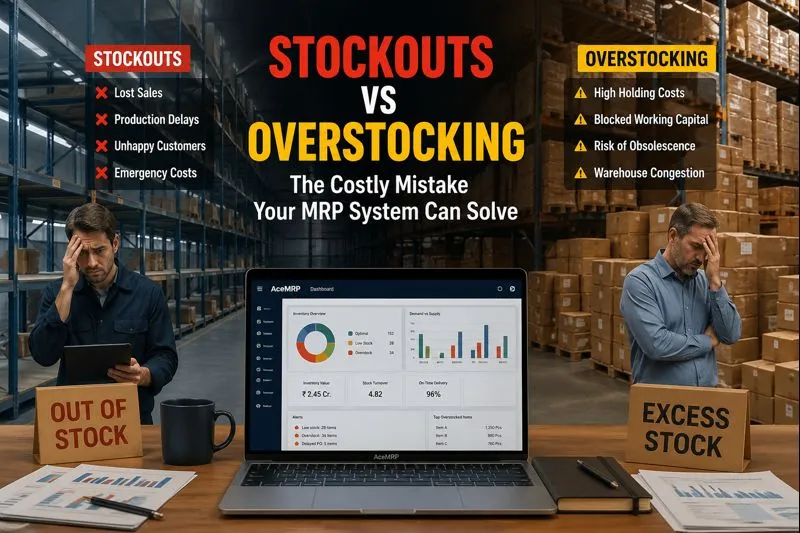
Stockouts vs Overstocking: Why Poor Inventory Decisions Are Costing You More Than You Think
In manufacturing, profitability is rarely lost in one big mistake—it slowly erodes through a series of poor decisions. One of the most critical yet overlooked areas where this happens is inventory management.
The ongoing struggle between stockouts vs overstocking is not just an operational inconvenience. It’s a double-edged business problem where both extremes silently damage margins, disrupt operations, and weaken customer trust.
When inventory runs out, revenue disappears. When inventory piles up, capital gets trapped.
At first glance, this seems like a balancing issue. But in reality, it reflects something deeper—a failure in decision-making systems.
Traditional ERP and MRP systems were built to provide visibility: what stock exists, what is needed, and when. But modern manufacturing demands more than visibility. It requires intelligence—systems that can guide decisions, not just report data.
This is where ERPbyNet’s AceMRP positions itself differently. It doesn’t just help you track inventory—it helps you make the right inventory decisions at the right time.
Stockouts: When Lack of Inventory Disrupts Revenue, Production, and Trust
Stockouts occur when demand—either from customers or production—cannot be fulfilled due to insufficient inventory.
While it may appear as a short-term issue, the ripple effects are far-reaching and often underestimated.
The Real Impact of Stockouts
- Immediate loss of revenue due to unfulfilled orders
- Production line stoppages caused by missing raw materials
- Increased procurement costs due to urgent purchasing
- Damage to customer relationships and brand reliability
- Internal chaos as teams shift into reactive problem-solving mode
Stockouts don’t just impact sales—they disrupt the entire operational rhythm of a business.
A Practical Scenario
Imagine a manufacturing company that receives a large confirmed order. Everything is ready—except one critical component. Due to inaccurate planning, that component is out of stock.
The consequences are immediate:
- Production halts
- Delivery timelines are missed
- Customer confidence drops
- Competitors step in
One small gap in inventory leads to a chain reaction of business losses
Overstocking: When Excess Inventory Becomes a Silent Financial Burden
On the opposite end, overstocking is often misunderstood as a “safe strategy.” Many businesses believe holding extra stock reduces risk—but in reality, it introduces a different kind of risk.
Overstocking occurs when inventory levels exceed actual demand requirements.
The Hidden Costs of Overstocking
- Capital gets locked in unsold or slow-moving inventory
- Warehousing and storage costs increase significantly
- Higher risk of product obsolescence or damage
- Reduced liquidity affects overall financial flexibility
- Inefficient use of warehouse space limits scalability
Unlike stockouts, overstocking doesn’t create immediate visible problems. Instead, it slowly drains profitability over time.
A Warehouse-Level Scenario
A company forecasts high demand and procures large volumes of raw materials. However, demand doesn’t meet expectations.
Months later:
- Inventory remains unsold
- Warehouse space is occupied
- New products cannot be stocked efficiently
- Cash flow is constrained
What initially felt like “preparedness” turns into a financial bottleneck.
The Double-Edged Problem: Why Stockouts and Overstocking Exist Together
Many organizations assume they are facing either stockouts or overstocking. In reality, most are dealing with both—simultaneously.
- Fast-moving items frequently go out of stock
- Slow-moving items accumulate excessively
This imbalance highlights a critical issue:
Inventory decisions are not aligned with actual demand patterns.
The root problem is not inventory itself—it is the lack of synchronized, data-driven decision-making across procurement, production, and sales.
Without intelligent coordination:
- Some items are under-planned
- Others are over-planned
The result is a system that is constantly out of balance.
Read More : Why Elevator Companies Struggle to Track AMC Contracts
The True Business Impact: How Inventory Imbalance Erodes Margins
Inventory mismanagement directly affects financial performance, often in ways that are not immediately visible.
Revenue Loss from Stockouts
- Missed sales opportunities
- Reduced order fulfillment rates
- Loss of repeat customers
- Declining market competitiveness
Cost Leakage from Overstocking
- Increased inventory carrying costs
- Insurance, maintenance, and handling expenses
- Write-offs due to expired or obsolete stock
Operational Inefficiencies Across the Board
- Frequent production rescheduling
- Increased dependency on emergency decisions
- Reduced workforce productivity
Strategic Consequences
- Poor forecasting credibility
- Weak confidence in planning systems
- Inability to scale operations effectively
Summary Comparison Table
| Impact Area | Stockouts | Overstocking |
| Revenue | Direct loss of sales | No immediate revenue benefit |
| Cost | Expedited procurement costs | High storage and carrying costs |
| Operations | Production downtime | Warehouse congestion |
| Cash Flow | Delayed inflows | Blocked working capital |
| Strategy | Customer dissatisfaction | Reduced business agility |
The key takeaway:
Both extremes reduce profitability—just in different ways.
Why Traditional Approaches Fail to Balance Inventory Effectively
Despite widespread adoption of ERP and MRP systems, many manufacturers still struggle with stockouts vs overstocking. The issue is not a lack of data—it’s the lack of intelligent, timely decision-making.
Traditional systems focus on visibility, but inventory balance requires actionable insights and synchronized decisions. Here’s where they fall short:
Limited Real-Time Visibility Slows Down Decisions
Most systems provide data, but not in true real time. Information is often delayed, fragmented, or spread across modules.
- Inventory levels don’t reflect actual on-ground stock instantly
- Procurement and production data are not fully synchronized
- Decisions rely on outdated reports
This delay leads to decisions based on past conditions, resulting in either stockouts or excess inventory.
Inaccurate Demand Planning Creates Imbalance
Traditional demand planning depends heavily on historical data, which fails in dynamic markets.
- Assumes past trends will repeat
- Ignores demand fluctuations and seasonality
- Lacks real-time adjustment
As a result:
- High-demand items run out of stock
- Low-demand items accumulate unnecessarily
Static Planning Models Cannot Adapt
Fixed rules like reorder points and safety stock levels are widely used but rarely updated.
- No flexibility to adjust with changing demand
- Assumes stable lead times and consumption patterns
- Continues outdated planning logic
This rigidity leads to consistent mismatch between supply and demand.
Siloed Decision-Making Breaks Alignment
Different departments operate independently, leading to disconnected decisions.
- Procurement focuses on bulk buying
- Sales pushes demand without supply alignment
- Production plans without real-time inventory validation
Without coordination, businesses face overstock in some areas and shortages in others.
Overuse of Safety Stock Increases Costs
Safety stock is often used as a fallback instead of improving planning accuracy.
- Compensates for poor forecasting
- Masks supply chain inefficiencies
- Leads to long-term overstocking
What starts as a buffer becomes a financial burden.
Root Cause vs Business Outcome
| Root Cause | Business Outcome |
| Static planning | Inventory imbalance |
| Poor forecasting | Demand-supply mismatch |
| Siloed operations | Inefficient decisions |
| Delayed insights | Reactive responses |
Read More : How ERP Can Help Navigate the Manufacturing Materials Shortage
The Intended Role of MRP Systems vs the Reality Businesses Experience
What an MRP System Is Supposed to Do
An ideal MRP system should:
- Align demand forecasts with supply planning
- Ensure timely procurement of materials
- Optimize inventory levels
- Support smooth production scheduling
Where Traditional MRP Systems Fall Short
In practice, many systems:
- Focus on reporting rather than decision-making
- Depend heavily on manual inputs
- Lack real-time adaptability
- Fail to integrate planning with execution
This creates a critical gap:
Businesses know what is happening—but not what they should do next.
How ERPbyNet’s AceMRP Transforms Inventory from Guesswork to Intelligent Decision-Making
Most MRP systems help you see what’s happening. AceMRP is built to help you act on it with clarity and precision.
Instead of treating stockouts and overstocking as isolated issues, AceMRP addresses the deeper challenge—how decisions are made across inventory, procurement, and production. It connects real-time data with intelligent logic to ensure every action is timely, aligned, and outcome-driven.
Real-Time Visibility That Leads to Immediate Action
Visibility becomes valuable only when it enables faster and better decisions. AceMRP ensures that all stakeholders operate with accurate, real-time information.
- Centralized view of inventory across all locations
- Live tracking of stock movement and consumption
- Instant identification of shortages and excess
This removes delays and ensures decisions are based on current conditions, not outdated reports.
Adaptive Demand Planning That Reflects Market Reality
Instead of relying on static forecasts, AceMRP continuously adjusts demand planning based on evolving data.
- Uses real-time demand trends and historical patterns
- Updates forecasts dynamically as conditions change
- Aligns sales projections with production and procurement
This reduces planning errors and ensures inventory aligns closely with actual demand.
Automated Replenishment That Maintains Balance
Manual replenishment often leads to inconsistency. AceMRP introduces system-driven replenishment to maintain optimal stock levels.
- Auto-generated reorder recommendations
- Elimination of manual estimation errors
- Balanced inventory without overstocking or shortages
This creates a consistent and controlled inventory flow.
Integrated Production and Inventory Planning
AceMRP ensures that production plans are always aligned with material availability.
- Synchronizes inventory data with production schedules
- Prevents delays caused by missing materials
- Enables smoother, uninterrupted workflows
This alignment improves efficiency and reduces operational disruptions.
Scalable Inventory Optimization Across SKUs
Managing large volumes of inventory requires more than manual oversight. AceMRP applies intelligence at scale.
- Recommends optimal stock levels for each SKU
- Identifies excess and slow-moving inventory
- Improves inventory turnover and reduces capital lock-in
This allows businesses to operate with lean and efficient inventory.
Proactive Exception Handling Instead of Reactive Fixes
AceMRP identifies risks early, allowing teams to act before problems escalate.
- Early alerts for potential stockouts
- Notifications for excess inventory buildup
- Faster and more confident decision-making
This shifts operations from reactive firefighting to proactive control.
Stronger Supplier Coordination and Procurement Planning
Procurement decisions become more aligned and predictable with better visibility and planning.
- Procurement cycles aligned with actual demand
- Improved coordination with suppliers
- Reduced variability in lead times
This leads to more reliable supply and fewer disruptions.
How AceMRP Solves Core Inventory Challenges
| Business Challenge | Traditional Outcome | AceMRP Outcome |
| Limited visibility | Delayed decisions | Real-time, actionable insights |
| Inaccurate forecasting | Demand-supply mismatch | Dynamic, adaptive demand planning |
| Manual replenishment | Over/under ordering | Automated, balanced replenishment |
| Production misalignment | Downtime and inefficiencies | Synchronized production and inventory |
| Excess inventory | Blocked capital | Optimized stock levels |
| Late issue detection | Reactive firefighting | Proactive alerts and early intervention |
| Supplier inconsistency | Delays and uncertainty | Better coordination and predictable supply |
AceMRP enables a shift from assumption-based planning to data-driven, synchronized decision-making, helping manufacturers consistently avoid both stockouts and overstocking while improving overall operational performance.
Before and After: A Practical Transformation with AceMRP
Before Implementing AceMRP
- Frequent stockouts of critical materials
- Excess inventory of low-demand items
- Production delays and missed deadlines
- High working capital blockage
- Constant reactive firefighting
After Implementing AceMRP
- Balanced inventory aligned with demand
- Significant reduction in stockouts and overstocking
- Smooth and predictable production planning
- Improved cash flow and capital utilization
- Shift from reactive to proactive decision-making
The transformation is not incremental—it’s foundational.
Key Business Benefits of a Decision-Driven MRP System
- Higher Profitability through optimized inventory levels
- Improved Cash Flow by reducing excess stock
- Operational Efficiency with synchronized processes
- Enhanced Customer Satisfaction through reliable deliveries
- Greater Business Agility in responding to demand changes
Moving Beyond Visibility: From Data Tracking to Decision Intelligence
| Traditional ERP | AceMRP (ERPbyNet) |
| Tracks and displays data | Interprets and drives decisions |
| Reactive approach | Proactive approach |
| Manual intervention | Automated intelligence |
| Static rules | Dynamic optimization |
Critical Insight:
Visibility without action leads to delay. Decision intelligence turns data into business outcomes.
Stop Managing Inventory—Start Making Smarter Decisions with AceMRP
The challenge of stockouts vs overstocking is not just about inventory—it reflects how effectively your business makes decisions. When planning relies on outdated data, static rules, or disconnected departments, imbalance becomes unavoidable. The result is a continuous cycle of missed opportunities, excess costs, and operational inefficiencies that directly impact your bottom line.
Today’s manufacturing environment demands more than visibility—it demands clarity, speed, and precision in decision-making. Businesses that continue to operate reactively will always struggle to maintain balance. The real shift happens when you move from tracking inventory to actively controlling it through intelligent systems.
ERPbyNet’s AceMRP is built to enable that shift. By combining real-time insights with automated planning and synchronized execution, it empowers your team to make faster, smarter, and more confident decisions. Instead of constantly fixing problems, you gain the ability to prevent them.
If inventory imbalance is affecting your operations, now is the time to act. Connect with our team to understand how AceMRP can help you reduce stockouts, avoid excess inventory, and bring complete control to your supply chain decisions.
Frequently Asked Questions (FAQs)
What is the difference between stockouts and overstocking?
Stockouts occur when a business runs out of inventory and cannot meet demand, leading to lost sales and production delays, whereas overstocking happens when excess inventory is held beyond actual demand needs, resulting in increased carrying costs, blocked working capital, and inefficiencies. While they appear opposite, both stem from poor planning and decision-making rather than just inventory mismanagement.
Why do stockouts and overstocking happen at the same time in a business?
Stockouts and overstocking often occur simultaneously because different products are managed using inconsistent or outdated planning methods, where fast-moving items are under-forecasted and slow-moving items are overestimated. This imbalance is typically caused by siloed decision-making, lack of real-time data, and static inventory rules that fail to adapt to changing demand patterns.
How do stockouts and overstocking impact profitability?
Stockouts directly reduce revenue by causing missed sales opportunities and customer churn, while overstocking increases operational costs through storage, insurance, and potential obsolescence. Together, they create a dual financial strain—one by limiting income and the other by increasing expenses—ultimately eroding overall profit margins.
What role does an MRP system play in inventory optimization?
An MRP system is designed to align demand with supply by planning material requirements, managing inventory levels, and supporting production schedules, but traditional systems often fall short because they rely on static rules and manual inputs. Modern solutions like AceMRP enhance this role by introducing real-time insights and automated decision-making, enabling businesses to proactively balance inventory and reduce inefficiencies.
How does ERPbyNet’s AceMRP help reduce stockouts and avoid excess inventory?
AceMRP helps reduce stockouts and overstocking by combining real-time visibility with intelligent demand planning, automated replenishment, and exception-based alerts, ensuring that inventory decisions are timely and data-driven. By synchronizing procurement, production, and inventory management, it enables businesses to maintain optimal stock levels, improve cash flow, and respond quickly to changing market conditions.