CategoriesERP (Enterprise Resource Planning)

From Paper Records to Digital Accuracy: Managing Staff with ERPbyNet

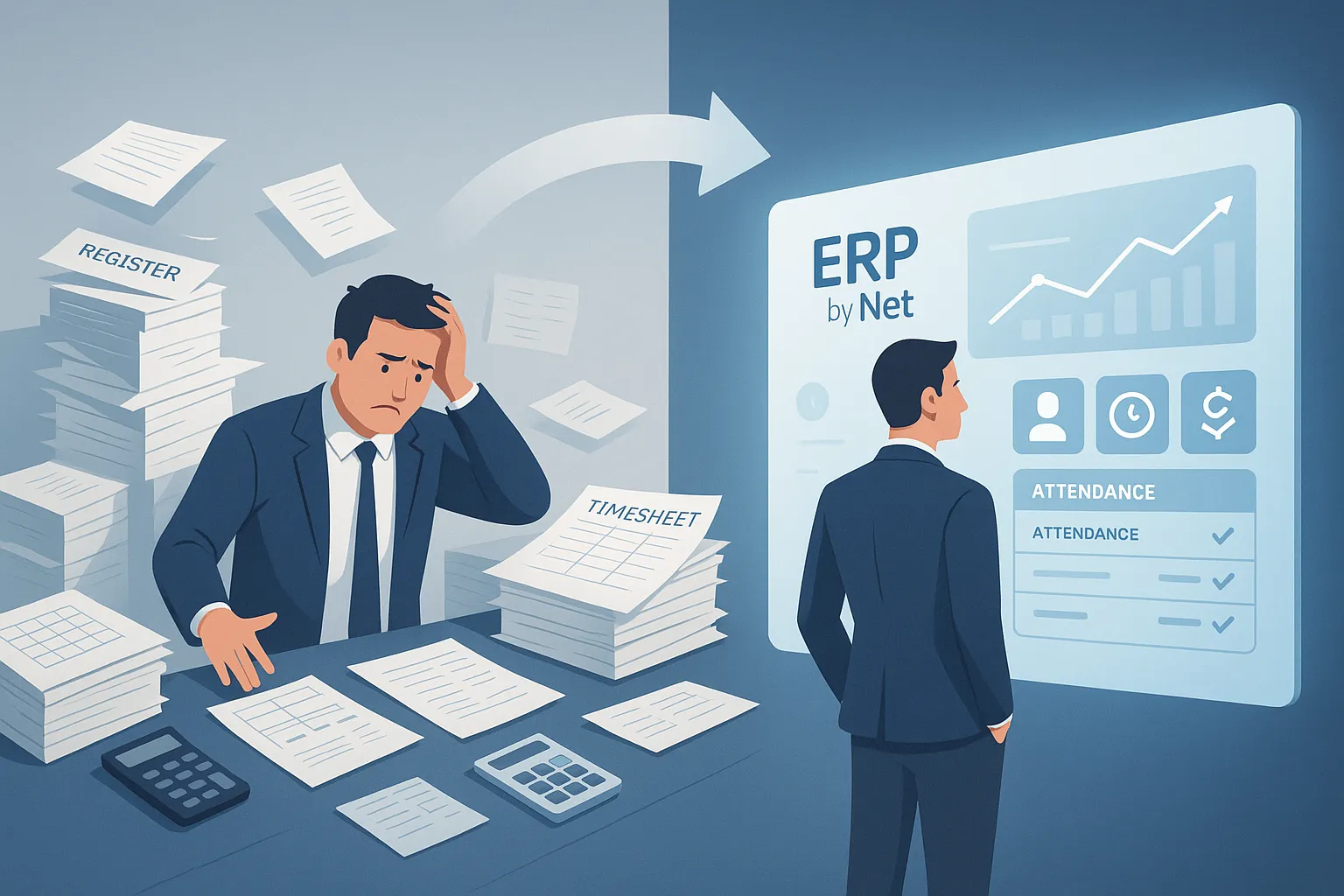
Every growing business knows the story too well. A manager spends Friday evenings buried in paper attendance registers, calculating overtime with a calculator, and chasing supervisors for missing timesheets. Payroll teams live in “Excel hell,” cross-checking formulas that never quite add up. Employees, on the other hand, feel frustrated when salaries are delayed or overtime hours are disputed.

This cycle drains time, money, and morale. For startups and SMEs, where every resource counts, the chaos of manual staff tracking can quickly snowball into bigger operational roadblocks. Missed deadlines, payroll errors, and project overruns become part of a routine that eats into profits.

But business does not need to be this way. With the right ERP solution, companies can move away from error-prone records and disjointed spreadsheets to a system that is centralized, transparent, and automated. That is exactly where ERPbyNet steps in—helping businesses achieve digital accuracy in staff management.

Why Paper Records Hold Businesses Back

Relying on paper registers and spreadsheets may feel manageable at first, but the cracks appear quickly as the workforce grows.

  • Inaccurate Data: Manual entries are prone to mistakes, whether intentional or accidental.

  • Payroll Disputes: Delays and disputes over overtime or leave lead to mistrust among staff.

  • Time Theft: Buddy punching or inflated reporting silently increases costs.

  • Slow Approvals: Manual verification and approvals delay payroll cycles.

  • No Visibility: Managers cannot get real-time insights into staff productivity or deployment.

In short, paper records create blind spots that make scaling a challenge. Businesses are left managing staff reactively instead of strategically.

Read More : How to Manage Inventory, Technicians & Invoices in One ERP Dashboard

How ERPbyNet Brings Digital Accuracy

How ERPbyNet Brings Digital Accuracy

ERPbyNet replaces the uncertainty of paper records with a reliable, ERP-powered staff tracking system built specifically for SMEs and fast-growing enterprises. By unifying timesheets, payroll, and workforce data into a single platform, businesses gain unmatched clarity and control over their operations. Here is how ERPbyNet delivers accuracy in every step:

1. Real-Time Time Tracking

With ERPbyNet, outdated paper logs are replaced by modern clock-in methods—mobile devices, biometric scanners, or GPS-based check-ins. Every working hour is recorded automatically, leaving no room for guesswork or inflated reporting. This ensures businesses pay only for actual work done, while employees enjoy the convenience of quick and reliable logging.

2. Automated Payroll Processing

Payroll is often one of the most error-prone areas when handled manually. ERPbyNet connects timesheet data directly to payroll, automatically calculating overtime, deductions, and allowances. This not only guarantees accuracy but also speeds up salary processing, ensuring staff are paid correctly and on time—every time.

3. Transparent Oversight with Dashboards

Managers no longer need to chase down updates or rely on verbal reports. ERPbyNet provides live dashboards showing exactly who is working, where they are deployed, and how their time is being used. This visibility helps leaders make smarter, data-backed decisions about staffing and workload distribution.

4. Accurate Project Costing

In project-based industries, labor costs are a major variable. ERPbyNet links staff hours directly to specific projects, giving managers real-time insights into costs against budgets. This allows for more precise forecasting, better allocation of resources, and reduced waste—keeping projects profitable and on track.

5. Simplified Compliance and Reporting

Labor regulations demand accurate records of attendance, breaks, and overtime. ERPbyNet generates detailed reports instantly, ensuring businesses can demonstrate compliance with ease. Instead of scrambling to prepare records for audits or inspections, companies have everything ready at the click of a button.

6. Building Staff Trust and Accountability

Transparency is powerful. When employees see their hours tracked clearly and fairly, disputes decrease and confidence increases. ERPbyNet fosters accountability on both sides—managers know productivity levels at a glance, and staff can trust that their contributions are recognized and rewarded accurately.

Read More :  Field Sales Automation ROI: What Sales Managers Are Actually Getting Today

Business Benefits of Moving to ERPbyNet

Shifting from paper-based systems to ERPbyNet is not simply a matter of digitizing records. It transforms how businesses operate, creating measurable improvements across efficiency, costs, employee satisfaction, and scalability. Here is a closer look at the key advantages:

1. Efficiency Through Automation

Manual reconciliation of timesheets consumes significant HR and payroll resources. With ERPbyNet, this entire process is automated. Attendance, working hours, overtime, and leave are recorded in real time and integrated directly with payroll. This reduces repetitive tasks, eliminates back-and-forth verifications, and allows teams to focus on strategic HR initiatives instead of data entry.

2. Significant Cost Savings

One of the hidden costs of manual logs is “time theft,” where inflated or inaccurate timesheets increase payroll expenses. ERPbyNet prevents these errors by capturing accurate data through mobile check-ins, GPS tracking, or biometric systems. Businesses immediately see cost reductions by paying only for actual hours worked.

3. Higher Employee Morale and Trust

When salaries are delayed or overtime is miscalculated, employee confidence takes a hit. ERPbyNet ensures on-time and error-free payroll processing. Transparent timesheet management builds trust—employees know their efforts are tracked fairly, and managers can resolve disputes quickly. This leads to stronger workforce morale and better staff retention.

4. Seamless Scalability for Growing Teams

What works for a 50-person team often collapses under the pressure of 500 or more. ERPbyNet is designed to scale with business growth, handling large and distributed teams without losing accuracy or speed. Whether a company is adding new projects, expanding into new regions, or managing multiple sites, ERPbyNet adapts effortlessly.

5. Data-Driven Workforce Insights

ERPbyNet does more than track time—it provides actionable insights. Managers can view patterns of productivity, track overtime trends, and forecast resource requirements. These analytics empower decision-making, helping businesses optimize staff allocation, reduce idle time, and improve overall project efficiency.

Read More : How ERP Helps Small Elevator Businesses Operate Like Big Players?

Real-World Scenarios

Construction Industry

A construction company running multiple sites faced long delays consolidating daily logbooks. After adopting ERPbyNet, workers began clocking in through mobile check-ins. Payroll cycles became faster, and labor costs were tracked accurately against each project.

Field Service Firms

A facility management provider struggled with client disputes over billed hours. ERPbyNet’s GPS-enabled check-ins provided transparent timesheets, ensuring invoices were backed by real data. Billing accuracy improved, strengthening client trust.

Healthcare Providers

A home healthcare company managing rotating shifts of caregivers faced compliance risks. With ERPbyNet, shift hours were logged automatically, ensuring staff received fair pay and compliance audits were passed without hassle.

Best Practices for Implementing ERPbyNet Staff Tracking

Best Practices for Implementing ERPbyNet Staff Tracking

Introducing ERPbyNet into daily operations is not just about deploying software—it’s about shaping habits, setting clear policies, and using technology to create accountability. To get the most out of the system, businesses should follow these best practices:

1. Go Mobile First

Encourage staff to use ERPbyNet’s mobile app or biometric check-ins as their primary way of logging hours. Mobile and GPS-based tracking ensures accuracy even when employees are on-site, in transit, or at client locations. This eliminates the gaps and inconsistencies that often appear in paper-based records.

2. Train Early and Consistently

Successful adoption starts with orientation. Introduce ERPbyNet during onboarding sessions and offer refresher training for supervisors and staff. When employees understand how the system benefits both them and the company—such as reducing payroll disputes—they’re more likely to use it correctly.

3. Integrate with Payroll for Seamless Processing

One of ERPbyNet’s strongest advantages is its ability to connect timesheets directly to payroll. Ensure this integration is set up from the start. Automated salary calculations, including overtime, deductions, and allowances, not only save HR time but also build trust with employees who expect timely payments.

4. Establish Clear Policies

Technology works best when guided by well-defined rules. Create transparent policies for overtime approvals, leave requests, and shift scheduling. When these are embedded into ERPbyNet, managers can enforce policies consistently, reducing confusion and improving fairness.

5. Leverage Dashboards and Analytics

ERPbyNet isn’t just a record-keeping tool—it’s a decision-making engine. Make full use of its dashboards to monitor attendance trends, overtime patterns, and resource utilization. These insights help managers anticipate staffing needs, balance workloads, and avoid unnecessary costs.

Read More : Cloud ERP in 2025: The Backbone of Elevator Service Operations

The Future of staff tracking

Moving from paper records to ERP systems is just the first step in a much larger transformation. The real future of workforce management lies in combining ERP platforms with advanced technologies that are reshaping how businesses operate.

Artificial Intelligence (AI) will play a key role in scheduling and workload distribution. Instead of managers manually assigning shifts, AI-driven tools will recommend optimized schedules based on employee availability, historical performance, and project demands. Predictive analytics will go a step further by helping businesses forecast staffing needs—whether that’s preparing for seasonal demand spikes or identifying departments that may face skill shortages.

Workflow automation will also become central to staff management. Routine approvals for leave, overtime, or shift swaps will be handled automatically within ERP systems, reducing bottlenecks and freeing managers to focus on strategy. For employees, this means faster responses and fewer frustrations with everyday tasks.

Businesses that embrace ERP today, like ERPbyNet’s staff tracking solution, are not just solving current inefficiencies—they are future-proofing their operations. By laying the digital foundation now, they prepare themselves for a future where workforce management is smarter, faster, and fully data-driven.

Conclusion

Paper records belong in filing cabinets, not in the heart of a modern business. ERPbyNet empowers organizations to replace guesswork with accuracy, delays with real-time tracking, and disputes with transparency. For businesses that depend on their workforce, ERPbyNet offers a solution that is simple, reliable, and scalable.

At ERPbyNet, we help businesses move from paper records to digital accuracy—making staff management easier, payroll more precise, and growth more achievable. Ready to make the shift? Let’s transform the way you manage your workforce.

FAQs

What is ERP staff tracking?

ERP staff tracking refers to using enterprise resource planning software to monitor employee attendance, working hours, and productivity in real time. Instead of relying on paper timesheets or manual logs, businesses gain a reliable, automated system that reduces errors and provides transparency.

Can small businesses benefit from ERPbyNet?

Absolutely. ERPbyNet is designed to be flexible and scalable, which means it works just as well for a 10-person startup as it does for a large enterprise. Small businesses gain structure, accuracy, and efficiency without being burdened by complex systems.

How does ERPbyNet improve payroll accuracy?

ERPbyNet links timesheets directly with payroll, so every hour worked—along with overtime, leave, or deductions—is calculated automatically. This eliminates the risk of human error, prevents disputes, and ensures staff are paid fairly and on time.

Does ERPbyNet support remote or field staff?

Yes. ERPbyNet is built for modern, mobile workforces. With GPS-enabled mobile check-ins and biometric options, businesses can track employees who work across sites, travel frequently, or operate remotely with complete accuracy.

How quickly can ERPbyNet be implemented?

Implementation is faster than most businesses expect. While timelines depend on company size and requirements, ERPbyNet is designed for quick deployment—helping businesses start seeing measurable benefits within weeks, not months.

Is training required to use ERPbyNet?

Minimal training is required. The platform is intuitive and user-friendly, meaning staff and managers can adapt quickly. A short orientation is usually enough to get teams comfortable with the system.

CategoriesERP (Enterprise Resource Planning)

How ERP Travel Tracking Improves Productivity and Cuts Costs

In today’s business world, organizations with field staff face a constant balancing act—ensuring employees are productive while keeping travel costs under control. Whether it’s sales representatives visiting clients, technicians attending service calls, or delivery teams on the move, travel is one of the largest and hardest-to-monitor expenses.

Unfortunately, many businesses still rely on manual methods like spreadsheets, paper receipts, and disconnected systems to manage travel and expenses. This approach not only wastes time but also leads to errors, fraud, and delayed reimbursements.

An ERP system with travel tracking capabilities offers a smarter alternative. By integrating travel management into the core ERP, businesses can streamline processes, empower employees, and gain real-time control over expenses. Let’s explore how ERP travel tracking transforms field operations into a productivity and cost-efficiency engine.

The Challenges of Manual Travel & Expense Tracking

The Challenges of Manual Travel & Expense Tracking

Managing travel and expenses manually may seem manageable at first, but as teams grow, the problems become clear:

  • Time-consuming for employees: Staff must keep receipts, record mileage, and compile reports—taking focus away from their core work.
  • Slow approval cycles: Managers often review claims only after weeks, creating frustration and delayed reimbursements.
  • Lack of transparency: Finance teams struggle to understand where travel budgets are going or whether policies are being followed.
  • Risk of errors and fraud: Inflated mileage claims, duplicate entries, or missing receipts are common.
  • Limited insight for decision-making: Without accurate data, managers cannot optimize routes, allocate resources effectively, or track travel ROI.

These issues result in higher costs, inefficient use of staff time, and an overall lack of accountability.

Read More : How to Manage Inventory, Technicians & Invoices in One ERP Dashboard

How ERP Travel Tracking Works

How ERP Travel Tracking Works

An ERP system integrates all travel and expense functions into one platform, ensuring real-time visibility and automation. Key features include:

  • Mobile-first logging: Employees record travel details directly through mobile apps, including mileage, time, and receipts.
  • GPS-enabled tracking: Routes and locations are automatically captured, validating employee travel without manual entry.
  • Automated expense categorization: Expenses are sorted into categories (fuel, meals, lodging) with policy checks applied instantly.
  • Seamless approval workflows: Claims are routed to managers automatically. If within policy limits, they can even be approved instantly.
  • Direct integration with finance: Approved expenses flow into the accounting system, ensuring accurate budget updates and faster reimbursements.
  • Centralized reporting dashboards: Managers and finance teams gain complete visibility into travel costs, trends, and compliance metrics.

By digitizing and automating every step, ERP eliminates the inefficiencies of manual travel management.

Read More : Project Management ERP: The Secret to On-Time and On-Budget Delivery

Driving Productivity Across the Field Workforce

Driving Productivity Across the Field Workforce

Travel tracking in ERP isn’t just about controlling costs—it directly boosts productivity for both employees and managers.

For field staff:

  • They no longer waste time compiling expense reports at the end of the week.
  • Receipts are captured instantly with a mobile camera, reducing the risk of lost records.
  • Reimbursement cycles are faster, leading to greater satisfaction and motivation.

For managers:

  • Real-time dashboards show where employees are and how much time is being spent on travel versus client work.
  • GPS validation eliminates constant back-and-forth updates, saving time on monitoring.
  • Optimized scheduling ensures staff are assigned to routes or clients in a logical order, reducing idle time and maximizing daily productivity.

This streamlined process frees up hours every week—time that can be spent on revenue-generating work rather than administrative tasks.

How ERP Travel Tracking Cuts Costs

Cost control is one of the biggest advantages of ERP-based travel management. Here’s how it delivers measurable savings:

  • Fraud prevention: GPS data confirms mileage, preventing inflated claims. Duplicate or suspicious entries are flagged instantly.
  • Enforced compliance: Policies around travel allowances, lodging categories, and daily limits are embedded into the system, ensuring employees cannot overspend.
  • Reduced administrative overhead: With automation, finance teams no longer spend hours checking receipts and manually posting expenses.
  • Route optimization: Data reveals the most efficient travel patterns, helping businesses cut down on unnecessary trips and fuel costs.
  • Budget control: Every expense is linked to a project, department, or cost center, allowing real-time budget tracking and better forecasting.

These improvements not only save money but also ensure that spending directly supports business goals.

Read More ; Field Sales Automation ROI: What Sales Managers Are Actually Getting Today

A Real-World Scenario

Consider a field service company with 50 technicians.

Before ERP: Each technician maintains a logbook of trips, submits receipts at the end of the week, and waits nearly two weeks for reimbursement. Managers spend hours verifying the data, while finance teams face constant delays and mismatched expense entries. Travel costs spiral out of control due to lack of oversight.

After ERP: Every technician uses a mobile app that automatically logs their travel with GPS, scans receipts on the go, and submits expenses instantly. Managers see trips in real time, approve claims within hours, and optimize schedules based on travel data. Finance teams get accurate, categorized expenses automatically entered into the ERP. Reimbursements happen within days, costs are reduced by 15–20%, and employees are happier.

This scenario shows how ERP transforms travel tracking from a pain point into a competitive advantage.

Best Practices for Implementation

To fully realize the benefits of ERP travel tracking, businesses should follow a structured approach:

  • Start small: Roll out the system to one team or region before expanding.
  • Define clear policies: Ensure travel allowances, categories, and approval thresholds are set within the ERP.
  • Train staff effectively: Educate employees on using mobile apps and highlight the benefits for faster adoption.
  • Monitor key metrics: Track indicators like average reimbursement time, total travel cost per employee, and compliance rate.
  • Scale strategically: Once proven, extend the solution across departments, customizing policies where necessary.

A thoughtful rollout ensures smooth adoption and faster ROI.

Conclusion

ERP-enabled travel tracking transforms one of the most complex aspects of workforce management into a streamlined, efficient, and transparent process. By combining mobile tools, GPS tracking, automated workflows, and real-time reporting, businesses gain control over expenses while empowering employees with faster, simpler processes.

The result is a win-win: employees save time and get reimbursed quickly, managers make better decisions with real-time insights, and organizations cut unnecessary costs while improving productivity.

For any business with a mobile workforce, ERP travel tracking isn’t just an upgrade—it’s a necessity for sustainable growth and operational efficiency. Contact Us Now for Free Demo.

FAQs on ERP Travel Tracking

What is ERP travel tracking?

ERP travel tracking is the integration of travel and expense management into an ERP system. It automates logging, approval, and reimbursement processes using mobile apps, GPS tracking, and real-time reporting, helping businesses gain full visibility and control over travel expenses.

How does ERP travel tracking improve employee productivity?

By eliminating manual reporting, employees don’t waste time collecting receipts, filling spreadsheets, or waiting weeks for reimbursements. Mobile apps and GPS validation simplify the process, allowing staff to focus on their core work instead of administrative tasks.

Can ERP travel tracking help reduce fraud and errors?

Yes. ERP systems use GPS validation, duplicate detection, and automated policy checks to prevent inflated mileage claims, missing receipts, and unauthorized expenses. This significantly reduces fraud and ensures compliance with company policies.

What kind of cost savings can businesses expect?

Companies typically reduce travel costs by 15–20% through fraud prevention, better route optimization, reduced administrative overhead, and real-time budget monitoring. Savings vary depending on company size and travel volume.

Is ERP travel tracking suitable for small businesses or only large enterprises?

ERP travel tracking benefits businesses of all sizes. For small businesses, it streamlines expense management and prevents overspending. For large enterprises, it provides scalable controls, compliance enforcement, and advanced reporting across multiple teams or regions.


CategoriesERP (Enterprise Resource Planning)

The Benefits of Automating Your AMC Contracts and Why You Need to Switch Now

If you’ve ever managed an Annual Maintenance Contract (AMC) with nothing but a spreadsheet, a phone, and a silent prayer, you know the drill. Renewal dates sneak up on you like uninvited guests. Invoices get buried in email threads. And just when you think you’re on top of it, a client calls to say, “Hey, wasn’t my AMC supposed to be renewed last week?”

It’s the business equivalent of Friday fire drills—chaotic, repetitive, and entirely avoidable. Operations managers, especially in growing SMEs, spend hours chasing AMC details: expiry dates, payment statuses, service history. That’s valuable time that could be spent actually growing the business.

The truth? AMC contract management doesn’t have to be a headache. With the right automation, you can turn renewal chaos into a predictable, revenue-generating machine. That’s where ERPbyNet comes in—bridging the gap between manual tracking and effortless AMC control.

What is AMC Contract Management (And Why It Matters More Than You Think)?

In simple terms, AMC contract management is the process of overseeing, renewing, and tracking annual maintenance agreements with your customers. Whether you service elevators, HVAC systems, medical devices, or IT infrastructure, these contracts are your lifeline for recurring revenue.

Traditionally, AMC management meant:

  • Manually updating spreadsheets.
  • Setting calendar reminders (that may or may not get snoozed forever).
  • Sending renewal proposals one client at a time.
  • Chasing approvals, then chasing payments.

This worked when you had 10 contracts. But once you’re dealing with hundreds across multiple clients, manual methods become a liability—leading to missed renewals, cash flow dips, and damaged client trust.

The Problem with Manual AMC Management

The Problem with Manual AMC Management

  1. Missed Renewals = Missed Revenue
    If your renewal reminder relies on someone “remembering” to send an email, you’re gambling with your income stream.
  2. Approval Delays
    Manual proposals often sit in inboxes, waiting for management to review—slowing everything down.
  3. Data Silos
    Service history in one folder, invoices in another, client communication somewhere else—it’s a mess.
  4. Poor Client Experience
    When a customer has to remind you about their contract, it’s a bad look.

Read More : How to Manage Inventory, Technicians & Invoices in One ERP Dashboard

How Automation Changes the Game

Automating AMC contract management transforms the entire process from reactive to proactive. Here’s what happens when ERPbyNet takes over:

1. Renewal Reminders That Never Forget

The system sends automatic alerts well before AMC expiry—weeks in advance—so you’re never blindsided.

2. Pre-filled Proposals in Seconds

ERPbyNet pulls in updated service dates, contract terms, and rates, generating ready-to-send proposals instantly.

3. Digital Approval Workflows

Managers can review and approve proposals from anywhere, with just a click—no more endless email loops.

4. Instant Invoice Integration

Once approved, invoices are generated automatically and linked to your billing module.

Real-World Example: Before and After Automation

Real-World Example: Before and After Automation

Before ERPbyNet:
Rajesh runs a mid-sized HVAC servicing company. Every quarter, his team scrambles to check which contracts are up for renewal. Someone inevitably misses one or two. Clients slip away, frustrated by delays.

After ERPbyNet:
The system flags all contracts due for renewal in the next 60 days, auto-generates proposals, and notifies both sales and service teams. Rajesh’s company now has a 98% renewal rate, plus happier clients who feel taken care of.

Read More : Project Management ERP: The Secret to On-Time and On-Budget Delivery

Key Benefits of AMC Contract Management Automation

Key Benefits of AMC Contract Management Automation

1. Revenue Stability

Automation ensures you never miss a renewal, protecting your recurring income stream.

2. Time Savings

What used to take hours (or days) now takes minutes. Your team can focus on value-adding work, not admin.

3. Better Client Relationships

Timely renewals and smooth communication make clients feel valued and secure.

4. Improved Accuracy

With centralized data, there’s no risk of sending outdated terms or incorrect prices.

5. Scalable Operations

Whether you have 50 or 5,000 AMCs, the process remains just as smooth.

Read More : How ERP Helps Small Elevator Businesses Operate Like Big Players?

AMC Automation vs. Manual Tracking: A Quick Comparison

Feature Manual Tracking Automated with ERPbyNet
Renewal Reminders Dependent on human memory Automated, scheduled alerts
Proposal Preparation Manual entry Pre-filled in seconds
Approval Process Email chains One-click digital workflow
Invoicing Separate process Auto-linked post-approval
Data Access Scattered files Centralized dashboard
Scalability Hard to manage >100 contracts Effortless at any scale

Why Switch Now? The Cost of Waiting

Every missed renewal is money left on the table—and a risk to your client relationship. According to Gartner, businesses that automate recurring contract processes see up to 25% higher customer retention.

Add to that the opportunity cost—hours wasted chasing paperwork instead of chasing growth—and it’s clear that waiting costs more than switching.

Trends Shaping the Future of AMC Contract Management

  • AI-powered predictions: Forecast renewal likelihood and suggest upsells.
  • Mobile-first approvals: Managers approve proposals on the go.
  • Integrated compliance tracking: Auto-generate compliance certificates alongside contracts.
  • Low-code customization: Tailor workflows without heavy coding.

ERPbyNet is already integrating these capabilities, keeping you ahead of the curve.

Read More : How Much Does ERP Cost in 2025? Complete Pricing Guide for All Business Sizes

 From Firefighting to Forecasting

Managing AMCs manually is like bailing water from a leaky boat—you’re constantly working, yet losing ground. Missed renewals, scattered data, and delayed invoicing create a cycle of firefighting instead of forward planning. Automation with ERPbyNet changes that story. It patches the leaks, centralizes your processes, and ensures a steady, predictable flow of renewals and revenue.

With smart reminders, instant proposal generation, and seamless billing integration, you move from reactive chaos to proactive control. No more last-minute scrambles—just clear visibility, timely actions, and happier clients.

At ERPbyNet, we design ERP solutions that don’t just fit your business—they grow with it. Whether you’re managing fifty contracts or five thousand, our AMC contract management tools keep you ahead, organized, and profitable. It’s time to stop fighting fires and start forecasting your next big win. Ready to make the switch? Let’s transform your workflow.

Still have questions about AMC contract management? Let’s clear them up.

1. What is AMC contract management software?

AMC contract management software is a specialized digital solution designed to handle the entire lifecycle of your Annual Maintenance Contracts. It automates key tasks such as tracking contract start and expiry dates, sending timely renewal reminders, generating proposals, and creating invoices. By centralizing all your contract data in one place, it eliminates the need for scattered spreadsheets or manual follow-ups, ensuring nothing slips through the cracks.

2. Who needs AMC contract automation?

Any business that relies on recurring maintenance agreements can benefit from AMC automation. This includes industries like HVAC servicing, elevator maintenance, IT infrastructure support, security systems, and manufacturing equipment servicing. If your business depends on renewals for steady revenue, automation ensures you never miss a date, maintain better client relationships, and save valuable administrative time.

3. Can ERPbyNet integrate with my existing systems?

Absolutely. ERPbyNet is built for compatibility and can integrate seamlessly with your existing tools through secure APIs. Whether you use accounting software like QuickBooks, a CRM system like Salesforce, or an inventory management platform, ERPbyNet connects them so your data flows effortlessly across departments—reducing double entry and boosting accuracy.

4. Will automation replace my staff?

Not at all. The goal of automation is to make your team more productive, not redundant. By removing repetitive administrative work—like manually tracking renewal dates or preparing invoices—your staff can focus on more strategic, high-value activities such as client service, sales, and business growth initiatives.

5. How fast can I get started?

With ERPbyNet, getting started is quick and straightforward. Depending on the complexity of your current processes and systems, implementation can take as little as a few weeks. We guide you through setup, configuration, and training to ensure your team is comfortable and confident using the system from day one.

6. Is AMC automation expensive?

Think of AMC automation as an investment rather than a cost. While there is an initial setup and subscription fee, the return is almost immediate. Businesses recover their investment through time saved, fewer missed renewals, reduced errors, and increased customer retention. In most cases, the boost in recurring revenue more than covers the cost within months.

CategoriesProject Execution & Site Management

Why Tablet-Based Site Surveys Are Transforming Elevator Modernization

In elevator modernization, speed and accuracy are not just desirable — they are essential. A single missed measurement or misplaced note can cause delays, inflate costs, and frustrate clients. Yet, many modernization teams still depend on outdated tools like clipboards, paper forms, and loose photo folders, slowing progress before installation even begins.

The truth is, paper-based surveys simply cannot keep pace with modern project demands. Data gets scattered, photos become disconnected from their relevant components, and manual transcription consumes valuable hours. This inefficiency creates a bottleneck that directly impacts project timelines.

Tablet-Based Site Surveys, powered by solutions like SmartSiteSurvey, solve this problem. With an all-in-one digital platform that integrates measurements, annotated photos, sketches, and offline capabilities, surveyors can capture complete, accurate data in the field and share it instantly with stakeholders. The result is a faster, smarter, and more reliable approach to elevator modernization.

The Problem with Legacy Survey Methods

The Problem with Legacy Survey Methods

Data Silos and Errors

Traditional surveys often store information across multiple tools — paper sheets, digital cameras, and separate email attachments. Each handoff introduces a higher risk of lost data, duplication, or errors.

Time-Consuming Transcription

Paper notes require manual entry into digital systems back at the office. Not only does this waste hours, but it also increases the chance of transcription mistakes that can lead to costly rework.

Limited Collaboration

Until paper notes are scanned or typed up, they remain inaccessible to project managers, engineers, and installation crews. This delay can result in critical miscommunications and late-stage design changes.

How Tablet-Based Site Surveys Change the Game

How Tablet-Based Site Surveys Change the Game

1. Portability Meets Power

A lightweight tablet replaces the need for clipboards, folders, and cameras. Tablet-Based Site Surveys keep every tool a surveyor needs in one place — perfect for tight elevator shafts, motor rooms, and high-rise rooftops.

2. Photo and Sketch Integration

With built-in cameras and annotation tools, surveyors can take high-resolution photos, draw directly on them, and link them to exact components. This clarity eliminates guesswork and ensures everyone is working from the same visual reference.

3. Offline Support for Remote Sites

Elevator modernization often happens in low-connectivity environments. SmartSiteSurvey allows work to continue without internet access, securely storing data until a connection is available for automatic syncing.

4. Robust Tools for Complex Retrofits

Older buildings present unique challenges such as irregular shaft dimensions or obsolete equipment. Tablet-Based Site Surveys provide real-time calculation tools, customizable checklists, and compliance references so no measurement is overlooked.

Read More : How to Manage Inventory, Technicians & Invoices in One ERP Dashboard

Real-World Impact in Elevator Modernization

Take a 1970s-era high-rise undergoing a full modernization. Using traditional methods might require:

  • Two separate site visits due to missing data

  • A week-long delay for manual transcription

  • Confusion between engineering and installation teams over unclear sketches

With SmartSiteSurvey’s Tablet-Based Site Surveys, the process changes dramatically:

  • Complete data capture — measurements, photos, and notes — in a single visit

  • Immediate digital reports shared with stakeholders

  • Reduced rework thanks to integrated, accurate records

Measurable ROI and Industry Trends

Adopting Tablet-Based Site Surveys delivers measurable results:

  • Up to 40% improvement in data accuracy compared to paper methods

  • 20–30% faster survey-to-installation timelines

  • Increased team confidence in pre-installation specifications

The elevator sector is following broader construction industry trends toward digital transformation. Companies that fail to modernize risk falling behind competitors who can deliver faster, more precise results.

Read More : Project Management ERP: The Secret to On-Time and On-Budget Delivery

Beyond Speed: The Strategic Advantage

Elevator modernization projects are often under strict timelines due to building occupancy requirements or compliance deadlines. Tablet-Based Site Surveys enable:

  • Faster project approvals

  • Fewer site revisits

  • Seamless communication between surveyors and planners

In a competitive marketplace, consistently delivering accurate, well-documented surveys ahead of schedule is more than operational efficiency — it’s a market differentiator.

Read More : Field Sales Automation ROI: What Sales Managers Are Actually Getting Today

 Tablet-Based Site Surveys in Elevator Modernization

In elevator modernization, every successful project starts with a precise, well-executed site survey. Relying on scattered paper notes, separate photo folders, and manual data entry is no longer just inefficient — it’s a competitive disadvantage. These outdated methods slow your workflow, increase the risk of errors, and delay project completion.

Tablet-Based Site Surveys with SmartSiteSurvey change the game. By combining measurements, annotated photos, sketches, and project notes into one portable platform, your team can capture complete, accurate data in real time. No more guesswork. No more searching for the right photo. No more duplicate site visits to fix missed details.

With offline functionality, SmartSiteSurvey works anywhere — from dimly lit machine rooms to remote elevator shafts. Its retrofit-ready tools ensure even the most complex modernization projects are documented with clarity and precision.

In an industry where speed, accuracy, and reliability are the keys to winning projects, adopting Tablet-Based Site Surveys gives you an immediate advantage. Deliver faster approvals, reduce costly rework, and impress clients with your efficiency.

Don’t let outdated processes limit your potential. Put SmartSiteSurvey in your team’s hands and transform every site survey into a powerful launchpad for modernization success — starting with your next project.

FAQs:

1. How do tablet-based surveys improve accuracy?

Tablet-based surveys improve accuracy by consolidating all project data — measurements, photos, notes, and sketches — into one unified digital workspace. This eliminates the risk of mismatched photos, unreadable handwriting, or lost paper forms. Features like built-in annotation tools allow surveyors to mark up images directly, reducing ambiguity and ensuring that every stakeholder sees the exact same information. The result is clearer communication, fewer mistakes, and more precise project execution.

2. Can SmartSiteSurvey work without an internet connection?

Yes. SmartSiteSurvey is designed for real-world conditions, which means it functions fully offline. Surveyors can continue taking measurements, capturing photos, and filling out forms even in remote areas, basements, or elevator shafts where connectivity is unreliable. Once the device reconnects to the internet, all data is automatically synced, so there’s no disruption to your workflow.

3. How does photo and sketch integration benefit the project?

By capturing images directly within the survey app and linking them to specific elevator components or measurements, teams gain visual clarity that text alone can’t provide. Annotated photos highlight key details such as wear patterns, structural modifications, or clearance issues. This visual record becomes a shared reference point for engineers, installers, and project managers, reducing follow-up calls and site revisits.

4. In what ways does it speed up modernization projects?

Tablet-based surveys cut out several manual steps in the traditional process. Instead of collecting data on paper, then typing it into a computer later, surveyors can submit fully digital reports from the field. This speeds up internal approvals, enables engineers to start designs sooner, and allows procurement teams to order parts without delay. In many cases, this streamlined approach can shorten the survey-to-installation timeline by 20–30%.

5. Is SmartSiteSurvey suitable for older buildings with irregular designs?

Absolutely. Elevator retrofitting in older buildings often involves dealing with non-standard dimensions, outdated layouts, and unique engineering challenges. SmartSiteSurvey includes customizable checklists, adjustable measurement templates, and the ability to capture unlimited photos. This flexibility ensures no detail is overlooked, even in buildings with decades-old infrastructure.

6. Can it integrate with existing project management software?

Yes. SmartSiteSurvey supports data export in formats compatible with popular project management and construction software. This means survey data can flow directly into your existing systems without manual re-entry, preserving data integrity and ensuring all teams — from field surveyors to office-based planners — are working from the same, up-to-date information.

CategoriesERP (Enterprise Resource Planning)

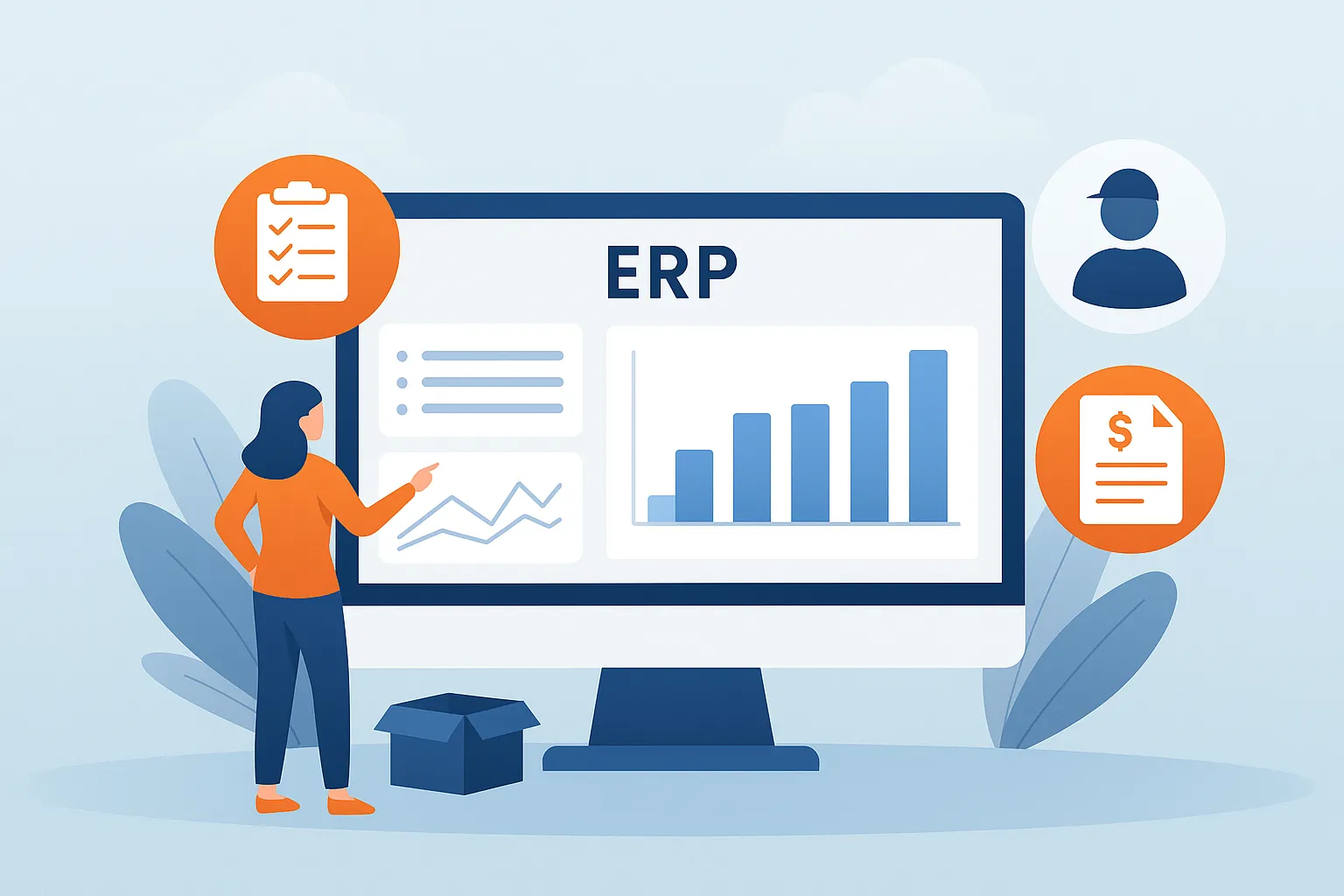
How to Manage Inventory, Technicians & Invoices in One ERP Dashboard

If you’ve ever been in the thick of running a growing business, you know how quickly simple operations can turn into full-blown Friday fire drills. One moment, you’re juggling customer calls; the next, you’re knee-deep in “Excel hell,” trying to match stock counts with yesterday’s sales, only to realize your technician schedule is two steps out of sync with your invoicing. By Monday, your team is already in silo confusion mode — and you’re wondering how this became normal.

It’s not that you don’t have tools. You have plenty — a scheduling app for your service team, accounting software for invoices, spreadsheets for inventory. But when these systems don’t talk to each other, you’re constantly switching tabs, double-entering data, and playing detective when things go wrong. Operations turn reactive, not proactive.

This is where a unified ERP dashboard changes the game. ERPbyNet brings your inventory, technician management, and invoicing under one roof — giving you a single source of truth to keep operations running like a well-rehearsed orchestra. Let’s break down the real-world problems you face, how an ERP platform addresses them, and why the end benefits go beyond just “efficiency.”

CAPE Framework: From Pain Points to Lasting Business Gains

CAPE Framework: From Pain Points to Lasting Business Gains

C – Customer Problems / Pain Areas

1. The Inventory Guessing Game

Without centralized tracking, stock levels become a mystery. Your team finds out about shortages only when an order is delayed or a job can’t be completed on-site. Manual updates in spreadsheets create lag time, and with multi-location storage, the chances of miscounts skyrocket.

2. Technician Scheduling Chaos

Coordinating technicians often means juggling text messages, phone calls, and last-minute reschedules. If a technician finishes early, you have no quick way to reassign them. If a job runs over, it’s a ripple effect across the day. This reactive approach often leads to customer frustration and wasted labor hours.

3. Invoicing Delays & Errors

When invoicing happens after the job — and relies on manual inputs from different departments — mistakes are inevitable. Lost paperwork, mismatched client details, or forgotten add-on charges chip away at your margins. Worse, delayed invoices slow down cash flow, which hits small businesses the hardest.

4. The “Multiple Systems” Tax

Using separate tools for each function creates data silos. Your technician app doesn’t pull live inventory data, your invoicing tool doesn’t track service time, and your accounting software doesn’t know when a job was completed. The cost? Lost time, duplicated work, and a lack of real-time insight for decision-making.

A – Advantages You Offer

Unified Dashboard for Everything

An ERP dashboard consolidates your inventory, technician schedules, and invoicing into one view. You don’t need to log in to three systems or chase down status updates. Every department works from the same live data set.

Real-Time Inventory Tracking

Instead of waiting for end-of-day counts, your ERP updates stock levels instantly as items are used in the field or sold. Technicians know if the required parts are in stock before they leave, preventing wasted trips.

Smart Technician Management

With ERPbyNet’s scheduling module, you can assign jobs, track progress, and make live changes. If a technician finishes early, the system flags availability so you can maximize productivity without guesswork.

Instant, Accurate Invoicing

As soon as a job is marked complete, the ERP auto-generates an invoice with all the relevant details — service time, parts used, discounts applied. This not only reduces errors but also improves cash flow by shortening the billing cycle.

P – Proof or Performance

Case Example – Service Company Efficiency Jump

A mid-sized appliance repair business switched from separate tools to ERPbyNet’s integrated dashboard. Within the first quarter:

  • Inventory-related delays dropped by 45% due to live stock updates. 
  • Technician idle time decreased by 30%, thanks to real-time reassignment. 
  • Invoicing speed improved from an average of 3 days post-service to same-day billing.

Adoption Trend Evidence

Industry research shows that businesses using integrated ERP systems see operational cost reductions of 10–25% within the first year. These savings come not just from efficiency but from fewer errors, less wasted labor, and better resource utilization.

Industry Comparisons

Function Old Way ERP-Driven Way
Inventory Updates Manual, end-of-day Automatic, real-time
Technician Scheduling Phone calls/texts Live dashboard assignment
Invoicing Delayed, error-prone Instant, accurate
Data Sharing Siloed, duplicated Centralized, synchronized

E – End Benefits / Emotional Trigger

When your inventory, technicians, and invoicing are all managed from one ERP dashboard, the benefits go beyond numbers. It’s about regaining control. You stop firefighting and start leading.

Your team works in sync — no more “Did you update the spreadsheet?” moments. Customers notice the difference too: faster service, fewer delays, accurate billing. That trust builds loyalty, and loyalty fuels growth.

For you, it’s the peace of mind that every moving part of your business is connected. You can make decisions with confidence because your data is live, accurate, and accessible — all from one screen. ERPbyNet delivers not just tools, but the clarity and control to run your business without the chaos.

Read More : Mobile ERP for Field Sales Teams: Work Anywhere, Close Everywhere

Beyond CAPE – Taking ERP Efficiency Further

1. The Central Nervous System of Your Business

Think of your ERP dashboard as the central nervous system — every signal, from stock changes to technician status updates, travels through it instantly. This means fewer “misfires” and more coordinated action.

2. From Reactive to Predictive

ERP doesn’t just help you respond to problems faster — it helps you avoid them altogether. Low stock alerts, technician workload forecasts, and invoice aging reports let you act before issues snowball.

3. Scalability Without the Growing Pains

When you add new services, expand your team, or open a new location, your ERP dashboard scales with you. There’s no scramble to patch together more tools or retrain your staff on different systems.

Read More : Field Sales Automation ROI: What Sales Managers Are Actually Getting Today

How It Works – The Flow in Real Life

How It Works – The Flow in Real Life

Step 1: Inventory Integration

Your warehouse stock is synced with your sales and service data. When a technician is assigned a job, the system checks and reserves required parts automatically.

Step 2: Technician Assignment & Tracking

Schedulers can drag-and-drop assignments, view each technician’s live location, and receive status updates in real time.

Step 3: Instant Invoicing

Once a job is marked complete, the ERP generates an invoice, applies any discounts, and pushes it directly to the customer’s preferred payment method.

Result: The entire job cycle — from part allocation to payment — happens in one continuous digital workflow, with no manual data transfers.

Industry Use Cases

Field Service Companies

Plumbing, electrical, HVAC — where technician time and parts availability directly affect customer satisfaction.

Retail & E-commerce

Synchronizing stock across physical stores and online platforms while ensuring accurate, fast billing.

Manufacturing

Coordinating raw materials, production schedules, and shipment invoicing in one view.

Features That Matter Most

Feature Why It Matters
Real-Time Inventory Prevents shortages & excess stock
Mobile Technician App Field teams stay updated without phone calls
Automated Invoicing Speeds up cash flow
Role-Based Access Ensures data security for different departments
API Integration Connects with your existing CRM or accounting software

Performance Metrics You Can Track

A well-implemented ERP dashboard lets you measure:

  • Job completion time (per technician, per location)
  • Inventory turnover rate
  • Invoice processing time
  • Customer satisfaction scores
  • First-time fix rate (critical for service-based businesses)

When you track these metrics in one place, decision-making becomes a data-driven process rather than guesswork.

Read More : How ERP Helps Small Elevator Businesses Operate Like Big Players?

Conclusion

Managing inventory, technician schedules, and invoicing separately is like trying to play a symphony with each musician reading a different sheet of music. A unified ERP dashboard puts everyone on the same page, in the same rhythm.

With ERPbyNet, you get a platform designed to centralize, simplify, and supercharge your operations — so you can focus on growth instead of putting out daily fires. Ready to see how it works? Let’s transform your workflow.

FAQs

Still have questions about ERP and how it fits your business? Let’s clear them up.

1. Can ERP really replace all my current tools?

Yes. A well-designed ERP can centralize functions like inventory tracking, scheduling, and invoicing, so you no longer need separate software for each.

2. Will it be hard for my team to learn?

Most modern ERP platforms are built with intuitive interfaces. With proper onboarding, your team can be up and running in weeks, not months.

3. Is ERP only for large enterprises?

No. Small and mid-sized businesses benefit significantly from ERP, often seeing faster ROI because they can implement changes quickly.

4. How does ERP improve cash flow?

By generating accurate invoices instantly and reducing billing delays, ERP speeds up payment cycles and strengthens cash flow.

5. What if my business has multiple locations?

An ERP can manage inventory and scheduling across multiple sites, giving you visibility into all operations from one dashboard.

6. How soon will I see results after implementation?

Many businesses notice efficiency gains within the first quarter, especially in reduced delays, improved scheduling, and faster invoicing.

CategoriesSales Automation

Mobile ERP for Field Sales Teams: Work Anywhere, Close Everywhere

In today’s fast-paced sales environment, speed is everything. Customers expect instant answers, real-time updates, and seamless service — whether you’re in the office, on the road, or halfway across the world. Yet, many field sales teams are stuck juggling outdated spreadsheets, disconnected CRMs, and endless phone calls just to confirm stock or check order status. The result? Slower response times, missed opportunities, and deals that slip through the cracks.

A mobile ERP for field sales changes that. It puts your entire business brain — from inventory and pricing to customer history and order tracking — right in your pocket. With a powerful ERP sales app, you can check availability, process orders, and update records instantly, all without breaking the flow of your sales conversation.

No more calling the warehouse for stock updates. No more delaying proposals until you’re back at your desk. No more losing valuable time to manual data entry. With cloud ERP and ERP inventory integration, your field sales team operates as a connected, high-performing unit anywhere, anytime.

If you want to work anywhere and close everywhere, the solution is simple: go mobile with ERP. And that’s where ERPbyNet delivers its real advantage.

Why Mobile ERP for Field Sales is a Game-Changer

Sales Has Left the Office

In the past, closing deals meant spending most of your time at the desk — reviewing orders, making calls, updating systems. But today’s sales happen everywhere:

  • In the car between site visits
  • At industry events between keynote sessions
  • On the shop floor during client walk-throughs
  • Over coffee with decision-makers

The challenge? Traditional ERP systems were designed for office-based teams, not road warriors. And while CRMs and sales tracking apps help, they’re often disconnected from inventory, order management, and accounting data. This means sales reps still have to call, message, or email to get the full picture.

A mobile ERP for field sales changes that. It puts your ERP solution right in your pocket — complete with ERP inventory integration, mobile app for sales tracking, and real-time cloud ERP access. The result? You can close deals without “checking back later.”

The Pain Points Mobile ERP Solves for Field Sales Teams

The Pain Points Mobile ERP Solves for Field Sales Teams

1. Inventory Uncertainty Kills Deals

Ask any sales rep: nothing kills momentum faster than not knowing what’s in stock. Without ERP inventory integration, you’re left guessing. A client may be ready to buy, but your hesitation signals doubt — and doubt gives them time to shop elsewhere.

With cloud ERP, the ERP sales app shows live inventory the moment you need it — even while sitting with the customer. You can confirm availability, provide accurate delivery estimates, and adjust orders based on real-time data.

2. Disconnected Sales Tracking Means Lost Opportunities

In a fast-moving sales cycle, time is your most valuable currency. Yet many field reps lose hours (or days) between a meeting and updating their records. Notes get scattered — in notepads, emails, or messaging apps. By the time details make it into your CRM, the lead may have gone cold.

A mobile app for sales tracking built into your ERP lets you update opportunities instantly after a meeting. Every follow-up is scheduled on the spot. Every client interaction is logged without needing to re-enter data later.

3. Manual Processes Drain Productivity

Excel may be great for calculations, but it’s terrible for mobile sales management. It’s slow, prone to errors, and creates multiple conflicting versions of the truth.

With a mobile ERP solution, data entry happens once and is instantly available across departments. A sales order entered from a client site appears in warehouse dashboards and accounting systems automatically — no duplicate work, no delays.

Read More : Field Sales Automation ROI: What Sales Managers Are Actually Getting Today

Key Features of a Mobile ERP for Field Sales

Key Features of a Mobile ERP for Field Sales

Real-Time Inventory and Pricing

Your ERP sales app connects directly to your central system, pulling in current stock levels, prices, discounts, and even special offers. This allows you to make confident offers during client conversations.

On-the-Spot Order Processing

With a mobile ERP for field sales, you can create and submit sales orders immediately after agreement — no waiting until you’re “back at the office.” This speeds up invoicing, accelerates delivery, and increases your close rates.

Centralized Customer Data

Every meeting, call, email, and order is stored in your ERP. This means before visiting a customer, you can check their purchase history, open quotes, overdue payments, and even previous support tickets — giving you richer context for better conversations.

Performance Dashboards on the Go

A mobile app for sales tracking isn’t just about input — it’s about insight. Your ERP dashboard shows progress toward targets, pipeline health, and territory performance, all updated in real time. Managers can see their team’s activity without chasing for updates.

Read More : Project Management ERP: The Secret to On-Time and On-Budget Delivery

Mobile ERP vs. Traditional Tools

Feature Mobile ERP for Field Sales Traditional Tools (Spreadsheets, Disconnected Apps)
Inventory visibility Live, accurate Delayed, manual
Customer history Complete, centralized Fragmented
Order processing Immediate from anywhere Office-bound
Data updates Automatic sync Manual re-entry
Sales performance tracking Real-time dashboards Periodic reports

The ROI of Mobile ERP for Field Sales

Investing in a cloud ERP with mobile capabilities pays for itself quickly:

  • Close deals faster with immediate answers to client questions.
  • Increase revenue by seizing opportunities before competitors.
  • Reduce admin time by cutting out duplicate data entry.
  • Boost customer satisfaction through accurate promises and timely delivery.

A recent Gartner study noted that businesses implementing mobile ERP in sales see up to 20% higher productivity in the first year, largely due to reduced admin time and faster deal cycles.

Read More : Cloud ERP in 2025: The Backbone of Elevator Service Operations

Why Cloud ERP is the Future of Field Sales

On-premise ERP systems simply can’t match the flexibility of cloud ERP. Cloud-based systems are always accessible, always updated, and secure enough for even the most data-sensitive industries. For mobile sales teams, this means:

  • No VPN headaches
  • No outdated software
  • No data silos

ERPbyNet designs ERP solutions for the reality of sales in motion — connecting field reps with everything they need to sell, serve, and succeed from anywhere.

Conclusion: Selling Without Borders

Field sales thrives on momentum. Every question answered instantly, every order processed without delay, every follow-up done on time moves you closer to a win.

The right mobile ERP for field sales lets you work anywhere and close everywhere. It combines the agility of mobile technology with the depth of a full ERP — giving you real-time inventory visibility, sales tracking, and order management in your pocket.

At ERPbyNet, we help businesses turn mobility into a sales advantage. Ready to give your team the tools to sell without limits? Let’s make it happen.

FAQs: Mobile ERP for Field Sales

1. What exactly is a mobile ERP for field sales?

A mobile ERP for field sales is a specially designed ERP sales app that runs on smartphones and tablets, enabling sales teams to manage every part of the sales process while on the move. It gives real-time access to inventory, customer records, pricing, and order creation tools without being tied to a desk. This means sales reps can respond to customer needs instantly, update records on the spot, and keep the entire sales cycle moving smoothly from any location.

2. How does ERP inventory integration work?

ERP inventory integration connects your mobile ERP directly to the company’s live inventory database, ensuring that sales reps always see up-to-the-minute stock levels. This eliminates the need to call the warehouse or wait for email confirmations before committing to a sale. It not only speeds up deal closures but also prevents overselling and reduces the risk of disappointing customers with unavailable products.

3. Can I create orders directly from the app?

Yes, a mobile ERP allows you to generate and submit sales orders instantly during customer meetings or field visits. Once an order is placed, it is automatically synced with the warehouse, accounting, and shipping systems, ensuring a seamless flow from sales to delivery. This means no duplicate entry, fewer delays, and faster order fulfillment, ultimately improving customer satisfaction and your close rate.

4. Why is cloud ERP better for mobile sales teams?

Cloud ERP is ideal for mobile sales teams because it allows secure, real-time access to the ERP system from anywhere without the need for VPNs or complicated setups. Updates and upgrades happen automatically in the background, so your team is always using the latest tools and features. It also reduces downtime, ensures consistent data across all users, and provides the flexibility sales teams need to operate efficiently in fast-paced environments.

5. Does a mobile ERP replace my CRM?

A mobile ERP doesn’t necessarily replace your CRM — instead, it can complement and even integrate with it. While a CRM focuses on managing customer relationships, a mobile ERP extends that capability by adding operational functions such as inventory management, order processing, and real-time reporting. This integration means your sales reps can see the full picture — from customer history to current stock — all in one place.

6. Can ERPByNet customize the system for my sales workflow?

Absolutely. ERPByNet specializes in tailoring ERP solutions to match each client’s unique sales process, industry requirements, and team workflow. Whether you need specialized pricing structures, custom dashboards, or integration with other business software, the system can be adapted to fit seamlessly into your daily operations. This ensures your mobile ERP works exactly the way your sales team works, maximizing adoption and results.


CategoriesERP (Enterprise Resource Planning)

Project Management ERP: The Secret to On-Time and On-Budget Delivery

It begins quietly, almost innocently. One day your project plan looks flawless, every milestone neatly aligned, every task marching to the right rhythm. Then the cracks appear. A shipment gets stuck halfway across the country. A subcontractor sends an apologetic message asking for “just one more week.” The budget spreadsheet you proudly updated last Friday is already two versions behind. Suddenly, your well-orchestrated plan feels more like a runaway train, and you’re left scrambling to keep it on the tracks.

If you’ve ever tried managing a project without a connected, integrated system, you know this storm all too well. You’ve spent hours juggling mismatched spreadsheets, each claiming to be the “final version.” You’ve dug through endless email threads searching for the latest status update. You’ve discovered—often too late—that three different teams are working from three entirely different sets of data. Finance waves a red flag about budget overruns only after the money has already been spent. And while the project struggles to find its footing, your weekends vanish into urgent calls, site visits, and frantic attempts to stitch fragmented information into a coherent plan.

But here’s the truth: delivering projects on time and within budget isn’t about pushing your team harder or asking for more late nights. It’s about working smarter. It’s about creating one unified source of truth where schedules, budgets, procurement, and site updates flow together seamlessly. This is exactly what ERPbyNet’s Project Management ERP delivers. It transforms disconnected efforts into a single synchronized engine—keeping every stakeholder informed, every milestone visible, and every rupee accounted for. With the right system, the chaos disappears, deadlines are met, budgets stay intact, and your team can finally focus on building success instead of putting out fires.

The Hidden Costs of Managing Projects the Old Way

When projects run on disconnected tools, you don’t just lose time—you lose visibility. The site team knows the installation is running behind, but procurement doesn’t. Finance sees an invoice that blows the budget, but operations have already signed off on the extra work. Every department is solving its own piece of the puzzle, but no one is seeing the full picture.

Spreadsheets, while familiar, become a breeding ground for confusion. Multiple versions float through inboxes, formulas break without warning, and updates lag behind reality. By the time you realise the schedule has slipped or the budget is stretched, your window for easy fixes is gone. These are the hidden costs—delays that pile up, budgets that creep, and opportunities that vanish.

How Project Management ERP Puts You Back in Control

How Project Management ERP Puts You Back in Control

A Project Management ERP isn’t just digital paperwork—it’s the command center of your project. It aligns planning, scheduling, budgeting, procurement, and field execution into one real-time, always-accurate view. And ERPbyNet takes this even further.

Smarter Scheduling

With forward and backward planning, you can set schedules based on a target completion date or work from the project start date. Every dependency is tracked, and any shift in one task ripples across the plan automatically—so there are no nasty surprises two weeks before handover.

Budget Tracking in Real Time

Instead of learning about overruns after the fact, you see them forming in real time. ERPbyNet flags deviations instantly, giving you the chance to adjust orders, negotiate terms, or reallocate resources before costs spiral.

Instant Field Updates

With SiteApp, your site team can log progress, upload photos, attach videos, and enter measurements directly from the field—even offline. Once connected, data syncs immediately, ensuring head office knows exactly where things stand without waiting for weekly reports.

Managing the Unexpected

Unplanned purchases are part of real-world projects. ERPbyNet captures these on the spot, links them to the project, and adjusts the budget accordingly. Nothing falls through the cracks, and you maintain control even when plans shift.

A Clean Project Handover

Instead of chasing documents at the last minute, all files—drawings, test results, approvals—are stored centrally and tied to the project record. Handovers stop being frantic and start being seamless.

Bringing It to Life: From Chaos to Clarity

Imagine a construction company working on multiple sites in different cities. Before ERPbyNet, updates from the field took days to reach headquarters. Procurement often learned about material shortages only after crews had stopped work. Schedules drifted quietly until the client started asking tough questions.

After implementing ERPbyNet’s Project Management ERP, the picture changed completely. Progress updates from the field appeared in real time, budgets were tracked to the rupee, and schedules were adjusted automatically when dependencies shifted. Materials were ordered just in time, and delays were spotted early enough to solve without panic. The team moved from reactive firefighting to proactive management—and projects began closing on time, within budget, and with far less stress.

The Measurable Payoff

Industry data shows that companies using integrated project management systems see a 25–30% improvement in on-time delivery and up to 20% cost savings in the first year alone. But beyond the numbers, the real payoff is the shift in culture—from managing crises to managing outcomes.

Teams stop working in silos. Communication becomes easier. Decision-making moves from gut instinct to solid data. And perhaps most importantly, clients start trusting your timelines again.

ERP vs. Traditional Tools

Feature Project Management ERP Spreadsheets & Disconnected Tools
Real-time updates Yes No
Centralized data Yes No
Automated alerts Yes Limited
Offline field access Yes No
Integrated budgeting Yes Manual
Role-based permissions Yes No

What’s Next for Project Management ERP

The future of project management isn’t just digital—it’s intelligent. ERP systems are starting to predict problems before they happen with AI-powered scheduling. They’re becoming easier to tailor with low-code customization. And they’re automating compliance tasks so you’re always audit-ready without extra effort.

ERPbyNet is building these capabilities into its platform so that your projects aren’t just tracked—they’re guided to success. This isn’t just about keeping up with change; it’s about staying ahead of it.

Conclusion

Projects fail when visibility fails. Missed deadlines and blown budgets aren’t the result of bad teams—they’re the result of bad information. ERPbyNet’s Project Management ERP brings every moving part of your project into a single, live system that turns confusion into clarity. The result? Predictable delivery, controlled costs, and fewer sleepless nights.

At ERPbyNet, we empower businesses to run smarter with ERP solutions that grow with you. If you’re ready to stop chasing updates and start hitting every milestone, now is the time to make the switch. Let’s Connect Today.

FAQs

What is a Project Management ERP?

A Project Management ERP is far more than just project scheduling software—it’s the central nervous system of your projects. It connects every aspect of project execution: scheduling, budgeting, procurement, resource allocation, and real-time field updates. Instead of juggling multiple disconnected tools, all your critical project data lives in a single platform. This means when a change happens—whether it’s a shift in the timeline, a cost adjustment, or a delivery delay—it’s reflected everywhere instantly. With ERPbyNet, managers, site teams, and finance work from the same, up-to-date version of the truth, reducing miscommunication and ensuring your projects finish on time and within budget.

Is Project Management ERP only for big companies?

Not at all. In fact, small and mid-sized businesses often gain the biggest advantage from implementing a Project Management ERP. Larger companies may have more resources to absorb delays or budget overruns, but SMEs usually operate with tighter margins and smaller teams—meaning mistakes and inefficiencies cost them disproportionately more. ERPByNet gives SMEs the same level of control and visibility as the biggest players in their industry, helping them compete on reliability, efficiency, and professionalism without needing a huge operations department.

How long does ERPByNet take to implement?

Implementation time depends on the complexity of your operations, the number of projects and locations you manage, and how prepared your existing data is. For most SMEs, ERPByNet can be fully implemented in as little as 8–12 weeks. This includes configuration, training your team, and ensuring smooth data migration from your old systems. The process is structured so you start seeing benefits quickly, even before the full rollout is complete. Our team works closely with you to avoid business disruption, ensuring a smooth transition with minimal downtime.

Can it work with my current tools?

Yes. ERPByNet is built with integration in mind. Whether you’re already using accounting systems, CRM platforms, HR software, or specialized industry tools, ERPByNet can connect with them via APIs or standard data exchange formats. This means you don’t have to throw away your existing investments—you simply make them work together seamlessly. By creating a unified ecosystem, you eliminate data silos and ensure that every department is operating on real-time, synchronized information.

Does it support multi-site projects?

Absolutely. Managing projects across multiple locations often leads to communication gaps, duplicated efforts, and inconsistent reporting. ERPByNet’s Project Management ERP gives you real-time visibility into progress, budgets, and issues across all sites—whether they’re in different cities or different countries. Site teams can update status directly from the field, even offline, and the system syncs when they reconnect. This keeps headquarters fully informed and allows you to make strategic decisions instantly rather than waiting for end-of-week reports.

How does it improve profitability?

Profitability isn’t just about winning projects—it’s about executing them efficiently. ERPByNet helps you avoid cost overruns by monitoring budgets in real time and sending alerts when spending approaches thresholds. It reduces idle time by improving scheduling and resource allocation. It prevents waste by aligning procurement with actual project needs. Most importantly, it eliminates the blind spots that lead to expensive last-minute fixes. Over time, this consistent control not only protects your margins but also strengthens your reputation, making it easier to win more—and better—projects.

Categoriesmrp services

The Evolution of MRP Systems: From Legacy Tools to Cloud-Based Platforms

Running a small or medium-sized business often feels like trying to juggle too many balls while someone keeps throwing in more. At first, it’s manageable — a few spreadsheets, some manual processes, and a small, tightly knit team. But as your company grows, the gaps in your systems start to show.

Suddenly, inventory is misplaced because the spreadsheet wasn’t updated in time. Payroll is delayed because HR and accounting are working on different data. Procurement orders clash with warehouse realities. You spend more time putting out fires than planning for growth. This operational chaos isn’t a sign of poor management — it’s a natural result of outdated tools that simply can’t keep up.

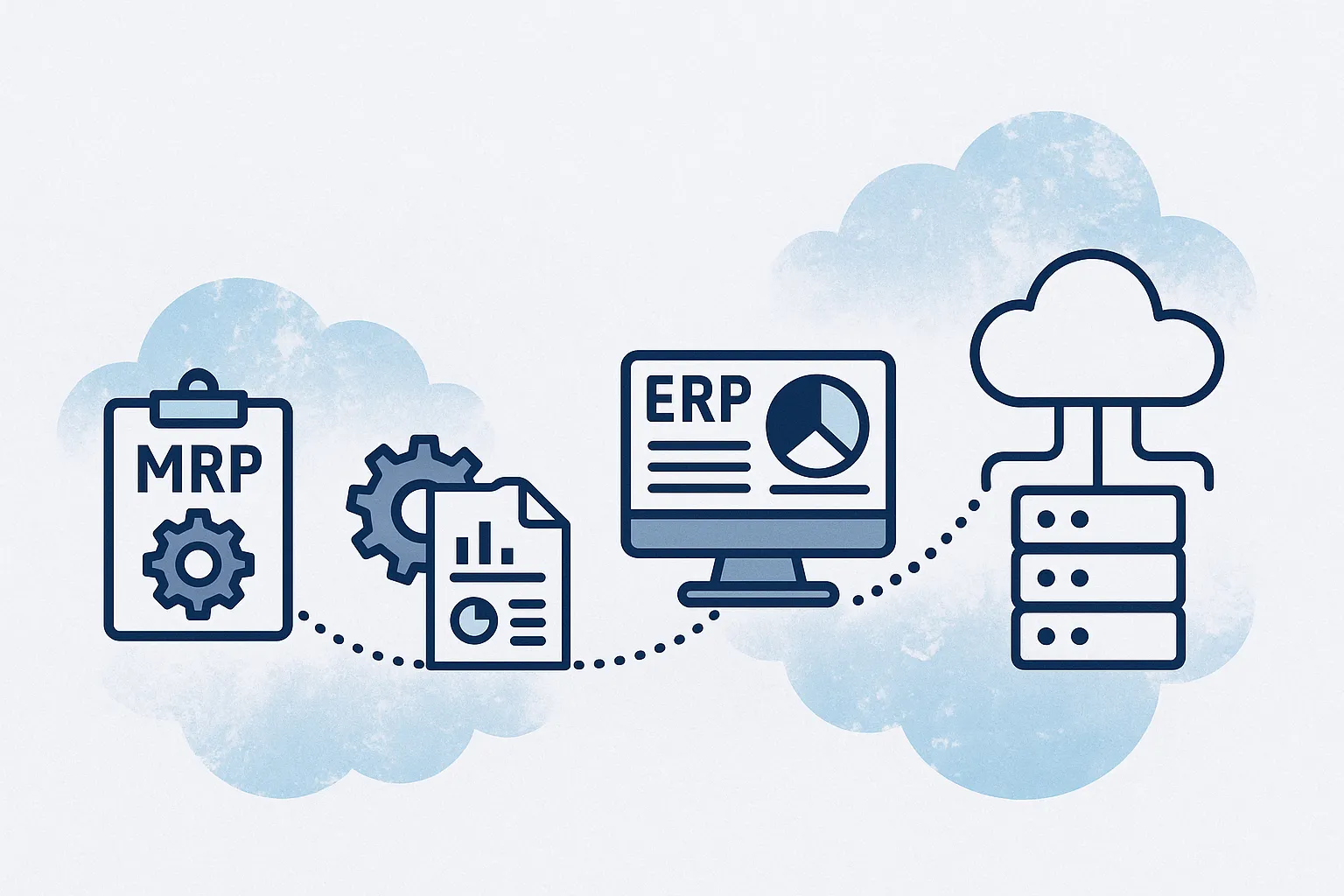
Years ago, Material Requirements Planning (MRP) was considered revolutionary. It automated the complex process of planning materials for production, freeing businesses from total reliance on manual calculations. But while MRP was powerful for its time, it was also narrow in focus. It didn’t know about your customers, your finances, your HR team, or your long-term growth strategy.

Today, we operate in a world that demands speed, flexibility, and integration across every department. That’s why MRP has evolved into Enterprise Resource Planning (ERP). And that’s where ERPbyNet comes in — providing modern, cloud-based ERP solutions like AceMRP that connect every part of your business, from inventory and HR to finance and sales.

The Origins: MRP in the 1960s

In the 1960s, manufacturing faced a common challenge: matching supply with demand. Manufacturers had to ensure raw materials were available when needed, but without overstocking. Overstock tied up cash and storage space; understock meant production delays and unhappy customers.

Material Requirements Planning was invented to solve this. At its core, MRP took three critical inputs:

  1. Bills of Materials (BOM) — The exact list of raw materials and components needed to build a product.

  2. Master Production Schedule (MPS) — The timetable of when each product would be made.

  3. Inventory Data — How much stock was currently on hand.

By combining these, MRP could tell manufacturers exactly when to order materials. It reduced guesswork, improved cash flow, and gave managers more confidence in production planning. However, early MRP systems ran on massive mainframes and were only accessible to large corporations. They were powerful but not flexible, and they only solved one piece of the puzzle.

The Evolution to MRP II in the 1980s

By the 1980s, businesses wanted more than just materials planning. They needed to plan labor schedules, machine usage, and costs. Manufacturing Resource Planning (MRP II) expanded the scope to include:

  • Capacity Planning: Matching production schedules to the actual capacity of machines and labor.

  • Workforce Scheduling: Ensuring the right number of workers were available for each production run.

  • Cost Tracking: Adding a layer of financial visibility to manufacturing decisions.

MRP II allowed businesses to plan more realistically and avoid assuming they had infinite resources. It was a big step forward — but still very much centered on manufacturing, with little connection to other critical areas like sales, finance, or HR.

The Birth of ERP in the 1990s

In the 1990s, business leaders realized something important: even the best manufacturing plan would fail if the rest of the company wasn’t aligned. Sales needed to know what could be produced and when. Finance needed to understand the cost implications of production decisions. HR needed to plan staffing based on production schedules.

This led to the rise of Enterprise Resource Planning (ERP) — systems designed to integrate every core function of a business into one platform. ERP included:

  • Finance and Accounting: Full general ledger, accounts payable and receivable, budgeting, and reporting.

  • Human Resources: Payroll, recruitment, compliance, and employee data management.

  • Customer Relationship Management (CRM): Sales tracking, lead management, and customer service.

  • Procurement: Supplier management and automated purchasing.

  • Inventory and Warehouse Management: Real-time stock levels, warehouse tracking, and distribution control.

The integration meant that if sales confirmed a new order, production schedules and procurement would adjust automatically. Finance would see the projected cash flow impact. HR could schedule extra shifts if needed. ERP provided a “single source of truth” — something legacy MRP systems could never achieve.

Read More : Production Planning Simplified: Why MRP software Is the Core of Smart Factories

The Cloud ERP Revolution

The Cloud ERP Revolution

Originally, ERP systems were massive, expensive, and complex. They were installed on company-owned servers and required large IT teams to maintain. This made ERP inaccessible for most SMEs.

The shift to cloud computing in the 2000s changed everything. Cloud-based ERP platforms brought:

  • Accessibility from Anywhere: All you need is an internet connection.

  • Lower Upfront Costs: Subscription-based pricing instead of huge hardware investments.

  • Scalability: Start with what you need, add modules as your business grows.

  • Automatic Updates: Always running the latest version with improved features.

Today, solutions like AceMRP from ERPbyNet bring enterprise-grade ERP capabilities to SMEs without the high cost or complexity.

Why Legacy Systems Hold Businesses Back

Even today, many businesses still rely on spreadsheets, disconnected software, or outdated on-premises MRP. This creates several challenges:

1. Inventory Chaos

Without real-time tracking, stock levels become inaccurate. Multiple warehouses or sales channels make this worse. Overstock wastes money, understock delays production, and both damage customer trust.

2. Payroll and HR Delays

When HR and finance operate on different systems, payroll processing becomes slow and error-prone. Compliance issues arise, and staff morale suffers.

3. Data Silos

Departments have their own “truth,” leading to mismatched numbers and poor decision-making. Finance may think the business is profitable while operations see growing losses.

Read More : Cloud-Based ERP vs. On-Premise ERP: What’s Right for Your Business

How Cloud ERP Solves These Problems

How Cloud ERP Solves These Problems

Unified Inventory and Procurement

In many businesses, inventory management is a constant source of frustration because information is scattered across different systems or updated only after the fact. This often results in costly errors — such as running out of essential materials in the middle of production or overstocking slow-moving items that tie up working capital.

With a cloud ERP platform like AceMRP from ERPbyNet, inventory data is shared across all your locations and updated in real time. This means your warehouse in one city and your retail outlet in another are always looking at the same, accurate stock levels. The system can automatically trigger purchase orders the moment inventory falls below a defined threshold, ensuring you never face unexpected shortages. At the same time, it prevents unnecessary overstocking by aligning procurement with actual demand patterns and supplier lead times. This level of precision leads to leaner, more efficient operations and healthier cash flow.

Integrated Accounting and HR

Finance and HR are two of the most data-sensitive functions in any business, yet they are often the most disconnected when using legacy tools. Accounting teams frequently spend hours re-entering operational data into finance systems, while HR managers struggle with manual payroll processing and fragmented compliance tracking. These inefficiencies not only waste valuable time but also increase the risk of costly errors.

ERPbyNet’s cloud ERP solutions integrate finance modules directly with operational data, eliminating the need for duplicate data entry. Every sale, purchase, or expense is automatically recorded in your accounting system, allowing finance teams to generate accurate, up-to-the-minute reports. HR automation takes care of payroll processing, leave tracking, and compliance management in a fraction of the time it would take manually. This integration ensures that your financial records are always correct, payroll is never delayed, and compliance requirements are consistently met.

Centralized Dashboards and APIs

Decision-making suffers when leaders have to pull data from multiple systems and reconcile it manually. By the time a complete picture emerges, the situation may have already changed. This reactive approach is a major drawback of traditional systems.

With ERPbyNet’s cloud ERP, all your critical business information is presented in centralized dashboards that update in real time. Whether you need to check sales performance, track inventory levels, monitor production schedules, or review financial KPIs, it’s all available at a glance. These dashboards give you a live pulse on your business, enabling faster and more confident decision-making.

Additionally, built-in APIs make it easy to connect the ERP with third-party tools such as logistics providers, e-commerce platforms, or CRM systems. This means your ERP becomes the central hub of your business ecosystem, ensuring that every tool you use works together seamlessly without manual intervention.

Read More :The Difference Between ERP and MRP Explained (For First-Time Buyers)

ERPbyNet in Action: Real-World Examples

Karthik’s Manufacturing Firm
Karthik’s mid-sized manufacturing business ran on spreadsheets. Order delays, high inventory costs, and inaccurate forecasts were common. Implementing AceMRP from ERPbyNet reduced inventory holding costs by 30% and improved order fulfillment by 20%.

Priya’s Textile Startup
Payroll delays and HR-finance misalignment slowed Priya’s operations. After switching to ERPbyNet’s ERP implementation service, payroll ran on time, HR compliance improved, and production schedules were met without last-minute crises.

ROI and Market Trends

  • Gartner reports that over 70% of SMEs now choose cloud ERP over traditional MRP.

  • Businesses moving from on-premises MRP to cloud ERP often see ROI improvements of 200% within 2–3 years.

  • Solutions like Zoho ERP, ERPNext, and SAP S/4HANA highlight the shift, but SMEs often choose tailored options like AceMRP for better fit and affordability.

The Future of ERP

ERP is no longer just a system of record — it’s becoming a system of intelligence. Trends include:

  • AI-Driven Forecasting for predicting demand and preventing shortages.

  • Low-Code Automation so non-technical teams can customize workflows.

  • IoT Integration connecting production equipment directly to ERP.

  • Compliance-Ready Modules automating regulatory reporting.

Read More : Top 10 ERP Implementation Mistakes and How to Avoid Them

Why Choose ERPbyNet

Why Choose ERPbyNet

Specialized in SME Needs

Many ERP systems are designed with large corporations in mind, making them too complex, expensive, or resource-heavy for small and medium-sized enterprises. ERPbyNet takes a different approach. Our solutions are designed specifically for SMEs, meaning every feature, every workflow, and every integration is scaled to match your operational needs and your budget. Whether you’re a growing startup or an established mid-sized company, our ERP tools are practical, affordable, and built to deliver measurable value without unnecessary complexity.

End-to-End Implementation

Choosing the right ERP platform is just the first step — getting it implemented effectively is where the real transformation happens. ERPbyNet offers a complete, guided journey from the initial needs assessment to system configuration, data migration, user training, and post-launch support. We work closely with your team to understand your processes and challenges so the ERP setup aligns perfectly with your business goals. This ensures your investment delivers maximum return from day one.

Flexible and Scalable

Your business is not static — and your ERP system shouldn’t be either. With ERPbyNet, you can start with the modules you need most, such as inventory management or accounting, and then expand into additional areas like HR automation, procurement, or analytics as your business grows. This flexibility allows you to adopt ERP in phases, controlling costs while ensuring the system evolves in step with your company’s expansion and changing requirements.

Conclusion

The evolution from traditional MRP systems to modern ERP platforms mirrors the increasing complexity of today’s business landscape. What worked in the past — isolated systems, manual tracking, and reactive planning — no longer provides the speed, accuracy, and visibility needed to compete. Businesses that continue to rely on outdated systems risk inefficiency, poor decision-making, and slower growth.

AceMRP from ERPbyNet offers the solution: a cloud-based ERP platform that integrates all your core business processes, delivers real-time insights, and scales with your growth. By replacing fragmented tools with a centralized, intelligent system, you gain control, clarity, and the agility to respond quickly to market changes. In a fast-moving business world, this isn’t just an upgrade — it’s a competitive advantage.

FAQs

What is the difference between MRP and ERP?
MRP is focused on planning materials and scheduling production to meet demand efficiently. ERP, on the other hand, integrates all core business functions — including finance, HR, sales, inventory, and procurement — into one centralized platform for complete operational visibility.

Is cloud ERP secure?
Yes. Cloud ERP systems use strong encryption, secure logins, and role-based permissions to safeguard sensitive business data. These measures ensure only authorized users have access while maintaining compliance with industry security standards.

Can SMEs afford cloud ERP?
Absolutely. Cloud ERP uses subscription-based pricing and phased implementation, allowing SMEs to start small and expand as needed. This approach helps achieve quick ROI through efficiency gains and reduced operational costs.

How long does ERP implementation take?
Most SMEs can expect implementation to take between 8–16 weeks. This period covers business needs assessment, system configuration, data migration, user training, and a smooth go-live process.

What if I’m moving from spreadsheets or legacy MRP?
ERPbyNet manages the entire transition, from migrating your existing data to configuring workflows and training your team. This ensures you move to the new system with minimal disruption to daily operations.

How does ERP support business growth?
ERP systems are designed to scale with your business. You can add new modules, integrate additional tools, and expand functionality as you grow — all without interrupting current processes.


Name
Verified by MonsterInsights