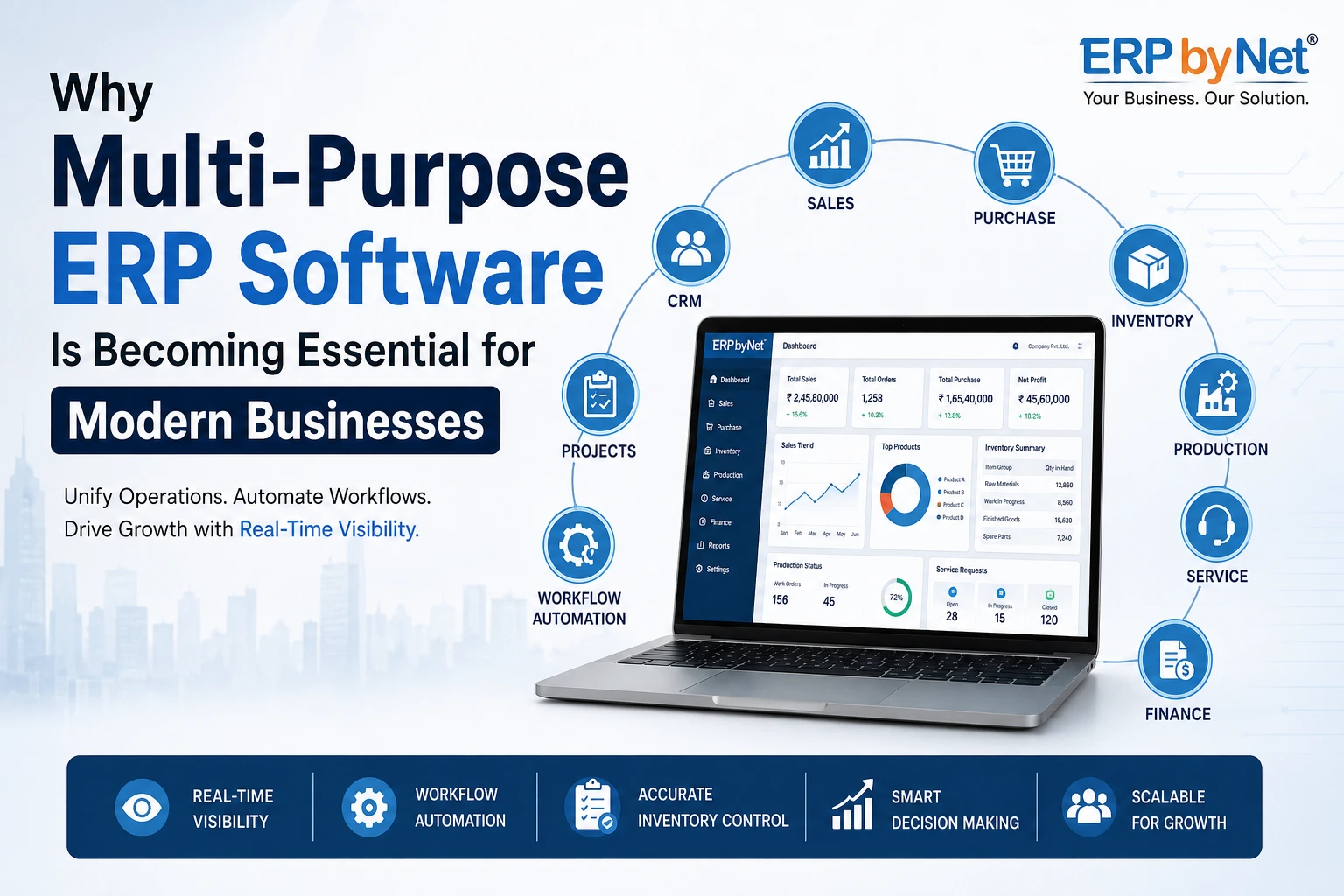
Why Multi-Purpose ERP Software Is Becoming Essential for Modern Businesses
Modern businesses are no longer struggling because of a lack of demand alone — many are struggling because their operations have become too fragmented to manage efficiently. Departments often work on disconnected software systems, spreadsheets continue to dominate critical processes, reporting takes days instead of minutes, and decision-makers frequently operate without real-time operational visibility. Inventory mismatches, delayed procurement approvals, production planning errors, service coordination gaps, and inconsistent financial tracking create operational bottlenecks that slow growth and increase costs across the organization.
As businesses expand, operational complexity grows exponentially. Manufacturing companies need synchronized production planning, service-driven businesses require faster field coordination, and industrial organizations demand accurate inventory, procurement, and financial visibility from a centralized system. Traditional standalone tools are no longer capable of supporting modern operational demands where speed, automation, accuracy, and scalability are essential.
This is why multi-purpose ERP software is rapidly becoming the operational backbone of modern enterprises. Platforms like ERPbyNet help businesses unify departments, automate workflows, centralize data, improve visibility, and create a scalable operational ecosystem that supports sustainable growth, operational efficiency, and smarter business decision-making.
Why Disconnected Business Systems Are Slowing Modern Operations
Many businesses still rely on separate systems for inventory, procurement, accounting, production, CRM, and service operations. While this setup may work temporarily, it becomes a major operational challenge as business complexity increases. Disconnected systems create information silos where departments operate independently without synchronized visibility, resulting in delays, duplication, reporting gaps, and costly operational errors.
For example, sales teams may commit delivery timelines without checking real-time inventory availability, procurement teams may order unnecessary materials, and service teams may struggle to track spare inventory across locations. Over time, these disconnected workflows slow operational efficiency and affect decision-making.
Common Operational Problems Caused by Traditional Systems
- Delayed approvals that slow business operations
- Inventory mismatches caused by disconnected tracking systems
- Poor coordination between departments and operational teams
- Repetitive manual data entry across multiple software tools
- Limited real-time visibility into daily business operations
- Customer service delays due to disconnected workflows
How Spreadsheet Dependency Increases Operational Risk
Many organizations still depend on Excel sheets for operational management, including:
- Production planning and manufacturing tracking
- Inventory updates and warehouse stock monitoring
- Vendor coordination and procurement management
- AMC tracking and maintenance scheduling
- Approval workflows and operational reporting
This often leads to:
- Manual calculation and reporting errors
- Duplicate data entries across departments
- Version mismatches between teams
- Delayed access to operational reports
- Increased operational confusion and dependency on employees
Traditional Systems vs Multi-Purpose ERP Systems
| Operational Area | Traditional Systems | Multi-Purpose ERP Software |
| Inventory Visibility | Manual stock tracking with limited accuracy | Real-time inventory visibility across locations |
| Workflow Coordination | Departments work independently | Connected cross-department workflows |
| Reporting Process | Delayed and fragmented reporting | Centralized dashboards with live insights |
| Approval Management | Manual approvals through emails and calls | Automated approval workflows |
| Production Planning | Spreadsheet-based production coordination | Integrated MRP and production planning |
| Service Operations | Reactive and manually coordinated service handling | Automated maintenance and service scheduling |
| Financial Reporting | Separate accounting and operational systems | Unified financial and operational visibility |
| Business Scalability | Difficult to scale operations efficiently | Scalable and centralized ERP ecosystem |
Read More : Stockouts vs Overstocking: Why Poor Inventory Decisions Are Costing You More Than You Think
How Multi-Purpose ERP Software Connects Business Operations Into One Intelligent Ecosystem
A multi-purpose ERP system acts as a centralized operational platform that connects all major business functions into one integrated ecosystem. Instead of departments working independently, ERP ensures information flows automatically across inventory, procurement, production, finance, CRM, and service operations.
This connected environment improves operational coordination, reduces manual dependency, and enables businesses to make faster and more informed decisions.
Core Business Functions Connected Through ERP
ERP systems centralize and integrate:
- Sales operations and customer relationship management
- Inventory tracking and warehouse coordination
- Procurement workflows and vendor management
- Manufacturing operations and production planning
- Financial accounting and profitability reporting
- Service operations and AMC management
- Real-time reporting and operational analytics
Example of an Integrated ERP Workflow
Sales → Inventory → Procurement → Production → Dispatch → Finance
In a connected ERP workflow:
- Sales orders are created and verified instantly
- Inventory availability is checked automatically
- Material shortages trigger procurement requests
- Production schedules update in real time
- Dispatch planning begins after production completion
- Invoice generation updates financial records automatically
Without ERP, these processes often rely on emails, calls, spreadsheets, and repetitive manual coordination. With ERPbyNet, workflows become centralized, automated, and fully traceable.
Read More : Why Elevator Companies Struggle to Track AMC Contracts
Why Real-Time Operational Visibility Has Become Essential for Modern Businesses
Modern businesses cannot afford delayed operational insights. Decisions made using outdated information often lead to overstocking, stock shortages, production delays, procurement inefficiencies, and poor customer experiences.
ERP dashboards provide real-time operational visibility that helps management teams monitor business performance proactively rather than reactively.
How ERP Dashboards Improve Business Monitoring
ERP systems provide live visibility into:
- Inventory status and stock movement across warehouses
- Production progress and active work order tracking
- Procurement activities and supplier commitments
- Financial performance and profitability analysis
- Service requests and AMC schedule monitoring
- Pending approvals and operational bottlenecks
- Customer complaints and support coordination
- Resource utilization and operational planning
This allows businesses to respond quickly to operational challenges and improve planning accuracy.
Operational Impact of Real-Time ERP Visibility
| Business Challenge | Without ERP Visibility | With ERP Visibility |
| Inventory Planning | Frequent stock mismatches and shortages | Accurate inventory monitoring and replenishment |
| Production Scheduling | Delays caused by poor coordination | Optimized production planning and execution |
| Procurement Decisions | Emergency purchasing and overspending | Forecast-driven procurement planning |
| Financial Reporting | Delayed access to profitability reports | Real-time financial and operational insights |
| Service Coordination | Missed maintenance and service schedules | Automated service tracking and alerts |
How Workflow Automation Reduces Operational Delays and Human Dependency
Manual workflows often slow operations and create heavy dependency on employees for approvals, tracking, and coordination. ERP automation helps businesses standardize operational processes, reduce repetitive manual work, and improve overall productivity.
Critical ERP Workflows That Benefit From Automation
Automated Approval Workflows
ERP systems streamline:
- Purchase approval and procurement authorization workflows
- Vendor onboarding and supplier approval processes
- Expense approval and reimbursement tracking
- Quotation validation and approval management
- Service escalation and complaint handling workflows
Production and Inventory Automation
ERP helps automate:
- Work order generation and production scheduling
- Resource allocation and manufacturing coordination
- Low-stock alerts and inventory replenishment notifications
- AMC renewal reminders and maintenance scheduling
- Service alerts and automated invoice reminders
This improves operational consistency while reducing delays caused by manual coordination.
Operational Benefits of Workflow Automation
| Operational Area | ERP Automation Impact |
| Approval Management | Faster approvals and reduced operational delays |
| Inventory Operations | Automated stock monitoring and replenishment alerts |
| Production Coordination | Improved scheduling and workflow accuracy |
| Service Management | Timely maintenance scheduling and customer support |
| Employee Productivity | Reduced manual workload and repetitive tasks |
| Operational Accountability | Better workflow tracking and process transparency |
Read More : Why Production Planning Software Is becoming a Strategic Priority for Manufacturers
How Centralized Inventory Management Prevents Stockouts, Overstocking, and Inventory Confusion
Inventory management is one of the most critical operational areas for growing businesses. Without centralized visibility, businesses often struggle with inaccurate stock data, warehouse mismatches, spare inventory confusion, and delayed replenishment planning.
Common Inventory Challenges Businesses Face
Many organizations experience:
- Duplicate inventory entries across warehouses and departments
- Untracked spare parts and uncontrolled inventory movement
- Frequent stock shortages affecting operational continuity
- Excess inventory carrying costs and blocked working capital
- Poor warehouse synchronization and stock visibility gaps
ERP systems solve these challenges by centralizing inventory visibility across warehouses, branches, project sites, and service teams.
ERP Capabilities That Improve Inventory Control
Real-Time Warehouse Visibility
ERP systems provide centralized visibility into:
- Raw material availability for production planning
- Finished goods inventory across multiple warehouses
- Spare inventory tracking for service operations
- Transit inventory movement between locations
- Multi-location stock visibility from a single dashboard
Batch and Serial Number Tracking
Businesses can track:
- Product movement and inventory lifecycle history
- Warranty records and customer support information
- Equipment maintenance and operational history
- Compliance documentation and audit traceability
This improves inventory accuracy, traceability, and operational control.
Why Vending Machine Businesses Need ERP Visibility for Inventory and Service Operations
Vending machine businesses operate across multiple locations, making inventory and service tracking difficult without centralized visibility.
Common Operational Challenges
| Challenges | Business Impact |
| Refill delays | Lost sales opportunities |
| Poor route coordination | Operational inefficiencies |
| Spare inventory confusion | Increased machine downtime |
| Manual AMC tracking | Missed maintenance schedules |
ERP systems help businesses manage machine-wise inventory, refill scheduling, technician coordination, and maintenance tracking from one platform, improving operational efficiency and reducing downtime.
How Material Handling Equipment Businesses Improve Service Operations Through ERP
Material handling equipment companies require strong coordination between maintenance teams, spare inventory, and customer service operations.
ERP helps businesses manage:
- Equipment lifecycle tracking
- Preventive maintenance schedules
- Technician allocation
- Spare inventory visibility
- Warranty and service records
This improves equipment reliability and service response efficiency.
Why Water Treatment Companies Need ERP for Project and Compliance Management
Water treatment companies manage project execution, plant maintenance, chemical inventory, and compliance documentation simultaneously. Without ERP, businesses often face delays, poor inventory tracking, and limited operational visibility.
ERP systems centralize:
- Project tracking
- Compliance documentation
- Chemical inventory management
- AMC and maintenance scheduling
This improves operational control and regulatory readiness.
How HVAC Businesses Improve Installation and Service Coordination Using ERP
HVAC businesses handle installation projects, maintenance operations, technician scheduling, and customer service workflows together, making coordination highly complex.
ERP Benefits for HVAC Operations
| Operational Area | ERP Improvement |
| Technician scheduling | Faster service coordination |
| Spare inventory tracking | Better inventory visibility |
| Complaint management | Improved customer response |
| Maintenance scheduling | Reduced service delays |
ERP helps HVAC businesses streamline operations and improve customer satisfaction.
Why Elevator Companies Require ERP for Maintenance and Compliance Management
Elevator businesses depend heavily on preventive maintenance, AMC tracking, compliance documentation, and fast breakdown response.
ERP systems help manage:
- AMC contracts and renewals
- Maintenance schedules
- Breakdown service requests
- Installation tracking
- Compliance records
This creates a more organized and service-focused operational workflow.
Warning Signs That Your Business Has Outgrown Spreadsheets and Disconnected Systems
As businesses grow, spreadsheets and disconnected tools often become major operational bottlenecks.
Common Signs Your Business Needs ERP
| Warning Signs | Operational Impact |
| Delayed reporting | Slow business decisions |
| Frequent inventory mismatches | Poor stock control |
| Siloed departments | Lack of coordination |
| Manual approvals | Workflow delays |
| Customer service inefficiencies | Reduced customer satisfaction |
If daily operations rely heavily on spreadsheets, calls, emails, and manual coordination, it is often a strong indication that the business needs a centralized ERP system for better visibility and scalable growth.
How ERPbyNet Helps Businesses Unify Operations, Improve Visibility, and Scale Efficiently
ERPbyNet helps businesses replace disconnected systems with a centralized ERP platform that improves coordination, operational visibility, automation, and long-term scalability.
| Business Area | How ERPbyNet Helps | Operational Impact |
| Inventory Management | Centralizes stock, warehouse, and spare inventory tracking | Reduces stock mismatches and inventory confusion |
| Production Planning & MRP | Automates production scheduling, BOM management, and material planning | Improves manufacturing efficiency and reduces delays |
| Procurement & Vendor Management | Streamlines purchase workflows, approvals, and supplier coordination | Enhances procurement visibility and reduces manual work |
| CRM & Service Operations | Manages complaints, AMC contracts, technician scheduling, and service requests | Improves customer response times and service coordination |
| Financial Reporting | Provides real-time accounting, profitability analysis, and expense tracking | Enables faster and more accurate business decisions |
| Workflow Automation | Automates approvals, notifications, reminders, and operational workflows | Increases productivity and reduces dependency on manual processes |
| Multi-Location Operations | Connects branches, warehouses, projects, and departments in one system | Improves centralized operational control |
| Real-Time Dashboards | Delivers live operational, inventory, finance, and service insights | Improves management visibility and decision-making |
| Cloud ERP Accessibility | Enables secure remote access and scalable business management | Supports growing and distributed businesses |
| Industry Flexibility | Supports manufacturing, HVAC, elevator, vending machine, engineering, water treatment, and industrial businesses | Adapts easily to industry-specific operational workflows |
Operational and Financial Benefits Businesses Experience After ERP Implementation
Operational Efficiency Improvements
Businesses implementing ERP systems often experience:
- Faster and more organized workflows
- Reduced manual dependency and paperwork
- Improved inventory accuracy and stock control
- Better production planning and coordination
- Streamlined procurement and approval processes
Financial Improvements
ERP systems help businesses improve:
- Real-time cash flow visibility
- Operational cost tracking
- Budget planning and financial control
- Profitability analysis and reporting accuracy
Customer Service Improvements
With integrated ERP workflows, businesses can achieve:
- Faster complaint resolution
- Improved service scheduling and coordination
- Better customer communication
- Higher customer satisfaction and retention
Scalability Benefits
ERP enables businesses to scale operations more efficiently through centralized workflows, standardized processes, real-time visibility, and better operational control across departments.
Why Businesses Without ERP Continue to Struggle With Operational Inefficiencies and Growth Challenges
Businesses without ERP systems often struggle with growing operational complexity because disconnected tools and manual processes cannot support modern business demands efficiently.
Major Operational Challenges Without ERP
- Delayed business decisions due to lack of real-time visibility
- Inventory inaccuracies and stock mismatches
- Poor coordination between departments
- Manual approval and workflow bottlenecks
- Production planning inefficiencies
- Compliance and reporting gaps
- Customer service delays and communication issues
- Limited scalability as operations expand
As businesses grow, these operational gaps increase costs, reduce productivity, impact customer trust, and create long-term growth challenges.
How AI, Cloud ERP, and Intelligent Automation Are Transforming Modern ERP Systems
Modern businesses are rapidly moving toward AI-powered and cloud-based ERP systems to improve operational speed, visibility, and decision-making. Today’s multi-purpose ERP platforms are no longer limited to basic business management — they now help organizations automate workflows, predict operational challenges, and optimize resources intelligently.
AI-Powered ERP Improves Smarter Decision-Making
AI-enabled ERP systems help businesses enhance:
- Predictive demand forecasting
- Inventory planning accuracy
- Operational analytics
- Automated reporting and insights
This allows businesses to make faster, data-driven decisions with reduced manual dependency.
Cloud ERP Enables Flexible and Scalable Operations
Cloud ERP software supports:
- Remote operational access
- Multi-location business management
- Faster implementation
- Reduced IT infrastructure costs
This flexibility is becoming essential for growing and service-driven businesses.
IoT Integration Enhances Real-Time Operational Monitoring
Industrial businesses increasingly connect ERP systems with IoT-enabled devices for:
- Equipment monitoring
- Predictive maintenance
- Real-time operational alerts
- Machine performance tracking
Why ERPbyNet Is Built for the Future
ERPbyNet helps businesses modernize operations through intelligent automation, cloud accessibility, and integrated workflows. With real-time dashboards and centralized operational visibility, businesses can improve efficiency, streamline coordination, reduce manual dependency, and scale operations more effectively for long-term growth.
Transform Your Operations Before Inefficiencies Start Limiting Your Growth
Modern businesses can no longer afford to operate through spreadsheets, disconnected software, and manual coordination. As operational complexity increases, delayed decisions, inventory confusion, reporting gaps, and workflow inefficiencies begin directly affecting profitability, customer satisfaction, and scalability. Businesses that fail to modernize often struggle to maintain operational control as they grow.
Whether you manage manufacturing operations, engineering projects, HVAC services, vending machine networks, elevator maintenance, or water treatment operations, centralized ERP visibility has become essential for improving efficiency, automation, and business performance.
ERPbyNet helps businesses streamline operations through intelligent workflow automation, real-time dashboards, integrated inventory management, production visibility, service coordination, and cloud-based accessibility — all within one scalable ERP ecosystem.
Start Building a Smarter, Faster, and Scalable Business With ERPbyNet. Book a demo with ERPbyNet today and discover how centralized ERP automation can transform your business operations, improve visibility, and accelerate long-term growth.
Frequently Asked Questions (FAQs)
What is multi-purpose ERP software?
Multi-purpose ERP software is an integrated business management system that centralizes operations such as inventory, procurement, production, finance, CRM, and service management into one unified platform.
Why do modern businesses need ERP software?
Modern businesses require ERP software to improve operational visibility, automate workflows, reduce manual dependency, and manage growing operational complexity efficiently.
How does ERP improve inventory management?
ERP systems provide real-time inventory visibility, warehouse tracking, batch management, serial tracking, and automated stock alerts that reduce stockouts and overstocking.
What industries benefit most from ERP systems?
Manufacturing, engineering, HVAC, elevator services, vending machine businesses, industrial equipment companies, and water treatment organizations benefit significantly from ERP implementation.
How does ERP improve production planning?
ERP improves production planning through MRP visibility, BOM management, automated work orders, demand forecasting, and production scheduling.
Can ERP software improve customer service?
Yes. ERP-integrated CRM and service modules help businesses manage complaints, AMC contracts, technician scheduling, and service workflows more efficiently.
What are the signs that a business needs ERP software?
Common signs include inventory confusion, delayed reporting, spreadsheet dependency, siloed teams, manual approvals, and operational inefficiencies.
How does cloud ERP differ from traditional ERP?
Cloud ERP provides remote accessibility, scalability, real-time synchronization, and reduced infrastructure dependency compared to traditional on-premise ERP systems.
How does AI improve ERP systems?
AI-powered ERP improves predictive forecasting, operational analytics, demand planning, intelligent reporting, and automation efficiency.
Why choose ERPbyNet for business operations?
ERPbyNet offers centralized operational visibility, workflow automation, inventory control, manufacturing management, service coordination, and scalable ERP capabilities tailored for modern industrial businesses.