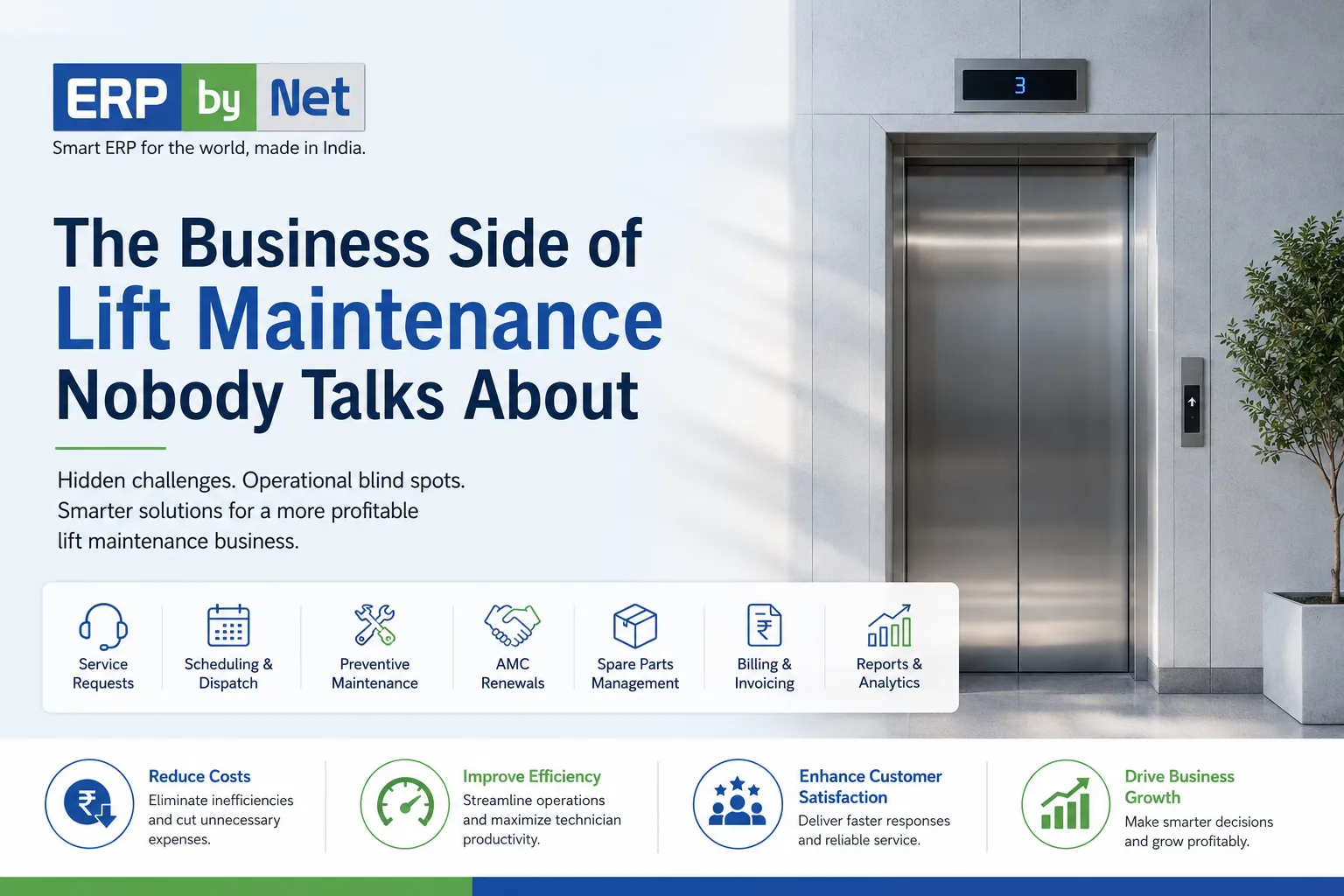
The Business Side of Lift Maintenance Nobody Talks About
Key Takeaways
- Successful lift maintenance businesses rely on efficient operations, not just skilled technicians, to deliver consistent service.
- Scheduling, AMC management, inventory control, and billing have a direct impact on profitability and customer retention.
- Disconnected systems and manual processes create delays, increase costs, and reduce operational visibility.
- Centralized ERP platforms help streamline business operations by connecting field service, finance, inventory, and customer management.
- Operational efficiency is the foundation of sustainable business growth in the competitive lift maintenance industry.
What You’ll Learn
- Why business operations are just as important as technical maintenance for long-term success.
- How AMC management, complaint handling, and technician scheduling influence business performance.
- The role of inventory, procurement, and financial management in reducing operational costs.
- How real-time business visibility enables faster decision-making and improved customer service.
- How ERPbyNet helps lift maintenance companies unify operations, improve productivity, and scale efficiently.
Real Insights
- Many lift companies focus on field service while overlooking operational processes, where hidden inefficiencies often reduce profitability.
- Missed AMC renewals, delayed invoicing, and poor inventory planning can quietly impact cash flow and customer satisfaction.
- Businesses with centralized operational data make faster, more informed decisions and respond more effectively to customer needs.
- Automating administrative workflows reduces manual effort and allows teams to focus on delivering high-quality service.
- The most successful lift maintenance businesses treat operations as a strategic advantage, using ERP technology to improve efficiency, profitability, and long-term growth.
When people think about a lift maintenance company, they usually picture technicians repairing elevators, replacing faulty components, or responding to emergency breakdowns. While these activities are critical, they represent only a small part of what determines whether a lift company succeeds or struggles.
Behind every successful lift maintenance business is an operation that must coordinate customers, technicians, service schedules, inventory, contracts, compliance, finance, and communication—all while ensuring every lift remains safe, reliable, and operational.
This is the Business Side of Lift Maintenance that rarely gets discussed.
Many lift companies invest in hiring experienced technicians and purchasing quality spare parts but continue managing their daily operations using spreadsheets, phone calls, WhatsApp messages, handwritten service reports, and disconnected software. These methods may work for a small operation, but as the customer base grows, they become major barriers to profitability and customer satisfaction.
The truth is simple:
A successful lift maintenance company is built on operational excellence—not just technical expertise.
The companies that consistently grow are those with complete visibility into every aspect of their operations. They know where their technicians are, which contracts are due for renewal, what spare parts are available, how quickly complaints are resolved, and which customers generate the highest value.
In this article, we’ll uncover the hidden business challenges that affect profitability and explain why modern lift companies are shifting from manual management to integrated business operations.
Lift Maintenance Is About Managing a Business, Not Just Maintaining Lifts
From the outside, a lift maintenance business may seem straightforward—receive a complaint, send a technician, fix the issue, and move on to the next job.
In reality, every service request sets off a chain of interconnected business activities that determine how efficiently the company operates and, ultimately, how profitable it becomes.
A single maintenance visit involves much more than technical expertise. It requires seamless coordination between customer service, field technicians, inventory, finance, and management. Every department plays a role in ensuring that the job is completed on time, within the agreed service levels, and without unnecessary costs.
Before a technician even arrives on-site, several critical questions need to be answered:
- Has the customer complaint been logged correctly?
- Is the most suitable technician available for the job?
- Are the required spare parts in stock?
- Does the technician have access to the equipment’s service history?
- Are SLA commitments and compliance requirements being met?
- Will the completed work be documented and invoiced without delay?
When these processes work together, the customer experiences fast, reliable service. When they don’t, even a simple repair can become an expensive operational problem.
This is why successful lift maintenance companies don’t just focus on repairing elevators—they focus on optimizing the entire service operation behind every repair.
The Cost of Poor Operational Visibility
Operational problems rarely begin with major failures. More often, they start with small inefficiencies that go unnoticed until they affect customer satisfaction and profitability.
Consider a typical service call.
A customer reports that a lift has stopped working during office hours. The service coordinator quickly assigns a technician, who travels to the site expecting to resolve the issue.
However, upon inspection, the technician discovers that a critical spare part isn’t available.
Instead of completing the repair, they must return to the warehouse, locate the required component, and schedule another visit.
What appeared to be a routine service request now creates a chain reaction:
- The customer experiences longer downtime.
- An additional site visit increases travel and fuel costs.
- The technician completes fewer jobs that day.
- Other scheduled appointments are delayed.
- Customer frustration grows, leading to follow-up calls or complaints.
- Billing is postponed until the work is finally completed.
The lift is eventually repaired—but the business has already absorbed unnecessary labour costs, administrative effort, travel expenses, and lost productivity.
Now imagine this scenario occurring multiple times every week across dozens or even hundreds of maintenance contracts.
The financial impact quickly becomes substantial.
The challenge is that these losses rarely appear in a single report. They are spread across technician time, inventory management, customer support, scheduling, and finance, making them difficult to identify without complete operational visibility.
This is why many lift maintenance companies believe they have a revenue problem, when in reality they have a visibility problem. Businesses that can see where time, money, and resources are being lost are in a far better position to improve efficiency, increase customer satisfaction, and protect long-term profitability.
Read More: From Complaint to Closure: What Really Happens During Lift Maintenance
The Hidden Costs That Quietly Reduce Profit Margins
Many business owners assume that increasing the number of service contracts automatically increases profits.
Unfortunately, revenue growth alone does not guarantee business success.
Without efficient operations, hidden costs can quietly erode margins every single day.
Some of the most common operational costs include:
Unnecessary Technician Travel
Poor scheduling often results in technicians travelling between distant locations multiple times a day. Extra fuel, travel time, and vehicle wear directly increase operating costs while reducing the number of jobs completed.
Repeat Site Visits
A missing spare part or incomplete service information frequently requires technicians to revisit the same site. Every repeat visit consumes valuable time that could have been spent servicing another customer.
Delayed Invoicing
When job reports are submitted late or manually processed, invoices are delayed. This slows cash flow and increases administrative workload.
Missed Preventive Maintenance
Preventive maintenance reduces breakdowns, but missed inspections often lead to costly emergency repairs that disrupt schedules and reduce customer confidence.
Lost AMC Renewals
Without systematic reminders and follow-up processes, valuable Annual Maintenance Contracts (AMCs) can expire unnoticed, resulting in recurring revenue loss.
Why Lift Maintenance Is a Recurring Revenue Business
Unlike one-time installation projects, lift maintenance generates recurring income through long-term service contracts.
These contracts provide predictable cash flow, improve resource planning, and create lasting customer relationships.
However, recurring revenue only remains stable when companies consistently deliver high-quality service.
Customers expect:
- Reliable lift performance
- Fast emergency response
- Preventive maintenance completed on time
- Accurate service records
- Professional communication
- Transparent reporting
- Minimal downtime
When these expectations are consistently met, contract renewals become much easier.
When they are not, customers begin exploring alternative service providers.
This is why operational consistency is often more valuable than occasional technical excellence.
The Metrics That Separate Growing Companies from Struggling Ones
Many lift maintenance companies monitor only a handful of business indicators, such as monthly revenue or the number of completed service calls.
While these metrics are useful, they do not explain why profitability changes.
Successful businesses monitor operational performance using key indicators that reveal the health of the entire organization.
Some of the most valuable KPIs include:
- Average response time
- First-time fix rate
- Technician utilization
- Preventive maintenance completion rate
- Emergency breakdown frequency
- Customer retention rate
- AMC renewal percentage
- Spare parts turnover
- Inventory carrying cost
- Revenue generated per technician
- Cost per service visit
- SLA compliance
- Outstanding service requests
- Repeat complaint ratio
These metrics provide actionable insights that help management identify inefficiencies before they become expensive problems.
Key Takeaway
Many lift maintenance companies focus on fixing elevators.
The most successful companies focus on improving the systems that keep their entire business running efficiently.
Every delayed service visit, missed renewal, repeat complaint, or inventory shortage affects profitability just as much as a technical issue.
Understanding these operational challenges is the first step toward building a scalable, profitable lift maintenance business.
Business Growth Increases Operational Complexity
Growing a lift maintenance business isn’t just about winning more contracts—it’s about managing more moving parts efficiently.
As your customer base expands, so does the complexity of your operations. More service requests require better technician scheduling, larger inventories demand tighter stock control, and additional AMCs increase the need for timely renewals and accurate billing.
What worked for managing 30 lifts often breaks down when you’re responsible for 300 or more.
Without standardized processes and centralized visibility, growth can lead to delayed service, rising operational costs, missed opportunities, and reduced customer satisfaction.
Many companies find themselves generating more revenue than ever before—but with less control over their daily operations.
Why Operational Visibility Matters Today
Customer expectations are changing rapidly. Clients now expect faster response times, digital service reports, transparent communication, and consistently reliable service.
At the same time, rising labour costs, increasing competition, and stricter compliance requirements are putting pressure on profit margins.
Relying on spreadsheets and disconnected systems makes it difficult to keep up.
Companies that embrace operational visibility and connected workflows can make faster decisions, improve technician productivity, strengthen AMC management, and deliver better customer experiences.
In today’s competitive market, operational visibility isn’t just an advantage—it’s essential for sustainable growth.
Read More: How Technology Is Reshaping Elevator Service Management
The Operational Blind Spots That Quietly Drain Profits

Most lift maintenance companies don’t lose money because of one major mistake.
Instead, profitability slowly disappears through dozens of small operational inefficiencies that occur every day.
A delayed technician, a missed AMC renewal, an unavailable spare part, an invoice sent a week late, or an emergency visit that could have been prevented—all of these may seem like isolated incidents. However, over weeks and months, they create significant financial losses.
The challenge is that these losses rarely appear in a single report. They are spread across different departments, making them difficult to identify without complete operational visibility.
Let’s explore the most common blind spots that affect lift maintenance businesses.
1. More Technicians Don’t Always Mean Better Performance
One of the biggest misconceptions in the industry is that hiring more technicians automatically improves service quality.
In reality, productivity matters far more than headcount.
Imagine two companies with ten technicians each.
- Company A completes 18 jobs per technician every week.
- Company B completes only 11 jobs per technician every week.
Although both businesses have the same workforce, Company A delivers significantly more value without increasing payroll costs.
The difference isn’t technical skill—it’s operational efficiency.
Several factors influence technician productivity:
Poor Job Scheduling
When technicians travel unnecessarily between distant sites, valuable working hours are wasted on the road instead of serving customers.
Incomplete Service Information
If technicians arrive without access to equipment history, previous repairs, warranty details, or customer notes, diagnosis takes longer and mistakes become more likely.
Missing Spare Parts
A technician who cannot complete a repair during the first visit often needs to return later, doubling travel time and increasing operational costs.
Manual Paperwork
Handwritten reports, manual approvals, and delayed job closures reduce the number of service calls that can be completed each day.
Key Takeaway
A highly productive team of 15 technicians can often outperform a poorly managed team of 25.
The goal should not be hiring more people—it should be enabling technicians to complete more successful jobs with fewer delays.
2. The Hidden Cost of Poor Spare Parts Management
Inventory is one of the largest investments for any lift maintenance company.
Unfortunately, it’s also one of the least optimized.
Many businesses face two common problems:
Overstocking
To avoid shortages, companies purchase excessive quantities of spare parts.
While this reduces stock-out risks, it creates new challenges:
- Capital remains tied up in inventory.
- Slow-moving parts occupy warehouse space.
- Components may become obsolete before being used.
- Cash flow becomes restricted.
Understocking
Keeping minimal inventory may appear cost-effective, but it often leads to:
- Emergency purchases at premium prices
- Delayed repairs
- Additional technician visits
- Longer customer downtime
- Lower first-time fix rates
Neither extreme is sustainable.
The most profitable lift companies maintain the right inventory—not simply more inventory.
Effective inventory management depends on accurate forecasting, service history, equipment age, seasonal demand, and real-time stock visibility.
When these elements are missing, inventory becomes a financial burden instead of a competitive advantage.
3. Manual Scheduling Creates Expensive Delays
Scheduling technicians manually may seem manageable when servicing a small number of lifts.
However, as operations grow, manual scheduling quickly becomes inefficient.
Common scheduling challenges include:
- Double-booked technicians
- Incorrect technician assignments
- Delayed emergency responses
- Excessive travel between locations
- Missed preventive maintenance visits
- Poor workload distribution
Every scheduling mistake affects more than just one appointment.
It creates a chain reaction that impacts customers, technicians, dispatchers, finance teams, and management.
A single delayed maintenance visit can trigger multiple complaints, increase overtime costs, and reduce customer confidence.
Modern scheduling isn’t simply about assigning jobs.
It’s about assigning the right technician, with the right skills, carrying the right spare parts, to the right location, at the right time.
That level of coordination is difficult to achieve using spreadsheets or phone calls alone.
4. Why Missed AMC Renewals Are One of the Biggest Revenue Leaks
Annual Maintenance Contracts (AMCs) are the foundation of predictable revenue for most lift maintenance companies.
Yet many businesses unintentionally lose contracts because renewal management remains a manual process.
Some common reasons include:
- Renewal reminders are forgotten.
- Quotations are sent too late.
- Customer follow-ups are inconsistent.
- Previous complaints remain unresolved.
- Contract records are incomplete.
- Service history isn’t readily available.
Every missed renewal represents more than the loss of one customer.
It also means:
- Lost recurring revenue
- Higher customer acquisition costs
- Reduced technician utilization
- Lower long-term profitability
Successful lift companies treat AMC renewals as a strategic business process rather than an administrative task.
Renewals should begin well before contract expiry, supported by complete service history, performance records, and proactive customer communication.
5. Disconnected Systems Create Operational Chaos
Many growing businesses use separate tools for different activities.
For example:
- Customer complaints are recorded in WhatsApp.
- Technician schedules are maintained in spreadsheets.
- Inventory is managed in another application.
- Invoices are prepared using accounting software.
- Service reports are stored as PDFs.
- Customer communication occurs through emails and phone calls.
Each department may function independently, but management lacks a complete view of the business.
As information moves between disconnected systems, delays and errors become unavoidable.
Common consequences include:
- Duplicate data entry
- Missing service records
- Delayed billing
- Incorrect inventory levels
- Communication gaps
- Slower decision-making
Without centralized information, management spends more time collecting data than acting on it.
6. Every Director Should Know These Business Numbers
Many directors review revenue at the end of each month.
However, revenue alone doesn’t reveal how efficiently the business is operating.
The most successful lift companies monitor operational performance every day.
Important metrics include:
Service Operations
- Open complaints
- Average response time
- Emergency call volume
- First-time fix rate
- Preventive maintenance completion
- Repeat complaints
Technician Performance
- Jobs completed per technician
- Average travel time
- Technician utilization
- Job closure rate
- Overtime hours
Inventory
- Fast-moving spare parts
- Slow-moving inventory
- Stock shortages
- Emergency purchases
- Inventory value
Customer Success
- AMC renewals due
- Customer satisfaction
- SLA compliance
- Contract profitability
- Customer retention
Finance
- Revenue per contract
- Outstanding invoices
- Cash flow
- Cost per service visit
- Gross profit margin
When these numbers are visible in one place, directors can identify trends early and make informed decisions before small issues become major problems.
Real Growth Requires Better Visibility—Not More Complexity
Many lift maintenance companies believe operational problems are simply part of running a growing business.
They aren’t.
Most challenges arise because management lacks visibility into what’s happening across departments.
When complaints, technicians, inventory, contracts, finance, and customer communication operate independently, even experienced teams struggle to maintain efficiency.
As businesses grow, the need isn’t just for more staff or more software.
The need is for better coordination.
Companies that gain complete visibility into their operations can:
- Reduce emergency visits through better preventive maintenance
- Improve technician productivity
- Increase first-time fix rates
- Minimize unnecessary travel
- Reduce inventory costs
- Improve AMC renewal success
- Deliver faster customer service
- Make better business decisions using real-time data
These improvements don’t just enhance operational efficiency—they directly increase profitability and customer retention.
The Future of Lift Maintenance Is Data-Driven
The lift maintenance industry is evolving rapidly.
Buildings are becoming smarter, customer expectations are increasing, and competition is stronger than ever. Property managers no longer evaluate maintenance providers based only on how quickly they respond to breakdowns. They also expect transparency, proactive communication, digital reporting, and consistent service quality.
At the same time, lift maintenance companies are facing rising labour costs, tighter compliance requirements, and increasing pressure to improve profitability.
To remain competitive, businesses need more than skilled technicians—they need complete operational visibility.
The future belongs to companies that can:
- Predict maintenance requirements before failures occur.
- Monitor technician productivity in real time.
- Manage inventory with accurate forecasting.
- Track contract performance and profitability.
- Deliver faster, data-driven customer service.
- Make informed business decisions using live operational insights.
Technology is no longer replacing people; it is helping people work smarter.
Companies that embrace digital operations today will be better positioned to scale tomorrow.
Read More: Why Elevator Companies Struggle to Track AMC Contracts
Common Mistakes Lift Maintenance Companies Should Avoid
Even experienced businesses can unknowingly adopt practices that reduce efficiency and profitability.
Recognizing these mistakes is the first step toward improving operations.
Depending on Manual Processes
Spreadsheets and handwritten records may work for small teams, but they become difficult to manage as customer numbers grow. Manual processes increase the risk of errors, duplicate work, and lost information.
Focusing Only on Emergency Repairs
Emergency work is important, but relying on reactive maintenance creates unpredictable schedules, higher costs, and lower customer satisfaction.
A balanced approach that prioritizes preventive maintenance helps reduce breakdowns and improve long-term profitability.
Ignoring Business Metrics
Many companies review financial reports at the end of the month but fail to monitor operational KPIs daily.
Without visibility into technician productivity, inventory movement, complaint trends, and contract performance, it’s difficult to identify issues before they affect the business.
Treating Departments as Separate Functions
Customer service, field operations, inventory, finance, and management should not work in isolation.
The most efficient businesses connect these departments through shared data and standardized workflows.
Delaying Digital Transformation
Many businesses postpone investing in operational systems until problems become overwhelming.
By then, customer dissatisfaction, operational inefficiencies, and rising costs have already begun affecting profitability.
Modernizing operations early makes growth far easier to manage.
Building a Business That Grows Sustainably
Growth should make a business stronger—not more complicated.
As lift maintenance companies expand, the number of service contracts, technicians, spare parts, customer requests, and financial transactions grows rapidly.
Without structured systems, every new customer adds more complexity.
Sustainable growth comes from building repeatable processes that allow the business to maintain high service quality regardless of size.
Successful companies achieve this by:
- Standardizing service workflows.
- Automating repetitive administrative tasks.
- Monitoring performance using real-time dashboards.
- Empowering technicians with digital tools.
- Improving communication between departments.
- Making business decisions based on accurate operational data.
When these practices become part of everyday operations, growth becomes easier to manage and more profitable.
Why Operational Visibility Is the Real Competitive Advantage
Every lift maintenance company repairs elevators.
What differentiates market leaders is how efficiently they operate behind the scenes.
The ability to answer critical business questions instantly gives management a significant advantage.
Questions such as:
- Which technicians are most productive?
- Which customers require immediate attention?
- Which contracts are nearing renewal?
- Which spare parts need replenishment?
- Which jobs remain incomplete?
- Which service contracts generate the highest margins?
- Where is the business losing money?
Without centralized operational data, finding these answers can take hours—or even days.
With integrated business visibility, they are available in real time.
This enables faster decisions, better customer service, and stronger financial performance.
How ERPbyNet Helps Lift Maintenance Businesses Stay Ahead

Managing a modern lift maintenance company requires more than individual software tools.
It requires a connected platform that brings together every critical business process.
ERPbyNet is designed specifically to help lift maintenance companies manage their complete operations from a single system.
With ERPbyNet, businesses can:
- Manage customer complaints efficiently.
- Schedule technicians intelligently.
- Track preventive maintenance activities.
- Monitor Annual Maintenance Contracts (AMCs).
- Control spare parts inventory.
- Generate accurate service reports.
- Automate billing processes.
- Improve financial visibility.
- Monitor operational KPIs through real-time dashboards.
- Support business growth with connected workflows.
Instead of switching between multiple systems, teams work with one platform that keeps information consistent, accessible, and up to date.
The result is better coordination, faster decision-making, improved customer satisfaction, and greater operational efficiency.
Final Thoughts
The lift maintenance industry has always been built on technical expertise.
Today, technical expertise alone is no longer enough.
Behind every successful lift maintenance company is a business that manages people, processes, inventory, customer relationships, contracts, and financial performance with precision.
The companies that continue relying on spreadsheets and disconnected systems may find it increasingly difficult to keep pace with rising customer expectations and growing operational complexity.
Those that invest in visibility, automation, and connected operations will be better prepared to improve efficiency, strengthen customer relationships, and achieve sustainable growth.
The business side of lift maintenance may not always be visible—but it has a direct impact on profitability, service quality, and long-term success.
Ready to Improve the Way Your Lift Maintenance Business Operates?
If you’re looking to gain complete visibility into your lift maintenance operations, streamline technician management, improve AMC renewals, control inventory, and make smarter business decisions, ERPbyNet can help.
Explore how ERPbyNet supports lift maintenance companies with an integrated platform designed to simplify operations, improve efficiency, and support sustainable business growth.
Frequently Asked Questions
What is the biggest business challenge in lift maintenance?
One of the biggest challenges is maintaining operational visibility across technicians, customer complaints, inventory, contracts, and billing. Without connected systems, businesses often experience delays, higher costs, and reduced profitability.
Why are Annual Maintenance Contracts (AMCs) so important?
AMCs provide predictable recurring revenue, improve customer retention, and make workforce planning easier. Efficient renewal management is essential for long-term business growth.
How does poor inventory management affect lift maintenance companies?
Incorrect inventory levels can lead to delayed repairs, emergency purchases, repeat site visits, and unnecessary capital tied up in slow-moving stock. Effective inventory control improves both service quality and cash flow.
Why is technician productivity more important than technician headcount?
A productive technician who completes more successful jobs with fewer repeat visits contributes significantly more value than simply increasing the size of the workforce. Efficient scheduling, access to service history, and spare parts availability all improve productivity.
How can ERP software improve lift maintenance operations?
ERP software connects customer service, field operations, inventory, finance, contracts, and reporting into one integrated platform. This improves operational visibility, reduces manual work, enhances decision-making, and helps businesses scale more efficiently.