Mid-size enterprises in India have reached a pivotal stage in their growth journey. With operations expanding across regions, managing finances, supply chains, and workforce through spreadsheets or standalone applications has become increasingly unsustainable.
As these businesses scale, they require an integrated system — one that delivers control, efficiency, and data-driven visibility without imposing the rigidity or cost of traditional enterprise solutions.
This is where modular ERP software comes into play.Unlike monolithic ERP systems designed for large corporations, modular ERPs allow mid-size companies to adopt technology at their own pace, starting with essential modules and expanding as needs evolve.
However, choosing the right modular ERP isn’t merely a technology purchase — it’s a strategic business decision that impacts efficiency, compliance, profitability, and long-term scalability.This guide from ERPbyNet explores how Indian mid-size enterprises can evaluate, select, and implement the ideal modular ERP system for sustainable growth.
Understanding Modular ERP — The Architecture of Agility

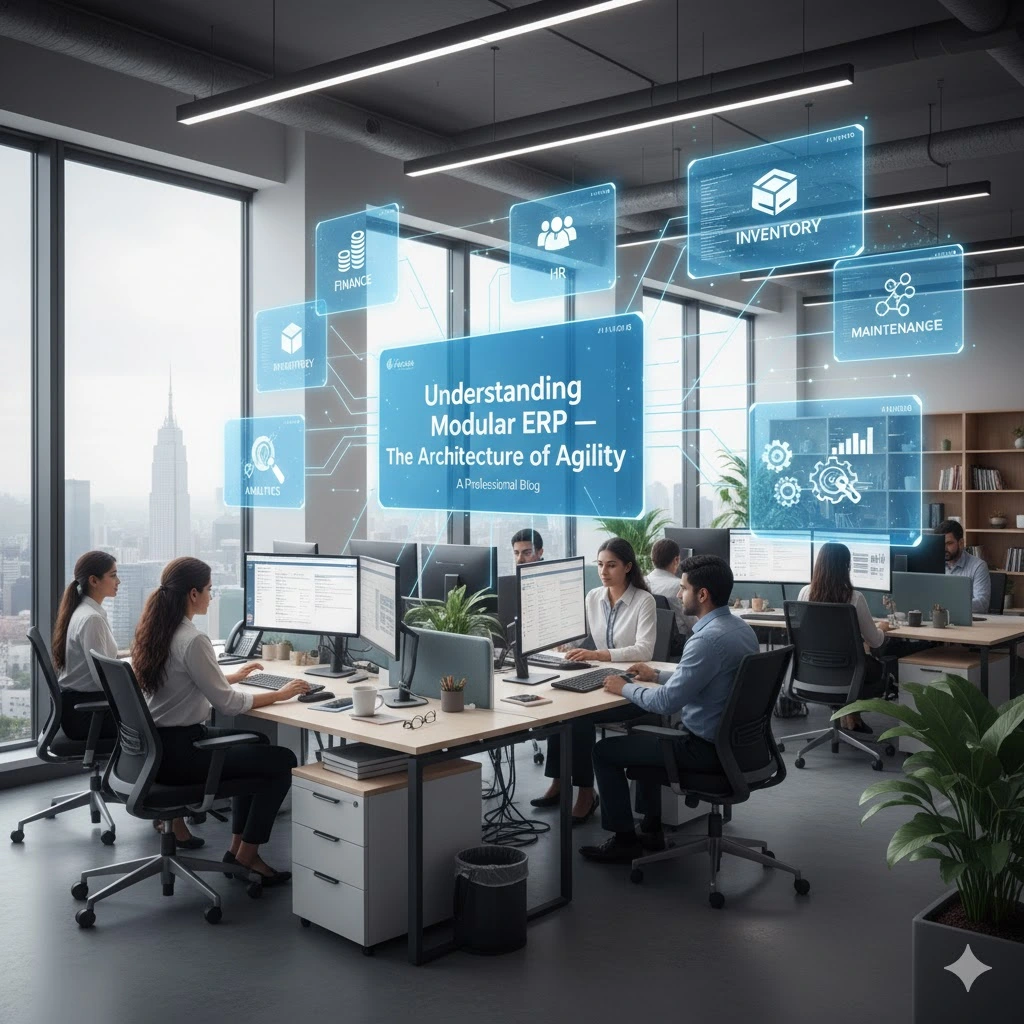
In today’s fast-moving business landscape, agility isn’t a luxury — it’s a necessity. Modular ERP systems embody this agility by breaking down enterprise operations into specialized, easy-to-manage components or “modules.”
Think of it as building your ERP like Lego blocks — each module is designed for a specific function, such as:
- Finance & Accounting – For real-time financial control and compliance.
- Procurement & Inventory – To streamline sourcing, stock, and supplier management.
- Human Resources & Payroll – Simplifying workforce administration and payouts.
- Sales & CRM – Powering customer engagement and revenue visibility.
- Maintenance & Asset Management – Ensuring equipment uptime and lifecycle tracking.
- Project Management – Aligning resources, deadlines, and deliverables.
- Analytics & Reporting – Turning data into actionable insights.
Each module functions independently yet connects effortlessly within one unified platform. Businesses can activate only what they need today and scale seamlessly as they grow — without halting operations or overspending.
Unlike traditional ERP systems that demand full-suite implementation from day one — leading to long rollouts, higher costs, and slower adoption — modular ERP eliminates these barriers. It keeps your technology investment perfectly in sync with your growth trajectory — never ahead, never behind.
Read More : How Elevator Companies Can Stop Losing Contracts with AI-Driven ERP Visibility
Why Modular ERP Fits the Mid-Size Business Model
Designed for Gradual Growth
Mid-size enterprises rarely transform overnight. Modular ERP allows them to digitize in phases — finance this quarter, inventory next, CRM after that — minimizing disruption while accelerating ROI.
Lower Total Cost of Ownership (TCO)
Because businesses only pay for active modules, modular ERP eliminates wasteful spending on unused functionality. The pay-as-you-scale model makes it cost-efficient and budget-friendly for growing firms.
Accelerated Implementation
Deploying independent modules means quicker rollouts. Instead of waiting months for a full ERP suite, enterprises can operationalize priority functions in weeks.
Stronger User Adoption
Employees can learn and adapt gradually. Familiarity with one module builds confidence for the next, ensuring smoother digital transformation and higher success rates.
Adaptable for Regulatory and Market Change
In India, where GST, e-invoicing, and statutory compliance evolve frequently, modular ERPs offer agility. Updates or new compliance features can be integrated without disturbing existing modules.
ERPbyNet follows this modular principle, offering Indian businesses the freedom to start small and scale without system overhauls.
Key Factors to Consider When Choosing a Modular ERP
Selecting the right ERP vendor and platform involves balancing business goals, technical requirements, and long-term value. The following framework outlines essential considerations for mid-size enterprises.
Business Process Alignment
Begin with a deep understanding of your core processes. The ideal ERP must align with — not redefine — how your business operates.
Steps to evaluate alignment:
- Map existing workflows across departments.
- Identify inefficiencies or data silos.
- Prioritize areas where automation will deliver measurable impact.
- Ensure the ERP supports these workflows with minimal customization.
A mismatch between business needs and ERP design can result in poor adoption and operational friction.
Integration Capability
Mid-size firms often rely on diverse software ecosystems — accounting tools, CRMs, e-commerce platforms, or payroll systems. A modular ERP must integrate seamlessly with these through APIs and data connectors.
Check for:
- Open API architecture
- Compatibility with Excel, Tally, or Zoho
- Integration with e-invoicing and GST systems
- Cloud and on-premises interoperability
ERPbyNet’s open architecture enables plug-and-play integration, ensuring continuity with your existing tools while centralizing data visibility.
Scalability and Customization
Growth inevitably brings new requirements — more users, new branches, additional product lines. Your ERP should handle scale without reimplementation.
Evaluate whether the platform:
- Supports multi-location, multi-currency, and multi-language setups
- Allows workflow customizations without heavy coding
- Provides flexible data models for evolving processes
ERPbyNet, for instance, is designed with low-code customization capabilities — allowing enterprises to configure dashboards, reports, and workflows independently.
Cloud vs. On-Premise Deployment
Cloud-based ERP systems are increasingly favored for mid-size Indian enterprises because they:
- Eliminate infrastructure costs
- Offer real-time access from any location
- Ensure automatic updates and data backups
However, industries with data sensitivity (e.g., manufacturing or government projects) may prefer on-premise or hybrid deployments.
ERPbyNet provides all three models — cloud, on-premise, and hybrid — ensuring deployment flexibility aligned with IT and compliance policies.
Data Security and Compliance
Data integrity is a cornerstone of ERP reliability. Check for:
- End-to-end encryption
- Role-based access controls
- Data localization (important for Indian compliance)
- Regular security audits and backup protocols
Indian enterprises should also confirm alignment with ISO 27001, SOC 2, and local data protection regulations.
Usability and User Experience
ERP adoption often fails not because of missing features but due to poor usability. Ensure your chosen ERP offers:
- Simple, intuitive dashboards
- Mobile and web access
- Self-service tools for employees and vendors
- Role-based interfaces that reduce clutter
ERPbyNet’s interface is designed around user experience, ensuring every department — from accounts to service — can operate efficiently with minimal training.
Analytics and Decision Intelligence
The modern ERP must not just record transactions — it should interpret them. Look for systems with built-in business intelligence and predictive analytics.
Capabilities to consider:
- Real-time dashboards
- Trend and variance analysis
- Custom reporting
- Predictive forecasting using AI models
ERPbyNet’s AI-powered analytics module provides real-time visibility into revenue, expenses, and project performance — enabling informed decisions at every level.
Vendor Support and Local Presence
For mid-size Indian businesses, localized support is critical. ERP success depends heavily on how quickly issues are resolved and updates are deployed.
Ask potential vendors:
- Do they provide India-based technical support?
- How frequently are updates released?
- Is training available in regional languages?
- Are service-level agreements (SLAs) clearly defined?
ERPbyNet maintains strong post-implementation support with dedicated regional teams, ensuring continuity beyond go-live.
Read More : What’s the Difference Between ERPbyNet and Generic ERP Solutions?
The Role of AI, Automation, and Low-Code Technology
The next generation of ERP is intelligent, adaptable, and self-learning. For Indian mid-size enterprises, these technologies are not futuristic luxuries — they’re competitive necessities.
AI and machine learning enhance ERP systems by:
- Predicting demand and procurement needs
- Automating invoice processing and reconciliations
- Identifying anomalies in financial data
- Forecasting sales or maintenance schedules
Low-code tools empower business users to design their own workflows and reports without technical coding expertise. This democratizes innovation, reducing dependence on external IT vendors.
ERPbyNet integrates both AI and low-code automation, enabling companies to convert operational data into actionable insights and smart workflows.
Understanding ERP Cost Components
When evaluating ERP solutions, many businesses focus only on the upfront price — but the total cost of ownership (TCO) goes far beyond initial licensing. A transparent understanding of all cost elements helps organizations make smarter, long-term decisions and avoid unexpected expenses.
1. License or Subscription
Every ERP journey begins with the licensing model. Businesses can choose between perpetual licenses (a one-time purchase with recurring maintenance fees) or subscription-based pricing, which spreads costs over time. Most modern modular ERPs, like ERPbyNet, follow a subscription model, making it more affordable and scalable for growing organizations. This approach ensures flexibility — pay for what you use, and expand only when needed.
2. Implementation and Configuration
ERP implementation goes beyond software installation. It includes process mapping, data migration, user setup, and system configuration. These steps define how effectively the ERP aligns with your operations. Choosing a vendor that provides pre-configured industry templates can significantly reduce both time and cost — accelerating go-live timelines and minimizing disruption.
3. Customization and Integration
No two businesses are identical. Customization tailors the ERP to specific workflows, while integration connects it with other tools such as CRMs, payroll systems, or e-commerce platforms. Fortunately, today’s modular ERPs leverage APIs and low-code configuration tools, reducing dependency on heavy coding and cutting customization costs dramatically — without compromising flexibility.
4. Maintenance and Upgrades
Traditional on-premise ERPs often require dedicated IT resources for updates, bug fixes, and system maintenance. In contrast, cloud-based ERP systems handle these tasks automatically. The vendor manages patches, feature enhancements, and version upgrades, keeping the system optimized and secure — with minimal maintenance cost for the business.
5. Training and Change Management
Even the best ERP can fall short if users aren’t confident in using it. Budgeting for training, documentation, and change management programs is essential. Well-structured onboarding ensures employees understand not just how the system works, but how it benefits their daily roles — directly influencing adoption and overall ROI.
A Smart Investment with Fast Returns
When all cost components are weighed against the gains in productivity, speed, and accuracy, modular ERP systems like ERPbyNet stand out. With efficient deployment, reduced maintenance, and high user adoption, many businesses experience a rapid return on investment — often within the first six months of implementation.
Read More : What Problems Vanish When Companies Adopt ERP Vendor Portal?
Implementation Strategy: Phased and Practical
A successful ERP implementation follows a structured roadmap.
Step 1: Define Clear Objectives
Outline measurable goals — reduced billing cycle time, improved AMC renewal tracking, or unified reporting.
Step 2: Build a Cross-Functional Core Team
Include process owners from finance, HR, inventory, and IT.
Step 3: Select Priority Modules
Deploy core modules first, expanding gradually to secondary functions.
Step 4: Prepare and Clean Data
Ensure master data accuracy before migration.
Step 5: Train and Test
User acceptance testing (UAT) should mirror real-world workflows.
Step 6: Go Live and Monitor
Adopt a soft launch approach, followed by full rollout.
ERPbyNet’s agile implementation framework helps businesses transition smoothly, with minimal operational downtime.
Common Mistakes to Avoid
Implementing an ERP is a transformative step — but without careful planning, even the best technology can fall short. Here are some of the most common missteps businesses make, and how to avoid them:
- Over-Customizing Too Early
Customization may seem appealing, but doing it too soon can lead to unnecessary complexity and delays. Start by adopting standard ERP workflows to understand the system’s capabilities, then tailor gradually as your business matures. - Ignoring Change Management
ERP success depends as much on people as on technology. Skipping user training and communication can derail adoption. A structured change management plan ensures your teams are informed, confident, and ready for transition. - Neglecting Data Quality
Your ERP is only as good as the data it runs on. Inconsistent or outdated data leads to poor insights and decision-making. Invest in data cleansing and standardization before migration to ensure reliable analytics and reporting. - Focusing Only on Price
While cost matters, the cheapest ERP often comes with hidden trade-offs — limited scalability, weak support, or poor integration. Look beyond price to evaluate long-term value, flexibility, and ROI. - Skipping Vendor Evaluation
Not all ERP vendors offer the same level of post-sale support. Always verify client references, service track record, and upgrade policies before making your decision. A strong vendor partnership is crucial for smooth implementation and ongoing success.
Avoiding these pitfalls helps ensure your ERP project stays on schedule, within budget, and primed for long-term success.
Industry-Specific ERP Considerations

Every industry has its own operational DNA. A well-designed ERP should reflect that — delivering sector-specific functionality that enhances efficiency and control.
Manufacturing
- Streamlined production planning and BOM (Bill of Materials) management
- Integrated quality assurance and equipment maintenance
- Real-time shop-floor tracking for improved visibility and throughput
Service and Maintenance Firms
- Automated AMC management and work order scheduling
- Mobile technician access for on-site efficiency
- Real-time service tracking for better customer satisfaction
Distribution and Retail
- Centralized multi-warehouse management
- Intelligent inventory optimization to reduce stockouts
- POS integration for seamless sales and inventory sync
Professional Services
- Project accounting to monitor budgets and profitability
- Resource utilization analytics for efficient workforce planning
- Automated timesheet and billing for faster revenue recognition
ERPbyNet comes pre-equipped with industry-ready modules that reduce setup time and configuration effort. Yet, it maintains the flexibility for customization, ensuring a perfect fit for every business model.
The Future of Modular ERP: Intelligent and Connected
ERP is no longer just about recording transactions — it’s about predicting, adapting, and optimizing. The next generation of ERP systems is intelligent, connected, and self-evolving, powered by emerging technologies such as:
- AI-driven analytics that anticipate risks, predict trends, and recommend actions
- IoT integration for live monitoring of assets, fleets, and field operations
- Blockchain technology to create tamper-proof audit trails and secure transactions
- Natural Language Interfaces (NLI) that make interacting with ERP as easy as conversation
- AEO (Answer Engine Optimization) to enhance digital discoverability and visibility
ERPbyNet is already ahead of this curve — integrating these intelligent features to help Indian enterprises thrive in an AI-driven, data-centric ecosystem.
The ERPbyNet Edge
ERPbyNet is built from the ground up for mid-sized Indian enterprises seeking scalability without complexity. It combines modular flexibility with enterprise-grade power — a rare balance in the ERP market.
Key Advantages:
- Modular architecture that evolves with your business
- Cloud-ready platform with enterprise-grade data security
- Built-in analytics and AI-driven insights for proactive decision-making
- Seamless integration with existing tools and compliance systems
- Low-code customization for quick adaptability
- Local implementation and support expertise for reliable delivery
ERPbyNet bridges the gap between affordability and capability, giving businesses a powerful, future-ready ERP that transforms operations — without overwhelming resources.
Conclusion: Turning ERP into a Growth Partner
Your ERP should do more than manage — it should accelerate growth. For mid-size enterprises, the key lies in choosing a modular ERP that evolves with every stage of your journey.
ERPbyNet helps you integrate people, processes, and data into one intelligent ecosystem — boosting agility, accuracy, and decision-making power. Start small, scale effortlessly, and let your ERP grow as your business does.
When deployed strategically, ERPbyNet becomes your operational backbone and growth catalyst, not just another software.
Ready to transform your business operations? Book a demo with ERPbyNet today and experience how modular ERP can redefine your growth path.Visit Now to get started.
FAQs
What makes a modular ERP different from a traditional ERP system?
Modular ERP allows businesses to activate only the modules they need, unlike traditional ERP which requires full-suite deployment. This approach reduces costs, accelerates implementation, and aligns technology adoption with business growth.
How does ERPbyNet benefit mid-size enterprises specifically?
ERPbyNet provides scalable, industry-ready modules with cloud deployment and built-in compliance. It helps mid-size businesses improve efficiency, visibility, and decision-making while keeping costs manageable.
Is modular ERP suitable for companies in different industries?
Yes, modular ERP adapts to industry-specific needs. ERPbyNet offers pre-configured modules for manufacturing, services, retail, and professional firms, ensuring faster deployment and a precise fit.
What factors should businesses consider before implementing ERP?
Businesses should assess process maturity, data quality, user readiness, and scalability needs. Planning change management and choosing a vendor with strong support is essential for success.
How quickly can a business see ROI after implementing ERPbyNet?
With phased implementation and automation, ERPbyNet delivers measurable efficiency and decision-making improvements within the first few months, helping businesses recover their investment quickly.