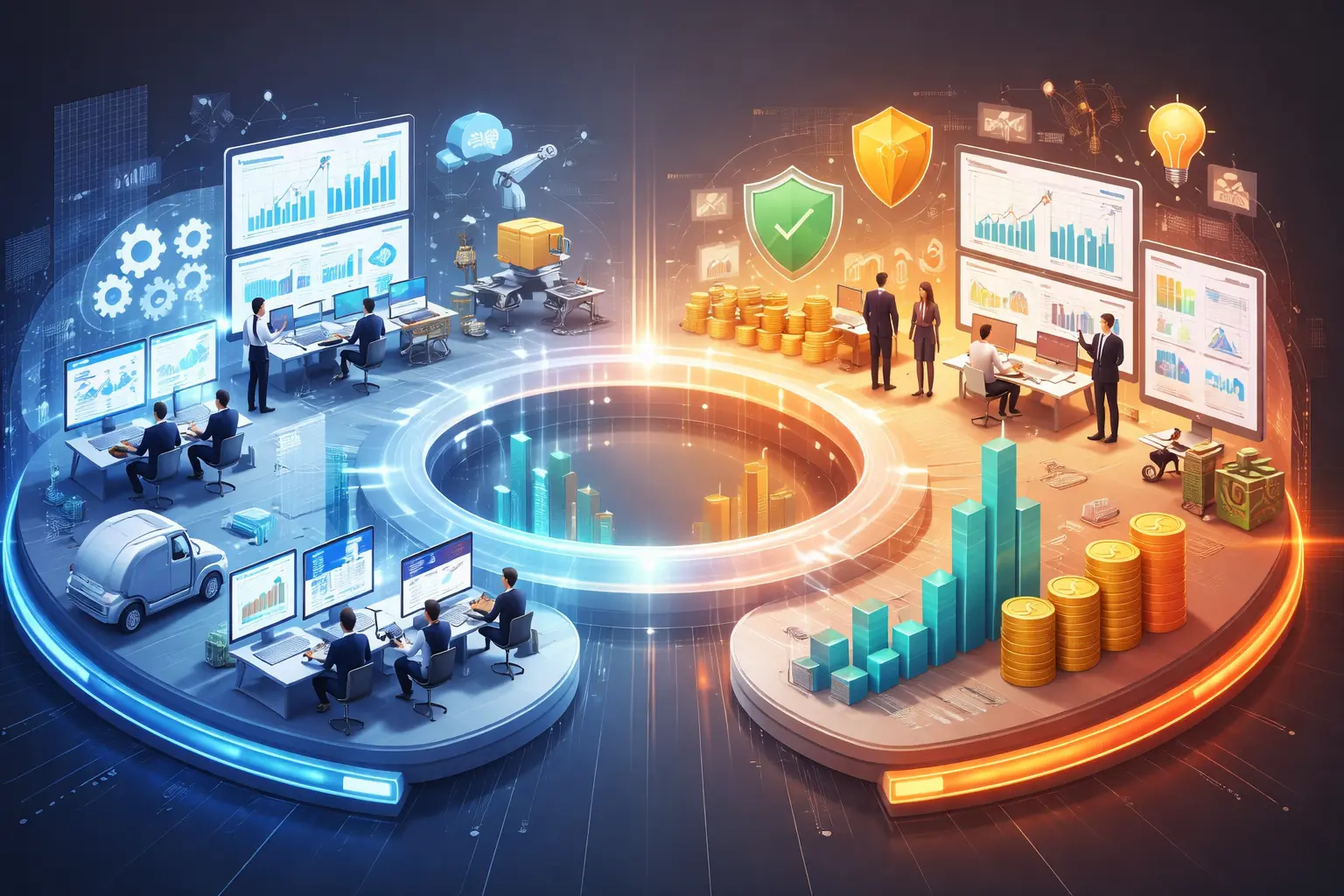
As enterprises grow in size and complexity, the way they manage resources, operations, and risk becomes a defining factor in long-term success. Over the years, businesses have adopted various frameworks and systems to improve efficiency, control costs, and support strategic decision-making. Among the most commonly discussed concepts are Enterprise Resource Planning (ERP) and Enterprise Resource Management (ERM).
Despite their similar names, ERP and ERM serve distinct purposes within an organization. They address different challenges, operate at different levels, and deliver value in different ways. However, confusion between these terms is widespread, leading to incorrect expectations, misaligned implementations, and underutilized systems.
This article provides a clear, comprehensive comparison of ERP and ERM, explains their key differences and benefits, and shows how modern platforms like ERPbyNet help organizations align operational execution with effective resource and risk management.
Understanding Enterprise Resource Planning (ERP)
What Is ERP?
Enterprise Resource Planning (ERP) refers to an integrated software system designed to manage and automate an organization’s core operational processes. ERP systems bring together data and workflows from multiple departments into a single, centralized platform.
At its core, ERP is about standardization, integration, and efficiency. Instead of each department operating in isolation with separate systems, ERP creates a unified view of business operations.
Core Functions of ERP
Most ERP systems include modules for:
- Finance and accounting
- Procurement and vendor management
- Inventory and supply chain management
- Manufacturing and production planning
- Sales and order management
- Human resources and payroll
- Project management and costing
By integrating these functions, ERP ensures that all departments work with consistent data and aligned processes.
Benefits of ERP
ERP delivers value by enabling organizations to:
- Eliminate data silos across departments
- Automate repetitive transactional tasks
- Improve accuracy and compliance
- Gain real-time visibility into operations
- Standardize processes across locations and business units
- Support scalability as the business grows
In essence, ERP helps organizations run the business efficiently on a day-to-day basis.
ERP as an Operational Backbone
ERP systems are primarily transactional and operational. They capture what has happened and what is happening now—sales orders, production updates, inventory movements, invoices, and payroll transactions. This makes ERP the system of record for enterprise operations.
Platforms like ERPbyNet are designed to strengthen this operational backbone, particularly for project-based and contract-driven industries, where coordination between engineering, procurement, execution, and finance is critical.
Read More: The Impact of Disconnected Finance Systems on Business Decisions
Understanding ERM: Enterprise Resource Management and Risk Management
The term ERM is often used in two related but distinct contexts, which contributes to confusion.
- Enterprise Resource Management
- Enterprise Risk Management
Both interpretations focus on management rather than transactions, and both rely heavily on accurate data—often provided by ERP systems.
ERM as Enterprise Resource Management
What Is Enterprise Resource Management?
Enterprise Resource Management refers to a management approach focused on planning, allocating, optimizing, and monitoring organizational resources. Unlike ERP, ERM is not primarily a software system but a strategic discipline supported by tools and data.
Resources managed under ERM include:
- Human resources and skills
- Financial capital
- Time and capacity
- Assets and equipment
- Project workloads
Key Objectives of Enterprise Resource Management
ERM aims to answer questions such as:
- Are the right people working on the right projects?
- Are resources underutilized or overburdened?
- Are budgets aligned with strategic priorities?
- Are projects staffed and scheduled effectively?
ERM focuses on optimization and decision-making, not just execution.
Benefits of Enterprise Resource Management
When implemented effectively, ERM helps organizations:
- Improve resource utilization
- Reduce project delays and cost overruns
- Align operational execution with strategic goals
- Improve forecasting and planning accuracy
- Increase organizational agility
ERM provides the management layer that turns operational data into actionable insights.
ERM as Enterprise Risk Management
What Is Enterprise Risk Management?
Enterprise Risk Management is a structured approach to identifying, assessing, and mitigating risks that could impact an organization’s objectives. These risks may be internal or external and often extend beyond operational processes.
Examples include:
- Financial and market risks
- Supply chain disruptions
- Cybersecurity threats
- Regulatory and compliance risks
- Project delivery risks
How ERM (Risk) Differs from ERP
While ERP focuses on efficiency and control, ERM focuses on resilience and preparedness. ERP ensures processes run smoothly; ERM ensures the organization can withstand uncertainty and change.
Benefits of Enterprise Risk Management
ERM enables organizations to:
- Anticipate potential disruptions
- Quantify the impact of risks
- Prioritize mitigation efforts
- Improve governance and compliance
- Support long-term strategic stability
Read More: Importance of ERP Integrations with Expense Management Software
Key Differences Between ERP and ERM
Although ERP and ERM are interconnected, their roles are clearly distinct.
ERP vs ERM: A Conceptual Comparison
| Aspect | ERP | ERM |
| Primary Focus | Operational execution | Strategic management and optimization |
| Nature | Software system | Management framework or discipline |
| Time Orientation | Present and historical | Present and future |
| Core Goal | Efficiency and accuracy | Optimization, resilience, and alignment |
| Users | Operational teams, finance, HR | Managers, executives, planners |
| Data Role | Generates and stores data | Interprets and uses data |
Key Insight
ERP answers the question:
“What is happening in the business?”
ERM answers the question:
“What should we do with this information?”
How ERP and ERM Work Together

ERP and ERM are not competing concepts. They are complementary layers of enterprise maturity.
ERP as the Foundation
ERP provides:
- Clean, consistent data
- Standardized processes
- Real-time operational visibility
Without a reliable ERP system, ERM initiatives lack accurate inputs.
ERM as the Decision Layer
ERM builds on ERP data to:
- Allocate resources more effectively
- Improve planning and forecasting
- Identify risks and constraints
- Support strategic trade-offs
Together, ERP and ERM create a closed loop where execution informs strategy, and strategy guides execution.
The Role of ERPbyNet in Bridging ERP and ERM
Modern enterprises require more than generic ERP solutions. They need platforms that understand industry-specific complexity and support both operational execution and effective management.
ERPbyNet’s Approach
ERPbyNet is designed to support organizations where projects, contracts, and engineering complexity drive operations. It combines strong ERP capabilities with features that directly support enterprise resource management.
Key strengths include:
- Integrated project and contract management
- Real-time visibility into costs, resources, and timelines
- Rule-based process automation to reduce dependency on manual controls
- Centralized data supporting planning and management decisions
By embedding management logic into operational workflows, ERPbyNet helps organizations move beyond transactional ERP toward true enterprise management.
Benefits of Aligning ERP and ERM Using ERPbyNet
Organizations that align ERP and ERM through a unified platform experience:
- Better control over project margins and resource utilization
- Reduced operational and delivery risks
- Improved forecasting accuracy
- Faster decision-making supported by real-time data
- Stronger governance with less manual oversight
ERPbyNet enables this alignment by ensuring that rules, processes, and data are consistently applied across the enterprise.
Common Challenges Without ERP-ERM Alignment
When ERP and ERM are disconnected, organizations often face:
- Resource overallocation or underutilization
- Late detection of risks and issues
- Inaccurate forecasts and budgets
- Overreliance on spreadsheets and manual tracking
- Limited visibility across departments and projects
These challenges are not caused by lack of data, but by lack of integration between execution and management.
Read More : How ERP Helps You Stay Ahead of Competitors With Faster Decisions
How ERP and ERM Work Together
Enterprise Resource Planning (ERP) and Enterprise Resource Management (ERM) are often viewed as overlapping or competing concepts. In practice, they represent two complementary layers of enterprise maturity. ERP establishes operational stability and data integrity, while ERM converts that operational foundation into informed, enterprise-level decision-making. Their combined use enables organizations to align daily execution with long-term objectives.
ERP as the Foundation
ERP functions as the operational backbone of the enterprise. It is responsible for executing standardized processes and capturing accurate transactional data across the organization.
Clean, Consistent Data
ERP consolidates data from multiple departments into a single system of record. This eliminates discrepancies that arise when teams rely on disconnected tools or spreadsheets.
ERP ensures:
- A centralized and reliable data source across finance, operations, procurement, HR, and projects
- Consistent data definitions and validation rules
- Reduced duplication and reconciliation effort
- Accurate historical and real-time records
Clean and consistent data is essential for ERM, as management decisions depend on trustworthy information. Without it, planning and optimization efforts are based on assumptions rather than facts.
Standardized Processes
ERP enforces standardized workflows and business rules across the enterprise, ensuring that activities are executed in a controlled and repeatable manner.
ERP-driven standardization enables:
- Uniform procurement, approval, and financial posting processes
- Consistent project costing and revenue recognition
- Predictable execution across locations and business units
- Improved auditability and compliance
For ERM, standardized processes create a stable operating environment where performance and resource usage can be measured accurately and compared meaningfully.
Real-Time Operational Visibility
Modern ERP systems provide continuous visibility into operational activities as they occur, rather than relying on delayed or manually compiled reports.
ERP delivers real-time insight into:
- Project progress and cost consumption
- Resource assignments and availability
- Inventory levels and procurement status
- Financial exposure and cash flow
This real-time visibility allows ERM initiatives to respond early to changes and emerging issues, rather than reacting after problems have already impacted outcomes.
ERP as a Prerequisite for Effective ERM
Without a reliable ERP foundation:
- Data remains fragmented across systems
- Resource utilization is difficult to measure accurately
- Forecasts lack credibility
- Risks are identified too late to influence outcomes
ERM initiatives depend on ERP to provide operational truth and consistency.
ERM as the Decision Layer
ERM builds on the operational data generated by ERP to support enterprise-level planning, optimization, and control. While ERP focuses on execution, ERM focuses on interpretation and direction.
Resource Allocation and Optimization
ERM evaluates how resources are currently used and how they should be distributed to align with strategic priorities.
ERM enables organizations to:
- Identify overutilized and underutilized resources
- Balance workloads across projects and teams
- Allocate budgets based on value and priority
- Improve capacity planning and utilization
ERP supplies the data; ERM determines how resources should be reassigned or optimized.
Planning and Forecasting
ERM uses ERP data to move beyond historical reporting toward forward-looking analysis.
ERM supports:
- Short-term and long-term planning
- Budgeting aligned with operational realities
- Forecasting based on actual performance trends
- Scenario analysis to evaluate potential changes
This planning capability ensures that forecasts are grounded in real operational data rather than theoretical assumptions.
Risk and Constraint Identification
ERM continuously analyzes ERP data to identify risks and constraints that could affect business objectives.
ERM helps uncover:
- Cost overruns and margin erosion
- Resource shortages or scheduling conflicts
- Delivery risks and operational bottlenecks
- Financial and compliance exposure
By detecting these issues early, ERM enables corrective actions while there is still time to mitigate impact.
Supporting Strategic Trade-Offs
At the enterprise level, leadership decisions often involve trade-offs between competing priorities.
ERM supports strategic decision-making by:
- Evaluating the impact of prioritizing one initiative over another
- Assessing resource and budget constraints
- Comparing alternative scenarios using ERP-backed data
- Enabling fact-based executive discussions
ERP provides the operational facts, while ERM provides the analytical framework to interpret those facts.
The Closed Loop Between ERP and ERM
When ERP and ERM operate together, they form a continuous management loop:
- ERP executes standardized processes and records real-time data
- ERM analyzes that data to guide planning and decision-making
- Strategic decisions are translated into operational plans
- ERP executes those plans and generates updated data
This loop ensures that operational execution and strategic management remain aligned, allowing organizations to continuously adjust and improve performance as conditions change.
The Evolution Toward Integrated Enterprise Management
The distinction between ERP and ERM highlights an important trend: enterprises are moving from systems of record to systems of insight and control.
Modern platforms like ERPbyNet reflect this evolution by:
- Embedding management rules into operational processes
- Reducing reliance on post-fact analysis
- Enabling proactive control instead of reactive correction
This shift is essential for organizations operating in complex, project-driven, and contract-based environments.
Turn Operations Into Intelligent Enterprise Control
ERP and ERM play distinct yet inseparable roles in building a resilient, high-performing enterprise. ERP delivers the operational backbone—ensuring process discipline, data accuracy, and execution consistency across the organization. ERM builds on that foundation to provide the management layer—optimizing resources, identifying risks early, and translating strategy into measurable action.
The real enterprise advantage is not achieved by implementing ERP or ERM in isolation. It is unlocked when execution and management are aligned, when operational data continuously informs decisions, and when strategic intent actively guides daily operations.
ERPbyNet is designed to enable this alignment by combining robust ERP foundations with management-oriented control mechanisms purpose-built for complex, project-driven businesses. By embedding rules, real-time visibility, and structured governance directly into operational workflows, ERPbyNet helps organizations move beyond simply running processes.
The next step is clear:
If your enterprise is executing efficiently but struggling to control resources, predict outcomes, or scale with confidence, it is time to unify ERP and ERM into a single, coherent operating model.
With ERPbyNet, enterprises don’t just run the business — they manage it intelligently, decisively, and sustainably.
FAQs
What is the main difference between ERP and ERM?
ERP is a system designed to manage and automate daily business operations such as finance, projects, procurement, and production, ensuring consistency and accuracy. ERM is a management approach that uses enterprise data to optimize resources, manage risks, and support strategic decision-making. ERP focuses on execution, while ERM focuses on control and direction.
Is ERP a part of ERM or are they completely separate?
ERP and ERM are not separate or competing initiatives. ERP provides the operational foundation by generating standardized and reliable data, while ERM builds on this data to support enterprise planning, forecasting, and decision-making. Together, they form connected layers of enterprise management.
Can a business implement ERM without ERP?
ERM can exist conceptually without ERP, but its effectiveness is limited without accurate and centralized operational data. In the absence of ERP, ERM relies on manual reporting and fragmented systems, increasing risk and reducing decision quality. A platform like ERPbyNet provides the structured data required for effective ERM.
How does ERPbyNet support both ERP and ERM objectives?
ERPbyNet combines strong ERP execution capabilities with management-oriented controls designed for project-based organizations. It enables standardized operations, real-time visibility, and embedded rules that support planning, governance, and informed decision-making across the enterprise.
Which industries benefit most from ERP and ERM integration?
Industries with complex workflows, long project lifecycles, and high resource dependency benefit most from ERP and ERM alignment. Engineering, EPC, manufacturing, infrastructure, water treatment, and contract-driven businesses gain improved control, predictability, and profitability with ERPbyNet.
What are the risks of relying only on ERP without ERM?
Organizations that rely only on ERP may operate efficiently but often lack foresight and strategic control. Without ERM, forecasting becomes unreliable, resource utilization weakens, and risks are identified too late to prevent impact.
How does ERP and ERM integration improve business performance?
When ERP and ERM work together, enterprises gain better visibility, stronger governance, improved planning accuracy, and faster decision-making. This integration ensures alignment between operational execution and strategic objectives, enabling sustainable growth.
Is ERPbyNet suitable for small and mid-sized enterprises?
ERPbyNet is designed to scale with organizational growth and is well-suited for mid-sized and growing enterprises. Its modular and rule-based design allows businesses to adopt capabilities progressively as complexity increases.
How long does ERPbyNet implementation typically take?
Implementation timelines depend on organizational scope and complexity, but ERPbyNet’s industry-aligned architecture minimizes customization. This results in faster deployment, reduced risk, and quicker realization of business value.
How can organizations get started with ERPbyNet?
Organizations can begin by assessing gaps in operational visibility, control, and resource management. ERPbyNet can then be configured to align execution with management goals, enabling a structured transition toward integrated ERP and ERM capabilities.