CategoriesERP (Enterprise Resource Planning)

The Real Future of ERP: What Experts Say Actually Works

For years, ERP has been presented as the system that will fix everything: delays, miscommunication, inventory mismatch, production friction, sales reporting gaps, and financial blind spots. It has been sold as a cure, a replacement, a transformation button. But every industry expert agrees on one thing: traditional ERP is not enough anymore.

The future of ERP is not about complexity. It is about clarity. It is about systems that do not just record processes but improve them. It is about empowering leadership to act, not react. And most importantly, the future of ERP will be defined by what actually works, not what marketing teams promise.

What follows is an expert-level breakdown of the ERP landscape ahead — shaped around the philosophy behind ERPbyNet.

ERP Is Becoming a Business Operating System, Not Just Software

ERP as a business operating system instead of software, showing ERPbyNet as the central operational core for decision-making, process control, and organizational visibility.

The future of ERP is no longer defined by how many modules a system contains, but by how completely it supports the business it runs. The organizations that will succeed are those that stop treating ERP as software they use occasionally and start treating it as the operational core that every function relies on. The shift is fundamental: ERP is no longer a tool. It is infrastructure.

This evolution transforms how ERP is understood inside the company:

  • It is not an IT system to manage; it becomes a framework leadership depends on.
  • It is not a reporting repository; it becomes the source of directional decisions.
  • It is not an administrative backend; it becomes operational visibility in real time.
  • It is not automation for tasks; it becomes orchestration for outcomes.

This shift is driven by the speed and complexity of modern operations. As businesses expand products, suppliers, channels, geographies, compliance requirements, and customer expectations, disconnected systems create performance friction. Manual intervention cannot scale past a certain point. Spreadsheets cannot protect margins. Department-driven tools cannot protect cross-functional efficiency.

A business operating system solves that gap.
In this model, ERP becomes the environment the business runs inside:

  • Processes are standardized instead of improvised
  • Data is validated instead of interpreted
  • Workflows are aligned instead of isolated
  • Responsibilities are defined instead of assumed
  • Performance is visible instead of discovered too late

It turns the organization from a collection of departments into a coordinated system.

This is the intention behind ERPbyNet. The goal is not to give companies another platform with menus and modules. The goal is to establish a central operating layer where planning, execution, accountability, and correction are connected. ERPbyNet is positioned not as software that businesses access, but as the structural core they operate on.

When ERP becomes the business operating system, growth stops depending on individual effort and starts depending on scalable structure. That is the shift the future demands

The Real Drivers of Future of ERP Success Are Operational, Not Technical

When experts are asked why ERP projects fail or underperform, the reasons rarely point to features. They point to fundamentals. Future ERP success will depend on aligning operational realities before enabling system automation. The organizations that win will be the ones who:

  • Standardize before digitizing
  • Clarify accountability before dashboards
  • Validate process owners before integrating systems
  • Document workflows before configuring modules
  • Clean data before enabling analytics
  • Align departmental goals before approving budget

ERPbyNet’s methodology is built on readiness first, deployment second. When experts say that the system should not outrun the people operating it, this is what they mean.

Read More : Importance of ERP Integrations with Expense Management Software

ERP Is Transitioning from Data Storage to Decision Enablement

Legacy ERP systems capture what happened. Future ERP systems explain why it happened and what to do next. The shift is from historical reporting to forward-direction intelligence.

A decision-ready ERP focuses on:

  • Predictive warning, not reactive reporting
  • Operational friction alerts before production halts
  • Margin risk indication before financial statements
  • Inventory risk signals before shortages occur
  • Customer churn indicators before accounts close
  • Skill-capacity conflict flags before scheduling errors

ERPbyNet’s architecture is increasingly aligned with this direction — advisory reporting, insight layering, and contextual alerts built to change the outcome, not document it.

Generic ERP Will Lose Ground to Industry-Structured Frameworks

The future is not about one-size ERP. It is about right-size ERP.

Generic platforms force organizations to compromise:

  • Too many unused modules
  • Too much dependency on customization
  • Too much friction between system and workflow

Industry-structured ERP reverses that approach:

  • Deploys only what is relevant
  • Aligns with industry workflow logic
  • Scales based on operational maturity
  • Reduces cost by eliminating unnecessary scope

Examples of sector alignment include:

Sector Core Operational Priority ERPbyNet Alignment
Manufacturing Material planning, capacity alignment, BOM accuracy Production logic + planning intelligence
Construction BOQ flow, subcontract control, on-site visibility Contract + project-led execution
Trading & Distribution Inventory turns, reordering logic, freight Stock velocity + cost-to-serve control
Retail Multi-location sync, pricing control, shrinkage POS + channel visibility + SKU health
Service & Support SLA deadlines, ticket cost benchmarking Workforce allocation + churn prevention

ERPbyNet’s future direction is based on vertical evolution, not universal assumption.

Read More :Why Accurate Data Entry Matters—and How ERP Ensures It Automatically

Integration Will Become the Most Valuable Feature of ERP

The next era of ERP does not reward isolation. It rewards systems that can sit at the center and orchestrate the business ecosystem. ERP will need to integrate with:

  • CRM, support desks, ticketing systems
  • Accounting and compliance engines
  • IoT devices, shop-floor machines, asset sensors
  • eCommerce, marketplaces, billing gateways
  • Workforce planning and scheduling systems

ERPbyNet’s integration philosophy is not bolt-on connectivity. It is architecture-first compatibility — APIs designed for continuity, not patches.

When ERP becomes the point of connection, it becomes the point of control.

AI Will Not Replace Workers — It Will Replace Guesswork

There is a misconception that AI arriving in ERP means automation will replace labor. Experts disagree. AI will not replace employees. It will multiply the capability of those who know how to use it. AI’s true impact in ERP will be:

  • Demand prediction for supply chain planning
  • Production simulation before loading capacity
  • Probability scores for sales win-loss outcomes
  • Margin alerts connected to pricing sensitivity
  • Preventive quality failure notifications
  • Asset failure probability for maintenance timing

ERPbyNet’s approach to AI is practical: insights must be attached to financial relevance. There is no value in predictions that do not save cost.

Reporting Will Shift from Snapshots to Live Operational Narratives

The CFO of tomorrow will not wait for month-end reports. The COO will not wait for shift summaries. The planner will not wait for manual entries. The sales leader will not wait for CRM sync delays.

The future state of reporting is not monthly or weekly — it is continuous. The business will always know:

  • What is performing above expectation
  • What is dropping below threshold
  • What is about to break and why
  • Where cost leakage is building
  • Where capacity failures will occur
  • Where customer dissatisfaction is forming

ERPbyNet is engineered to become the narrative, not a late summary of it.

Cost Strategy, Not Cost Surprise, Will Decide ERP Adoption

ERP pricing has historically been a source of frustration. The future belongs to transparency. Organizations no longer accept:

  • Undefined customization scope
  • Undefined implementation duration
  • Undefined support boundaries
  • Undefined reporting expansion
  • Undefined integration charges

The new standard is clarity:

  • What is essential today
  • What becomes relevant post-adoption
  • What can be deferred without penalty
  • What ROI baseline leadership can expect

ERPbyNet structures its commercial framework around investment-return logic, not acquisition logic. The system is not purchased; it is justified.

Read more : How ERP Helps You Stay Ahead of Competitors With Faster Decisions

User Adoption Will Matter More Than System Capability

The future of ERP will not be won by the system with the most features. It will be won by the system people are willing to use every day. In every unsuccessful ERP project, the issue is rarely the software — it is the gap between what the system expects and what users are prepared to deliver.

A system becomes a liability when:

  • Users do not understand how it connects to their responsibilities
  • Processes feel harder inside the system than outside it
  • Navigation competes with productivity instead of supporting it

A system becomes an asset when:

  • Tasks become faster, not heavier
  • Output becomes more credible, not more questioned
  • Data becomes trusted, not manually corrected

In other words: adoption is the performance factor, not the afterthought.

Why Users Commit to an ERP

Users adopt a system when it directly improves the way they work. Adoption is created when the ERP:

  • Removes duplicated entries instead of multiplying steps
  • Clarifies responsibilities instead of creating dependency on IT
  • Highlights next actions instead of forcing users to search for them
  • Provides one truth instead of conflicting versions of data
  • Helps them perform with confidence instead of hesitation

At this stage, the ERP stops being a platform and becomes part of the operational identity of the company.

How ERPbyNet Engineers Adoption (Not Assumes It)

ERPbyNet does not introduce users to the system when configuration ends. It prepares them while configuration is still in progress. Adoption is built into the deployment architecture through:

Awareness First
Before a feature is taught, the reason for it is explained. People cannot adopt what they cannot contextualize.

Process Before Page
Users learn their workflow inside the system, not just where buttons are placed. Workflow replaces menu memorization.

Scenarios Over Screenshots
Training is built around real daily tasks — customer queries, production delays, purchase requests, stock adjustments — not abstract examples.

Responsibility by Capability
Ownership is handed over only after proficiency is demonstrated, not assumed.

The Result

When adoption is engineered, resistance decreases. Hesitation reduces. Output improves. Software dependency shifts into operational confidence. The ERP is no longer a system that users are forced to operate — it becomes the system they rely on to operate the business.

This is the difference between “ERP installed” and “ERP working.”

Read More :How ERP Helps You Stay Ahead of Competitors With Faster Decisions

Why ERPbyNet Fits the Direction Industry Experts Predict

The future ERP landscape has defined expectations. ERPbyNet aligns with those expectations as a platform built with intention:

Future ERP Expectation ERPbyNet Response
Business operating system Vertical-ready architecture
Decision-led design Advisory insights and predictive context
Integration-first API routing and ecosystem interoperability
Data clarity Validation checkpoints, structured inputs
Controlled cost Milestone investment, no blind commitments
Workforce adoption Scenario-based learning and readiness mapping

The goal is not to replace the business system. The goal is to evolve the business into a system.

Take Control of Your Transformation, Not Chances

The next generation of ERP success will belong to organizations that transform thoughtfully, not those who rush toward technology without preparation. The goal is no longer simply digital adoption; the real value lies in operational clarity, informed decision-making, and sustainable growth. ERP is evolving from being a software solution into becoming the core of business intelligence and performance.

ERPbyNet is built to match that future. It adapts to how your organization truly functions rather than forcing change through complexity. It equips leadership with real-time visibility and confidence, guiding teams toward predictable outcomes. Every feature is anchored to measurable impact, not assumptions.

When ERP empowers people and processes to work smarter together, transformation becomes continuous and scalable. ERPbyNet delivers exactly that direction — clarity first, technology second, and business success always at the center.

Take the lead. Discuss your ERP readiness with ERPbyNet today.

FAQs

1. What actually determines ERP success today?

Success depends on clean data, clear process ownership, and leadership alignment before implementation. When the foundation is prepared, the system delivers value. ERPbyNet focuses on readiness first to ensure this.

2. Why are companies moving toward industry-specific ERP?

Because generic ERP creates rework. Industry-specific ERP aligns with real workflows, reduces customization, and speeds up results. ERPbyNet is built with sector-specific logic to avoid complexity and waste.

3. Is AI in ERP practical or just hype?

AI matters when it supports decision-making, not when it is used as a trend. ERPbyNet applies AI for prediction, prevention, and insight that ties directly to operational outcomes.

4. How does ERP actually reduce operational cost?

By eliminating duplication, preventing delays, and improving accuracy. ERPbyNet reduces cost through phased deployment, integration-first planning, and ROI-based expansion instead of overselling modules upfront.

5. What is the biggest risk during ERP implementation?

Misalignment between expectations and actual processes. ERPbyNet avoids this through readiness evaluation, workflow mapping, and adoption planning before configuration begins.
CategoriesERP (Enterprise Resource Planning)

Importance of ERP Integrations with Expense Management Software

In today’s fast-moving business environment, organisations are under constant pressure to control costs, maintain compliance, and make faster, data-driven decisions. While most companies rely on an ERP system as the backbone of their operations, many still manage employee expenses through disconnected tools, spreadsheets, or standalone expense applications.

This disconnect creates more than just inconvenience. It leads to delayed reporting, manual reconciliation, policy violations, limited visibility into real spending, and increased risk during audits. Over time, these inefficiencies quietly erode profitability and slow down growth.

This is where ERP integrations with expense management software become critical.

At ERPbyNet, we believe expense management should not operate in isolation. When tightly integrated with ERP, expense data becomes accurate, real-time, compliant, and actionable—empowering finance teams and leadership with complete financial control.

This blog explores why ERP–expense management integration is essential, the challenges businesses face without it, the tangible benefits of integration, and how ERPbyNet enables organisations to manage expenses intelligently as they scale.

Understanding ERP and Expense Management: Why Integration Matters

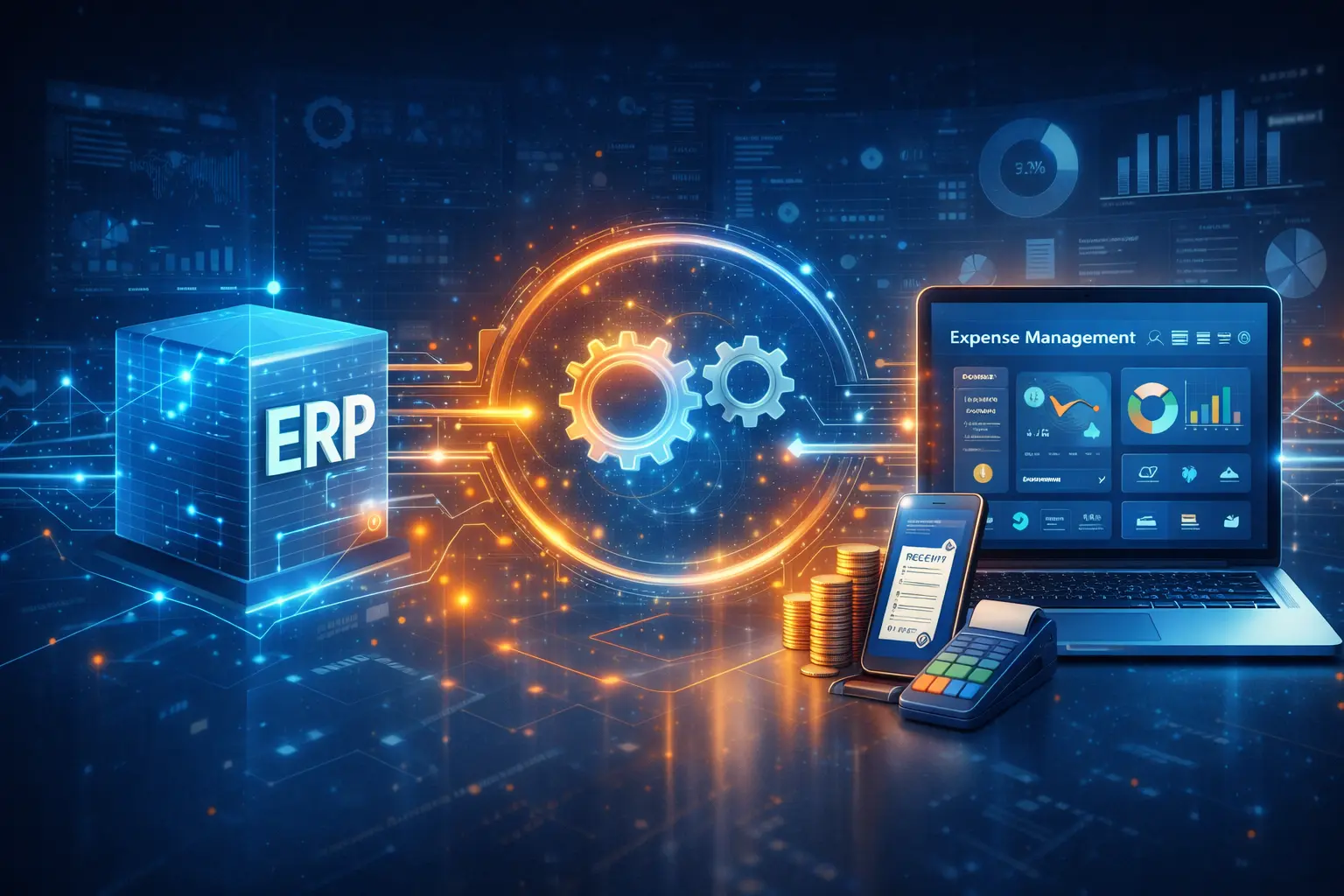
ERP and expense management software integration showing centralized business data and streamlined expense workflows

What Does an ERP System Do?

An ERP (Enterprise Resource Planning) system centralises core business functions such as:

  • Accounting and finance
  • Procurement and vendor management
  • Inventory and operations
  • Payroll and compliance
  • Reporting and analytics

ERP systems act as the single source of truth for business data.

What Is Expense Management Software?

Expense management software focuses specifically on:

  • Employee expense submission
  • Receipt capture and categorisation
  • Policy enforcement
  • Approval workflows
  • Reimbursements and accounting entries

While powerful, expense tools alone do not provide complete financial context without ERP integration.

The Problem with Standalone Expense Tools

When expense management systems are not integrated with ERP:

  • Finance teams manually re-enter data
  • Reports are delayed or inaccurate
  • Budget tracking becomes reactive
  • Policy violations go unnoticed
  • Audits become painful

Integration bridges this gap, transforming expense data into strategic financial insight.

Read More : Best Practices for Automating Elevator Project Planning & Material Management

Why ERP Integration with Expense Management Is No Longer Optional

1. Real-Time Financial Visibility Across the Organisation

One of the biggest advantages of integrating expense management with ERP is real-time visibility into spending.

Without integration:

  • Expense data reaches ERP days or weeks later
  • Leadership views outdated financial reports
  • Budget overruns are discovered too late

With ERPbyNet integration:

  • Approved expenses flow instantly into ERP
  • Department-wise and project-wise spending is visible in real time
  • Finance teams can proactively manage cash flow

This level of visibility enables smarter decisions, tighter controls, and faster responses to financial risks.

2. Elimination of Manual Data Entry and Errors

Manual data entry is one of the biggest sources of inefficiency in finance operations.

Disconnected systems force finance teams to:

  • Re-enter expense data into ERP
  • Match receipts manually
  • Fix duplicate or incorrect entries

This not only consumes time but also introduces errors that compromise reporting accuracy.

With ERPbyNet’s integrated approach:

  • Expense data syncs automatically
  • GL codes, tax rules, and cost centers are applied correctly
  • Errors caused by duplication or omission are eliminated

The result is clean, reliable financial data that finance teams can trust.

3. Stronger Policy Compliance and Spend Control

Policy enforcement becomes extremely difficult when expense systems operate independently from ERP.

Common challenges include:

  • Employees submitting out-of-policy expenses
  • Managers approving expenses without visibility into budgets
  • Finance discovering violations only during audits

ERPbyNet enables rule-based policy enforcement through integration:

  • Expense limits are defined centrally
  • Out-of-policy expenses are flagged automatically
  • Approval workflows align with company hierarchy and budgets

This ensures compliance is enforced at the point of spend—not after the money is gone.

4. Faster Approvals and Employee Reimbursements

Delayed reimbursements frustrate employees and damage trust in finance processes.

Without integration:

  • Approvals move slowly
  • Finance waits for data reconciliation
  • Reimbursements are delayed

ERP-integrated expense management with ERPbyNet enables:

  • Automated approval workflows
  • Faster validation of expenses
  • Seamless posting into accounting

Employees get reimbursed faster, while finance teams operate more efficiently—creating a better experience for everyone involved.

5. Improved Budgeting and Forecasting Accuracy

Accurate budgeting depends on complete and current data.

Disconnected expense systems cause:

  • Gaps in actual vs planned spend
  • Inaccurate forecasts
  • Reactive financial planning

ERPbyNet’s integrated expense management ensures:

  • Expenses update budgets in real time
  • Forecasts reflect actual spending patterns
  • Finance teams can adjust plans proactively

This improves both short-term cash flow management and long-term strategic planning.

6. Enhanced Audit Readiness and Transparency

Audits are often stressful due to missing receipts, incomplete records, and inconsistent approvals.

ERP integration simplifies audits by:

  • Maintaining digital audit trails
  • Linking expenses to approvals and receipts
  • Ensuring consistent accounting treatment

With ERPbyNet:

  • Auditors can trace expenses from submission to posting
  • Compliance documentation is always available
  • Audit preparation time is drastically reduced

Transparency becomes a built-in feature—not an afterthought.

7. Reduced Risk of Fraud and Financial Leakage

Fraud and duplicate claims are common risks in manual or disconnected expense processes.

ERP-integrated systems help:

  • Detect duplicate or suspicious claims
  • Flag unusually high expenses
  • Prevent unauthorised reimbursements

ERPbyNet strengthens internal controls by embedding expense governance directly into the ERP ecosystem, reducing financial leakage and protecting the organisation.

Challenges Businesses Face Without ERP–Expense Integration

Organisations that delay integration often experience:

  • Fragmented financial data
  • Slow month-end closures
  • Limited spend visibility
  • Increased compliance risk
  • Overworked finance teams

These issues compound as the business grows, making integration not just beneficial—but unavoidable.

Read More : Why an ERP Upgrade May Cost More Than an ERP Replacement

ERPbyNet’s Approach to Expense Management Integration

ERPbyNet expense management integration with real-time data sync, configurable approvals, and centralized financial control

At ERPbyNet, we don’t believe in forcing businesses to adapt to rigid systems. Our approach is built around flexibility, scalability, and real-world usability.

1. Seamless Data Synchronisation

ERPbyNet ensures:

  • Real-time syncing of expense data
  • Accurate mapping to GL accounts and cost centers
  • Consistent tax and compliance handling

2. Configurable Approval Workflows

Businesses can:

  • Define approval hierarchies
  • Set department-specific rules
  • Automate routing based on spend limits

3. Centralised Financial Control

All expense data flows into ERPbyNet’s central financial engine, giving leadership:

  • Unified reporting
  • Real-time dashboards
  • Actionable insights

4. SME-Friendly, Scalable Design

ERPbyNet is designed for growing businesses:

  • Simple to implement
  • Easy to use
  • Scales with organisational complexity

Read More : 5 Signs Your Business Needs Manufacturing ERP Software

Who Benefits Most from ERP-Integrated Expense Management

Business Type Challenges Without ERP-Expense Integration Benefits of ERP-Integrated Expense Management
Growing SMEs Growing SMEs often face limited finance team capacity, rely on manual expense tracking, and lack early visibility into spending patterns. With ERP-integrated expense management, these businesses can efficiently control costs without increasing finance staff, automate expense approvals and accounting postings, and gain real-time visibility that prevents inefficiencies from scaling.
Mid-Sized Enterprises Mid-sized enterprises struggle with managing expenses across multiple departments and locations, inconsistent expense policies, and complex audit requirements. ERP integration centralises expense data across teams and locations, enforces consistent approval workflows and company policies, and enhances audit readiness and overall governance.
Enterprises Large enterprises face the challenge of complex multi-region operations, varying regional expense policies, and a higher risk of financial leakage. ERP-integrated expense management standardises expense policies globally, strengthens internal controls and compliance, and consolidates reporting to deliver actionable real-time insights for strategic decision-making.

Key Insight

ERP-integrated expense management scales with your business. SMEs gain control and early financial visibility, mid-sized enterprises achieve governance and efficiency, and large enterprises benefit from global standardisation, compliance, and actionable insights.

Best Practices for Successful ERP–Expense Integration

To maximise value, businesses should:

  1. Clearly define expense policies
  2. Align approval workflows with organisational structure
  3. Ensure accurate master data mapping
  4. Train employees and finance teams
  5. Continuously monitor and optimise processes

ERPbyNet supports these best practices through configurable modules and ongoing support.

The Strategic Impact of ERP-Integrated Expense Management

When expense management is fully integrated with ERP:

  • Finance shifts from data entry to analysis
  • Leadership gains real-time financial insight
  • Employees experience faster, smoother processes
  • Businesses operate with confidence and control

This transformation directly impacts profitability, scalability, and decision-making quality.

Turning Expense Management into a Strategic Advantage

Expense management is no longer just an administrative task. In modern businesses, it plays a critical role in financial governance, compliance, and growth strategy.

By integrating expense management software with ERP, organisations eliminate inefficiencies, reduce risk, and gain real-time visibility into spending.

ERPbyNet enables this integration seamlessly—helping businesses move from reactive expense tracking to proactive financial control.

If your organisation is still managing expenses outside your ERP, now is the time to rethink your approach. The right integration doesn’t just save time—it unlocks smarter, more resilient growth.

Ready to simplify expense management and gain complete financial visibility? Discover how ERPbyNet can help your business integrate, automate, and scale with confidence.

Frequently Asked Questions (FAQs)

1. What does ERP integration with expense management software mean?

ERP integration with expense management software means connecting your expense tracking system directly with your ERP platform so that expense data flows automatically into core financial modules like accounting, budgeting, and reporting. With ERPbyNet, this integration ensures expense entries are accurate, policy-compliant, and instantly reflected in real-time financial reports—without manual intervention.

2. Why is ERP integration important for managing business expenses?

ERP integration is important because it eliminates manual data entry, reduces errors, improves compliance, and provides real-time visibility into company spending. Without integration, expense data often remains fragmented, delaying insights and increasing financial risk. ERPbyNet enables businesses to maintain complete financial control by centralising expense data within the ERP system.

3. How does ERPbyNet help improve expense policy compliance?

ERPbyNet enforces expense policies through configurable rules and approval workflows. Expenses that exceed limits or violate company policies are automatically flagged before approval. This proactive control helps organisations prevent overspending, reduce policy violations, and maintain consistent governance across departments and locations.

4. Can ERP-integrated expense management scale with growing businesses?

Yes. ERP-integrated expense management is especially valuable for growing businesses. As transaction volumes and teams expand, manual processes become inefficient and risky. ERPbyNet is designed to scale smoothly—supporting multi-department, multi-location, and increasing expense volumes without adding complexity to finance operations.

5. How does ERP integration simplify audits and financial reporting?

When expense management is integrated with ERP, all expense records, approvals, and receipts are stored centrally with a clear audit trail. ERPbyNet makes audits faster and more transparent by allowing auditors and finance teams to trace every expense from submission to accounting entry, reducing compliance effort and audit risk.


CategoriesERP (Enterprise Resource Planning)

Why Automation in project Software Is Changing the Game for Businesses Everywhere

Running a business without the right systems is like trying to conduct an orchestra where every musician follows a different sheet of music. Work gets done, yes — but it’s messy, exhausting, and far from harmonious. Field teams chase instructions over calls and messages, managers rely on delayed updates, and leadership struggles to see the full picture. Over time, inefficiency quietly becomes “normal.”

In a business environment where speed, accuracy, and customer experience define success, fragmented operations are no longer just inconvenient — they’re expensive. Companies today need streamlined processes, centralized information, and smarter decision-making to stay competitive. The margin for error has shrunk, while customer expectations continue to rise.

This is where Enterprise Resource Planning (ERP) transforms from a backend system into a strategic advantage. More importantly, when ERP powers field service automation, it removes chaos from day-to-day operations. At ERPbyNet, we help businesses bridge the gap between complexity and clarity — turning scattered field activities into a single, intelligent operational engine.

From Clipboards to Cloud: How Field Service Work Has Evolved

Field service operations were never meant to be simple. Coordinating people who work outside the office — technicians, inspectors, service agents — has always been a logistical challenge.

Traditionally, field operations relied on:

  • Paper job cards
  • Manual scheduling boards
  • Phone-based coordination
  • End-of-day reporting
  • Spreadsheet-based tracking

For small teams, this worked — barely. But as businesses expanded across regions, clients, and service lines, the cracks widened.

This evolution mirrors the journey of ERP itself.

A Brief Look at ERP’s Origins

ERP began decades ago as basic material planning and accounting software. Over time, it absorbed inventory management, HR automation, procurement, compliance, and analytics. Today, ERP platforms act as the central nervous system of modern organizations.

When field service workflows are plugged into ERP, something powerful happens:

  • Data silos disappear
  • Decisions become data-driven
  • Operations become predictable

Field service automation isn’t a separate tool — it’s ERP reaching the frontline.

What Is Automation in Field Service Software?

Field service automation refers to the use of ERP-powered automation technology to plan, execute, track, and analyze all activities performed by field teams.

This includes:

  • Job scheduling and dispatch
  • Real-time technician tracking
  • Mobile work order updates
  • Inventory usage logging
  • Customer confirmations
  • Automated billing and payroll triggers

Instead of relying on memory, manual reporting, or delayed communication, automation ensures every action updates the system instantly.

Think of it as replacing guesswork with clarity.

The Hidden Costs of Manual Field Operations

Many businesses don’t realize how much manual field operations are costing them — because the losses are spread across departments.

1. Data Silos That Kill Visibility

When field teams operate outside ERP systems, data gets trapped:

  • Finance doesn’t see completed jobs
  • Inventory teams don’t know what was consumed
  • Managers don’t have real-time status
  • Leadership sees outdated reports

Decisions based on partial data are risky — and often wrong.

2. Payroll and Billing Bottlenecks

Late job reports lead to:

  • Delayed payroll cycles
  • Incorrect invoices
  • Revenue leakage
  • Employee dissatisfaction

One missed service report can ripple across finance and HR.

3. Multi-Branch Chaos

For businesses operating across cities or regions, manual coordination creates inconsistency:

  • Different processes per branch
  • No unified KPIs
  • Uneven service quality

Growth magnifies disorder when systems don’t scale.

4. Compliance and Audit Risks

Manual documentation increases the risk of:

  • Missing service records
  • Inaccurate logs
  • Regulatory non-compliance
  • Failed audits

Automation doesn’t just improve efficiency — it protects the business.

Read More : How ERP Helps You Stay Ahead of Competitors With Faster Decisions

How ERP-Powered Automation Fixes Field Service Operations

Automation delivers real impact only when it’s centralized, connected, and intelligent — and that’s exactly what ERP platforms are designed to do. Instead of fixing one problem at a time, ERP-powered automation brings every moving part of field service operations into a single, synchronized system. The result is fewer gaps, faster decisions, and smoother execution across the board.

Centralized Scheduling and Smart Dispatch

At the heart of field service efficiency lies scheduling — and manual scheduling is where things most often break down. ERP-powered automation replaces guesswork with logic.

With ERP automation, tasks are assigned based on:

  • Technician availability, ensuring workloads are balanced and realistic
  • Skill matching, so the right expert is sent the first time
  • Location proximity, reducing travel time and fuel costs
  • Priority levels and SLAs, so urgent jobs are handled without disruption

This intelligent dispatching eliminates double bookings, reduces technician idle time, and significantly improves response speed. Instead of reacting to problems, businesses stay one step ahead of them.

Real-Time Field Visibility

One of the biggest challenges in field operations is not knowing what’s happening — until it’s too late. ERP solves this by turning field activity into real-time insight.

With mobile-enabled ERP dashboards:

  • Technicians update job status instantly from the field
  • Managers track progress live without chasing calls or messages
  • Customers receive accurate ETAs, improving transparency and trust
  • Leadership sees performance trends across teams, regions, and timelines

There’s no need to wait for end-of-day reports or manually compiled updates. Every action taken in the field becomes visible the moment it happens — creating accountability, clarity, and confidence at every level.

Inventory Management Automation in the Field

Inventory issues are often the silent killers of field service efficiency. Missing parts, incorrect stock records, and delayed reorders can stall jobs and frustrate customers.

When field service workflows are connected directly to inventory management automation:

  • Parts usage updates automatically as soon as a job is completed
  • Stock levels adjust in real time, eliminating manual reconciliation
  • Reordering triggers intelligently, preventing both shortages and overstocking

This tight integration ensures technicians always have what they need, finance teams maintain accurate records, and operations run without avoidable interruptions.

Learn more through ERPbyNet’s inventory management automation solutions and see how field operations and inventory finally work in sync.

Use-Case Storytelling: Real Problems, Real Impact

Use Case 1: Payroll Delays That Hurt Morale

A service company with 50 technicians processed payroll manually. Every month:

  • Job completion data arrived late
  • Managers corrected errors
  • Payroll took 8–10 days

After ERP-driven automation:

  • Job completion synced instantly
  • Payroll data auto-updated
  • Processing time dropped to 2 days

Employee trust improved — and HR stress vanished.

Use Case 2: Scaling Across Multiple Locations

A growing SME expanded into four cities. Suddenly:

  • Managers lost visibility
  • Reporting formats varied
  • Service quality fluctuated

ERP dashboards centralized:

  • Job completion metrics
  • Technician productivity
  • Branch-level KPIs

Growth became controlled, not chaotic.

ERP Platforms vs Standalone Field Tools

Many businesses try to fix field challenges using isolated apps. While helpful short-term, they create long-term problems.

Standalone Tools:

  • Operate in silos
  • Require manual data syncing
  • Don’t integrate finance or HR
  • Increase system complexity

ERP Platforms:

  • Centralize all operations
  • Connect accounting modules
  • Enable HR automation
  • Provide unified dashboards

Industry leaders like SAP, Oracle, NetSuite, and Zoho ERP prove that ERP-centric automation scales best — but SMEs need solutions designed for their reality.

ERPbyNet focuses on custom ERP solutions that grow with your business, not against it.

ROI and Adoption Trends: Why Businesses Are Moving Fast

Automation is no longer experimental — it’s measurable.

According to Statista, companies adopting operational automation report productivity improvements of 20–30% within the first year.

Meanwhile, Gartner highlights ERP-driven automation as a top priority for organizations aiming to reduce operational risk and improve decision accuracy.

The message is clear: automation delivers ROI — fast.

Read More : Best Practices for Automating Elevator Project Planning & Material Management

ERPbyNet’s Approach to Field Service Automation

At ERPbyNet, we don’t believe that every business should bend itself to fit rigid software. Field service operations are too dynamic — and businesses grow too differently — for one-size-fits-all systems to work in the real world.

That’s why our approach to field service automation is built around flexibility, scalability, and practicality.

We focus on:

  • SME-first ERP tools designed specifically for growing businesses, not overengineered enterprise systems that add complexity instead of clarity
  • Modular implementation, so you adopt only what you need today — and expand effortlessly as your operations grow
  • Scalable automation that supports both small teams and large, multi-location field forces without performance bottlenecks
  • Role-based permissions that ensure every user sees exactly what they need — nothing more, nothing less
  • API-driven integrations that connect seamlessly with your existing accounting, CRM, and third-party tools

Whether you’re managing 10 technicians or 200, ERPbyNet ensures your ERP adapts to your workflows, your growth pace, and your business reality — not the other way around.

Explore our ERP implementation service to see how field service automation can be tailored to your operations, not forced upon them.

Automation Is About Trust, Not Just Speed

Automation is often talked about in terms of speed and efficiency — but its real power lies in trust.

When automation is implemented the right way:

  • Employees trust payroll accuracy, because completed work is captured instantly and correctly
  • Customers trust service commitments, because schedules, updates, and timelines are reliable
  • Managers trust dashboards, because data is real-time, centralized, and consistent
  • Leaders trust forecasts, because decisions are backed by clean, connected operational data

When systems work quietly and reliably in the background, teams stop firefighting. Instead of chasing updates or fixing errors, they focus on improving service quality, scaling operations, and driving sustainable growth.

Read More : Why an ERP Upgrade May Cost More Than an ERP Replacement

The Future of Field Service Automation

Field service automation is only getting smarter — and ERP systems are at the center of this evolution.

What’s coming next:

  • AI-powered scheduling that dynamically assigns jobs based on urgency, skills, and availability
  • Predictive maintenance that identifies potential failures before they disrupt operations
  • Low-code workflow customization that allows businesses to adapt processes without heavy development
  • Built-in compliance readiness that simplifies audits and regulatory reporting

As these capabilities mature, ERP systems will increasingly act as decision engines, not just record keepers.

Businesses that adopt ERP-driven field service automation early won’t just improve efficiency — they’ll build operations that are resilient, intelligent, and ready for whatever comes next.

Build Smarter Field Operations That Scale With You

Automation in field service software is no longer a “nice-to-have” or a future consideration — it has become the backbone of modern, high-performing businesses. As customer expectations rise and operations become more complex, relying on manual coordination or disconnected tools only limits growth. True scalability, resilience, and profitability come from systems that work together seamlessly and intelligently.

This is where ERP-driven automation makes the difference. By centralizing field operations, finance, inventory, and people management, businesses gain real-time visibility, operational control, and the confidence to make faster, smarter decisions. The result isn’t just efficiency — it’s consistency, accountability, and a foundation that supports long-term growth.

At ERPbyNet, we help businesses move beyond operational chaos with custom-fit ERP solutions designed around how you actually work. Our platforms grow with you, adapt to your processes, and simplify complexity at every stage of your journey.

Ready to take control of your field operations and scale with clarity?
Explore our ERP implementation service and let’s transform your workflow into a system that works as hard as you do.

FAQs

Still have questions about ERP and how it fits your business? Let’s clear them up.

What is field service automation in ERP?

It connects field activities directly to ERP systems, enabling real-time updates, automated billing, and centralized visibility.

Is ERP suitable for SMEs?

Absolutely. ERPbyNet designs ERP platforms specifically for growing businesses, not just enterprises.

How does ERP improve technician productivity?

By reducing manual reporting, optimizing scheduling, and providing real-time access to job details.

Can ERP integrate with existing software?

Yes. ERP systems use APIs to integrate accounting, CRM, and third-party tools.

How long does ERP implementation take?

ERPbyNet uses phased rollouts to ensure faster adoption with minimal disruption.

What’s the biggest benefit of field service automation?

Complete operational visibility — from job assignment to billing — in one centralized system.


CategoriesERP (Enterprise Resource Planning)

How ERP Helps You Stay Ahead of Competitors With Faster Decisions

In a rapidly evolving business landscape, speed matters — not just in execution, but in decision-making. Companies that can digest data quickly, respond to market changes, and align internal processes in real time typically outpace their peers. This is where a robust Enterprise Resource Planning (ERP) platform becomes more than just software — it becomes a strategic advantage.

At ERPbyNet, we believe modern businesses — especially in project-driven, engineering, manufacturing, and services sectors — need more than fragmented tools: they need a unified system that empowers fast, data-driven decisions across every function.

In this blog, we unpack how ERP helps your organization stay ahead of competitors through faster decisions — and why ERPbyNet is uniquely positioned to deliver this advantage.

What is ERP — and why “faster decision-making” matters

ERP system enabling faster decision-making with real-time data visibility across finance, inventory, and operations — ERPbyNet

The essence of ERP

Enterprise Resource Planning (ERP) refers to a suite of integrated applications that manage a company’s core business processes — finance, inventory, procurement, manufacturing or services operations, HR, sales, and more — all unified under a single data model. 

Rather than using disparate systems for each department — spreadsheets for finance, separate tools for inventory, manual logs for production planning, etc. — ERP consolidates everything into one platform. This means all data flows into a single source of truth. This consolidation unlocks key advantages: cross-department visibility, real-time data access, and automated workflows — all essential for businesses that need to respond quickly to internal changes or market shifts.

Why speed of decisions is a competitive differentiator

In traditional setups, making critical decisions often involves data gathering from multiple silos — sales data here, inventory status there, pending orders somewhere else. Compiling that data manually is time-consuming and error-prone. By the time you have the report, the business context may have changed.

But in fast-moving industries — manufacturing, project-based services, engineering — delays can cost you: delayed shipments, stock-outs, inefficient resource allocation, cost overruns, lost opportunities.

With ERP-driven real-time visibility and analytics, you can:

  • Spot bottlenecks or capacity constraints before they become critical 
  • Forecast demand or cash flow and proactively plan resource allocation or procurement 
  • React quickly to new orders or changing priorities without waiting for manual reports

In other words: faster, data-driven decisions = better agility & competitiveness.

What ERPbyNet offers — built for fast, informed decision-making

Before diving deeper into ERP benefits, it helps to understand why ERPbyNet is particularly suited for businesses that need speed, accuracy, and flexibility.

  • Specialization for project- & engineering-driven businesses — ERPbyNet isn’t a generic ERP. It’s designed with contract engineering, project-based, and service-management industries in mind. This focus means features are tailored to real-world challenges faced by such businesses: dynamic scheduling, multiple stakeholders, complex procurement, site-based operations, etc. 
  • Integrated across all processes — From engineering, procurement, inventory to installation planning, dispatch, finance and project-level tracking — ERPbyNet links all critical functions. 
  • Better long-term cost efficiency than generic ERP solutions — While generic ERPs may sometimes appear cheaper up front, ERPbyNet offers long-term value, especially for specialized operations where generic packages would require heavy customization. 
  • Real-time control, transparency & unified data model — ERPbyNet ensures you have up-to-date, accurate data across teams and functions, facilitating faster, well-informed decisions.

In short: ERPbyNet is built not just for process automation — but for agility, foresight, and competitive edge.

7 Ways ERP Empowers Faster, Smarter Decision-Making

How ERPbyNet improves decision-making speed through real-time data, automation, forecasting, visibility, collaboration, financial insights, and scalability.

Here’s a detailed breakdown of how ERP (and ERPbyNet in particular) helps organizations speed up decision-making and stay competitive.

1. Unified, Real-Time Data — One Platform, Many Insights

Because ERP centralizes data from finance, operations, inventory, procurement, projects and more — you no longer need to compile fragmented data sources manually. 

This unified view gives leadership and managers a single source of truth. Whether you want to check current inventory levels, project progress, cash flow status, or pending purchase orders — it’s all accessible immediately.

Real-time data eliminates delays. Decisions based on stale or partial data — which often lead to overstocking, stockouts, or resource misallocation — become a thing of the past.

2. Automated Processes & Reduced Manual Overhead

Modern ERP automates repetitive, manual tasks: procurement cycles, stock reordering, invoice generation, financial consolidation, project cost tracking, etc.

By reducing manual work, ERP frees up your team to focus on strategic tasks — resource planning, project bidding, market response, customer service, etc. You’re not busy reconciling spreadsheets — you’re making moves.

This speed translates directly to competitiveness: faster procurement, quicker invoice cycles, immediate project updates.

3. Better Forecasting & Planning = Proactive Decisions

With historical data, real-time updates, and integrated modules (sales, inventory, finance, procurement), ERP systems enable accurate demand forecasting, resource planning, and budgeting. 

For example — if your sales orders spike, ERPbyNet can alert you about upcoming resource constraints (inventory shortfall, manpower shortage) before they derail delivery. This lets you respond proactively: reorder materials, reallocate workforce, or reschedule tasks.

In short: you stop reacting to events — you plan ahead.

4. End-to-End Visibility — From Order to Delivery to Payment

ERP connects all stages: order entry → procurement → production/engineering → dispatch/installation → billing → payment → feedback — ensuring complete traceability. 

This end-to-end visibility helps identify bottlenecks (procurement delays, material shortages, project overshoot), track project profitability, and ensures nothing falls through cracks. Decision-makers get a clear view of what’s going on across departments — enabling quick corrective or strategic actions.

5. Cross-Department Collaboration & Communication

With data and workflows unified, different teams (sales, operations, procurement, finance, projects) don’t work in silos anymore. ERP ensures everyone is on the same page — the same underlying data, updates, priorities. 

This collaboration helps speed up decision cycles. For example: sales may get a large order — procurement can instantly check stock or lead times, operations can assess capacity, finance can project cash flow — all in real time. This collaborative agility helps you seize opportunities faster than competitors stuck in fragmented systems.

6. Financial Transparency & Risk Management

ERP gives clear visibility into finances: costs, margins, cash flow, pending payments, project-level profitability — all in real time. 

When you know your real-time financial health, you can make informed decisions — whether to bid on a new project, defer expenses, hire additional manpower, or adjust pricing.

Moreover, ERP helps standardize controls, ensuring compliance and reducing risks — especially relevant if you’re in regulated industries or manage large supply chains. 

7. Scalability & Flexibility — Grow Without Losing Control

As your business scales — more projects, employees, locations — a modular ERP system like ERPbyNet can grow with you.

Because the system integrates different functions, you can add modules (e.g. procurement, project management, inventory, finance) as you grow — without disrupting existing workflows. This scalability helps maintain agility even as complexity increases, allowing faster decisions even in a larger organization.

Why Many Competitors Fail Without ERP — And How ERPbyNet Bridges That Gap

Running a business without ERP (or with fragmented tools) might seem manageable — until things scale. Common pitfalls:

  • Multiple data silos — finance uses spreadsheets, procurement uses separate logs, inventory runs on manual tracking. Result: inconsistent data, delays, errors. 
  • Slow, manual decision cycles — collating data from different departments, waiting for updates, manual reconciliation → decisions come too late. 
  • Resource misallocation — overstocking inventory, wrong manpower assignment, cash-flow bottlenecks — because data is incomplete or outdated. 
  • Poor visibility into project or cost-level profitability — no clear way to know which projects are profitable, where costs are bleeding. 
  • Inflexibility during scaling — processes break down when operations expand, adding employees, products, or locations. 

ERPbyNet addresses these challenges directly:

  • By centralizing all data, it eliminates silos. 
  • By offering real-time updates and automated workflows, it ensures decision-makers always have current, accurate information. 
  • By being industry-specialist (engineering, projects, services) rather than generic, it fits real business needs with minimal customization — reducing cost and complexity. 
  • By providing scalable modules, it supports growth without compromising agility.
    In short: ERPbyNet helps turn business complexity into strategic strength — enabling faster, smarter management and competitive advantage.

Read More : Best Practices for Automating Elevator Project Planning & Material Management

When Implementing ERP — Best Practices to Maximize Decision-Speed Gains

ERP itself is powerful — but to truly derive the “faster decision-making” advantage, you must implement it thoughtfully. Here are best practices you should follow (and which ERPbyNet supports well):

1. Define Clear Objectives & Use Cases

Before diving in, map out what you need ERP to solve: is it project tracking, inventory issues, procurement delays, financial reporting, resource allocation? Clear goals help you pick modules and shape workflows — ensuring ERP serves your business, not the other way around.

2. Involve Stakeholders from Day One

ERP affects departments across the org: finance, operations, procurement, projects, HR. Involve all relevant stakeholders at the start — so everyone’s needs are captured, adoption improves, and resistance is minimized.

3. Clean Up & Standardize Data

Since ERP works on shared data, consistency and accuracy matter. Clean up your legacy data, standardize product codes, item names, project codes, cost centers — to avoid “garbage in, garbage out.”

4. Modular & Phased Implementation

Don’t try to go “all modules at once.” Begin with critical modules (say, project + inventory + procurement + finance), stabilize them, then expand. ERPbyNet’s modular architecture supports this phased growth — reducing risks, smoothing transition, and delivering value early.

5. Train Users & Build Governance

Users need training; processes need documentation; responsibilities must be defined (who updates what, who approves what). Without governance, data accuracy and speed of decisions suffer.

6. Monitor & Iterate — Use Analytics & KPIs

Once ERP is live, track key KPIs: project completion times, procurement turnaround, cash flow cycles, inventory turnover, cost variances. Use these metrics to fine-tune processes and optimize decision-making.

Read More : How ERP Software Companies in India Are Shaping the Future of the Engineering Industry

Real-World Impact: What Faster Decisions Look Like With ERPbyNet

To bring this into context, here are scenarios — common in engineering, manufacturing or services firms — where ERPbyNet’s decision-speed advantage shines:

Scenario 1: Urgent Client Order — Fast Procurement & Execution

A client gives a last-minute order, demanding quick turnaround. With ERPbyNet:

  • Sales enters the order → system checks inventory and stock status 
  • Procurement module flags low stock for required raw materials / components 
  • Purchase order is generated automatically, vendor lead times are available, approvals flow fast 
  • Project scheduling module reallocates workforce / machines 
  • Delivery date is updated — and finance can forecast payment and cash-flow

Outcome: What would take days of cross-communication, emails and excel sheets — now happens in hours. Faster response wins the client and delivers on time.

Scenario 2: Forecasted Demand Spike — Proactive Resource Planning

Sales data indicates an upcoming surge in orders (e.g. big project win or seasonal demand). ERPbyNet allows management to:

  • Forecast resource needs (inventory, manpower, cash flow) 
  • Pre-order materials, allocate workforce, plan schedules 
  • Ensure no stockouts or overbooking — avoiding delays or overcommitment

This proactive planning — enabled by a unified system — gives a business agility that competitors operating on silos cannot match.

Scenario 3: Real-Time Cost & Profitability Tracking — Better Bidding & Strategy

For project-based businesses, knowing project-level costs and margins is crucial. With ERPbyNet:

  • Costs (materials, labor, overhead) are tracked in real time 
  • Variances are visible immediately — if a project is bleeding costs, you spot it early 
  • Future bids can be made based on accurate historical cost + performance data — leading to more competitive, yet profitable, proposals 

This level of insight and speed empowers strategic decisions — whether to bid, price, or resource — faster and more confidently than traditional approaches.

Read More: Why an ERP Upgrade May Cost More Than an ERP Replacement

Why Businesses Risk Falling Behind Without ERP — The Hidden Cost of Slow Decisions

Many companies (especially small and mid-size) rely on spreadsheets, disparate tools, and manual coordination. While this may work in early stages, as complexity increases the cost of “slow decisions” rises:

  • Delays in procurement or execution → missed deadlines, unhappy clients 
  • Over or under-stocking inventory → tied-up working capital or production holdups 
  • Lack of real-time visibility → delayed detection of issues, cost overruns, inefficiencies 
  • Poor forecast and planning → reactive decisions, higher risk, lower competitiveness

Competitors leveraging ERP (or modern management systems) get ahead by seeing problems before they escalate and reacting faster. In a dynamic market — speed can be the difference between growth and stagnation.

With ERPbyNet, your business doesn’t just keep pace — it stays ahead.

Take the Lead — Choose ERPbyNet for Faster, Smarter Decisions

In today’s high-speed business world, your ability to make quick, confident decisions determines whether you lead the market or fall behind. If you’re still relying on spreadsheets, disconnected tools, and manual reporting, you’re already operating slower than your competitors.

ERP is no longer optional — it’s the backbone of agile, data-driven organizations. And you don’t need just any ERP system — you need a platform built for your industry, your workflows, and your growth goals. That’s exactly what ERPbyNet delivers.

With ERPbyNet, you gain the power to:

  • View real-time insights across finance, operations, inventory, procurement, and projects
  • Make instant, informed decisions that drive revenue and performance
  • Scale without complexity or losing control
  • Respond faster to customers, market shifts, and operational challenges

While others wait for manual reports and approvals, you’ll already be executing the next move. ERPbyNet turns decision-speed into a competitive weapon.

Ready to outperform your competitors?

Move from spreadsheets to strategic speed — Book a Demo with ERPbyNet today.

FAQs

1. How does an ERP help in faster decision-making?

ERP centralizes real-time data from all departments, removing manual reporting delays and enabling quick, accurate decisions.

2. Why is fast decision-making important for competitive advantage?

Faster decisions help businesses respond quickly to customer needs, avoid delays, reduce costs, and seize opportunities before competitors.

3. What kinds of decisions improve with ERP?

ERP supports daily operational choices, tactical planning, and strategic forecasting — covering finance, inventory, projects, procurement, and resource allocation.

4. How does ERP improve team collaboration?

ERP eliminates data silos and ensures everyone works on the same updated information, speeding up coordination and approvals.

5. Why choose ERPbyNet instead of generic ERP systems?

ERPbyNet is industry-focused, easy to implement, offers real-time visibility, and scales with your business — enabling faster decisions with lower cost and complexity.

Name
Verified by MonsterInsights