CategoriesERP (Enterprise Resource Planning)

The Evolution of ERP — From Manual Processes to Machine Intelligence

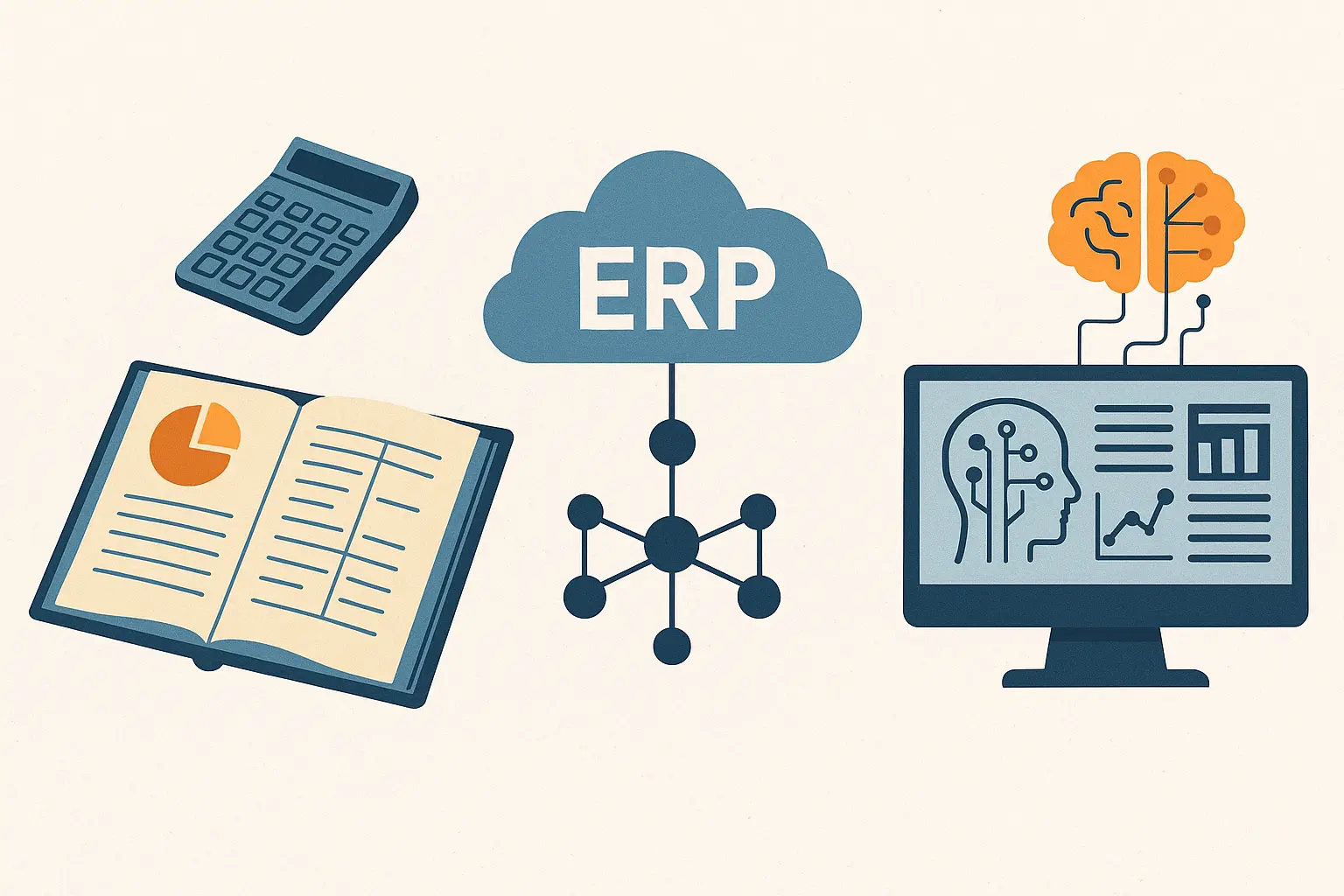
Enterprise Resource Planning (ERP) has transformed the very DNA of how organizations function. What began as simple systems for bookkeeping and record management has now evolved into intelligent ecosystems that analyze, predict, and optimize operations.

The transition from paper files and manual ledgers to AI-powered, cloud-driven ERP platforms marks one of the most significant revolutions in business technology. Today’s ERP is not just about automation—it’s about insight, intelligence, and integration.

ERPbyNet stands at the center of this evolution, offering a platform that embodies decades of technological progress while preparing businesses for the future of intelligent enterprise management.

The Manual Era — Before ERP Was Born

Long before technology entered the boardroom, businesses were driven by human effort and paper trails. Every function operated separately, with minimal coordination and maximum redundancy.

How Operations Worked Then:

  • Accounting relied on physical ledgers and handwritten records.
  • Procurement handled documentation through printed purchase orders.
  • HR maintained attendance and payroll manually.
  • Inventory tracking was done with physical stock counts and registers.

Each department had its own version of truth. Data had to be copied multiple times, making processes slow and error-prone. Reports were delayed, decisions were reactive, and efficiency was limited by human capacity.

The lack of integration was the biggest challenge. As organizations grew, this fragmentation caused delays in decision-making and inconsistencies across departments. Businesses needed a system that could connect these isolated functions—and that need became the foundation for ERP’s earliest form.

The Foundation Years — The Birth of MRP

The first major breakthrough came in the 1960s with Material Requirements Planning (MRP). Designed for manufacturing industries, MRP answered one vital question: What materials are needed, and when?

It revolutionized production planning and inventory management by automating what was once manual guesswork. Companies could now coordinate procurement with production schedules, reducing waste and ensuring smooth operations.

By the 1980s, this evolved into Manufacturing Resource Planning (MRP II)—an advanced version that integrated not only materials but also labor, equipment, and financial planning.

Key Milestones of the MRP Era:

  • Automated inventory tracking and bill of materials.
  • Linked shop-floor operations with financial data.
  • Introduced structured scheduling and forecasting.

The concept of integration began to take root. Businesses started viewing technology as the enterprise’s nervous system—linking every department through a shared flow of information.

This idea of connectivity was the seed that grew into modern ERP.

The 1990s — ERP Takes Shape

The 1990s were the decade that defined Enterprise Resource Planning as we know it. The term “ERP” was introduced by Gartner to describe a unified platform that integrated all core business functions—from finance and manufacturing to HR and procurement.

ERP became the new standard for efficiency and visibility. Instead of each department maintaining its own software or paper system, everything was centralized. Data could now move seamlessly across departments in real time.

What ERP Changed:

  • Unified database replaced fragmented information.
  • Cross-department collaboration improved significantly.
  • Real-time dashboards enhanced management decisions.

However, these early ERP systems were on-premise, meaning they required extensive infrastructure, expensive servers, and long implementation timelines. Vendors like SAP, Oracle, and Baan led the market, but only large enterprises could afford the cost and complexity.

While ERP solved integration, it created a new challenge—limited flexibility. The systems were rigid, updates required heavy IT involvement, and customization was costly. These limitations sparked the next evolution: cloud-based ERP.

Read More : The Evolution of MRP Systems: From Legacy Tools to Cloud-Based Platforms

The 2000s — The Cloud Revolution

The early 2000s ushered in a new era. The rise of the internet and cloud computing changed how businesses deployed software. ERP moved from physical servers to the cloud, giving organizations the ability to access systems anytime, anywhere.

What Cloud ERP Brought:

  • No need for costly infrastructure or complex installations.
  • Subscription-based pricing replaced heavy upfront investments.
  • Data became accessible in real time across devices and locations.

For small and medium businesses, this was a turning point. Cloud ERP leveled the playing field, allowing smaller firms to access enterprise-grade tools once reserved for global corporations.

Mobility became another defining feature. Managers could approve purchase orders, review reports, or check inventory from a phone or laptop. ERP became portable, connected, and collaborative.

ERPbyNet was born from this very revolution—offering scalable, cloud-native ERP solutions for organizations of all sizes. Its mission was simple: to make enterprise automation accessible, secure, and affordable without sacrificing customization.

The 2010s — Integration, Analytics, and Industry 4.0

As businesses entered the 2010s, ERP transformed from being a transactional system into a strategic intelligence platform. The fourth industrial revolution—Industry 4.0—further accelerated this shift, integrating IoT, automation, and data analytics.

ERP systems began interacting directly with machines, sensors, and connected devices. Real-time data from manufacturing floors, supply chains, and logistics could now be processed instantly.

Impact of Industry 4.0 on ERP:

  • Smart sensors provided real-time production visibility.
  • Predictive maintenance reduced downtime.
  • Automated alerts improved supply chain efficiency.

ERP also became more analytical. Instead of simply recording data, it began analyzing it—identifying inefficiencies, trends, and growth opportunities. Dashboards replaced reports, and decision-making became proactive rather than reactive.

User experience improved dramatically. Complex interfaces gave way to intuitive dashboards and mobile accessibility. ERPbyNet embraced this shift, designing interfaces that empowered users without technical training, promoting collaboration and real-time workflow approvals.

The Age of Artificial Intelligence — When ERP Learned to Think

The integration of Artificial Intelligence (AI) and Machine Learning (ML) redefined ERP once again. What was once a system of records became a system of intelligence.

AI-enabled ERP platforms such as ERPbyNet now analyze patterns, forecast outcomes, and automate decisions. This marks a monumental leap from managing data to understanding it.

AI in ERP Changes Everything:

  • Predictive analytics forecasts demand and sales trends.
  • Machine learning automates tasks like invoice matching and scheduling.
  • Natural language queries allow managers to “talk” to the system.

Instead of asking IT to run a report, executives can simply ask: “Show me the top five performing regions for last quarter,” and get results instantly.

ERPbyNet integrates AI throughout its workflows. From financial forecasting to production optimization, the system learns continuously, reducing manual effort and improving decision accuracy. It minimizes errors, accelerates processing, and empowers leaders to make faster, data-backed choices.

Read More : How ERP Helps Small Elevator Businesses Operate Like Big Players?

ERPbyNet — Built for the Modern Enterprise

 digital illustration showing modern enterprise using ERPbyNet cloud and AI-powered ERP platform

Modern enterprises operate in a fast-moving, data-driven world where agility and intelligence define competitiveness. ERPbyNet was built precisely for this environment — merging the scalability of cloud technology with the intelligence of AI to create a secure, flexible, and future-ready ERP ecosystem.

What Makes ERPbyNet Different

Cloud-Native Foundation
ERPbyNet’s cloud-first design ensures seamless access from anywhere, anytime. With real-time synchronization and zero server maintenance, teams stay connected and productive across geographies.

Modular and Scalable
Businesses can start small and scale easily. ERPbyNet’s modular design allows you to activate only the features you need — from finance and inventory to HR, CRM, and analytics — reducing complexity and cost.

AI-Powered Automation
Intelligent workflows automate repetitive processes like approvals, data validation, and reporting. Machine learning continuously refines accuracy, freeing teams to focus on strategy and growth.

Analytics-Driven Insights
Custom dashboards turn data into decisions. ERPbyNet delivers real-time visibility into operations, performance, and profitability — empowering faster, evidence-based decisions.

Enterprise-Grade Security
Multi-layered encryption, access controls, and compliance with global standards ensure data integrity and business continuity.

Built for Every Business

ERPbyNet delivers equal value to enterprises and SMEs alike. Large organizations gain multi-site visibility and global synchronization, while smaller firms access affordable automation without IT dependency. Its adaptability across manufacturing, retail, logistics, and services makes it one of the most versatile ERP solutions in today’s market.

The Future — From Automation to Augmentation

The next phase of ERP evolution goes beyond automation. It enters augmentation, where systems don’t just execute tasks—they assist humans in strategic thinking.

Future ERPs will become self-learning ecosystems capable of predicting changes and acting autonomously.

What’s Next in ERP Evolution:

  • AI-driven systems that recommend real-time production adjustments.
  • Integration with blockchain for secure, transparent transactions.
  • Use of digital twins to simulate and optimize processes.
  • Seamless IoT connectivity for real-time monitoring.

As ERP grows smarter, human roles will evolve too. Managers will focus less on operations and more on interpreting insights. ERPbyNet envisions a world where humans and intelligent systems collaborate, making data-driven decisions faster and more precisely than ever before.

Navigating Challenges in ERP Implementation

Even with all its potential, ERP transformation is not without challenges. Data migration, cultural resistance, and cybersecurity remain key considerations for businesses adopting new systems.

ERPbyNet addresses these challenges with thoughtful design and guided support.

How ERPbyNet Simplifies Transition:

  • Tools for seamless data migration and validation.
  • Modular rollout plans that ease user adoption.
  • Built-in encryption and role-based access for security.
  • Compliance with international standards for data protection.

The human element is equally critical. ERP implementation succeeds when people embrace it. ERPbyNet prioritizes user training and intuitive interfaces to ensure that transformation feels natural—not forced.

Read More : A Complete Guide to Elevator Maintenance Software for OEMs and Service Firms

ERP as the Intelligence Core of Modern Business

The story of ERP mirrors the story of modern enterprise itself: a journey from fragmented workflows to unified intelligence. From the days of ledgers and manual labor to AI-driven predictive analytics, ERP has become the digital brain of business operations.

ERPbyNet exemplifies this evolution. It does more than automate—it learns, adapts, and empowers. It transforms data into strategy and operations into growth.

In a world where agility defines success, ERP is no longer optional—it is essential. The shift from manual to machine intelligence represents not just technological advancement but a complete reimagining of business potential.

ERPbyNet stands at the forefront of this transformation, guiding businesses toward a future where intelligence and innovation move hand in hand. The evolution continues, and ERPbyNet ensures every enterprise is ready for what’s next.

Ready to Build the Future of Your Enterprise?

Step into a new era of business intelligence with ERPbyNet — where automation meets innovation. Whether you’re modernizing legacy systems or starting your digital transformation, ERPbyNet empowers your organization with real-time analytics, AI-driven automation, and cloud-native flexibility. Experience the difference between managing data and mastering it.
Transform your workflows, reduce operational bottlenecks, and unlock growth with one unified platform.
Take the first step today — connect with ERPbyNet and make your enterprise truly intelligent.

Frequently Asked Questions

What makes ERPbyNet different from traditional ERP systems?

ERPbyNet is built on a modern cloud infrastructure that integrates AI and analytics directly into workflows. Unlike traditional ERPs, it offers real-time insights, modular flexibility, and predictive automation — reducing manual work and improving decision-making accuracy.

Can ERPbyNet work for small and medium-sized businesses?

Yes. ERPbyNet is designed to be scalable and cost-effective. Its subscription model and modular architecture allow SMEs to implement only the features they need, ensuring affordability without compromising on performance or intelligence.

How secure is ERPbyNet’s cloud-based system?

Security is central to ERPbyNet’s architecture. The system includes encryption, role-based access control, regular audits, and compliance with international standards like GDPR, ensuring that business data remains protected across all departments.

Does ERPbyNet support integration with other tools or legacy systems?

Absolutely. ERPbyNet is built with integration flexibility in mind. It can seamlessly connect with CRMs, HR software, accounting tools, and legacy databases to maintain workflow continuity and unified data visibility.

What kind of support does ERPbyNet provide after implementation?

ERPbyNet offers comprehensive post-launch support including training, updates, system monitoring, and troubleshooting assistance. Businesses also benefit from continuous optimization and AI-driven upgrades that keep the platform future-ready.
 

CategoriesERP (Enterprise Resource Planning)

ERP Customization vs ERP Configuration: What’s Better for Your Business?

In today’s competitive digital landscape, Enterprise Resource Planning (ERP) systems have become the operational core for businesses across industries — from manufacturing and retail to logistics and service management. These systems integrate diverse processes into a unified platform, improving visibility, productivity, and decision-making. However, during implementation, organizations often encounter a crucial question: should they customize the ERP to match specific workflows, or configure it using built-in settings to align with business goals?

The debate around ERP Customization vs ERP Configuration goes beyond technology — it’s about choosing the right strategy for scalability, cost-efficiency, and long-term success. Each approach offers unique benefits and challenges that can significantly influence system performance and return on investment. In this article, ERPbyNet explores both options in depth, guiding you to determine which path best supports your organization’s operational and strategic objectives.

Understanding ERP Customization and Configuration

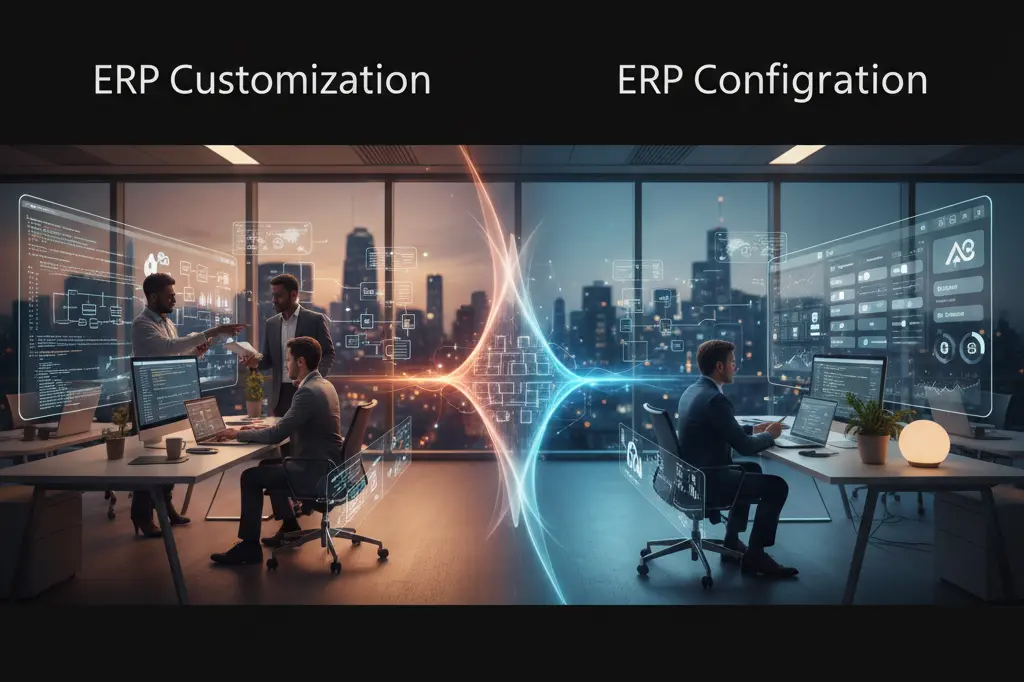
Business professionals comparing ERP customization and configuration settings on digital dashboards in a modern office environment.

Before exploring their pros and cons, it’s essential to understand the clear distinction between customization and configuration — two terms often used interchangeably but meaningfully different in the ERP landscape.

What is ERP Configuration?

ERP configuration refers to setting up the system’s built-in parameters and features to match your business processes — without altering the software’s core code. It’s about using what’s already available and adjusting it to suit your needs.

For instance, configuring an ERP might involve:

  • Defining user roles and permissions
  • Setting up tax rules, currencies, or units of measure
  • Establishing workflow approvals
  • Adjusting reporting templates
  • Defining business rules for inventory or accounting

Configuration is done through the ERP’s interface, not through programming. It is quick, safe, and supported by ERP vendors.

What is ERP Customization?

ERP customization, on the other hand, involves modifying the system’s source code, adding new functionalities, or changing existing ones. It’s about building on top of the existing ERP architecture to fulfill unique business requirements.

Examples include:

  • Creating new modules or dashboards
  • Integrating external applications via custom APIs
  • Developing tailored approval hierarchies beyond default options
  • Designing industry-specific workflows

While customization allows maximum flexibility, it also introduces challenges — such as higher cost, longer implementation time, and complexities during upgrades.

Read More : How ERP Simplifies Multi-Location Warehouse Management for Indian Businesses

The Core Difference Between Configuration and Customization

Aspect ERP Configuration ERP Customization
Definition Adjusting system settings and parameters Modifying source code or adding new functionality
Complexity Low to medium High
Cost Lower Higher
Implementation Time Quick Longer
Vendor Support Fully supported May void warranty/support if overdone
Upgrade Compatibility Seamless May cause version conflicts
Flexibility Limited to built-in options Unlimited (depends on development scope)
Risk Minimal Moderate to high
Maintenance Effort Low High
Ideal For Standardized processes Unique or complex business needs


Why the Distinction Matters

Choosing between configuration and customization is not merely a technical choice — it’s a strategic business decision. It determines your ERP system’s scalability, upgrade path, cost of ownership, and adaptability to future changes.

A company that over-customizes too early risks creating a rigid, hard-to-upgrade system. Meanwhile, a business that avoids customization completely might limit its competitive advantage if its processes are genuinely unique.

Thus, the goal should be strategic alignment — adopting the right balance between configuration and customization that matches your company’s growth trajectory.

Read More : How ERP Systems Support Supply Chain Management

When to Choose ERP Configuration

Configuration is typically the best starting point for most businesses, especially during the early stages of ERP implementation. It allows companies to align operations with industry best practices rather than reinventing processes unnecessarily.

1. You Have Standardized Business Processes

If your workflows align closely with the ERP’s out-of-the-box modules, configuration is sufficient. For example, many manufacturing and trading companies can easily use standard inventory, sales, and finance modules with minimal changes.

2. You Want Faster Implementation

Configuration reduces go-live timelines because no code modifications are required. Businesses can deploy the system quickly and begin operations faster.

3. You Need Low Maintenance and Easy Upgrades

Configured systems are easier to maintain and automatically compatible with new ERP releases. This ensures business continuity without version conflicts.

4. You Prefer Cost Efficiency

Since configuration relies on built-in settings, it significantly cuts down on development costs, testing, and training time.

5. You Follow Industry Standards

Industries with well-defined regulations or ISO-compliant processes often prefer configuration to maintain standardization and audit readiness.

When to Choose ERP Customization

Customization becomes essential when your business processes are unique, or when off-the-shelf ERP capabilities cannot handle your requirements effectively.

1. You Have Unique Business Workflows

Companies in specialized industries — like elevator service management, project-based engineering, or pharmaceutical manufacturing — often have unique workflows that standard ERP modules cannot support without code changes.

2. You Require Competitive Differentiation

Customization can help businesses embed proprietary processes or automation that competitors cannot easily replicate. This becomes a long-term differentiator.

3. Integration Needs Are Complex

If your ERP needs to connect with third-party platforms (CRM, IoT devices, AI-based analytics tools, or government portals), custom API development might be required.

4. You Seek Advanced Automation and Intelligence

For instance, ERPbyNet clients often request AI-driven predictive maintenance dashboards, dynamic pricing, or automated compliance management — features that demand deep customization.

5. You Aim for Scalability

Growing organizations sometimes customize ERP to support new product lines, business units, or regional operations that weren’t part of the original deployment scope.

Pros and Cons of ERP Configuration

Advantages of ERP Configuration

  1. Quick and Cost-Effective Implementation
    Configuration uses pre-built ERP functionalities and user interfaces to align the system with your business processes. Since it doesn’t involve modifying source code, it drastically reduces the time and cost required for deployment. Businesses can go live faster and start realizing ROI within weeks rather than months.

  2. Fully Vendor-Supported
    Configurations are standard practices approved and supported by ERP vendors like ERPbyNet. This ensures that your system remains under warranty, eligible for regular updates, patches, and security enhancements without any compatibility risks.

  3. Lower Maintenance Cost
    Because configuration doesn’t involve custom code, the system is easier to maintain and troubleshoot. Routine tasks like bug fixes, updates, or process changes can be managed internally without relying heavily on technical teams or developers, reducing ongoing costs.

  4. Seamless Software Upgrades
    ERP systems evolve frequently, and upgrades can bring new features or compliance changes. Configured systems transition smoothly to newer versions since no deep code-level modifications exist. This allows organizations to stay current with minimal disruption.

  5. Encourages Process Standardization
    Configuration aligns your operations with proven, industry-standard best practices embedded within the ERP. This encourages uniformity across departments, improves reporting accuracy, and enhances regulatory compliance — especially beneficial for multi-location enterprises.

Disadvantages of ERP Configuration

  1. Limited Flexibility for Niche Processes
    Since configuration relies on pre-defined system capabilities, it might not accommodate highly specialized or unique workflows. Businesses with unconventional requirements could find themselves constrained by the system’s default functionality.

  2. May Require Process Adaptation to Fit System Design
    To align with the ERP’s structure, organizations might need to modify their existing workflows. While this often promotes best practices, it can create initial resistance among teams accustomed to legacy processes.

  3. Can Restrict Innovation if Used Rigidly
    A purely configuration-based approach can sometimes discourage innovation. When organizations avoid customization altogether, they risk missing opportunities for automation, AI integration, or competitive differentiation that could enhance performance.

Pros and Cons of ERP Customization

Advantages of ERP Customization

  1. Tailored to Unique Business Processes
    Customization allows businesses to modify or expand the ERP system to mirror their exact operational workflows. Whether it’s a custom approval hierarchy, industry-specific compliance feature, or AI-driven dashboard, customization ensures the ERP adapts to you — not the other way around.

  2. Enhances User Experience and Operational Efficiency
    A system designed around your team’s real-world workflows increases user satisfaction and adoption rates. Custom dashboards, forms, and role-based views can simplify daily operations, reduce errors, and eliminate redundant steps.

  3. Allows Deep Integration with Other Enterprise Systems
    Many organizations rely on a network of applications — CRM, HRMS, IoT sensors, e-commerce platforms, and analytics tools. Customization enables seamless integration between ERP and these systems, ensuring smooth data flow and unified visibility across operations.

  4. Provides Long-Term Competitive Advantage
    Businesses that use customization strategically can embed proprietary processes or automation capabilities that competitors cannot easily replicate. These custom features become a long-term differentiator, improving agility, service quality, and scalability.

Disadvantages of ERP Customization

  1. Expensive to Develop and Maintain
    Customization involves programming, testing, and long-term technical upkeep. Development requires skilled ERP professionals, which increases the upfront investment and recurring support costs compared to configuration.

  2. Can Delay Implementation Timelines
    Every customized feature must be designed, developed, tested, and validated. This can extend project timelines and sometimes lead to scope creep if requirements aren’t well-defined from the start.

  3. May Cause Upgrade and Compatibility Issues
    When ERP vendors release new versions, custom modules can create compatibility challenges. Even minor updates might require code adjustments to keep everything functioning properly. Without proper version control, upgrades can become costly or time-consuming.

  4. Requires Skilled Technical Support
    Customized systems demand ongoing support from technical experts familiar with the specific codebase. This dependency can increase maintenance risks if internal resources are unavailable or external consultants are required frequently.

Read More : Why ERP Is Essential for Managing Annual Equipment Surveys Efficiently

Balancing Both Approaches — The Hybrid Strategy

For most enterprises, the smartest approach is a balance between configuration and selective customization.

ERPbyNet’s implementation philosophy emphasizes configuring the system to its fullest potential first and customizing only where it genuinely adds value.

A balanced ERP ensures:

  • Quicker deployment with minimal risk
  • Controlled development cost
  • Scalability for future business needs
  • Maintainable system architecture

By following a “configure first, customize later” strategy, companies can enjoy both standardization and flexibility.

Case Example: Balancing Customization and Configuration with ERPbyNet

Let’s consider a mid-size manufacturing company implementing ERPbyNet.

Phase 1 — Configuration:
The company configures modules for accounting, procurement, and inventory management. It defines user roles, workflow approvals, and tax rules through ERPbyNet’s in-built settings.

Phase 2 — Customization:
As the business expands, it develops a custom dashboard for predictive maintenance using IoT integration and adds a vendor portal for real-time collaboration.

Result:
By prioritizing configuration and adding customization only where needed, the company achieved:

  • A faster go-live within six months
  • Seamless upgrade to the next ERPbyNet version
  • 20% lower maintenance cost
  • Improved team collaboration and visibility

This balanced model reflects ERPbyNet’s commitment to delivering scalability, simplicity, and innovation without unnecessary code complexity.

The Role of AI in ERP Customization and Configuration

Artificial Intelligence (AI) is transforming how ERP systems are customized and configured. Modern ERP solutions like ERPbyNet leverage AI to simplify decision-making and automation.

AI-Assisted Configuration

AI can analyze business data and suggest optimal configuration settings — such as workflow approval hierarchies, resource allocation, and demand forecasting. This reduces human error and accelerates setup.

AI-Driven Customization

AI tools now automate aspects of customization, such as creating predictive dashboards or chatbots for user support. These smart features reduce the traditional cost and time overhead of custom coding.

Predictive Maintenance and Process Optimization

AI modules in ERPbyNet analyze patterns to predict equipment failure or identify process bottlenecks — blending configuration intelligence with customized analytics.

Adaptive ERP Systems

Next-gen ERP systems adapt automatically to business changes using machine learning. This convergence of configuration and intelligent customization defines the future of ERP.

Key Factors to Consider Before Deciding

Before finalizing whether to configure or customize your ERP, consider the following critical factors:

  1. Business Process Complexity: Are your operations standardized or unique?
  2. Budget Constraints: Can your business absorb higher development and maintenance costs?
  3. Timeline Expectations: Do you have the bandwidth for extended development cycles?
  4. Upgrade Frequency: How often does your ERP vendor release new versions?
  5. Long-Term Scalability: Will your chosen path support future expansion?
  6. Vendor Ecosystem: Does your ERP vendor (like ERPbyNet) provide flexible customization tools and API support?
  7. User Readiness: Are your teams capable of adopting new processes or will they require custom interfaces?

Decision Framework: How to Choose the Right Approach

Decision Criteria If YES, Choose Configuration If YES, Choose Customization
Processes follow industry standards
Need for unique workflow
Limited budget
Complex integrations required
Rapid go-live needed
Desire for proprietary system
Minimal maintenance required
Long-term differentiation

This table can guide leadership teams during ERP planning workshops to align decisions with both operational and strategic goals.

Common Mistakes to Avoid

  1. Over-Customizing Too Early
    Many companies rush into customization before fully exploring what the system can already do. This leads to unnecessary complexity.

  2. Ignoring Upgrade Compatibility
    Heavy customization can break compatibility during software upgrades. Always ensure custom modules follow best coding practices and vendor guidelines.

  3. Lack of Documentation
    Customizations without proper documentation create long-term maintenance issues when teams change.

  4. Neglecting Change Management
    Even configuration changes require training and communication. Ignoring this can reduce user adoption.

  5. Not Consulting the Vendor Early
    Vendors like ERPbyNet offer strategic consulting to help clients identify the most cost-effective balance. Skipping vendor input can lead to overspending.

Best Practices Recommended by ERPbyNet

Team of professionals reviewing ERP workflows and best practices on digital dashboards in a modern office environment.

  1. Start with Process Mapping
    Document your workflows thoroughly to identify what can be standardized and what requires customization.

  2. Prioritize Configuration First
    Explore all built-in capabilities before requesting code modifications.

  3. Adopt Modular Customization
    Develop separate plug-in modules instead of changing the core ERP. This makes maintenance easier.

  4. Ensure Upgrade Safety
    Follow vendor coding standards to keep your custom modules compatible with future versions.

  5. Test Rigorously
    Every customization should undergo extensive testing for functionality, performance, and integration.

  6. Plan for Continuous Improvement
    Regularly review configurations and customizations to ensure they still align with evolving business goals.

Future Trends in ERP Adaptability

The boundary between configuration and customization is blurring due to cloud, AI, and low-code technologies. Modern ERPs like ERPbyNet are evolving toward adaptive systems that offer the best of both worlds.

Low-Code Customization

Drag-and-drop tools allow users to create dashboards and workflows without deep coding — bridging the gap between configuration and customization.

Continuous Configuration Intelligence

AI continuously learns from data to reconfigure workflows dynamically, optimizing performance and efficiency.

Cloud-Native Extensibility

Cloud ERPs allow external micro-services integration, making customization easier without touching the core codebase.

Embedded Analytics and Automation

ERPbyNet’s AI-driven analytics modules let businesses automate routine processes and decisions through intelligent configuration options.

Conclusion: Build Your Future-Ready ERP with ERPbyNet

The debate on ERP Customization vs ERP Configuration isn’t about choosing sides — it’s about choosing growth. The smartest businesses know that the right ERP doesn’t just fit your processes; it accelerates them.

ERP configuration delivers faster implementation, cost-efficiency, and simplicity. ERP customization gives you flexibility, innovation, and scalability. The real success lies in combining both — configuring intelligently and customizing strategically.

At ERPbyNet, we help you do exactly that. Our AI-powered, modular ERP platform is built to adapt — configure what works out of the box, customize where it matters most, and grow without limits.

Don’t let rigid systems slow your transformation. Empower your business with ERPbyNet — the smarter, scalable ERP designed for your next stage of growth.

Start your journey today. Request a personalized demo with our ERP experts.

Frequently Asked Questions (FAQs)

1. What is the main difference between ERP customization and ERP configuration?

ERP customization involves modifying the ERP’s source code or creating new features to meet unique business needs. ERP configuration, on the other hand, means setting up system parameters — such as workflows, roles, and business rules — without altering the underlying code. Configuration is faster, safer, and easier to maintain, while customization provides deeper flexibility.

2. Is ERP customization always necessary for successful implementation?

Not necessarily. Many businesses achieve complete functionality through configuration alone, especially when using a flexible ERP like ERPbyNet, which supports extensive setup options. Customization is recommended only when standard features cannot address critical or unique workflows that define your competitive edge.

3. Can heavy customization impact ERP upgrades?

Yes. Over-customization can make future upgrades complex and time-consuming, as changes to the source code may conflict with new software releases. ERPbyNet minimizes this risk through modular customization — allowing you to extend functionality without affecting the core system, ensuring smooth upgrade compatibility.

4. Which is more cost-effective — configuration or customization?

Configuration is generally more cost-effective because it relies on existing system capabilities and requires minimal technical intervention.
Customization, while more expensive upfront, can deliver long-term ROI if it supports unique processes that drive efficiency, automation, or business growth.

5. How does ERPbyNet balance customization and configuration for clients?

ERPbyNet follows a “configure-first, customize-smartly” approach. Our consultants analyze your business processes to maximize standard configurations and apply customization only where it adds measurable value — such as advanced automation, AI analytics, or industry-specific modules. This ensures faster implementation, easier upgrades, and sustainable scalability.


CategoriesERP (Enterprise Resource Planning)

How ERP Simplifies Multi-Location Warehouse Management for Indian Businesses

In the dynamic world of Indian business, where efficiency, speed, and accuracy define success, warehouse management has emerged as one of the most crucial pillars of operational excellence. For companies operating across multiple cities and states—managing several warehouses, distribution centers, or storage units—maintaining visibility, accuracy, and control is a daily challenge.

From managing stock transfers between branches to synchronizing real-time inventory data, the complexity multiplies with every new location. Many Indian enterprises today—especially in manufacturing, retail, FMCG, logistics, and distribution—are realizing that manual coordination or fragmented systems can no longer sustain their growth. That’s where ERPbyNet, a cloud-based ERP solution designed for modern Indian businesses, steps in to simplify multi-location warehouse management like never before.

The Growing Complexity of Multi-Location Warehousing in India

The Growing Complexity of Multi-Location Warehousing in India

India’s vast geography and diverse consumer base make multi-location warehousing both an opportunity and a challenge. As companies expand from one region to another, they need to ensure product availability across multiple points without overstocking or stockouts.

Let’s look at some of the key challenges businesses face when managing multiple warehouses:

  1. Lack of centralized visibility:
    Without a unified system, tracking stock levels across different warehouses becomes difficult. Managers often rely on manual reports or phone updates that delay decision-making.

  2. Inaccurate inventory data:
    When different warehouses operate on isolated systems, discrepancies arise between physical stock and recorded data, leading to mismatched inventory and poor forecasting.

  3. Complex stock transfers:
    Moving goods from one warehouse to another involves documentation, approval, and coordination—often causing bottlenecks without proper automation.

  4. Inconsistent processes:
    Each warehouse may follow its own format for billing, dispatch, and reporting. This inconsistency leads to compliance issues, inefficiency, and errors.

  5. High operational costs:
    Manual management results in higher labor costs, slow reconciliation, and wastage—all of which impact profitability.

In short, as businesses scale, manual coordination becomes unsustainable. To ensure smooth, synchronized operations, organizations need an intelligent system that integrates every warehouse into a single operational framework. This is precisely where ERPbyNet creates measurable impact.

Read More : How to Choose Modular ERP Software for Mid-Size Enterprises

ERPbyNet: Unifying Multi-Location Warehouses Under One Intelligent System

ERPbyNet is a next-generation, cloud-based ERP solution built to address the complexities of multi-location management. It connects every warehouse, branch, and department through a single digital ecosystem—ensuring that decision-makers have complete control and visibility, no matter how geographically spread their operations are.

Here’s how ERPbyNet simplifies multi-location warehouse management for Indian businesses:

1. Centralized Inventory Control

At the heart of ERPbyNet lies its centralized inventory management system. All warehouse data—whether it’s in Mumbai, Pune, Chennai, or Delhi—is consolidated into a single platform. Businesses can view real-time inventory levels, item movement, and stock valuation across every location.

This transparency eliminates data silos and ensures every decision—from procurement to dispatch—is based on accurate, real-time information. Managers can easily identify slow-moving or fast-moving stock, prevent overstocking, and respond proactively to demand fluctuations.

Key Benefits:

  • Real-time stock tracking across all warehouses
  • Unified product database and SKU standardization
  • Instant visibility into stock shortages or surpluses
  • Accurate valuation and batch-wise tracking

2. Seamless Inter-Warehouse Transfers

Transferring goods between multiple locations is often one of the most complicated tasks in logistics. With ERPbyNet, this process becomes completely streamlined. The system automates transfer requests, approvals, and documentation—all within the ERP environment.

Each transfer is tracked digitally, ensuring accountability at every stage. Warehouse teams can create transfer notes, update stock automatically, and monitor goods in transit—all without manual data entry.

Result: Faster, error-free stock movement and efficient coordination between warehouses.

3. Real-Time Data Synchronization

One of ERPbyNet’s most powerful features is real-time data synchronization. The system updates all stock changes instantly across all connected locations. When a product is sold, dispatched, or received, every relevant record—inventory, accounting, and logistics—is updated simultaneously.

This ensures that decision-makers, regardless of location, work with the most current data. It also eliminates the risk of duplicate or outdated records that often plague multi-location businesses using disconnected systems.

4. Intelligent Demand Forecasting and Replenishment

Managing multiple warehouses requires anticipating demand accurately at each location. ERPbyNet’s intelligent analytics and forecasting tools help businesses identify consumption patterns and predict future needs based on sales data, seasonality, and regional trends.

This ensures optimal stock levels—enough to meet demand, but not so much that capital gets tied up in excess inventory. Automated replenishment suggestions further simplify the process, ensuring every warehouse remains well-stocked at the right time.

Outcome: Reduced carrying costs, improved cash flow, and higher customer satisfaction.

5. Standardized Processes Across All Locations

In many organizations, each warehouse functions differently—leading to inconsistent documentation, reporting, and compliance. ERPbyNet eliminates this inconsistency by creating standardized workflows and approval hierarchies across every branch.

Whether it’s purchase orders, dispatch notes, or inventory audits, all processes follow uniform templates and approval rules. This standardization ensures smoother audits, better compliance, and improved operational discipline.

6. Enhanced Multi-Level Security and Access Control

Managing user access across multiple warehouses is a significant security challenge. ERPbyNet provides multi-level role-based access control, ensuring each user can only view and manage data relevant to their role and location.

Branch managers can access their respective warehouse data, while corporate heads retain global visibility. This not only enhances data security but also prevents unauthorized actions or errors caused by unrestricted access.

7. Integrated Accounting and Financial Reconciliation

In traditional systems, accounting for multiple warehouses often leads to duplication or mismatch between operational and financial records. ERPbyNet integrates warehouse transactions directly with accounting modules.

Every stock movement—purchase, sale, or transfer—automatically reflects in the financial books. The system supports branch-wise profitability analysis, GST-compliant invoicing, and consolidated financial reporting.

This integration ensures accuracy, eliminates redundant entries, and simplifies audits for multi-location enterprises.

8. Location-Wise Performance Tracking

One of ERPbyNet’s strengths lies in its analytics and reporting capabilities. Businesses can compare warehouse performance metrics such as order fulfillment rate, storage utilization, delivery turnaround time, and cost per unit across locations.

This empowers management to identify inefficiencies and replicate best-performing practices across branches. Over time, it helps build a culture of continuous improvement and accountability.

9. Scalability for Growing Businesses

As Indian enterprises expand into new cities or states, ERPbyNet scales effortlessly. Adding a new warehouse or branch doesn’t require separate software or data migration—just create a new location within the ERP system and it automatically integrates into the central network.

This flexibility ensures that growth doesn’t bring complexity. Whether you have 3 locations or 30, ERPbyNet maintains the same level of efficiency, control, and visibility.

10. Cloud Advantage for Anytime, Anywhere Access

In today’s distributed business environment, cloud-based ERP systems are no longer optional—they are essential. ERPbyNet’s cloud architecture ensures that your warehouse operations remain accessible and functional from any location, at any time.

Whether a manager is traveling or working remotely, they can log in securely to view stock levels, approve transfers, or analyze performance dashboards. This continuous access ensures business continuity even during disruptions such as travel restrictions or local shutdowns.

Additional Benefits:

  • No dependence on on-premise servers
  • Automatic data backup and disaster recovery
  • Minimal IT maintenance costs
  • Seamless software updates without downtime

Read More : How Can ERP Help Companies Control Unpredictable Travel Budgets?

The Indian Context: Why ERPbyNet Is Ideal for Multi-Location Operations

 Digital illustration of India’s logistics and warehouse management showing ERPbyNet cloud system connecting warehouses, transport routes, and e-commerce hubs.

India’s logistics and warehousing ecosystem is evolving rapidly, driven by rising e-commerce, manufacturing growth, and government initiatives like the GST framework and National Logistics Policy. These changes have made digital visibility and compliance more important than ever.

Here’s why ERPbyNet is uniquely suited to the Indian business landscape:

1. GST-Compliant Operations

ERPbyNet automates GST invoicing, e-way bill generation, and tax reconciliation across all warehouses—ensuring complete compliance with Indian tax laws.

2. Support for Regional Diversity

Different states may follow unique logistical processes, vendor relationships, and cost structures. ERPbyNet allows warehouse-specific customization while maintaining centralized control.

3. Integration with Indian Transport and Distribution Models

Whether your business operates through regional distributors, third-party logistics providers, or self-managed warehouses, ERPbyNet integrates seamlessly with local supply chain partners for smoother operations.

4. Cost-Effective Cloud Deployment

Unlike traditional ERP systems that require heavy infrastructure investment, ERPbyNet’s cloud-based model makes advanced technology affordable for mid-sized Indian enterprises. Businesses pay for what they use, avoiding large upfront costs.

Case Example: From Chaos to Control

Consider an Indian consumer goods manufacturer with warehouses in Mumbai, Ahmedabad, and Bengaluru. Each warehouse previously maintained its own Excel records and manually sent updates to the head office. Delays in stock updates led to frequent overstocking in one location and shortages in another. Financial reconciliation took weeks every month.

After implementing ERPbyNet, all three warehouses were integrated under a single cloud platform. Real-time stock visibility helped the company shift goods dynamically between regions based on demand. Transfer approvals were automated, and financial records updated instantly. Within six months, they achieved a 25% reduction in stockholding costs and a 40% improvement in order fulfillment speed.

This transformation illustrates how ERPbyNet converts fragmented operations into a unified, data-driven system.

Read More : How ERP Systems Support Supply Chain Management

Business Benefits at a Glance

Challenge ERPbyNet Solution Result
Disconnected warehouse data Centralized cloud-based inventory Real-time visibility
Manual stock transfers Automated inter-warehouse transfer workflows Faster coordination
Inaccurate reporting Real-time dashboards and analytics Data-driven decision-making
High operational costs Process automation and optimized inventory Improved profitability
Limited scalability Flexible cloud architecture Easy expansion into new regions

The Strategic Impact: Beyond Warehouse Efficiency

Implementing ERPbyNet is not just about managing warehouses—it’s about enabling a smarter, more agile organization. Here’s how it drives strategic advantages:

  1. Better Decision-Making – With consolidated data, leaders can make faster, more informed decisions about procurement, distribution, and expansion.

  2. Enhanced Customer Satisfaction – Accurate stock data ensures timely delivery and higher service reliability.

  3. Operational Agility – Businesses can quickly respond to regional demand shifts, supply chain disruptions, or regulatory changes.

  4. Stronger Collaboration – Unified systems encourage seamless coordination between departments, suppliers, and logistics partners.

  5. Future Readiness – As India moves toward a more digital economy, ERPbyNet positions businesses to stay ahead through automation and intelligence.

Implementation Ease and Local Support

Unlike complex legacy ERPs that take months to deploy, ERPbyNet’s modular, cloud-based setup ensures rapid implementation with minimal disruption. Our local Indian support teams understand regional challenges, ensuring smooth onboarding and training across all warehouse locations.

ERPbyNet’s flexible modules can be customized to suit specific industries—manufacturing, distribution, FMCG, trading, or logistics—so every business gets a tailored fit, not a generic template.

Why Indian Businesses Choose ERPbyNet

  • Designed for Indian market realities: From multi-GST handling to local language reports, ERPbyNet is built for the Indian business ecosystem.
  • Affordable and scalable: Cloud model eliminates heavy IT costs while allowing easy growth.
  • Proven reliability: Trusted by businesses across India for managing complex, multi-location operations.
  • End-to-end automation: From procurement to dispatch, every warehouse process is digitized.
  • Dedicated support: Local experts ensure timely assistance and smooth performance.

Transform Your Warehouse Network with ERPbyNet

Managing multiple warehouses across cities or states doesn’t have to be complex. With ERPbyNet, Indian businesses can unify every location under one intelligent, cloud-driven platform that ensures real-time visibility, streamlined inventory control, and automated workflows. Whether you operate three warehouses or thirty, ERPbyNet simplifies coordination, reduces costs, and enhances decision-making through data-driven insights. It’s more than just an ERP system—it’s a strategic partner designed to help your business scale with precision and confidence.

Take the next step toward operational excellence. Streamline your multi-location operations today with ERPbyNet and discover how automation can turn warehouse management into a competitive advantage.
Visit Us to schedule your personalized demo and experience firsthand how ERPbyNet empowers growing Indian enterprises to achieve efficiency, transparency, and control across every warehouse location.

FAQs 

1. What is multi-location warehouse management, and why is it important for Indian businesses?

Multi-location warehouse management refers to overseeing multiple warehouses or storage facilities from a central system. For Indian businesses that operate across states or regions, it ensures product availability, reduces logistics costs, and maintains real-time visibility across all locations—critical for efficient distribution and customer satisfaction.

2. How does ERPbyNet help manage multiple warehouses efficiently?

ERPbyNet connects all warehouse operations—inventory, transfers, accounting, and reporting—through a single cloud-based ERP platform. It offers real-time data synchronization, automated stock transfers, standardized workflows, and intelligent analytics to simplify coordination and decision-making across all locations.

3. Is ERPbyNet suitable for small and mid-sized businesses with limited IT infrastructure?

Yes. ERPbyNet is a cloud-based ERP solution that requires no heavy hardware or IT setup. Businesses can access it securely from any location using an internet connection, making it cost-effective and ideal for small and mid-sized enterprises expanding into multiple regions.

4. How does ERPbyNet ensure data accuracy across different warehouses?

Every stock transaction—whether it’s a purchase, sale, or inter-warehouse transfer—is updated in real time. ERPbyNet eliminates manual data entry and duplication by maintaining a centralized database, ensuring all stakeholders work with accurate, up-to-date information.

5. Can ERPbyNet handle GST and regional compliance for Indian warehouses?

Absolutely. ERPbyNet is fully GST-compliant and automates tax calculations, e-way bills, and invoice management across all warehouse locations. It’s designed specifically for Indian regulatory needs, ensuring seamless compliance while simplifying operations.

CategoriesERP (Enterprise Resource Planning)

The Role of Artificial Intelligence in Modern ERP for Field Service Teams

When a business grows without the right systems, chaos quietly creeps in. Field operations lose track of tasks, inventory data gets scattered across spreadsheets, and teams spend more time reacting than planning. The result? Lost efficiency, missed opportunities, and constant firefighting — the silent killers of growth.

In today’s competitive market, operational visibility isn’t a luxury; it’s survival. Companies that can centralize information, automate repetitive tasks, and make smarter, data-driven decisions are the ones that stay ahead. Efficiency is the new currency — and technology is the mint.

That’s where Enterprise Resource Planning (ERP) powered by Artificial Intelligence (AI) steps in. ERPbyNet bridges the gap between complexity and clarity — helping field service organizations move from reactive management to predictive performance. This is more than software; it’s the foundation for how modern teams think, work, and grow.

The Evolution of ERP: From Accounting Modules to Intelligent Ecosystems

Once upon a time, ERP systems were little more than digital accounting books — a place to manage ledgers and payroll. Over the decades, these platforms evolved to include inventory management, supply chain tracking, and HR automation. Giants like SAP, Oracle, and NetSuite defined the early landscape, setting the standard for centralized business software.

But in 2025, ERP has entered a new era — one infused with AI and machine learning. Today’s resource planning software doesn’t just record what happened; it anticipates what’s coming next.

AI-driven ERP platforms analyze real-time data from multiple sources — IoT devices, mobile apps, APIs, and dashboards — to generate insights that drive faster, smarter decisions. For field service teams, that’s transformative.

Read More  : How Elevator Companies Can Stop Losing Contracts with AI-Driven ERP Visibility

Why Field Service Teams Need AI-Powered ERP Now More Than Ever

The Hidden Cost of Manual Coordination

Field service teams live in motion — technicians on the road, parts moving between warehouses, invoices waiting for approval. Without a unified ERP system, these moving parts often operate in silos.

Imagine a technician showing up to a repair site without the right part because inventory wasn’t updated in real time. Or a field manager struggling to track job completion times across regions. These are more than inconveniences; they’re profit leaks.

According to a 2024 Gartner report, businesses lose nearly 20% of operational efficiency annually due to disconnected data systems and manual reporting. The solution? AI-enabled ERP that connects every moving piece of your field service operation — from the first customer request to the final invoice.

How Artificial Intelligence Transforms ERP for Field Service Operations

Field technician using AI-powered ERP dashboard for predictive maintenance and real-time resource allocation.

1. Predictive Maintenance — Fix Before It Breaks

Traditional maintenance is reactive: something breaks, a technician is dispatched, and time (plus money) is lost. AI changes that. By analyzing sensor data, historical logs, and performance trends, AI-driven ERP systems can predict equipment failures before they happen.

For example:

  • A field technician gets a proactive alert that a generator is likely to fail in 72 hours. 
  • The ERP automatically schedules a service call, assigns the nearest available technician, and reserves necessary parts from inventory.

This predictive maintenance model not only saves downtime but also increases customer satisfaction and reduces emergency repair costs.

2. Smarter Resource Allocation

In large-scale operations, dispatching the right technician to the right job is both an art and a science. AI-powered ERP turns it into a science. Using algorithms that consider skill sets, location data, traffic conditions, and job urgency, the system automates work order assignment in seconds.

The result:

  • Faster response times 
  • Lower fuel consumption 
  • Higher first-time fix rates

In industries like HVAC, telecom, or renewable energy, where efficiency directly impacts margins, this kind of optimization can lead to 15–25% cost savings annually (source: Statista, 2025 Field Operations Study).

3. Real-Time Inventory Intelligence

Field operations can’t afford to run out of parts. AI-based ERP platforms use pattern recognition to forecast inventory needs. The system learns from past usage, supplier lead times, and seasonality to automatically reorder stock before shortages occur.

Picture this: your ERP notices an increase in demand for air filters due to rising summer temperatures and automatically raises purchase orders to avoid delays. That’s the power of machine learning in inventory management automation — less guessing, more doing.

4. AI-Driven Dashboards and Decision Support

Modern ERP dashboards go far beyond charts and numbers. They learn your behavior and adapt insights accordingly. For example:

  • Managers see predictive KPIs like “Projected Service Delays” or “High-Risk Assets.” 
  • Finance teams get alerts about anomalies in expense patterns. 
  • HR gets nudges when technician fatigue trends upward, reducing burnout risks.

By integrating these dashboards with natural language queries (“Show me overdue maintenance in Region B”), ERPbyNet transforms complex data into conversational, actionable intelligence.

5. Enhanced Customer Experience Through Intelligent Automation

AI inside ERP isn’t just about internal efficiency — it also touches the customer. Through integrated CRM modules, chatbots, and automated service updates, clients receive real-time notifications on job status, technician arrival, and invoice completion.

It’s the kind of seamless experience people now expect in the age of Amazon. When field service becomes transparent and proactive, customer trust compounds — and repeat business follows naturally.

Read More : How Can ERP Help Companies Control Unpredictable Travel Budgets?

The ROI of AI-Powered ERP Systems

Let’s talk numbers — because transformation must make financial sense.

Recent Forrester research found that organizations implementing AI-driven ERP solutions saw:

  • 32% faster task completion across field operations 
  • 25% reduction in inventory costs through predictive restocking 
  • 40% improvement in service response accuracy 

Beyond numbers, there’s a human ROI: happier teams, fewer errors, and leaders who can finally sleep at night knowing their operations run predictably.

At ERPbyNet, our ERP implementation service focuses on measurable outcomes — connecting data, people, and processes in a way that empowers business owners to scale confidently.

From Reactive to Predictive: The AI-Driven Workflow Revolution

Traditional ERP systems act as historians — great at telling you what happened yesterday. AI-driven ERP acts as a strategist, guiding you toward what will happen tomorrow.

Here’s how the transformation unfolds:

Traditional ERP AI-Enhanced ERP
Records data manually Analyzes data in real time
Generates static reports Provides dynamic, predictive insights
Reacts to issues post-occurrence Prevents issues before they arise
Requires manual task scheduling Automates assignments intelligently
Focuses on data storage Focuses on decision augmentation

For field service teams, this shift is monumental. It’s the difference between chasing problems and outsmarting them.

Overcoming Industry Pain Points Through AI-Driven ERP

Fragmented Data and Siloed Systems

Disconnected spreadsheets and legacy tools make it nearly impossible to get a full view of operations. AI bridges these silos by synchronizing every touchpoint — from job tickets to supplier invoices — into a single real-time system of truth.

Compliance and Audit Challenges

Field industries often face stringent safety and regulatory compliance standards. AI-enabled ERP platforms can auto-generate audit trails, flag anomalies, and maintain version-controlled documentation — saving weeks of manual reporting.

Labor Shortages and Skill Gaps

As skilled technicians become harder to find, AI assists in automating task prioritization and recommending upskilling opportunities. For example, ERPbyNet’s systems can highlight recurring job errors and suggest training based on technician performance analytics.

Future Trends: Where ERP and AI Are Headed

The next chapter of ERP isn’t about bigger systems — it’s about smarter, more adaptive ecosystems.

  • AI-Assisted Decision Engines: Systems that not only recommend but execute decisions autonomously within pre-set parameters. 
  • Low-Code Automation: Allowing managers to design workflows visually without coding, accelerating innovation. 
  • Voice and Conversational ERP: Natural voice commands for dashboards, enabling hands-free insights in the field. 
  • Augmented Reality (AR) for Field Training: Technicians using AR overlays connected to ERP data for on-site guidance.

ERPbyNet is actively integrating these next-gen capabilities into its custom ERP solutions, ensuring clients remain future-ready in every sense.

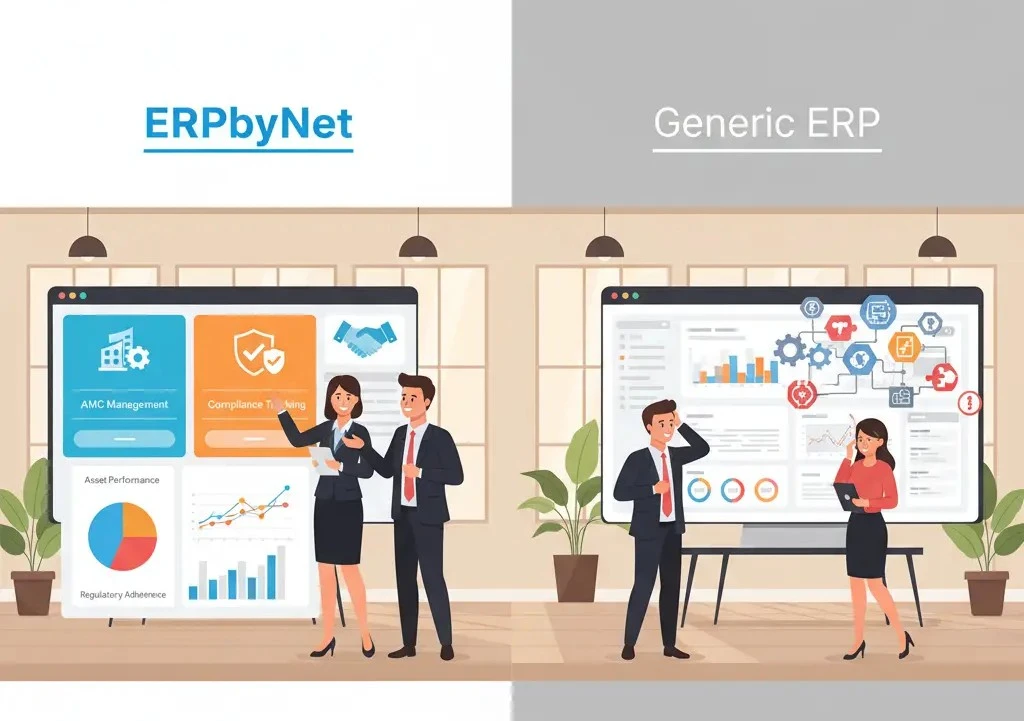
Read More : What’s the Difference Between ERPbyNet and Generic ERP Solutions?

Conclusion: Turning Complexity into Clarity

AI has transformed ERP from a static reporting system into a living, learning partner for your business. For field service teams, it means fewer blind spots, faster workflows, and happier customers.

At ERPbyNet, we empower businesses to run smarter with custom-fit ERP solutions that grow with you.
Ready to simplify your operations? Explore our ERP implementation service and let’s transform your workflow — one intelligent insight at a time.

FAQs

Still have questions about ERP and how it fits your business? Let’s clear them up.

1. What is an AI-powered ERP system?

It’s a modern ERP platform that uses artificial intelligence and machine learning to analyze data, automate decisions, and optimize workflows — helping teams predict outcomes instead of reacting to them.

2. How does AI improve field service management?

AI helps by forecasting equipment failures, assigning technicians intelligently, and automating customer communications — ensuring efficiency from the first service request to the last invoice.

3. Is AI-based ERP only for large enterprises?

Not anymore. Cloud ERP and modular deployment make it accessible for SMEs and startups. ERPbyNet specializes in scalable solutions that fit your growth stage and budget.

4. Can AI help reduce operational costs?

Absolutely. Predictive analytics minimize downtime, inventory optimization prevents overstocking, and automation reduces manual labor — all leading to substantial cost savings.

5. What’s the difference between traditional ERP and AI-driven ERP?

Traditional ERP records and reports. AI-driven ERP interprets and predicts — transforming your system from a data warehouse into a decision engine.

6. How secure is AI-powered ERP?

ERPbyNet ensures enterprise-grade data security through role-based permissions, encrypted APIs, and compliance with global data standards — so innovation never comes at the cost of safety.

CategoriesERP (Enterprise Resource Planning)

How to Choose Modular ERP Software for Mid-Size Enterprises

Mid-size enterprises in India have reached a pivotal stage in their growth journey. With operations expanding across regions, managing finances, supply chains, and workforce through spreadsheets or standalone applications has become increasingly unsustainable.

As these businesses scale, they require an integrated system — one that delivers control, efficiency, and data-driven visibility without imposing the rigidity or cost of traditional enterprise solutions.

This is where modular ERP software comes into play.Unlike monolithic ERP systems designed for large corporations, modular ERPs allow mid-size companies to adopt technology at their own pace, starting with essential modules and expanding as needs evolve.

However, choosing the right modular ERP isn’t merely a technology purchase — it’s a strategic business decision that impacts efficiency, compliance, profitability, and long-term scalability.This guide from ERPbyNet explores how Indian mid-size enterprises can evaluate, select, and implement the ideal modular ERP system for sustainable growth.

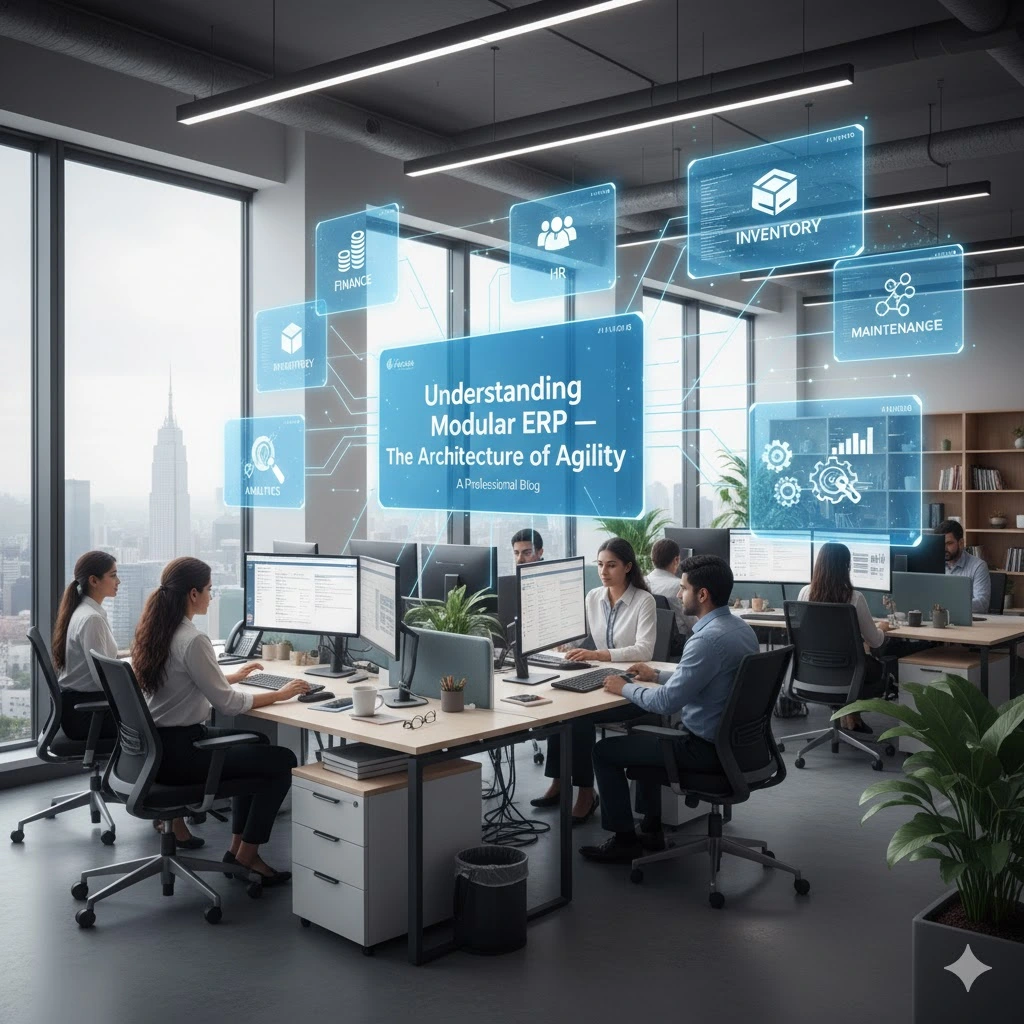
Understanding Modular ERP — The Architecture of Agility

Modular ERP Architecture for Mid-Size Enterprises | ERPbyNet

In today’s fast-moving business landscape, agility isn’t a luxury — it’s a necessity. Modular ERP systems embody this agility by breaking down enterprise operations into specialized, easy-to-manage components or “modules.”

Think of it as building your ERP like Lego blocks — each module is designed for a specific function, such as:

  • Finance & Accounting – For real-time financial control and compliance.
  • Procurement & Inventory – To streamline sourcing, stock, and supplier management.
  • Human Resources & Payroll – Simplifying workforce administration and payouts.
  • Sales & CRM – Powering customer engagement and revenue visibility.
  • Maintenance & Asset Management – Ensuring equipment uptime and lifecycle tracking.
  • Project Management – Aligning resources, deadlines, and deliverables.
  • Analytics & Reporting – Turning data into actionable insights.

Each module functions independently yet connects effortlessly within one unified platform. Businesses can activate only what they need today and scale seamlessly as they grow — without halting operations or overspending.

Unlike traditional ERP systems that demand full-suite implementation from day one — leading to long rollouts, higher costs, and slower adoption — modular ERP eliminates these barriers. It keeps your technology investment perfectly in sync with your growth trajectory — never ahead, never behind.

Read More : How Elevator Companies Can Stop Losing Contracts with AI-Driven ERP Visibility

Why Modular ERP Fits the Mid-Size Business Model

 Designed for Gradual Growth

Mid-size enterprises rarely transform overnight. Modular ERP allows them to digitize in phases — finance this quarter, inventory next, CRM after that — minimizing disruption while accelerating ROI.

Lower Total Cost of Ownership (TCO)

Because businesses only pay for active modules, modular ERP eliminates wasteful spending on unused functionality. The pay-as-you-scale model makes it cost-efficient and budget-friendly for growing firms.

Accelerated Implementation

Deploying independent modules means quicker rollouts. Instead of waiting months for a full ERP suite, enterprises can operationalize priority functions in weeks.

Stronger User Adoption

Employees can learn and adapt gradually. Familiarity with one module builds confidence for the next, ensuring smoother digital transformation and higher success rates.

Adaptable for Regulatory and Market Change

In India, where GST, e-invoicing, and statutory compliance evolve frequently, modular ERPs offer agility. Updates or new compliance features can be integrated without disturbing existing modules.

ERPbyNet follows this modular principle, offering Indian businesses the freedom to start small and scale without system overhauls.

Key Factors to Consider When Choosing a Modular ERP

Selecting the right ERP vendor and platform involves balancing business goals, technical requirements, and long-term value. The following framework outlines essential considerations for mid-size enterprises.

Business Process Alignment

Begin with a deep understanding of your core processes. The ideal ERP must align with — not redefine — how your business operates.

Steps to evaluate alignment:

  1. Map existing workflows across departments.
  2. Identify inefficiencies or data silos.
  3. Prioritize areas where automation will deliver measurable impact.
  4. Ensure the ERP supports these workflows with minimal customization.

A mismatch between business needs and ERP design can result in poor adoption and operational friction.

Integration Capability

Mid-size firms often rely on diverse software ecosystems — accounting tools, CRMs, e-commerce platforms, or payroll systems. A modular ERP must integrate seamlessly with these through APIs and data connectors.

Check for:

  • Open API architecture
  • Compatibility with Excel, Tally, or Zoho
  • Integration with e-invoicing and GST systems
  • Cloud and on-premises interoperability

ERPbyNet’s open architecture enables plug-and-play integration, ensuring continuity with your existing tools while centralizing data visibility.

Scalability and Customization

Growth inevitably brings new requirements — more users, new branches, additional product lines. Your ERP should handle scale without reimplementation.

Evaluate whether the platform:

  • Supports multi-location, multi-currency, and multi-language setups
  • Allows workflow customizations without heavy coding
  • Provides flexible data models for evolving processes

ERPbyNet, for instance, is designed with low-code customization capabilities — allowing enterprises to configure dashboards, reports, and workflows independently.

Cloud vs. On-Premise Deployment

Cloud-based ERP systems are increasingly favored for mid-size Indian enterprises because they:

  • Eliminate infrastructure costs
  • Offer real-time access from any location
  • Ensure automatic updates and data backups

However, industries with data sensitivity (e.g., manufacturing or government projects) may prefer on-premise or hybrid deployments.

ERPbyNet provides all three models — cloud, on-premise, and hybrid — ensuring deployment flexibility aligned with IT and compliance policies.

 Data Security and Compliance

Data integrity is a cornerstone of ERP reliability. Check for:

  • End-to-end encryption
  • Role-based access controls
  • Data localization (important for Indian compliance)
  • Regular security audits and backup protocols

Indian enterprises should also confirm alignment with ISO 27001, SOC 2, and local data protection regulations.

Usability and User Experience

ERP adoption often fails not because of missing features but due to poor usability. Ensure your chosen ERP offers:

  • Simple, intuitive dashboards
  • Mobile and web access
  • Self-service tools for employees and vendors
  • Role-based interfaces that reduce clutter

ERPbyNet’s interface is designed around user experience, ensuring every department — from accounts to service — can operate efficiently with minimal training.

Analytics and Decision Intelligence

The modern ERP must not just record transactions — it should interpret them. Look for systems with built-in business intelligence and predictive analytics.

Capabilities to consider:

  • Real-time dashboards
  • Trend and variance analysis
  • Custom reporting
  • Predictive forecasting using AI models

ERPbyNet’s AI-powered analytics module provides real-time visibility into revenue, expenses, and project performance — enabling informed decisions at every level.

Vendor Support and Local Presence

For mid-size Indian businesses, localized support is critical. ERP success depends heavily on how quickly issues are resolved and updates are deployed.

Ask potential vendors:

  • Do they provide India-based technical support?
  • How frequently are updates released?
  • Is training available in regional languages?
  • Are service-level agreements (SLAs) clearly defined?

ERPbyNet maintains strong post-implementation support with dedicated regional teams, ensuring continuity beyond go-live.

Read More : What’s the Difference Between ERPbyNet and Generic ERP Solutions?

The Role of AI, Automation, and Low-Code Technology

The next generation of ERP is intelligent, adaptable, and self-learning. For Indian mid-size enterprises, these technologies are not futuristic luxuries — they’re competitive necessities.

AI and machine learning enhance ERP systems by:

  • Predicting demand and procurement needs
  • Automating invoice processing and reconciliations
  • Identifying anomalies in financial data
  • Forecasting sales or maintenance schedules

Low-code tools empower business users to design their own workflows and reports without technical coding expertise. This democratizes innovation, reducing dependence on external IT vendors.

ERPbyNet integrates both AI and low-code automation, enabling companies to convert operational data into actionable insights and smart workflows.

Understanding ERP Cost Components

When evaluating ERP solutions, many businesses focus only on the upfront price — but the total cost of ownership (TCO) goes far beyond initial licensing. A transparent understanding of all cost elements helps organizations make smarter, long-term decisions and avoid unexpected expenses.

1. License or Subscription

Every ERP journey begins with the licensing model. Businesses can choose between perpetual licenses (a one-time purchase with recurring maintenance fees) or subscription-based pricing, which spreads costs over time. Most modern modular ERPs, like ERPbyNet, follow a subscription model, making it more affordable and scalable for growing organizations. This approach ensures flexibility — pay for what you use, and expand only when needed.

2. Implementation and Configuration

ERP implementation goes beyond software installation. It includes process mapping, data migration, user setup, and system configuration. These steps define how effectively the ERP aligns with your operations. Choosing a vendor that provides pre-configured industry templates can significantly reduce both time and cost — accelerating go-live timelines and minimizing disruption.

3. Customization and Integration

No two businesses are identical. Customization tailors the ERP to specific workflows, while integration connects it with other tools such as CRMs, payroll systems, or e-commerce platforms. Fortunately, today’s modular ERPs leverage APIs and low-code configuration tools, reducing dependency on heavy coding and cutting customization costs dramatically — without compromising flexibility.

4. Maintenance and Upgrades

Traditional on-premise ERPs often require dedicated IT resources for updates, bug fixes, and system maintenance. In contrast, cloud-based ERP systems handle these tasks automatically. The vendor manages patches, feature enhancements, and version upgrades, keeping the system optimized and secure — with minimal maintenance cost for the business.

5. Training and Change Management

Even the best ERP can fall short if users aren’t confident in using it. Budgeting for training, documentation, and change management programs is essential. Well-structured onboarding ensures employees understand not just how the system works, but how it benefits their daily roles — directly influencing adoption and overall ROI.

A Smart Investment with Fast Returns

When all cost components are weighed against the gains in productivity, speed, and accuracy, modular ERP systems like ERPbyNet stand out. With efficient deployment, reduced maintenance, and high user adoption, many businesses experience a rapid return on investment — often within the first six months of implementation.

Read More : What Problems Vanish When Companies Adopt ERP Vendor Portal?

Implementation Strategy: Phased and Practical

A successful ERP implementation follows a structured roadmap.

Step 1: Define Clear Objectives

Outline measurable goals — reduced billing cycle time, improved AMC renewal tracking, or unified reporting.

Step 2: Build a Cross-Functional Core Team

Include process owners from finance, HR, inventory, and IT.

Step 3: Select Priority Modules

Deploy core modules first, expanding gradually to secondary functions.

Step 4: Prepare and Clean Data

Ensure master data accuracy before migration.

Step 5: Train and Test

User acceptance testing (UAT) should mirror real-world workflows.

Step 6: Go Live and Monitor

Adopt a soft launch approach, followed by full rollout.

ERPbyNet’s agile implementation framework helps businesses transition smoothly, with minimal operational downtime.

Common Mistakes to Avoid

Implementing an ERP is a transformative step — but without careful planning, even the best technology can fall short. Here are some of the most common missteps businesses make, and how to avoid them:

  1. Over-Customizing Too Early
    Customization may seem appealing, but doing it too soon can lead to unnecessary complexity and delays. Start by adopting standard ERP workflows to understand the system’s capabilities, then tailor gradually as your business matures.
  2. Ignoring Change Management
    ERP success depends as much on people as on technology. Skipping user training and communication can derail adoption. A structured change management plan ensures your teams are informed, confident, and ready for transition.
  3. Neglecting Data Quality
    Your ERP is only as good as the data it runs on. Inconsistent or outdated data leads to poor insights and decision-making. Invest in data cleansing and standardization before migration to ensure reliable analytics and reporting.
  4. Focusing Only on Price
    While cost matters, the cheapest ERP often comes with hidden trade-offs — limited scalability, weak support, or poor integration. Look beyond price to evaluate long-term value, flexibility, and ROI.
  5. Skipping Vendor Evaluation
    Not all ERP vendors offer the same level of post-sale support. Always verify client references, service track record, and upgrade policies before making your decision. A strong vendor partnership is crucial for smooth implementation and ongoing success.

Avoiding these pitfalls helps ensure your ERP project stays on schedule, within budget, and primed for long-term success.

Industry-Specific ERP Considerations

Industry-Specific ERP Modules for Mid-Size Enterprises | ERPbyNet

Every industry has its own operational DNA. A well-designed ERP should reflect that — delivering sector-specific functionality that enhances efficiency and control.

Manufacturing

  • Streamlined production planning and BOM (Bill of Materials) management
  • Integrated quality assurance and equipment maintenance
  • Real-time shop-floor tracking for improved visibility and throughput

Service and Maintenance Firms

  • Automated AMC management and work order scheduling
  • Mobile technician access for on-site efficiency
  • Real-time service tracking for better customer satisfaction

Distribution and Retail

  • Centralized multi-warehouse management
  • Intelligent inventory optimization to reduce stockouts
  • POS integration for seamless sales and inventory sync

Professional Services

  • Project accounting to monitor budgets and profitability
  • Resource utilization analytics for efficient workforce planning
  • Automated timesheet and billing for faster revenue recognition

ERPbyNet comes pre-equipped with industry-ready modules that reduce setup time and configuration effort. Yet, it maintains the flexibility for customization, ensuring a perfect fit for every business model.

The Future of Modular ERP: Intelligent and Connected

ERP is no longer just about recording transactions — it’s about predicting, adapting, and optimizing. The next generation of ERP systems is intelligent, connected, and self-evolving, powered by emerging technologies such as:

  • AI-driven analytics that anticipate risks, predict trends, and recommend actions
  • IoT integration for live monitoring of assets, fleets, and field operations
  • Blockchain technology to create tamper-proof audit trails and secure transactions
  • Natural Language Interfaces (NLI) that make interacting with ERP as easy as conversation
  • AEO (Answer Engine Optimization) to enhance digital discoverability and visibility

ERPbyNet is already ahead of this curve — integrating these intelligent features to help Indian enterprises thrive in an AI-driven, data-centric ecosystem.

The ERPbyNet Edge

ERPbyNet is built from the ground up for mid-sized Indian enterprises seeking scalability without complexity. It combines modular flexibility with enterprise-grade power — a rare balance in the ERP market.

Key Advantages:

  • Modular architecture that evolves with your business
  • Cloud-ready platform with enterprise-grade data security
  • Built-in analytics and AI-driven insights for proactive decision-making
  • Seamless integration with existing tools and compliance systems
  • Low-code customization for quick adaptability
  • Local implementation and support expertise for reliable delivery

ERPbyNet bridges the gap between affordability and capability, giving businesses a powerful, future-ready ERP that transforms operations — without overwhelming resources.

Conclusion: Turning ERP into a Growth Partner

Your ERP should do more than manage — it should accelerate growth. For mid-size enterprises, the key lies in choosing a modular ERP that evolves with every stage of your journey.

ERPbyNet helps you integrate people, processes, and data into one intelligent ecosystem — boosting agility, accuracy, and decision-making power. Start small, scale effortlessly, and let your ERP grow as your business does.

When deployed strategically, ERPbyNet becomes your operational backbone and growth catalyst, not just another software.

Ready to transform your business operations? Book a demo with ERPbyNet today and experience how modular ERP can redefine your growth path.Visit Now to get started.

FAQs

What makes a modular ERP different from a traditional ERP system?

Modular ERP allows businesses to activate only the modules they need, unlike traditional ERP which requires full-suite deployment. This approach reduces costs, accelerates implementation, and aligns technology adoption with business growth.

How does ERPbyNet benefit mid-size enterprises specifically?

ERPbyNet provides scalable, industry-ready modules with cloud deployment and built-in compliance. It helps mid-size businesses improve efficiency, visibility, and decision-making while keeping costs manageable.

Is modular ERP suitable for companies in different industries?

Yes, modular ERP adapts to industry-specific needs. ERPbyNet offers pre-configured modules for manufacturing, services, retail, and professional firms, ensuring faster deployment and a precise fit.

What factors should businesses consider before implementing ERP?

Businesses should assess process maturity, data quality, user readiness, and scalability needs. Planning change management and choosing a vendor with strong support is essential for success.

How quickly can a business see ROI after implementing ERPbyNet?

With phased implementation and automation, ERPbyNet delivers measurable efficiency and decision-making improvements within the first few months, helping businesses recover their investment quickly.


CategoriesERP (Enterprise Resource Planning)

How Elevator Companies Can Stop Losing Contracts with AI-Driven ERP Visibility

In today’s service-driven market, elevator maintenance contracts are the lifeblood of every business. They provide predictable revenue, long-term client relationships, and brand stability. Yet, many elevator companies lose these valuable contracts — not because of poor service quality, but due to operational inefficiencies and missed visibility.

Manual tracking, outdated spreadsheets, and fragmented communication create blind spots. Renewal dates are missed. Follow-ups slip through the cracks. Service teams react instead of plan. Clients, frustrated by delays and unresponsiveness, quietly switch to competitors who appear more organized and proactive.

This isn’t just a management issue; it’s a visibility problem. Without real-time access to contract data, service history, and renewal cycles, companies operate in the dark. That’s where AI-driven ERP systems like ERPbyNet make the difference.

The Shift: From Reactive Management to Predictive Visibility

Traditional ERP systems focus on storing information — customer details, service logs, invoices, and contracts. But storing data isn’t the same as understanding it.

AI-driven ERP introduces intelligence into that data. Instead of just recording transactions, it predicts trends, alerts teams to upcoming actions, and ensures no renewal or compliance task is ever missed.

With ERPbyNet’s AI-powered insights, elevator companies can:

  • Anticipate contract renewals before they expire.
  • Identify clients at risk of churn.
  • Optimize technician scheduling based on service demand.
  • Maintain complete visibility across multiple sites, contracts, and clients.

This transition from reactive to predictive management helps businesses stop losing contracts — not by chance, but by design.

Read More : How Can ERP Help Companies Control Unpredictable Travel Budgets?

The Visibility Factor: Why It Matters More Than Ever

In the elevator service industry, visibility is power. It determines how fast your team responds, how accurately you plan, and how confidently your clients trust you.

Consider this simple scenario: a contract renewal date approaches, but the reminder sits buried in a shared spreadsheet. The service manager misses the update, the contract expires silently, and the client moves on.

Now imagine a different reality — one powered by ERPbyNet’s AI-driven dashboard. The system identifies the upcoming renewal weeks in advance, notifies the responsible team, and even suggests the best time to approach the client based on their service satisfaction and payment history.

That’s not automation — that’s intelligent foresight. And in a competitive market, foresight wins contracts.

How AI-Driven ERP Visibility Works

ERPbyNet brings together three layers of intelligence that transform how elevator companies operate:

  1. Centralized Data Management
    All contract, service, and billing information is unified in one platform. No more scattered Excel sheets or lost renewal reminders.

  2. AI Alerts and Predictive Insights
    The system uses machine learning to recognize renewal patterns, flag high-value contracts, and alert teams before deadlines.

  3. Performance Dashboards and Real-Time Reports
    Management gets complete clarity on performance — who’s due for renewal, which contracts are profitable, and where delays are happening.

Together, these layers create a transparent operational ecosystem. Teams know what’s happening, managers know what’s coming, and clients know they’re in capable hands.

Read More : How Does the Absence of ERP Complicate Travel Cost Tracking?

The Cost of Losing Visibility

Losing even one AMC (Annual Maintenance Contract) can have a ripple effect. It’s not just the loss of service revenue — it’s the missed cross-sell opportunity, reduced technician utilization, and damaged brand credibility.

Here’s what happens when visibility breaks down:

  • Missed Renewals: No reminders, no follow-ups, lost revenue.
  • Delayed Service Responses: Poor coordination leads to client frustration.
  • Data Silos: Teams can’t access real-time information, creating inefficiency.
  • Low Accountability: Without clear dashboards, responsibility blurs across departments.

AI-driven ERP visibility prevents all these outcomes by ensuring that every contract is tracked, every service is scheduled, and every opportunity is followed through.

Real-World Example: Transforming Renewal Management

A mid-sized elevator maintenance company managing over 800 contracts struggled with missed renewals and inconsistent follow-ups. Their processes were spreadsheet-driven and email-dependent.

After implementing ERPbyNet, their contract renewal efficiency improved dramatically. AI-powered alerts now notify teams 30 days before any renewal date. The dashboard highlights at-risk clients, and automated reports track revenue impact.

Within six months, renewal retention rose by 40%, and client satisfaction scores improved significantly. More importantly, the company’s management gained full visibility into service delivery and revenue forecasting.

This example demonstrates how technology doesn’t just organize data — it drives measurable business outcomes.

The Role of AI in Decision-Making

AI within ERPbyNet doesn’t replace human decision-making; it enhances it. By analyzing patterns across contracts, payments, and customer feedback, it provides actionable insights that help managers make smarter decisions faster.

For instance, AI can predict which clients are likely to renew based on service history, identify potential delays before they escalate, and even recommend personalized communication strategies.

In an industry where timing and trust determine success, these insights directly contribute to customer retention and revenue stability.

Integrating AEO + GEO + SEO with ERP Visibility

AI-driven illustration showing the integration of AEO, GEO, and SEO strategies with ERP visibility for elevator companies using ERPbyNet.

While operational visibility helps you manage contracts better, digital visibility ensures your brand gets found when potential clients are searching for solutions.

That’s why ERPbyNet doesn’t stop at automation — it’s also optimized for AEO (Answer Engine Optimization), GEO targeting, and SEO.

As AI-driven search platforms like Google Gemini and ChatGPT dominate user queries, elevator businesses must ensure their ERP solutions and service offerings are discoverable. ERPbyNet helps companies align both internal efficiency and external visibility:

  • AEO: Your content becomes the “answer” AI platforms choose.
  • GEO: Localized service pages attract nearby maintenance contracts.
  • SEO: Keyword strategies ensure consistent ranking across search results.

This dual advantage — internal operational control and external discoverability — keeps elevator companies ahead of competitors who are still relying on traditional methods.

Read More : ERP Vendor Portals: Features, Benefits, and Best Practices

The Future of Contract Management

As client expectations evolve, contract management will no longer be about renewals alone. It will revolve around experience, transparency, and proactive engagement.

Tomorrow’s elevator companies will need systems that:

  • Predict service needs before breakdowns occur.
  • Generate AI-assisted reports for client transparency.
  • Deliver 360-degree dashboards showing performance, uptime, and satisfaction.

ERPbyNet is already building toward this vision. Its AI-driven framework not only automates what you do today but also prepares your business for what’s next.

Building Long-Term Trust Through Visibility

Contracts are built on trust, and trust grows with consistency. When clients see that your company never misses a renewal, always communicates on time, and maintains smooth operations, they stay loyal.

AI-driven ERP visibility helps establish that consistency. It ensures every team member — from service coordinators to top management — operates from the same source of truth.

When visibility becomes part of your culture, client confidence naturally follows.

How ERPbyNet Makes It Happen

ERPbyNet dashboard showing smart renewal tracking, AI-powered insights, and integrated AMC modules for elevator service management.

ERPbyNet isn’t just another ERP solution; it’s purpose-built for industries like elevator services, where recurring contracts and maintenance cycles define success.

Here’s how ERPbyNet empowers your business:

  • Smart Renewal Tracking: Get automatic alerts before contract expiry.

  • AI-Powered Insights: Identify high-value customers and retention opportunities.

  • Integrated AMC Modules: Manage service, billing, and communication in one place.

  • Custom Dashboards: Track KPIs, profitability, and renewal performance.

  • Scalable Design: Grow seamlessly as your contracts and clients expand.

ERPbyNet turns complexity into clarity. Every renewal, every client, every transaction — visible, trackable, and manageable from one intelligent platform.

The Competitive Advantage of Being AI-Ready

Elevator companies that adopt AI-driven ERP systems early will have a decisive edge. While competitors are busy chasing missed renewals, your company will be busy nurturing retained clients, improving margins, and forecasting growth.

AI readiness is no longer optional; it’s a business differentiator. It determines who leads and who follows in the evolving service ecosystem. ERPbyNet ensures you’re always leading.

Key Takeaways

  1. Visibility prevents revenue loss. Missing contracts often comes from poor tracking, not poor service.

  2. AI-driven ERP creates predictability. It turns scattered data into proactive actions.

  3. Operational and digital visibility must align. AEO + GEO + SEO ensure your services get found.

  4. ERPbyNet delivers measurable impact. From renewal efficiency to client satisfaction, the results speak for themselves.

  5. Future growth requires intelligence. The companies that use data smartly will retain clients and grow faster.

Conclusion: Don’t Let Visibility Be the Reason You Lose Clients

In a competitive market, missed contract renewals aren’t just mistakes—they’re lost revenue. If your business isn’t leveraging intelligent insights and real-time tracking, valuable clients may be slipping away.

ERPbyNet provides AI-powered visibility that helps you track, manage, and grow contracts efficiently. From anticipating renewals to understanding client needs, it enables smarter, faster decision-making.

With ERPbyNet, you can streamline operations, reduce downtime, and ensure every client receives timely service—turning reliability into a competitive advantage.

We focus on ERP solutions that boost contract retention and operational control. Would you like us to share our pricing and proposal? Please let me know.

Visit Here to schedule a demo or consultation today.

FAQS

What is AI-driven ERP visibility and how does it help elevator companies?
AI-driven ERP visibility means having real-time, data-backed insights into your contracts, services, 

How does ERPbyNet help prevent missed AMC renewals?
ERPbyNet automates contract tracking with AI-powered reminders and predictive alerts. It notifies teams before contracts expire, highlights high-priority clients, and centralizes all AMC details — so you never lose a contract due to oversight.

Can ERPbyNet be customized for our elevator business operations?
Yes. ERPbyNet is built with flexibility in mind. It can be tailored to match your company’s workflow — from AMC scheduling and technician management to billing, reporting, and multi-branch coordination.

What makes ERPbyNet different from traditional ERP software?
Unlike traditional ERPs that simply store data, ERPbyNet uses artificial intelligence to analyze and act on it. It provides predictive insights, AI alerts, and interactive dashboards — helping elevator companies make smarter, faster decisions with full visibility.

How can AI and AEO together improve my business growth?
While AI-driven ERP improves operational visibility, AEO (Answer Engine Optimization) enhances your digital visibility. This means your business not only operates efficiently but also appears in AI-generated search results (like ChatGPT or Google Gemini) when potential clients search for elevator ERP solutions.


CategoriesERP (Enterprise Resource Planning)

How Can ERP Help Companies Control Unpredictable Travel Budgets?

Corporate travel once symbolized growth; now it represents one of the biggest budgeting uncertainties. As companies expand operations, client meetings, audits, and site visits demand frequent travel — yet the costs tied to these movements fluctuate beyond control.
Airfare surges overnight, hotel prices shift by the hour, and unexpected cancellations throw entire budgets off balance. Even well-managed organizations find themselves facing the same recurring issue — planned travel budgets rarely match actual expenses.

These variances aren’t caused by poor planning alone. The real problem lies in fragmented systems and delayed visibility. Finance teams often see the full picture only after the money has been spent. And by then, corrective action is too late.

In a fast-changing economy, controlling travel costs requires more than tracking receipts. It demands a connected ecosystem where finance, HR, and operations work in real time. That’s exactly where ERP systems like ERPbyNet redefine the game — transforming unpredictable travel spending into predictable financial intelligence.

The Hidden Traps Behind Uncontrolled Travel Costs

Corporate travel once symbolized growth; now it represents one of the biggest budgeting uncertainties. As companies expand operations, client meetings, audits, and site visits demand frequent travel — yet the costs tied to these movements fluctuate beyond control. Airfare surges overnight, hotel prices shift by the hour, and unexpected cancellations throw entire budgets off balance. Even well-managed organizations find themselves facing the same recurring issue — planned travel budgets rarely match actual expenses. These variances aren’t caused by poor planning alone. The real problem lies in fragmented systems and delayed visibility. Finance teams often see the full picture only after the money has been spent. And by then, corrective action is too late. In a fast-changing economy, controlling travel costs requires more than tracking receipts. It demands a connected ecosystem where finance, HR, and operations work in real time. That’s exactly where ERP systems like ERPbyNet redefine the game — transforming unpredictable travel spending into predictable financial intelligence. The Hidden Traps Behind Uncontrolled Travel Costs Unpredictable travel budgets don’t emerge overnight; they are the result of layered inefficiencies buried deep within daily operations. Ever-Changing Market Rates Travel pricing is dynamic. Airfare and hotel rates fluctuate based on seasonality, availability, and global trends. Without live integration between booking data and budget forecasts, finance teams rely on outdated estimates. By the time expense reports are consolidated, actual costs have already overshot approved budgets. Uncoordinated Booking Channels Employees often book trips through multiple platforms — corporate agencies, online portals, or even personal apps. When booking data is dispersed, it becomes nearly impossible to reconcile expenses quickly or accurately. The lack of a unified view delays reporting and hides overspending until it’s too late. Policy Violations That Slip Through Most companies have travel policies on paper — but enforcement in practice is inconsistent. Managers may approve exceptions for convenience, and employees may select premium options outside guidelines. Each isolated decision may seem minor, but collectively, they create significant cost leakage. Manual Expense Handling Spreadsheets and paper receipts still dominate in many organizations. This manual processing creates delays, duplicates, and errors. Finance teams are forced into a reactive stance — identifying issues weeks after they’ve already impacted cash flow. Limited Predictive Insight Traditional travel tools only tell companies what they spent, not what they’re about to spend. Without predictive analysis, forecasting future travel costs becomes guesswork. This blind spot prevents proactive financial management and locks organizations into a cycle of retrospective adjustments. Read More : Why ERP Is Essential for Managing Annual Equipment Surveys Efficiently Why Conventional Travel Tools Can’t Solve the Problem Over the past decade, Travel & Expense (T&E) software has helped automate basic processes like claim submissions and approvals. But these tools operate in isolation. The data they collect rarely syncs directly with accounting, HR, or project systems. That means even with automation, companies still lack end-to-end financial visibility. A T&E tool may record an employee’s travel cost, but it doesn’t connect that expense to the specific cost center, project, or client account. The result is fragmented data, inconsistent reporting, and countless hours spent on manual reconciliation. This disconnection causes: Budget overruns that appear only after reporting cycles. Difficulty identifying where travel costs are rising. Inaccurate financial forecasting due to delayed data flow. In today’s environment — where every rupee and every decision counts — this lag is unacceptable. Finance leaders don’t just need visibility; they need control in real time. That’s where ERP systems like ERPbyNet come in — bridging data silos, enforcing policy compliance, and turning travel spending into an intelligent, trackable process from the moment it’s initiated. Read More : Elevator Compliance ERP to Manage Surveys & Testing Certificates ERPbyNet: Turning Fragmented Data into Financial Clarity ERPbyNet eliminates the scattered nature of travel management by bringing every process — from request to reimbursement — into one integrated system. Instead of juggling multiple platforms, companies manage travel through a single, unified ERP environment connected directly to finance and HR. Every booking, approval, and reimbursement automatically syncs with the organization’s budgetary framework. This ensures real-time accuracy, consistency, and transparency at every step. Through ERPbyNet, organizations can: Set and monitor department-wise or project-wise travel budgets. Track expenses live, not retrospectively. Automate compliance checks before approvals. Generate dynamic reports that reflect up-to-the-minute financial data. This isn’t just automation — it’s accountability built into the workflow. From Visibility to True Control Recording expenses is only half the challenge; the real goal is to prevent unnecessary costs before they occur. ERPbyNet empowers finance teams to achieve that by delivering continuous visibility across the travel lifecycle. As travel requests are raised, the system automatically checks available budgets and alerts managers if proposed costs exceed limits. Once a trip is approved and booked, expenses flow into a centralized ledger instantly. This gives decision-makers a real-time view of cumulative spending, enabling them to take corrective actions long before the month-end reports arrive. With ERP-driven alerts, overspending becomes preventable rather than discoverable. This proactive model is what separates financial control from mere expense tracking. Automating Compliance for Seamless Policy Enforcement Human oversight can never match the speed and accuracy of automated enforcement. ERPbyNet embeds company travel policies directly into its system architecture, ensuring compliance happens by design. When an employee books a flight, requests a hotel, or submits a claim, ERPbyNet automatically cross-checks each detail against approved rules. For example: Travel class limits are validated before booking. Daily allowance caps are pre-applied to claims. Non-compliant expenses are flagged instantly for review. This not only accelerates approvals but also ensures fairness and consistency across the organization. Managers don’t have to micromanage every request — the system itself enforces financial discipline. Read More : How ERP Travel Tracking Improves Productivity and Cuts Costs The Power of Centralized Booking and Approval Workflows In many organizations, travel approvals are spread across emails and spreadsheets, making accountability hard to track. ERPbyNet replaces this chaos with structured, transparent workflows. Employees raise travel requests through the ERP system itself, specifying details such as destination, purpose, and estimated cost. The system validates available budget limits automatically before routing the request to the appropriate manager. Once approved, the booking happens through integrated vendor channels, ensuring negotiated corporate rates apply every time. This single pipeline eliminates duplicate approvals, prevents untracked bookings, and ensures every rupee spent aligns with policy and budget before any transaction is made. Real-Time Budget Tracking That Changes the Game Traditional finance teams operate with lagging information — reconciling after-the-fact data that’s weeks old. ERPbyNet transforms this experience with live dashboards and automated alerts. Managers and finance heads can monitor: Current vs. approved budgets for every department or project. Category-level spending on airfare, lodging, and local travel. Alerts when spending nears or exceeds defined thresholds. Instead of waiting for reports, decision-makers act in the moment. This agility turns financial governance into a proactive, continuous process — ensuring no expense goes unnoticed or unchecked. Automated Expense Reconciliation for Effortless Accuracy Reconciliation is one of the most tedious and error-prone stages in travel management. ERPbyNet simplifies it completely. Receipts can be uploaded directly via web or mobile interface. The system then automatically matches each expense to its corresponding trip request and approved limit. Any mismatch is highlighted instantly for verification. Reimbursements, once approved, flow directly into integrated payroll or accounts payable modules — ensuring consistency across all financial records. The result: faster settlements, fewer disputes, and complete audit readiness. Automation here isn’t just about speed — it’s about creating a reliable financial audit trail that withstands scrutiny at any scale. Strengthening Vendor and Rate Management Another hidden driver of overspending is inconsistent vendor pricing. When employees book individually without centralized oversight, negotiated discounts go unused. ERPbyNet prevents that. It consolidates all vendor relationships — airlines, hotels, cab services — within the ERP ecosystem. During booking, the system prioritizes preferred vendors and applies negotiated rates automatically. Finance teams gain full visibility into vendor performance and rate utilization, allowing them to: Track which suppliers deliver the best value. Identify pricing discrepancies early. Use consolidated data for future negotiations. This integration not only saves money but also strengthens an organization’s leverage in vendor management — turning travel spend into a strategic advantage. Read More : What Problems Vanish When Companies Adopt ERP Vendor Portal? Where Efficiency Meets Empowerment ERPbyNet doesn’t just make processes faster — it empowers every stakeholder. Employees benefit from simplified requests and quicker reimbursements. Managers approve with full visibility and confidence. Finance teams shift from reactive accounting to strategic forecasting. Efficiency, in this context, isn’t about cutting corners. It’s about creating a culture of control, transparency, and trust — where every trip aligns with both business goals and financial prudence. From Visibility to Predictability — The Next Step in Financial Control Gaining visibility into travel expenses is an important milestone, but true control begins when visibility turns into predictability. For modern organizations, the question isn’t just “Where did the money go?” — it’s “Where is it likely to go next?” ERPbyNet elevates financial planning from historical review to proactive foresight. By using integrated data, analytics, and automation, the platform doesn’t simply record what has happened; it forecasts what’s about to happen. Through trend analysis and predictive modeling, ERPbyNet helps organizations identify when and where travel spending will surge, which departments are at risk of overshooting budgets, and how to allocate funds intelligently. This predictive approach transforms financial management from a reactive cycle to a continuous, data-driven strategy. The Shift from Reactive Budgeting to Predictive Intelligence Most companies still rely on backward-looking reports when planning budgets. These reports, while accurate, only reflect what’s already occurred. Market conditions, however, are constantly changing — rendering static budgets obsolete within weeks. ERPbyNet’s predictive analytics layer bridges that gap. By combining historical data, real-time booking trends, and seasonal price behavior, the system anticipates future fluctuations in travel costs. For example: If airfare typically spikes during the last quarter due to global events or conferences, ERPbyNet alerts managers in advance. If a particular region or client project historically exceeds travel budgets, the system adjusts future projections accordingly. If seasonal travel demand is expected to rise, ERPbyNet recommends securing bulk vendor contracts early to lock in lower rates. This predictive insight allows finance teams to plan dynamically — adjusting allocations before budget overruns occur, not after. The result is a travel management process that learns, adapts, and improves continuously. Connecting the Dots: HR, Finance, and Procurement in Sync In most organizations, travel costs intersect with multiple functions — HR (for approvals and entitlements), Finance (for accounting and compliance), and Procurement (for vendor management). When these departments operate independently, financial blind spots emerge. ERPbyNet unites these critical touchpoints under one cohesive framework. HR Integration: Employee roles, seniority, and travel entitlements are mapped directly into the ERP system. Only authorized employees can raise certain types of travel requests, ensuring that all bookings align with corporate policies. Finance Integration: Every approved expense automatically flows into the general ledger, categorized by department, cost center, or project. This ensures seamless reconciliation and immediate impact analysis on the company’s overall financial position. Procurement Integration: Vendor contracts, negotiated rates, and service-level agreements are built directly into the ERP. This ensures every booking adheres to approved supplier relationships and pricing structures. This cross-departmental synchronization eliminates data silos and gives leadership a 360-degree view of travel-related financial activity. Each trip, booking, and claim connects directly to its broader business purpose. Turning Data into Strategy ERPbyNet goes beyond operational automation to deliver strategic intelligence. The system’s analytics dashboards transform raw travel data into actionable insights that drive better decisions across the organization. Finance leaders can instantly identify: Which departments consistently exceed their travel limits. Which destinations or vendors generate the highest costs. How much of total travel expenditure directly supports billable client work. These insights empower decision-makers to refine travel policies, negotiate smarter contracts, and allocate budgets more effectively. Over time, patterns emerge that reveal where organizations can optimize travel — not just to reduce costs, but to improve overall business performance. For instance, data may show that certain client visits yield minimal ROI compared to virtual meetings, or that mid-tier hotels deliver the same quality as premium options at lower rates. These discoveries enable companies to make decisions based on evidence, not assumptions. Continuous Monitoring and Real-Time Adjustments Traditional budgeting models rely on quarterly or monthly reviews — by which point overspending has already occurred. ERPbyNet replaces static monitoring with a real-time feedback loop that keeps budgets aligned every day. When a department’s travel spend exceeds a defined percentage of its limit, managers are notified instantly. If travel frequency spikes unexpectedly in a particular region, finance can investigate and take immediate corrective measures. This continuous monitoring ensures that financial discipline isn’t a one-time audit task — it becomes a daily habit embedded into the organization’s workflow. ERPbyNet gives teams the confidence to make adjustments in real time, ensuring every trip and every transaction aligns with the company’s evolving financial goals. Building Accountability Across Every Level Budget control isn’t solely a finance function; it’s an organizational mindset. ERPbyNet fosters that culture by making every stakeholder accountable. Employees see their approved travel entitlements before making bookings, reducing the risk of non-compliant claims. Managers can approve or reject requests based on live budget visibility rather than static assumptions. Finance teams, in turn, spend less time chasing receipts and more time analyzing financial health. This visibility creates a sense of shared responsibility. When everyone understands how their travel decisions impact overall company performance, financial governance becomes a collective effort rather than a top-down enforcement. Smarter Forecasting with Machine Learning As organizations scale, travel data becomes complex — spanning thousands of trips, vendors, and fluctuating markets. ERPbyNet uses machine learning algorithms to interpret this growing volume of data with precision. Over time, the system identifies recurring trends, behavioral patterns, and anomalies that humans might overlook. For example: If certain employees frequently cancel trips, ERPbyNet adjusts future projections to account for cancellation costs. If specific vendors routinely modify rates, the system recalibrates cost assumptions accordingly. If the company expands into new territories, ERPbyNet uses regional price patterns to estimate realistic travel budgets. This evolving intelligence ensures that financial forecasts become sharper and more reliable each quarter — turning experience into insight, and insight into measurable savings. Sustainability and Smarter Spending Beyond profitability, today’s organizations are increasingly conscious of sustainability. Reducing unnecessary travel not only lowers costs but also minimizes environmental impact. ERPbyNet supports sustainable business goals by analyzing travel data to identify where physical meetings can be replaced with virtual alternatives. Companies can track their carbon footprint alongside financial metrics, enabling decisions that balance economic efficiency with ecological responsibility. For instance, reducing short domestic flights by 15% could save up to 10–12% in annual travel expenses — while simultaneously contributing to the organization’s sustainability objectives. ERPbyNet gives leaders the clarity to make these balanced, forward-thinking choices. Real-World Transformation: From Overspending to Optimization Consider a technology services company operating across multiple cities. Despite having strict travel policies, their quarterly audits revealed up to 20% deviation between planned and actual travel budgets. The reason? Disconnected booking systems, delayed approvals, and inconsistent vendor rates. After deploying ERPbyNet: All travel requests were routed through a centralized system with built-in budget validation. Real-time alerts informed department heads of spending thresholds. Expense reconciliation time was reduced by over 60%. Vendor contracts were consolidated and optimized based on ERPbyNet’s cost analysis. Within six months, the company reduced travel expenditure by 18% and achieved near-perfect forecasting accuracy. The finance team reported not just savings, but predictability — a shift from chasing costs to controlling them with confidence. The ERP Advantage Over Standalone Travel Tools Standalone T&E tools handle expense automation — but ERPbyNet provides financial intelligence. Here’s how the difference plays out in practice: Aspect Traditional Travel Tool ERPbyNet Data Management Scattered across multiple systems Unified under one ERP ecosystem Budget Visibility Post-expense reporting Real-time monitoring and alerts Policy Enforcement Manual or partial Fully automated and rule-based Reporting Static and descriptive Dynamic, analytical, and predictive Vendor Management External or separate Integrated with finance and procurement Forecasting Limited to history Driven by AI and trend modeling ERPbyNet doesn’t just make data visible — it makes it actionable. Every transaction contributes to a smarter, more connected financial strategy. Empowering the Future of Financial Governance As organizations adapt to a data-driven economy, finance teams need more than compliance — they need confidence. ERPbyNet offers that confidence by aligning operational efficiency with strategic oversight. It transforms travel management from a fragmented administrative process into a unified, insight-rich ecosystem that anticipates challenges before they occur. By bringing automation, analytics, and accountability under one roof, ERPbyNet helps finance leaders reclaim control — not only over travel budgets but over the financial health of the entire organization. Future-Ready, Scalable, and Strategic In an unpredictable business world, flexibility is power. ERPbyNet’s scalable architecture ensures that as companies grow — whether they manage five trips a month or five thousand — control, compliance, and clarity remain constant. Its predictive budgeting tools continue learning and adapting with every transaction, providing an evolving understanding of cost trends, market volatility, and performance efficiency. This scalability allows companies to plan with agility — adjusting budgets, policies, and strategies dynamically as business realities shift. The result is a finance function that doesn’t just react to change but anticipates it. Take Control of Your Travel Budgets — Starting Today Unpredictable travel expenses shouldn’t dictate your financial decisions. They signal a gap in visibility, control, and trust — gaps that ERPbyNet is built to close. By integrating every stage of travel management — from planning and booking to budgeting and predictive analytics — ERPbyNet transforms uncertainty into actionable clarity. No more guessing where costs will arise; with ERPbyNet, you anticipate them, plan around them, and stay firmly in control. It’s time to move beyond expense tracking and step into expense mastery. Let ERPbyNet give your organization the precision, insight, and confidence to manage every journey strategically — on budget, on policy, and on point. Reclaim control. Redefine efficiency. Discover how ERPbyNet can make every travel decision a smarter financial move. FAQs 1. How does an ERP system help in controlling unpredictable travel budgets? An ERP system centralizes travel bookings, approvals, and expenses in one platform, offering real-time visibility and control. It tracks spending against budgets, enforces policies automatically, and alerts teams about overspending. This proactive monitoring helps organizations manage costs efficiently and prevent budget overruns. 2. Why are traditional travel and expense tools not enough for modern businesses? Traditional tools work in isolation, offering limited visibility and delayed reporting. They show expenses only after spending occurs. ERP systems like ERPbyNet integrate travel, finance, and procurement data, giving companies a complete and timely view of costs to make quicker, informed decisions. 3. How can ERPbyNet improve forecasting and travel cost predictability? ERPbyNet uses analytics and machine learning to study travel patterns, vendor rates, and seasonal trends. It predicts future costs and spending surges, helping finance teams adjust budgets in advance. This data-driven approach turns unpredictable travel expenses into accurate financial forecasts. 4. What role does policy automation play in managing travel budgets effectively? Policy automation in ERPbyNet ensures every booking and expense follows company rules. The system automatically flags policy breaches, prevents unauthorized spending, and ensures approvals stay within set limits. This consistency keeps travel budgets disciplined and compliant. 5. Can ERP systems like ERPbyNet reduce administrative workload for finance teams? Yes, ERPbyNet automates manual tasks like receipt tracking, expense verification, and reconciliation. With integrated workflows and instant reporting, finance teams save time, reduce errors, and focus more on analysis and strategy instead of routine paperwork.

Unpredictable travel budgets don’t emerge overnight; they are the result of layered inefficiencies buried deep within daily operations.

Ever-Changing Market Rates
Travel pricing is dynamic. Airfare and hotel rates fluctuate based on seasonality, availability, and global trends. Without live integration between booking data and budget forecasts, finance teams rely on outdated estimates. By the time expense reports are consolidated, actual costs have already overshot approved budgets.

Uncoordinated Booking Channels
Employees often book trips through multiple platforms — corporate agencies, online portals, or even personal apps. When booking data is dispersed, it becomes nearly impossible to reconcile expenses quickly or accurately. The lack of a unified view delays reporting and hides overspending until it’s too late.

Policy Violations That Slip Through
Most companies have travel policies on paper — but enforcement in practice is inconsistent. Managers may approve exceptions for convenience, and employees may select premium options outside guidelines. Each isolated decision may seem minor, but collectively, they create significant cost leakage.

Manual Expense Handling
Spreadsheets and paper receipts still dominate in many organizations. This manual processing creates delays, duplicates, and errors. Finance teams are forced into a reactive stance — identifying issues weeks after they’ve already impacted cash flow.

Limited Predictive Insight
Traditional travel tools only tell companies what they spent, not what they’re about to spend. Without predictive analysis, forecasting future travel costs becomes guesswork. This blind spot prevents proactive financial management and locks organizations into a cycle of retrospective adjustments.

Read More : Why ERP Is Essential for Managing Annual Equipment Surveys Efficiently

Why Conventional Travel Tools Can’t Solve the Problem

Over the past decade, Travel & Expense (T&E) software has helped automate basic processes like claim submissions and approvals. But these tools operate in isolation. The data they collect rarely syncs directly with accounting, HR, or project systems.

That means even with automation, companies still lack end-to-end financial visibility.
A T&E tool may record an employee’s travel cost, but it doesn’t connect that expense to the specific cost center, project, or client account. The result is fragmented data, inconsistent reporting, and countless hours spent on manual reconciliation.

This disconnection causes:

  • Budget overruns that appear only after reporting cycles.
  • Difficulty identifying where travel costs are rising.
  • Inaccurate financial forecasting due to delayed data flow.

In today’s environment — where every rupee and every decision counts — this lag is unacceptable. Finance leaders don’t just need visibility; they need control in real time.

That’s where ERP systems like ERPbyNet come in — bridging data silos, enforcing policy compliance, and turning travel spending into an intelligent, trackable process from the moment it’s initiated.

Read More : Elevator Compliance ERP to Manage Surveys & Testing Certificates

ERPbyNet: Turning Fragmented Data into Financial Clarity

ERPbyNet Integrated Travel Management Dashboard

ERPbyNet eliminates the scattered nature of travel management by bringing every process — from request to reimbursement — into one integrated system. Instead of juggling multiple platforms, companies manage travel through a single, unified ERP environment connected directly to finance and HR.

Every booking, approval, and reimbursement automatically syncs with the organization’s budgetary framework. This ensures real-time accuracy, consistency, and transparency at every step.

Through ERPbyNet, organizations can:

  • Set and monitor department-wise or project-wise travel budgets.
  • Track expenses live, not retrospectively.
  • Automate compliance checks before approvals.
  • Generate dynamic reports that reflect up-to-the-minute financial data.

This isn’t just automation — it’s accountability built into the workflow.

From Visibility to True Control

Recording expenses is only half the challenge; the real goal is to prevent unnecessary costs before they occur. ERPbyNet empowers finance teams to achieve that by delivering continuous visibility across the travel lifecycle.

As travel requests are raised, the system automatically checks available budgets and alerts managers if proposed costs exceed limits. Once a trip is approved and booked, expenses flow into a centralized ledger instantly.
This gives decision-makers a real-time view of cumulative spending, enabling them to take corrective actions long before the month-end reports arrive.

With ERP-driven alerts, overspending becomes preventable rather than discoverable. This proactive model is what separates financial control from mere expense tracking.

Automating Compliance for Seamless Policy Enforcement

Human oversight can never match the speed and accuracy of automated enforcement. ERPbyNet embeds company travel policies directly into its system architecture, ensuring compliance happens by design.

When an employee books a flight, requests a hotel, or submits a claim, ERPbyNet automatically cross-checks each detail against approved rules.
For example:

  • Travel class limits are validated before booking.
  • Daily allowance caps are pre-applied to claims.
  • Non-compliant expenses are flagged instantly for review.

This not only accelerates approvals but also ensures fairness and consistency across the organization. Managers don’t have to micromanage every request — the system itself enforces financial discipline.

Read More : How ERP Travel Tracking Improves Productivity and Cuts Costs

The Power of Centralized Booking and Approval Workflows

In many organizations, travel approvals are spread across emails and spreadsheets, making accountability hard to track. ERPbyNet replaces this chaos with structured, transparent workflows.

Employees raise travel requests through the ERP system itself, specifying details such as destination, purpose, and estimated cost. The system validates available budget limits automatically before routing the request to the appropriate manager.
Once approved, the booking happens through integrated vendor channels, ensuring negotiated corporate rates apply every time.

This single pipeline eliminates duplicate approvals, prevents untracked bookings, and ensures every rupee spent aligns with policy and budget before any transaction is made.

Real-Time Budget Tracking That Changes the Game

Traditional finance teams operate with lagging information — reconciling after-the-fact data that’s weeks old. ERPbyNet transforms this experience with live dashboards and automated alerts.

Managers and finance heads can monitor:

  • Current vs. approved budgets for every department or project.
  • Category-level spending on airfare, lodging, and local travel.
  • Alerts when spending nears or exceeds defined thresholds.

Instead of waiting for reports, decision-makers act in the moment. This agility turns financial governance into a proactive, continuous process — ensuring no expense goes unnoticed or unchecked.

Automated Expense Reconciliation for Effortless Accuracy

Reconciliation is one of the most tedious and error-prone stages in travel management. ERPbyNet simplifies it completely.
Receipts can be uploaded directly via web or mobile interface. The system then automatically matches each expense to its corresponding trip request and approved limit. Any mismatch is highlighted instantly for verification.

Reimbursements, once approved, flow directly into integrated payroll or accounts payable modules — ensuring consistency across all financial records.
The result: faster settlements, fewer disputes, and complete audit readiness.

Automation here isn’t just about speed — it’s about creating a reliable financial audit trail that withstands scrutiny at any scale.

Strengthening Vendor and Rate Management

Another hidden driver of overspending is inconsistent vendor pricing. When employees book individually without centralized oversight, negotiated discounts go unused. ERPbyNet prevents that.

It consolidates all vendor relationships — airlines, hotels, cab services — within the ERP ecosystem. During booking, the system prioritizes preferred vendors and applies negotiated rates automatically.

Finance teams gain full visibility into vendor performance and rate utilization, allowing them to:

  • Track which suppliers deliver the best value.
  • Identify pricing discrepancies early.
  • Use consolidated data for future negotiations.

This integration not only saves money but also strengthens an organization’s leverage in vendor management — turning travel spend into a strategic advantage.

Read More : What Problems Vanish When Companies Adopt ERP Vendor Portal?

Where Efficiency Meets Empowerment

ERPbyNet doesn’t just make processes faster — it empowers every stakeholder.
Employees benefit from simplified requests and quicker reimbursements. Managers approve with full visibility and confidence. Finance teams shift from reactive accounting to strategic forecasting.

Efficiency, in this context, isn’t about cutting corners. It’s about creating a culture of control, transparency, and trust — where every trip aligns with both business goals and financial prudence.

From Visibility to Predictability — The Next Step in Financial Control

Gaining visibility into travel expenses is an important milestone, but true control begins when visibility turns into predictability. For modern organizations, the question isn’t just “Where did the money go?” — it’s “Where is it likely to go next?”

ERPbyNet elevates financial planning from historical review to proactive foresight. By using integrated data, analytics, and automation, the platform doesn’t simply record what has happened; it forecasts what’s about to happen.

Through trend analysis and predictive modeling, ERPbyNet helps organizations identify when and where travel spending will surge, which departments are at risk of overshooting budgets, and how to allocate funds intelligently. This predictive approach transforms financial management from a reactive cycle to a continuous, data-driven strategy.

The Shift from Reactive Budgeting to Predictive Intelligence

Most companies still rely on backward-looking reports when planning budgets. These reports, while accurate, only reflect what’s already occurred. Market conditions, however, are constantly changing — rendering static budgets obsolete within weeks.

ERPbyNet’s predictive analytics layer bridges that gap. By combining historical data, real-time booking trends, and seasonal price behavior, the system anticipates future fluctuations in travel costs.

For example:

  • If airfare typically spikes during the last quarter due to global events or conferences, ERPbyNet alerts managers in advance. 
  • If a particular region or client project historically exceeds travel budgets, the system adjusts future projections accordingly. 
  • If seasonal travel demand is expected to rise, ERPbyNet recommends securing bulk vendor contracts early to lock in lower rates.

This predictive insight allows finance teams to plan dynamically — adjusting allocations before budget overruns occur, not after. The result is a travel management process that learns, adapts, and improves continuously.

Connecting the Dots: HR, Finance, and Procurement in Sync

In most organizations, travel costs intersect with multiple functions — HR (for approvals and entitlements), Finance (for accounting and compliance), and Procurement (for vendor management). When these departments operate independently, financial blind spots emerge.

ERPbyNet unites these critical touchpoints under one cohesive framework.

HR Integration:
Employee roles, seniority, and travel entitlements are mapped directly into the ERP system. Only authorized employees can raise certain types of travel requests, ensuring that all bookings align with corporate policies.

Finance Integration:
Every approved expense automatically flows into the general ledger, categorized by department, cost center, or project. This ensures seamless reconciliation and immediate impact analysis on the company’s overall financial position.

Procurement Integration:
Vendor contracts, negotiated rates, and service-level agreements are built directly into the ERP. This ensures every booking adheres to approved supplier relationships and pricing structures.

This cross-departmental synchronization eliminates data silos and gives leadership a 360-degree view of travel-related financial activity. Each trip, booking, and claim connects directly to its broader business purpose.

Turning Data into Strategy

ERPbyNet goes beyond operational automation to deliver strategic intelligence. The system’s analytics dashboards transform raw travel data into actionable insights that drive better decisions across the organization.

Finance leaders can instantly identify:

  • Which departments consistently exceed their travel limits.
  • Which destinations or vendors generate the highest costs.
  • How much of total travel expenditure directly supports billable client work.

These insights empower decision-makers to refine travel policies, negotiate smarter contracts, and allocate budgets more effectively. Over time, patterns emerge that reveal where organizations can optimize travel — not just to reduce costs, but to improve overall business performance.

For instance, data may show that certain client visits yield minimal ROI compared to virtual meetings, or that mid-tier hotels deliver the same quality as premium options at lower rates. These discoveries enable companies to make decisions based on evidence, not assumptions.

Continuous Monitoring and Real-Time Adjustments

Traditional budgeting models rely on quarterly or monthly reviews — by which point overspending has already occurred. ERPbyNet replaces static monitoring with a real-time feedback loop that keeps budgets aligned every day.

When a department’s travel spend exceeds a defined percentage of its limit, managers are notified instantly. If travel frequency spikes unexpectedly in a particular region, finance can investigate and take immediate corrective measures.

This continuous monitoring ensures that financial discipline isn’t a one-time audit task — it becomes a daily habit embedded into the organization’s workflow.
ERPbyNet gives teams the confidence to make adjustments in real time, ensuring every trip and every transaction aligns with the company’s evolving financial goals.

Building Accountability Across Every Level

Budget control isn’t solely a finance function; it’s an organizational mindset. ERPbyNet fosters that culture by making every stakeholder accountable.

Employees see their approved travel entitlements before making bookings, reducing the risk of non-compliant claims. Managers can approve or reject requests based on live budget visibility rather than static assumptions. Finance teams, in turn, spend less time chasing receipts and more time analyzing financial health.

This visibility creates a sense of shared responsibility. When everyone understands how their travel decisions impact overall company performance, financial governance becomes a collective effort rather than a top-down enforcement.

Smarter Forecasting with Machine Learning

As organizations scale, travel data becomes complex — spanning thousands of trips, vendors, and fluctuating markets. ERPbyNet uses machine learning algorithms to interpret this growing volume of data with precision.

Over time, the system identifies recurring trends, behavioral patterns, and anomalies that humans might overlook. For example:

  • If certain employees frequently cancel trips, ERPbyNet adjusts future projections to account for cancellation costs.
  • If specific vendors routinely modify rates, the system recalibrates cost assumptions accordingly.
  • If the company expands into new territories, ERPbyNet uses regional price patterns to estimate realistic travel budgets.

This evolving intelligence ensures that financial forecasts become sharper and more reliable each quarter — turning experience into insight, and insight into measurable savings.

Sustainability and Smarter Spending

Beyond profitability, today’s organizations are increasingly conscious of sustainability. Reducing unnecessary travel not only lowers costs but also minimizes environmental impact.

ERPbyNet supports sustainable business goals by analyzing travel data to identify where physical meetings can be replaced with virtual alternatives.
Companies can track their carbon footprint alongside financial metrics, enabling decisions that balance economic efficiency with ecological responsibility.

For instance, reducing short domestic flights by 15% could save up to 10–12% in annual travel expenses — while simultaneously contributing to the organization’s sustainability objectives. ERPbyNet gives leaders the clarity to make these balanced, forward-thinking choices.

Real-World Transformation: From Overspending to Optimization

Consider a technology services company operating across multiple cities. Despite having strict travel policies, their quarterly audits revealed up to 20% deviation between planned and actual travel budgets. The reason? Disconnected booking systems, delayed approvals, and inconsistent vendor rates.

After deploying ERPbyNet:

  • All travel requests were routed through a centralized system with built-in budget validation.
  • Real-time alerts informed department heads of spending thresholds.
  • Expense reconciliation time was reduced by over 60%.
  • Vendor contracts were consolidated and optimized based on ERPbyNet’s cost analysis.

Within six months, the company reduced travel expenditure by 18% and achieved near-perfect forecasting accuracy. The finance team reported not just savings, but predictability — a shift from chasing costs to controlling them with confidence.

The ERP Advantage Over Standalone Travel Tools

Standalone T&E tools handle expense automation — but ERPbyNet provides financial intelligence. Here’s how the difference plays out in practice:

Aspect Traditional Travel Tool ERPbyNet
Data Management Scattered across multiple systems Unified under one ERP ecosystem
Budget Visibility Post-expense reporting Real-time monitoring and alerts
Policy Enforcement Manual or partial Fully automated and rule-based
Reporting Static and descriptive Dynamic, analytical, and predictive
Vendor Management External or separate Integrated with finance and procurement
Forecasting Limited to history Driven by AI and trend modeling

ERPbyNet doesn’t just make data visible — it makes it actionable. Every transaction contributes to a smarter, more connected financial strategy.

Empowering the Future of Financial Governance

As organizations adapt to a data-driven economy, finance teams need more than compliance — they need confidence. ERPbyNet offers that confidence by aligning operational efficiency with strategic oversight.

It transforms travel management from a fragmented administrative process into a unified, insight-rich ecosystem that anticipates challenges before they occur.
By bringing automation, analytics, and accountability under one roof, ERPbyNet helps finance leaders reclaim control — not only over travel budgets but over the financial health of the entire organization.

Future-Ready, Scalable, and Strategic

In an unpredictable business world, flexibility is power. ERPbyNet’s scalable architecture ensures that as companies grow — whether they manage five trips a month or five thousand — control, compliance, and clarity remain constant.

Its predictive budgeting tools continue learning and adapting with every transaction, providing an evolving understanding of cost trends, market volatility, and performance efficiency.
This scalability allows companies to plan with agility — adjusting budgets, policies, and strategies dynamically as business realities shift.

The result is a finance function that doesn’t just react to change but anticipates it.

Take Control of Your Travel Budgets — Starting Today

Unpredictable travel expenses shouldn’t dictate your financial decisions. They signal a gap in visibility, control, and trust — gaps that ERPbyNet is built to close.

By integrating every stage of travel management — from planning and booking to budgeting and predictive analytics — ERPbyNet transforms uncertainty into actionable clarity. No more guessing where costs will arise; with ERPbyNet, you anticipate them, plan around them, and stay firmly in control.

It’s time to move beyond expense tracking and step into expense mastery.
Let ERPbyNet give your organization the precision, insight, and confidence to manage every journey strategically — on budget, on policy, and on point.

Reclaim control. Redefine efficiency. Discover how ERPbyNet can make every travel decision a smarter financial move.

FAQs

How does an ERP system help in controlling unpredictable travel budgets?

An ERP system centralizes travel bookings, approvals, and expenses in one platform, offering real-time visibility and control. It tracks spending against budgets, enforces policies automatically, and alerts teams about overspending. This proactive monitoring helps organizations manage costs efficiently and prevent budget overruns.

Why are traditional travel and expense tools not enough for modern businesses?

Traditional tools work in isolation, offering limited visibility and delayed reporting. They show expenses only after spending occurs. ERP systems like ERPbyNet integrate travel, finance, and procurement data, giving companies a complete and timely view of costs to make quicker, informed decisions.

How can ERPbyNet improve forecasting and travel cost predictability?

ERPbyNet uses analytics and machine learning to study travel patterns, vendor rates, and seasonal trends. It predicts future costs and spending surges, helping finance teams adjust budgets in advance. This data-driven approach turns unpredictable travel expenses into accurate financial forecasts.

What role does policy automation play in managing travel budgets effectively?

Policy automation in ERPbyNet ensures every booking and expense follows company rules. The system automatically flags policy breaches, prevents unauthorized spending, and ensures approvals stay within set limits. This consistency keeps travel budgets disciplined and compliant.

Can ERP systems like ERPbyNet reduce administrative workload for finance teams?

Yes, ERPbyNet automates manual tasks like receipt tracking, expense verification, and reconciliation. With integrated workflows and instant reporting, finance teams save time, reduce errors, and focus more on analysis and strategy instead of routine paperwork.


CategoriesERP (Enterprise Resource Planning)

What’s the Difference Between ERPbyNet and Generic ERP Solutions?

In today’s fast-paced business environment, choosing the right software can make or break your operations, which is why understanding ERPbyNet vs Generic ERP Solutions is crucial. Companies relying on fragmented systems, manual processes, or disconnected data often struggle to stay competitive, while organizations using integrated ERP platforms gain efficiency, accuracy, and real-time insights.

ERP solutions unify essential business functions—finance, procurement, HR, inventory, and customer service—into a single platform. This centralization eliminates duplication, reduces errors, and empowers leaders to make smarter decisions. However, not all ERP systems are created equal, and the choice you make can significantly impact productivity, compliance, and long-term growth.

Businesses typically face two options: generic ERP solutions, designed to work across multiple industries, and ERPbyNet, a specialized ERP built for industry-specific workflows. While generic ERPs may seem flexible initially, companies often encounter hidden challenges such as costly customizations, compliance hurdles, and extended implementation timelines.

ERPbyNet, in contrast, is ready-to-use for industries like elevator services, field operations, and compliance-heavy sectors, streamlining processes from day one. This blog explores the key differences to help you make a confident, future-ready ERP decision.

Why Do Businesses Choose Generic ERP Solutions in the First Place?

Generic ERP systems dominate the market for a reason—they promise flexibility and wide applicability. But to understand their limitations, let’s first examine why they attract so many businesses in the beginning.

What You Typically Get in a Generic ERP

Generic ERP solutions are designed as “all-purpose” tools. Their key components usually include:

  • Finance and accounting modules to manage invoices, payroll, and ledgers.
  • Procurement and supply chain features to track vendor activities.
  • HR modules for attendance, leaves, and recruitment.
  • CRM (Customer Relationship Management) for managing clients.

The idea is simple: build a platform that can be used across industries—whether it’s retail, healthcare, or manufacturing.

The Initial Appeal: Why Companies Say Yes

At first glance, generic ERP systems appear to be a safe choice because of:

  1. Lower upfront costs: Many generic ERPs come with basic packages at affordable entry-level pricing.
  2. Flexibility to grow: Organizations can add modules as they expand.
  3. Familiar interfaces: With large-scale adoption, employees may already be familiar with these platforms.
  4. Wide availability of consultants: There’s no shortage of professionals who can implement or support generic ERP systems.

These reasons often convince decision-makers to adopt a generic ERP, believing it to be both cost-effective and scalable.

Where Generic ERP Starts to Show Cracks

However, reality strikes soon after implementation. For industries with specialized workflows, the limitations become clear.

  • Customization costs spiral: To align processes with the ERP, companies must hire consultants or developers.
  • Integrations get messy: Compliance tracking, AMC renewals, or field-service workflows require add-ons.
  • Implementation delays occur: What was supposed to be a 6-month project often stretches to 18 months or more.
  • Employee adoption lags: Staff find workarounds when the system doesn’t match their day-to-day tasks.

What looked like a “flexible” system becomes a long-term liability—expensive to maintain, slow to adapt, and frustrating for employees.

Read More : What Problems Vanish When Companies Adopt ERP Vendor Portal?

What Makes ERPbyNet Different from the Rest?

What Makes ERPbyNet Different from the Rest?

This is where ERPbyNet changes the game. Unlike generic ERP solutions that try to cover every industry, ERPbyNet is built with industries that need specialized attention.

Built with Industry Needs in Mind

ERPbyNet was not designed as a “one-size-fits-all” system. Instead, it focuses on industries like:

  • Elevator companies managing AMC contracts and compliance certifications.
  • Field service organizations dealing with remote staff, travel, and timesheet approvals.
  • Compliance-driven businesses where safety audits and documentation are crucial.

By addressing real industry pain points, ERPbyNet provides a system that feels natural to use, minimizing the need for constant customization.

The Features That Set ERPbyNet Apart

ERPbyNet comes with capabilities that generic ERPs usually lack:

  1. AMC Renewals and Proposals – Automated reminders and workflows for contract renewals.
  2. Field Operations Support – Integrated travel, expense management, and field approvals.
  3. Attendance and Timesheet Tracking – A single platform to monitor employee productivity.
  4. Safety Audits and Compliance Management – Built-in features for inspections, certifications, and compliance records.
  5. Vendor Portal – Simplified vendor collaboration, reducing friction in procurement.
  6. Industry-Specific CRM – Tools designed for contract renewals and client lifecycle management.

Why Businesses Prefer ERPbyNet Over Generic ERP

Organizations that adopt ERPbyNet quickly realize the system is designed to work the way they do, not the other way around. Unlike generic ERP solutions, it comes pre-aligned with industry-specific workflows, which means there’s minimal need for costly customizations. Businesses can focus on operations instead of endlessly tweaking software to fit their needs.

Implementation is also dramatically faster. With ready-to-use modules, companies can go live in weeks rather than months or years, allowing teams to start improving efficiency almost immediately. This rapid deployment directly contributes to a faster return on investment and reduced downtime during transitions.

Cost predictability is another reason ERPbyNet stands out. Without the constant reliance on external consultants or repeated adjustments, organizations maintain control over total ownership costs, avoiding the hidden fees that often come with generic ERP systems.

Moreover, ERPbyNet’s team brings deep industry expertise, providing relevant guidance and support that generic vendors rarely offer. Compliance tracking, safety audits, and quality control are built-in, ensuring businesses can operate confidently without regulatory risks.

Ultimately, ERPbyNet doesn’t just manage your processes—it enhances them, driving efficiency, accuracy, and long-term growth in ways generic ERPs rarely achieve.

Head-to-Head: ERPbyNet vs Generic ERP Solutions

Choosing between ERPbyNet and a generic ERP isn’t just about software—it’s about how your organization operates every single day. Let’s break down the comparison across critical areas.

Cost: Upfront Savings vs Long-Term Value

  • Generic ERP often looks affordable when evaluating base pricing. Companies pay for a starter package and add modules over time. However, hidden expenses such as customization, consultant fees, and integration costs pile up quickly.
  • ERPbyNet may not appear as the cheapest option on paper, but it provides predictable ownership costs. Because it’s preconfigured for specific industries, there’s no endless cycle of coding and recoding. Over time, the savings are significant.

Customization: Endless Tweaks vs Ready-to-Use

  • Generic ERP requires constant customization. A company might need months to configure workflows for AMC renewals or safety audits.
  • ERPbyNet, in contrast, delivers these features out of the box. Companies can skip the customization marathon and get straight to using the software productively.

Implementation: Months of Work vs Swift Rollout

  • Generic ERP projects often drag on. Implementation involves heavy planning, workshops, custom development, and multiple testing phases. What should be a 6-month journey can easily stretch to 18 months or longer.
  • ERPbyNet is designed for faster deployment. With industry workflows pre-built, organizations can roll out in weeks and start reaping benefits sooner.

Vendor Expertise: Broad Knowledge vs Industry Insight

  • Generic ERP vendors serve a wide range of industries. While they understand ERP basics, they rarely grasp the nuances of compliance-heavy businesses or AMC-driven industries.
  • ERPbyNet vendors bring domain expertise. Their familiarity with elevator companies, field service management, and vendor-driven businesses means they can solve problems more effectively.

Compliance and Quality: Extra Add-Ons vs Built-In Control

  • Generic ERP usually treats compliance as an afterthought. Businesses must rely on plugins or third-party integrations to meet audit or safety requirements.
  • ERPbyNet integrates compliance directly into the system, making safety certifications, quality checks, and audits part of everyday operations.

Scalability: Growing in General vs Growing with You

  • Generic ERP scales well technically, but adapting it to industry-specific growth requires more investment. For example, adding modules for AMC contracts isn’t simple.
  • ERPbyNet grows naturally with your business. Its modules are aligned to your industry, so scaling up is both smoother and cheaper.

Maintenance and Upgrades: Disruption vs Smooth Sailing

  • Generic ERP often struggles with upgrades because custom code conflicts with new releases. Companies are forced into expensive reworks.
  • ERPbyNet simplifies upgrades. Since the platform is already industry-aligned, updates enhance functionality rather than break it.

ROI: Slow Returns vs Quick Wins

  • Generic ERP ROI is often delayed because implementation takes longer and customization never stops.
  • ERPbyNet ROI arrives faster. Businesses see immediate improvements in compliance, vendor management, and service workflows.

Read More : How ERP Systems Support Supply Chain Management

The Hidden Costs No One Talks About in Generic ERP Solutions

The Hidden Costs No One Talks About in Generic ERP Solutions

Many companies underestimate the true cost of generic ERP systems. What looks cost-effective on paper can quickly become a financial burden.

Customization Fees That Never End

Each industry-specific workflow—AMC renewals, safety audits, vendor portals—requires heavy customization. These changes don’t just cost money once; they often need rework with every upgrade.

Integration Headaches

Generic ERPs lack built-in tools for compliance-heavy industries. As a result, businesses spend additional resources integrating third-party software for tasks ERPbyNet includes natively.

Upgrade Roadblocks

Every system upgrade introduces risks. Custom code written for earlier versions may no longer work, forcing businesses to pay again for modifications.

Training Gaps

When software doesn’t align with employee workflows, staff need more training sessions. Even then, adoption is slow, and productivity suffers.

Delayed Projects

Implementation delays are costly. A system that takes 18 months instead of 6 months to deploy leaves businesses without the efficiencies they were promised.

These hidden costs can often double or even triple the expected budget, leaving decision-makers frustrated.

How ERPbyNet Delivers Faster ROI for Your Business

Waiting months—or even years—to see results from a generic ERP can be frustrating. ERPbyNet changes the game by delivering measurable value from day one, turning ROI from a distant promise into an immediate reality. Here’s why it works so effectively.

Out-of-the-Box Fit
ERPbyNet comes ready with industry-specific modules designed for real business workflows. From AMC renewals to vendor management and field operations, everything is preconfigured, so you don’t waste time reinventing processes. You can start streamlining operations immediately, saving both time and resources.

Employee-Friendly Adoption
ERPbyNet mirrors how your teams actually work. Employees find it intuitive, adoption happens faster, and resistance is minimized. Less training, fewer workarounds, and more productivity mean your business starts reaping benefits right away.

Lower Dependence on Consultants
Unlike generic ERP systems that constantly require external consultants, ERPbyNet reduces this dependency. With built-in, industry-ready workflows, you save money and avoid delays caused by external interventions.

Seamless Upgrades
Updates are designed to enhance, not disrupt. ERPbyNet evolves with your business, ensuring new features integrate smoothly without downtime or costly rework.

Real-Time Insights for Smarter Decisions
From tracking AMCs to monitoring compliance and vendor performance, ERPbyNet gives leaders the data they need to make informed, timely decisions. This transparency allows your business to optimize resources, improve efficiency, and boost profitability.

With ERPbyNet, ROI isn’t just a promise—it’s fast, measurable, and sustainable, empowering your business to grow confidently and efficiently.

Real-World Scenarios: Where ERPbyNet Wins

ERPbyNet Real-Time Analytics


To understand the differences clearly, let’s look at real-world use cases.

Elevator Companies Automating AMC Renewals

Elevator companies often manage hundreds of AMCs simultaneously. With a generic ERP, this means endless customization for reminders, billing cycles, and compliance checks. ERPbyNet, however, has AMC workflows pre-built, ensuring smoother renewals, better customer service, and zero compliance lapses.

Field-Service Companies Managing Teams on the Move

Field-service organizations deal with engineers on the road. Generic ERPs may handle basic attendance but fail at travel reimbursements, field approvals, or integrated timesheets. ERPbyNet brings all these elements together, saving time for both field staff and managers.

Vendor Management Without the Friction

Vendor relationships can make or break supply chains. Generic ERP systems usually require add-ons for vendor portals. ERPbyNet includes one by default, making procurement and collaboration seamless.

Read More : Why ERP Is Essential for Managing Annual Equipment Surveys Efficiently

Thinking Long-Term: The Bigger Business Impact

When investing in an ERP solution, organizations aren’t just buying software—they’re setting the foundation for how their business will run for years to come. The long-term consequences of choosing the wrong system can be costly.

What Happens with Generic ERP Over Time

Generic ERP solutions may work adequately at the beginning. They cover basic processes and give organizations a sense of order. But as industries evolve, these systems often become roadblocks instead of enablers.

  • Rising maintenance costs: More customizations mean higher long-term spending.
  • Compliance risks: Industries with strict regulations face repeated audit failures without the right tools.
  • Employee dissatisfaction: Workarounds and inefficiencies frustrate staff, reducing productivity.
  • Slower innovation: Organizations stuck in maintenance mode struggle to adopt new technologies.

In the long run, a generic ERP system that looked “affordable” often becomes a financial and operational burden.

Why ERPbyNet Future-Proofs Your Business

ERPbyNet is built with the future in mind. Its focus on compliance, automation, and industry alignment ensures businesses stay ahead.

  • Compliance-ready workflows mean businesses avoid fines and penalties.
  • Scalable modules allow organizations to expand without costly overhauls.
  • Continuous updates ensure the system evolves with industry trends.
  • Employee-first design helps staff stay productive and engaged.

The difference is clear: while generic ERP systems can limit growth, ERPbyNet enables it.

Take Control of Your Business with ERPbyNet

Choosing the right ERP isn’t just a software decision—it’s a business strategy. When comparing generic ERP solutions to ERPbyNet, the question is simple: do you want a system that tries to serve everyone, or one built to serve your business perfectly?

Generic ERPs may handle basic tasks, but once complexity, compliance, or field operations come into play, costs rise, timelines extend, and frustration mounts. ERPbyNet is different. Designed for precision and industry-specific needs, it handles AMC renewals, vendor management, timesheets, and compliance out of the box—no endless customization required.

By choosing ERPbyNet, you reduce hidden costs, accelerate ROI, and future-proof your operations. Don’t settle for generic solutions that slow your growth. Transform your workflows today, streamline operations, and unlock measurable business results. Schedule a demo or contact ERPbyNet now to see the difference for yourself.

FAQs

How is ERPbyNet different from generic ERP systems like SAP or Oracle?

Generic ERP systems such as SAP or Oracle are built to serve a wide range of industries, offering a strong foundation but often requiring extensive customization to meet specialized business needs. ERPbyNet, on the other hand, is industry-specific, with features like AMC management, compliance audits, and vendor portals already built in. This design reduces both the cost and complexity of implementation while providing a system that aligns directly with your operational workflows.

Which industries benefit the most from ERPbyNet?


ERPbyNet is particularly effective for industries where compliance, service contracts, and field operations are critical. This includes elevator companies managing AMCs, field-service organizations tracking teams on the move, and compliance-driven sectors that require regular safety audits and certifications. Its industry-focused features allow businesses to streamline operations without relying on costly customizations.

Does ERPbyNet cost more than generic ERP solutions?


While ERPbyNet may appear more expensive upfront compared to generic ERP packages, it significantly reduces long-term costs. Minimal customization, fewer integrations, and built-in industry features lower the total cost of ownership. Over time, businesses save money by avoiding hidden fees, repeated consultant interventions, and ongoing development expenses.

How quickly can ERPbyNet be implemented compared to a generic ERP?

Generic ERP implementations often take 12 to 18 months due to extensive customizations and configuration requirements. ERPbyNet, being ready-to-use for specific industries, enables much faster go-live timelines, often within weeks. This accelerated deployment allows businesses to realize ROI sooner and start benefiting from streamlined operations immediately.

Can ERPbyNet scale as my business grows?


Absolutely. ERPbyNet is designed with scalability in mind, allowing businesses to expand without costly redevelopment. As your operations grow, modules for vendor management, AMC renewals, compliance tracking, and employee workflows grow with you. Unlike generic ERP systems, scaling ERPbyNet is seamless and aligns with the evolving needs of your business.


Name
Verified by MonsterInsights