CategoriesERP (Enterprise Resource Planning)

ERP Vendor Portals: Features, Benefits, and Best Practices

Every growing business knows the frustration of supplier chaos. Emails buried in inboxes, contracts floating across different folders, and vendors asking for updates that your team can’t find quickly. It feels like you’re running in circles, stuck in what some founders call “spreadsheet purgatory.”

Imagine it’s Friday afternoon. Your purchasing manager is chasing three suppliers for order confirmations while finance is scrambling to close the books. The warehouse is calling about a stock-out, and somewhere in between, another vendor is asking for payment status. This is what happens when communication relies on disconnected tools and outdated processes.

But there’s a smarter way forward. An ERP Vendor Portal centralizes supplier collaboration, improves visibility, and gives your business the kind of control that spreadsheets and ad-hoc emails can’t. At ERPbyNet, we’ve seen firsthand how companies transform supplier management when they put structure around their vendor relationships. This article explores exactly what an ERP Vendor Portal is, the features to look for, the benefits it delivers, and the best practices to make it a success.

What Is an ERP Vendor Portal?

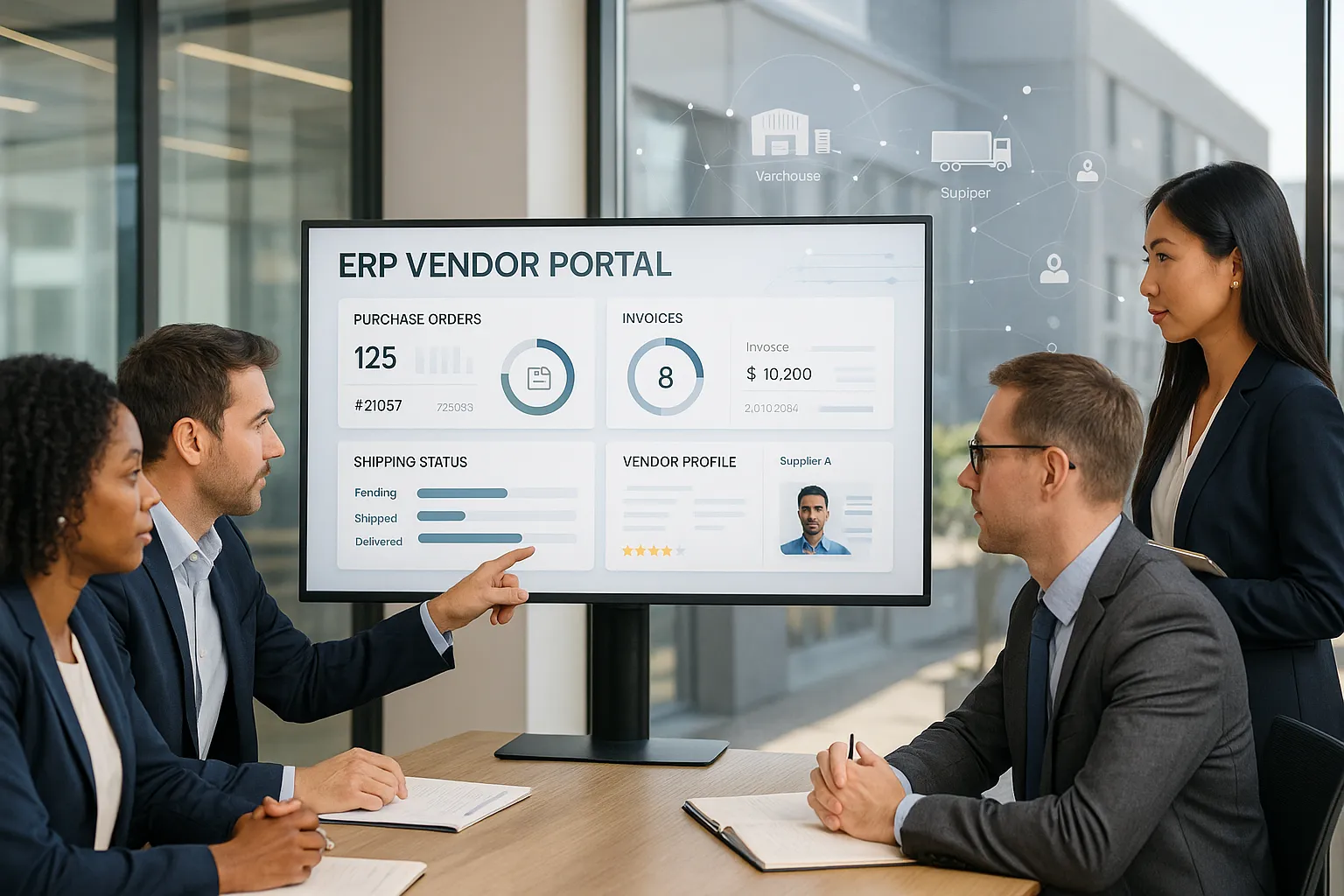
An ERP Vendor Portal is a digital gateway where businesses and their suppliers interact in real time. Think of it as a secure online office where purchase orders, invoices, shipping details, and compliance documents live. Instead of scattered email chains and phone calls, vendors log in, view their transactions, and update information directly in the system.

The concept grew out of the early days of ERP tools, when companies like SAP and Oracle pioneered integrated business software. Over time, businesses realized that it wasn’t enough to just manage internal data. Suppliers are an extension of the enterprise, and connecting them directly into the system was the next logical step. Today, ERP vendor portals are a core component of resource planning software, whether offered by giants like NetSuite or modern platforms such as ERPbyNet.

Core Features of an ERP Vendor Portal

Core Features of an ERP Vendor Portal

Centralized Dashboards

Vendors and managers access one shared interface, displaying purchase orders, invoices, delivery timelines, and status updates. Dashboards reduce the “where is that file?” problem and give every user clear visibility.

Document Management

Modern portals support secure uploads, version control, and e-signatures. Whether it’s tax certificates, compliance forms, or contracts, everything is stored with proper roles and permissions.

Order and Invoice Tracking

Vendors can confirm orders, submit invoices, and check payment status without repeatedly contacting your finance team. Automated updates keep everyone aligned.

Communication Tools

Rather than bouncing between email and chat, portals often integrate direct messaging, automated notifications, or even APIs that sync with existing ERP platforms.

Role-Based Access Control

Suppliers see only the data relevant to them. Internal teams manage permissions to ensure security and compliance across all vendor interactions.

Integration with ERP Modules

Since the vendor portal is part of the larger ERP system, it ties into accounting modules, inventory management, and HR automation where vendor records intersect. This integration reduces friction and keeps business software unified.

Read More : The Evolution of MRP Systems: From Legacy Tools to Cloud-Based Platforms

Benefits of ERP Vendor Portals

Benefits of ERP Vendor Portals

Eliminate Manual Data Entry

Re-entering supplier details across multiple spreadsheets isn’t just boring—it’s risky. One typo in a vendor’s bank details or delivery schedule can cost thousands. With an ERP Vendor Portal, all vendor information lives in one secure system and updates flow automatically across departments.
Key advantages:

  • Fewer errors from duplicate entries

  • Faster purchase order processing

  • Real-time synchronization with finance and inventory modules

  • Less admin overhead for procurement teams

Strengthen Supplier Relationships

A vendor portal isn’t just a piece of software—it’s a trust-building tool. Suppliers value transparency, and when they can see their order history, invoices, and payment status without chasing your team, the partnership deepens. Disputes shrink because expectations are clear.
How it helps:

  • Vendors check statuses 24/7 without waiting on emails

  • Shared visibility builds accountability on both sides

  • Faster dispute resolution keeps projects on track

  • Stronger vendor loyalty leads to better pricing and service

Save Time and Cut Costs

Time is money, and vendor portals save plenty of both. By streamlining procurement workflows, your staff spend less time chasing signatures and more time optimizing operations. Gartner reports double-digit efficiency gains for companies adopting ERP-linked portals.
Cost/time savings examples:

  • Reduced invoice processing time (from days to hours)

  • Lower administrative costs by automating document handling

  • Shorter procurement cycles, speeding up product launches

  • Clear audit trails that save time during financial reviews

Ensure Compliance and Reduce Risk

Vendor compliance is often a ticking time bomb—one missing certificate can derail a contract. A portal keeps everything centralized and up to date, complete with reminders for renewals and automated audit trails.
Risk management features:

  • Automated alerts for expiring certifications

  • Secure storage of tax forms and contracts

  • Role-based access to protect sensitive vendor data

  • Instant audit-ready records, reducing penalties and delays

Scale With Confidence

Growth is exciting, but managing vendors at scale is overwhelming without the right tools. What works for 10 suppliers falls apart when you reach 100. ERP Vendor Portals are designed to grow alongside your business, handling complexity without adding unnecessary overhead.
Scalability benefits:

  • Onboard new suppliers quickly with standardized workflows

  • Manage multi-location vendors without communication gaps

  • Support global supplier networks with currency and tax flexibility

  • Handle higher transaction volumes without additional staff

Read More : Understanding the Role of Bill of Materials (BOM) in Elevator Manufacturing with ERP

Common Business Pain Points Solved

  • Inventory Shortages: Multi-location businesses often suffer stock-outs because suppliers don’t update delivery delays quickly. Portals provide real-time updates that prevent surprises.

  • Payment Confusion: Finance teams spend days reconciling invoices. Vendor portals allow suppliers to check payment status directly, eliminating “when will I get paid?” calls.

  • Data Silos: Procurement, finance, and operations all need the same vendor information. Portals eliminate silos by creating one shared source of truth.

  • Compliance Failures: Missing documents can cause costly penalties. Automated alerts in the portal ensure vendors keep certifications and documents up to date.

Best Practices for Successful ERP Vendor Portal Adoption

1. Start with Vendor Education

A portal is only as strong as the people using it. Provide clear training, easy-to-follow onboarding guides, and open channels for vendor feedback.

2. Customize Access Levels

Not every supplier needs the same visibility. Tailor dashboards, roles, and permissions to different vendor categories to keep data secure and relevant.

3. Integrate Across ERP Modules

Ensure that the vendor portal connects seamlessly to your accounting, inventory, and HR systems. This avoids duplicate work and gives you true automation.

4. Prioritize User Experience

If the portal feels clunky, vendors won’t use it. Choose intuitive interfaces with simple navigation, clean dashboards, and mobile-friendly access.

5. Automate Notifications and Workflows

Set up alerts for expiring documents, delayed shipments, or pending payments. Automation reduces human error and ensures smoother supplier collaboration.

6. Measure ROI and Adoption Rates

Track key metrics: vendor participation, time saved in procurement, invoice accuracy, and reduction in disputes. These benchmarks demonstrate the tangible value of the portal.

Read More : Top 10 ERP Implementation Mistakes and How to Avoid Them

Real-World Scenario

Consider a mid-sized retail company with 50 suppliers across three countries. Before adopting an ERP vendor portal, purchase orders were sent via email, invoices were processed manually, and compliance documents were tracked on shared drives. Errors were frequent, and the finance team spent 20 hours each week chasing paperwork.

After implementing an ERPbyNet vendor portal, suppliers onboarded within days, invoices synced automatically to accounting modules, and procurement staff cut administrative time by 60 percent. Vendors appreciated the transparency, leading to stronger partnerships and faster deliveries. The company grew its supplier base by 30 percent without adding extra back-office staff.

Looking Ahead: The Future of ERP Vendor Portals

ERP vendor portals are evolving beyond simple transaction hubs. Artificial intelligence is beginning to predict supplier risks, while low-code tools make it easier to tailor workflows without heavy IT involvement. Compliance readiness, once an afterthought, is now built into the design. As ERP systems move toward greater automation, vendor portals will become not just a convenience but a necessity for competitive businesses.

Ready to Take Control of Supplier Chaos?

Supplier management doesn’t have to feel like a juggling act of spreadsheets, emails, and last-minute fire drills. With an ERP Vendor Portal, you gain clarity, transparency, and efficiency—all in one place. From reducing costly errors to building stronger vendor partnerships, the impact extends across every corner of your business.

At ERPbyNet, we specialize in turning supplier management from a constant headache into a streamlined, growth-ready system. Our ERP solutions are designed to scale with your business, giving you the tools to stay compliant, cut costs, and keep suppliers aligned.

Don’t let outdated processes slow you down. It’s time to simplify, centralize, and take control.
Start your journey with ERPbyNet today—and transform the way you work.

FAQs

What is an ERP Vendor Portal?

It’s a secure online platform where businesses and their suppliers collaborate on orders, invoices, documents, and compliance requirements within the ERP system.

How does an ERP Vendor Portal differ from a supplier portal?

The terms are often used interchangeably, but an ERP Vendor Portal is integrated directly into ERP software, connecting procurement with accounting, inventory, and other business modules.

Do small businesses really need a vendor portal?

Yes, even smaller businesses benefit. A portal reduces manual admin, builds stronger supplier relationships, and prepares your operations to scale without adding back-office staff.

What are the most important features to look for?

Dashboards, document management, order tracking, role-based access, and integration with core ERP modules are the essentials. Automation and notifications are also highly valuable.

How long does it take to implement a vendor portal?

Implementation time depends on business size and complexity. Some companies can onboard vendors within weeks, while larger rollouts may take a few months.

What’s the ROI of adopting an ERP Vendor Portal?

Businesses typically see faster order processing, fewer errors, reduced admin hours, and stronger vendor relationships. Over time, the portal pays for itself by cutting costs and improving scalability.


CategoriesERP (Enterprise Resource Planning)

ERP for Elevator Service Companies: Managing Contracts, Technicians & SLAs

Elevator service companies live at the intersection of urgency and precision. Clients expect quick responses, flawless maintenance, and transparent service records—yet behind the scenes, many providers are still juggling outdated spreadsheets, scattered files, and disconnected tools. What starts as a manageable system for a small team quickly turns into operational chaos once the business begins to scale.

Annual Maintenance Contracts (AMCs) slip through unnoticed, technicians lose hours due to poor scheduling, and Service Level Agreements (SLAs) are breached simply because managers lack real-time visibility. The result? Lost revenue, frustrated clients, and overworked staff who spend more time chasing data than delivering value.

The problem isn’t skill or dedication—it’s the lack of a centralized system to hold everything together. This is where Enterprise Resource Planning (ERP) comes in. At ERPByNet, we’ve seen firsthand how a well-designed ERP platform transforms elevator service companies by streamlining contract management, empowering technicians, and ensuring SLA compliance with precision.

The Unique Challenges of Elevator Service Companies

The Unique Challenges of Elevator Service Companies

1. AMC Contract Management: The Silent Profit Killer

Annual Maintenance Contracts (AMCs) are the backbone of an elevator service business. They ensure steady revenue and long-term client relationships. But here’s the catch: every contract has unique terms, renewal dates, pricing, and compliance obligations. Managing these manually is like trying to track hundreds of Netflix subscriptions with sticky notes.

Without a structured system:

  • Renewals get missed, leading to revenue leakage.
  • Service teams accidentally provide free service on expired contracts.
  • Disputes arise because terms and conditions aren’t accessible to technicians in the field.

In short: poor contract visibility equals lost money.

2. Technician Scheduling: The Domino Effect

Elevator downtime isn’t just an inconvenience—it’s a safety hazard and a PR nightmare for your client. Tenants stuck in lobbies quickly turn into angry calls to building management, which turn into urgent escalations to you.

But assigning technicians is harder than it sounds:

  • Who’s available?
  • Who has the right part in stock?
  • Who’s closest to the client site?

Without ERP, most companies use phone calls, WhatsApp groups, or whiteboards to allocate work. The result? Overlap, idle time, and wasted fuel costs. A poorly managed schedule creates a domino effect where one delayed job snowballs into five missed ones.

3. SLA Compliance: The Client’s Stopwatch

Service Level Agreements (SLAs) are the contracts within the contract. A client might sign an AMC, but what they really care about is this: “When my elevator breaks down, how fast will you fix it?”

SLAs typically specify:

  • Response time (e.g., within 2 hours)
  • Resolution time (e.g., within 24 hours)
  • Uptime guarantee (e.g., 99.5% availability)

Failing an SLA means penalties, strained client trust, and sometimes contract termination. When service tickets are logged manually, it’s almost impossible to ensure compliance at scale.

Read More : Why ERP Projects Go Over Budget [And How To Prevent It]

ERP: The Control Room of Elevator Services

Think of ERP as the elevator control system of your business. Just as a control panel ensures the elevator goes to the right floor at the right time, ERP ensures your contracts, technicians, and SLAs move in sync.

Centralized Contract Management

With ERP:

  • Digital Contract Vault: Every AMC is digitized and searchable.
  • Renewal Reminders: Automated alerts notify your sales or ops team months in advance.
  • Linked Payments: Invoices, receipts, and payment milestones are tied directly to the contract.
  • Compliance Tracking: Warranty clauses, parts coverage, and SLA terms are visible to both managers and technicians.

This eliminates the silent profit leaks of missed renewals and unmanaged contracts.

Smart Technician Scheduling

ERP turns scheduling into a science:

  • Real-Time GPS Tracking: Assign the nearest available technician, reducing travel time.
  • Skill-Match Allocation: A technician certified in high-rise elevators isn’t sent to a basic 4-floor lift repair.
  • Shift Management: HR automation ensures no technician is overbooked or underutilized.
  • Mobile Apps: Field staff update job status, used parts, and client signatures directly into the ERP system.

The result: faster response times, happier technicians, and even happier clients.

SLA Monitoring in Real-Time

ERP doesn’t just track SLAs—it enforces them:

  • Timers Start Automatically: The moment a ticket is raised, the SLA clock begins.
  • Escalation Alerts: Managers get notified when deadlines are at risk.
  • Dashboard Reports: SLA compliance rates can be tracked by technician, region, or client.
  • Client Transparency: Some ERP platforms even provide customer portals where clients see ticket status in real time.

Instead of firefighting, managers get proactive control.

Read More : ERP for Elevator Company: Solving the Service Headache Every Firm Faces

Real-World Impact: A Case Study

Consider a mid-sized elevator service provider handling 600+ AMC contracts across three cities. Before ERP, they:

  • Lost nearly 20% of contracts annually due to missed renewals.
  • Averaged 4+ hours response time because technician assignments were manual.
  • Paid over $150,000 in SLA penalties in one year alone.

After implementing ERPByNet’s custom ERP solutions:

  • AMC Renewal Rates jumped by 35% thanks to automated reminders.
  • Response Times fell to 1.5 hours with GPS-based assignments.
  • SLA Compliance hit 92%, saving over $200,000 in penalties annually.

The system didn’t just improve efficiency—it restored client confidence and unlocked scalability.

Read More : The Benefits of Automating Your AMC Contracts and Why You Need to Switch Now

ERP Market Insights

According to Statista, the global ERP market will exceed $123 billion by 2030, fueled by industries moving away from fragmented tools toward integrated platforms【Statista】.

Meanwhile, Gartner predicts that by 2026, over 60% of service-based companies will deploy ERP systems enhanced by AI and analytics【Gartner】. For elevator service companies, this shift isn’t optional—it’s survival.

ERP vs Traditional Tools: The Brutal Truth

Feature Spreadsheets & Standalone Tools ERP Platforms (ERPByNet)
AMC Contract Tracking Manual, error-prone Automated, centralized
Renewal Management Easily overlooked Reminder alerts & auto-renew options
Technician Allocation Phone calls, guesswork GPS, skill-based, optimized
SLA Monitoring Manual logs, after-the-fact Real-time dashboards, alerts
Reporting Delayed, fragmented Instant, unified
Scalability Breaks after ~100 contracts Designed for growth

How Data Flows in an ERP for Elevator Service Companies

How Data Flows in an ERP for Elevator Service Companies

Picture this: a tenant in a high-rise calls your helpline because the elevator is stuck. In a traditional setup, panic sets in—phone calls fly, files are searched, technicians are tracked down manually. But with ERP, the process is as smooth as the elevator ride itself.

Here’s how the flow works, step by step:

Step 1: The client request lands in the system
Instead of sticky notes or email chaos, every service request is logged directly into the ERP. No double entries, no lost messages—just a clean digital record.

Step 2: The ticket instantly connects to the AMC contract
The system automatically pulls in contract details: coverage type, warranty clauses, and SLA terms. This ensures your team knows whether the service is billable, covered, or due for renewal.

Step 3: SLA timer starts ticking
The ERP doesn’t wait for a human reminder—it knows your promises. A built-in timer begins counting down the response and resolution time.

Step 4: The nearest skilled technician gets the job
No more guesswork. Using GPS tracking and skill-based matching, the system assigns the technician who is closest and best qualified to handle the issue. Efficiency meets expertise.

Step 5: Technician updates everything on the go
Through a mobile app, the technician logs arrival time, work progress, parts used, and even captures the client’s digital signature. Managers see updates in real time—no paperwork bottlenecks.

Step 6: SLA compliance is monitored live
As the technician works, the system continues to track SLA performance. If a deadline is at risk, managers receive instant alerts so they can intervene before it becomes a breach.

Step 7: The invoice is generated automatically
Once the job is closed, the ERP prepares an invoice linked directly to the AMC terms—removing delays, errors, and awkward client disputes.

Step 8: Management dashboards light up with insights
At the end of the cycle, managers can see the big picture: service times, technician performance, contract profitability, and SLA compliance—all in one dashboard.

 This seamless flow ensures no job slips through the cracks. From the moment the client calls to the moment the invoice is paid, ERP acts like the brain of your service company—coordinating, tracking, and optimizing every step.

Beyond the Basics: What Else ERP Unlocks

  • Inventory Management Automation: Keep spare parts stocked, avoid downtime from unavailable components.
  • Integrated Accounting Modules: Syncs directly with service jobs, eliminating billing delays.
  • HR Automation: Manage payroll, shifts, and training certifications.
  • IoT & API Integration: Connect ERP with smart elevators for predictive maintenance.

Conclusion: Elevating Service with ERP

Running an elevator service company without ERP is like managing a high-rise without a control system—chaos is inevitable. With ERPByNet, companies gain the ability to track contracts, schedule technicians intelligently, and deliver SLA promises without sleepless nights.

The future of ERP is even brighter, with AI-driven scheduling, predictive maintenance, and low-code automation already redefining service industries. Those who adopt today will be the trusted leaders tomorrow.

At ERPByNet, we empower businesses to run smarter with ERP solutions that scale as you grow. Ready to simplify your operations? Let’s transform your workflow.

FAQs

1. What is ERP for elevator service companies?

It’s specialized business software that centralizes AMC contracts, technician scheduling, and SLA monitoring—replacing spreadsheets and isolated tools.

2. How does ERP help with AMC renewals?

It tracks expiry dates, sends automatic reminders, and links payments directly to contracts, ensuring zero missed renewals.

3. Can ERP track technician productivity?

Yes. GPS and mobile apps let managers track routes, service completion, and even spare parts used—giving complete visibility.

4. How does ERP improve SLA compliance?

By starting timers automatically, sending alerts, and generating reports, ERP ensures deadlines are consistently met.

5. Is ERP suitable for small service firms?

Absolutely. Cloud-based ERP scales to your size—you pay only for features you need.

6. Does ERP integrate with IoT elevators?

Yes. Modern ERP platforms connect with IoT-enabled systems, making predictive maintenance possible.

CategoriesERP (Enterprise Resource Planning)

ERP for Engineering Companies: Managing Design, Cost, and Resources

ERP for Engineering turns fragmentation into flow. Engineering organizations don’t stumble from lack of ingenuity; they leak value through version confusion, spreadsheet sprawl, and tool silos that scramble design, cost, and capacity signals. The fix isn’t another add-on—it’s a shared backbone that centralizes inventory management, project costing, accounting, quality, and the shop floor in one place. With controlled revisions, role-based permissions, real-time dashboards, and open APIs, data moves once and stays trustworthy, so leaders see risk early, planners schedule with confidence, and finance protects margins before they slip.

That clarity makes growth repeatable: multi-level BOMs aligned with CAD, capacity plans grounded in reality, and projects tied to live costs and revenue. At ERPByNet, we empower businesses to run smarter with custom-fit ERP solutions that scale as you grow. Ready to simplify your operations? Let’s transform your workflow. The sections ahead show how to connect design, cost, and resources into one operating rhythm.

Why ERP exists (and why engineers should care)

Before “ERP,” there was MRP—Material Requirements Planning from the 1960s that translated demand into parts and schedules. The 1980s added capacity planning (MRP II). By the 1990s, Enterprise Resource Planning stretched past the plant into finance, HR, sales, and supply chain—the whole business. Today, ERP sits at the heart of your business software stack, where dashboards, APIs, roles, and permissions centralize data and decisions. In engineering companies, that means one source of truth from CAD to cash.

You’ll hear names like SAP, Oracle, NetSuite, and Zoho ERP. They differ in scope and complexity, but the goal is the same: streamline, optimize, and centralize operations so you reduce friction between good engineering and profitable delivery.

The engineering reality: five pains ERP fixes

The engineering reality: five pains ERP fixes

1) Design changes ricochet through costs and deadlines

The pain: A late ECO tweaks a sub-assembly. Procurement buys the wrong rev; production builds the old one; finance books rework; engineering gets the blame.
How ERP helps: Multi-level BOMs with robust revision control tie each ECO to cost roll-ups and effective dates. Purchasing only sees approved revs; WIP updates when a change is released; margin impact appears in the project P&L before anyone picks up a tool.

2) Multi-location inventory creates hidden shortages

The pain: You have stock on paper but not at the right site. Expedites eat margins; customers see delay, not complexity.
How ERP helps: Real-time availability by location, lot/serial tracking, and reorder points per site. Transfer orders are planned, not panicked. For project-based work (ETO/MTO), soft-allocate critical parts to projects so engineering changes don’t starve other builds.

3) Project costing is fuzzy until it’s too late

The pain: You quote 22% gross margin and close at 9%. Hours leak, subcontractor invoices surprise you, and procurement buys alternates not reflected in the quote.
How ERP helps: Project accounting captures labor, materials, and overhead to the right WBS in real time. Cost-to-complete forecasts update with timesheets and purchase receipts. Use earned value (EV, CPI/SPI) to course-correct mid-build, not post-mortem.

4) Compliance and traceability drain attention

The pain: You’re juggling ISO 9001, aerospace/medical documentation, and customer audits. Paper trails and file shares aren’t audit-ready.
How ERP helps: Quality modules attach non-conformances to lots/serials, capture inspections at receiving and in-process, and auto-generate certificates and travelers. Roles and permissions limit who can release a rev. Audit logs are built-in.

5) People scheduling and capacity are guesswork

The pain: Your best planner is a superhero with a whiteboard and three calendars. Overtime spikes, weekends vanish, and somehow jobs still collide on the same machine.
How ERP helps: Finite capacity planning schedules by work center and skill. HR automation and time capture feed actual vs. planned hours, so you can balance workloads, cross-train intelligently, and quote lead times you’ll hit.

Read More : ERP for Elevator Company: Solving the Service Headache Every Firm Faces

How ERP connects CAD to cash (the data model that matters)

  1. Design & PLM: CAD/PLM publish controlled BOMs and revisions into ERP via APIs.
  2. Engineering & Methods: Routings, work instructions, and inspection plans attach to rev-controlled items.
  3. Quote to Order: Estimating pulls accurate BOMs and routings; margin modeling includes purchase price variance and subcontracting.
  4. Procurement & Inventory: Approved vendor lists and lead times drive MRP; dock-to-stock inspection closes the loop.
  5. Production: Execution scans serials/lots; dashboards show throughput and bottlenecks.
  6. Finance: Project and job costs hit the right GL; revenue recognition aligns with milestones or shipments.
  7. Service/Field: As-built data becomes as-maintained; warranties and spares link back to the original design.

ERP vs. traditional tools (why spreadsheets eventually lose)

Capability Spreadsheets & Point Apps Modern ERP
Revision control File names & human memory Item/BOM revs with effectivity & audit trail
Project margin visibility After-the-fact Real-time with labor, materials, overhead
Capacity planning Whiteboards & gut feel Finite scheduling with constraints
Multi-site inventory Separate systems One ledger; transfers & allocations
Compliance Paper trails Embedded NC/CAPA, document control, e-sign
Forecasting Manual MRP, demand planning, simulations
Security Shared folders Role-based permissions and approvals

Read More : How ERP Travel Tracking Improves Productivity and Cuts Costs

Choosing the right ERP for engineering: a practical comparison

Vendor (example) Best-fit snapshot Strength highlights Typical complexity
SAP S/4HANA Large/global engineering & discrete manufacturing Deep industry content, strong compliance, powerful analytics Higher—suited to complex, multi-national footprints
Oracle NetSuite Fast-growing multi-site SMEs Unified suite (finance, supply chain, projects), fast deployment Medium—broad functionality with partner ecosystem
Microsoft Dynamics 365 Mid-market to enterprise Familiar UX, extensibility with Power Platform Medium to higher—varies by module mix
Zoho ERP (Zoho suite) Smaller teams & startups Cost-effective, integrated CRM/finance, quick wins Lower—lighter depth but fast time-to-value

Tip: For CAD/PLM-heavy environments, assess native connectors and partner solutions for SolidWorks, Inventor, Creo, or Altium. Look for API depth, webhook support, and prebuilt adapters to minimize custom glue code.

What ROI looks like (with numbers you can defend)

When ERP replaces fragmented tools—especially in product-centric industries—payback is measurable. A Forrester Total Economic Impact study (commissioned) on a manufacturing-focused cloud suite reported 114% ROI, 30% productivity lift in warehouse/operations roles, and a 70% reduction in revenue leakage from stronger financial integrity and insights. Infor+1dam.infor.com

Cloud ERP also reduces lifecycle costs by shifting maintenance and upgrades to the vendor. As Gartner notes, cloud ERP typically operates on a single code line with the provider responsible for keeping customers current—meaning fewer disruptive patch projects and more predictable access to new capabilities. Gartner

Implementation playbook for engineering companies

Implementation playbook for engineering companies

Phase 0: Business case & scope you can stick to

  • Pick the outcomes: “Cut ECO cycle time by 40%,” “Reduce expediting by 60%,” “Hit 95% OTD.”
  • Map your golden threads: Choose one or two product families, one site, and a representative project type (ETO/MTO).
  • Stage the rollout: Finance + Inventory + Projects first; advanced planning and quality next.

Phase 1: Design the data model

  • Items & BOMs: Normalize naming, units, alternates, and revisioning.
  • Routings: Standardize work centers and labor categories so schedules and costs are meaningful.
  • Chart of accounts & project structure: Align WBS to how you recognize revenue and manage cost-to-complete.

Phase 2: Integrations that matter

  • CAD/PLM → ERP: Decide what’s master where. Typically, PLM masters engineering BOMs; ERP masters purchasing and production BOMs.
  • Time capture & HR: Make it painless. Mobile or terminal entry against operations/WBS reduces variance headaches.
  • Supplier collaboration: Use vendor portals or EDI for confirmations, ASNs, and quality feedback.

Phase 3: Change management (the real project)

  • Super-users by function: Engineering, planning, purchasing, finance, quality.
  • Simulation weeks: Run MRP and schedules on sandbox data; fix master data before go-live.
  • Cutover rehearsal: Dry-run receiving, job travelers, and first article inspection so Day-1 isn’t a trust fall.

Read More : How to Manage Inventory, Technicians & Invoices in One ERP Dashboard

Deep-dive use cases for engineering-led firms

A. Multi-site, multi-revision BOM control

Scenario: A product line has three customer variants and two engineering revs in play.
Solution: Use effectivity dates and revision status to keep purchasing and production synchronized. Variant management avoids duplicating whole BOMs; only deltas change.

B. Subcontracting and special processes

Scenario: Heat-treat and coating happen outside. Paperwork lags parts.
Solution: Subcontract operations exist in the routing; POs tie to specific job steps; serials follow the part; quality checks resume on receipt.

C. Project cash flow & milestone billing

Scenario: 9-month ETO contract with retainage.
Solution: Project accounting with milestone billing, retainage tracking, and earned value. Procurement and time entries feed cost-to-complete forecasts automatically.

D. Engineering services + product mix

Scenario: Half your revenue is NRE or field retrofits.
Solution: Use service and projects modules so time and materials hit the right contract; spares link to installed base and warranty rules.

What to measure (and how soon)

Track these six KPIs from month one:

  1. On-time delivery (customer-level)
  2. Engineering change cycle time (request → release)
  3. Inventory turns and days on hand by class
  4. Expedite count and premium freight spend
  5. Quote accuracy vs. actual margin
  6. Schedule adherence at critical work centers

Expect a noisy first month. By quarter two, data quality stabilizes; by quarter three, planning improvements show up in inventory and expedite metrics; by year one, margin variance narrows.

Comparing ERP features engineers actually use

Feature Why it matters What “good” looks like
Multi-level BOM with effectivity Prevents old-rev builds Date/serial effectivity + ECO links + where-used
APS / finite scheduling Promises you can keep Constraint-aware with what-if simulation
Project accounting Margin visibility WBS-level cost, revenue, EAC, earned value
Quality & traceability Compliance without chaos NC/CAPA tied to serials/lots + doc control
Native CAD/PLM connectors Fewer manual steps Bi-directional updates + change workflows
Analytics & dashboards Decisions on time Role-tailored KPIs; drill-downs to transactions
Open APIs Extend, don’t contort REST services; events/webhooks; secure roles

Read More : How ERP Helps Small Elevator Businesses Operate Like Big Players?

Adoption trends shaping your plan

  • Cloud first for resilience: Staying current is a business advantage. Cloud ERP providers keep customers on the latest release while managing infrastructure and patches—reducing upgrade risk and operational drag. Gartner
  • Value over vanity: Anchor the program to operational KPIs and margin. Independent TEI analysis shows triple-digit ROI is achievable when execution discipline and data quality are in place. Infordam.infor.com

Common pitfalls (and how to dodge them)

  1. Scope sprawl: If everything is priority-1, nothing is. Time-box releases.
  2. Underestimating master data: Bad items and vendors equal bad plans and bad buys.
  3. DIY everything: Configuration is smart; heavy custom code becomes technical debt.
  4. No executive drumbeat: Weekly steering isn’t micromanagement; it’s signal over noise.
  5. Skipping training: On-screen work instructions and in-app help beat PDFs no one opens.

Stop the Fire Drills—Start Your ERP Momentum

Ready to trade Excel chaos for calm execution? Book a 30-minute discovery with ERPByNet and bring your biggest blocker—ECO churn, multi-site inventory, or slipping project margins. We’ll walk a single live job end-to-end, tracing CAD → BOM → purchasing → shop floor → invoice to surface the leaks that quietly drain time and margin. In one focused session, you’ll see where data breaks, where approvals stall, and where costs wander off the quote—so action is obvious and momentum starts now.

You’ll leave with a crisp, 90-day roadmap that names owners, dates, and success metrics, plus a pilot plan that stands up the essentials (items/BOMs, inventory, projects) to prove the win on real work. From there, we scale into planning, quality, and analytics with confidence. We help engineering leaders achieve predictable delivery and margin control through cloud-first ERP that connects design to the shop floor. Talk to our experts today—make engineering boring, in the best possible way.

FAQs

Still have questions about ERP and how it fits your business? Let’s clear them up.

1) Do I need PLM and ERP, or can ERP handle design control?

If you have frequent ECOs and regulated documentation, PLM is the right home for design history and approvals, while ERP owns purchasing, production BOMs, and costs. The two should sync through APIs so released revisions flow cleanly into planning and purchasing.

2) How long does an ERP rollout take for a 150-person engineering firm?

A focused first phase (finance, items/BOMs, purchasing, inventory, projects) commonly lands in 4–6 months with clean data and limited customizations. Advanced planning and quality typically follow in phase two. Timelines shrink when you standardize master data early.

3) What does “cloud ERP” practically change for my team?

Upgrades stop being mini-projects. The provider keeps your environment current on a single code line, so you get new features without weekend cutovers. Security patches and performance tuning are centralized, and remote access is straightforward. Gartner

4) We make engineered-to-order products. Can ERP handle one-off designs?

Yes. Use project structures (WBS), configurable BOMs/routings, and effectivity dates. Tie quotes to real routings and standard operations so estimates match how you actually build. Subcontract steps (like coating or heat-treat) should be explicit in routings.

5) What ROI should we expect—and when?

Early wins show up as fewer expedites, better inventory turns, and cleaner margin visibility. Forrester’s TEI shows strong ROI within 12–24 months for a representative manufacturing suite when governance and change control are in place. Infordam.infor.com

6) How do we reduce the risk of “ERP becoming a monster project”?

Lock scope to outcomes, choose a pilot value stream, and appoint empowered super-users. Run conference-room pilots with real data, rehearse cutover, and keep weekly steering to remove roadblocks. Favor configuration over code, and insist on measurable KPIs.


Name
Verified by MonsterInsights