ERP Vendor Portals: Features, Benefits, and Best Practices
Every growing business knows the frustration of supplier chaos. Emails buried in inboxes, contracts floating across different folders, and vendors asking for updates that your team can’t find quickly. It feels like you’re running in circles, stuck in what some founders call “spreadsheet purgatory.”
Imagine it’s Friday afternoon. Your purchasing manager is chasing three suppliers for order confirmations while finance is scrambling to close the books. The warehouse is calling about a stock-out, and somewhere in between, another vendor is asking for payment status. This is what happens when communication relies on disconnected tools and outdated processes.
But there’s a smarter way forward. An ERP Vendor Portal centralizes supplier collaboration, improves visibility, and gives your business the kind of control that spreadsheets and ad-hoc emails can’t. At ERPbyNet, we’ve seen firsthand how companies transform supplier management when they put structure around their vendor relationships. This article explores exactly what an ERP Vendor Portal is, the features to look for, the benefits it delivers, and the best practices to make it a success.
What Is an ERP Vendor Portal?
An ERP Vendor Portal is a digital gateway where businesses and their suppliers interact in real time. Think of it as a secure online office where purchase orders, invoices, shipping details, and compliance documents live. Instead of scattered email chains and phone calls, vendors log in, view their transactions, and update information directly in the system.
The concept grew out of the early days of ERP tools, when companies like SAP and Oracle pioneered integrated business software. Over time, businesses realized that it wasn’t enough to just manage internal data. Suppliers are an extension of the enterprise, and connecting them directly into the system was the next logical step. Today, ERP vendor portals are a core component of resource planning software, whether offered by giants like NetSuite or modern platforms such as ERPbyNet.
Core Features of an ERP Vendor Portal

Centralized Dashboards
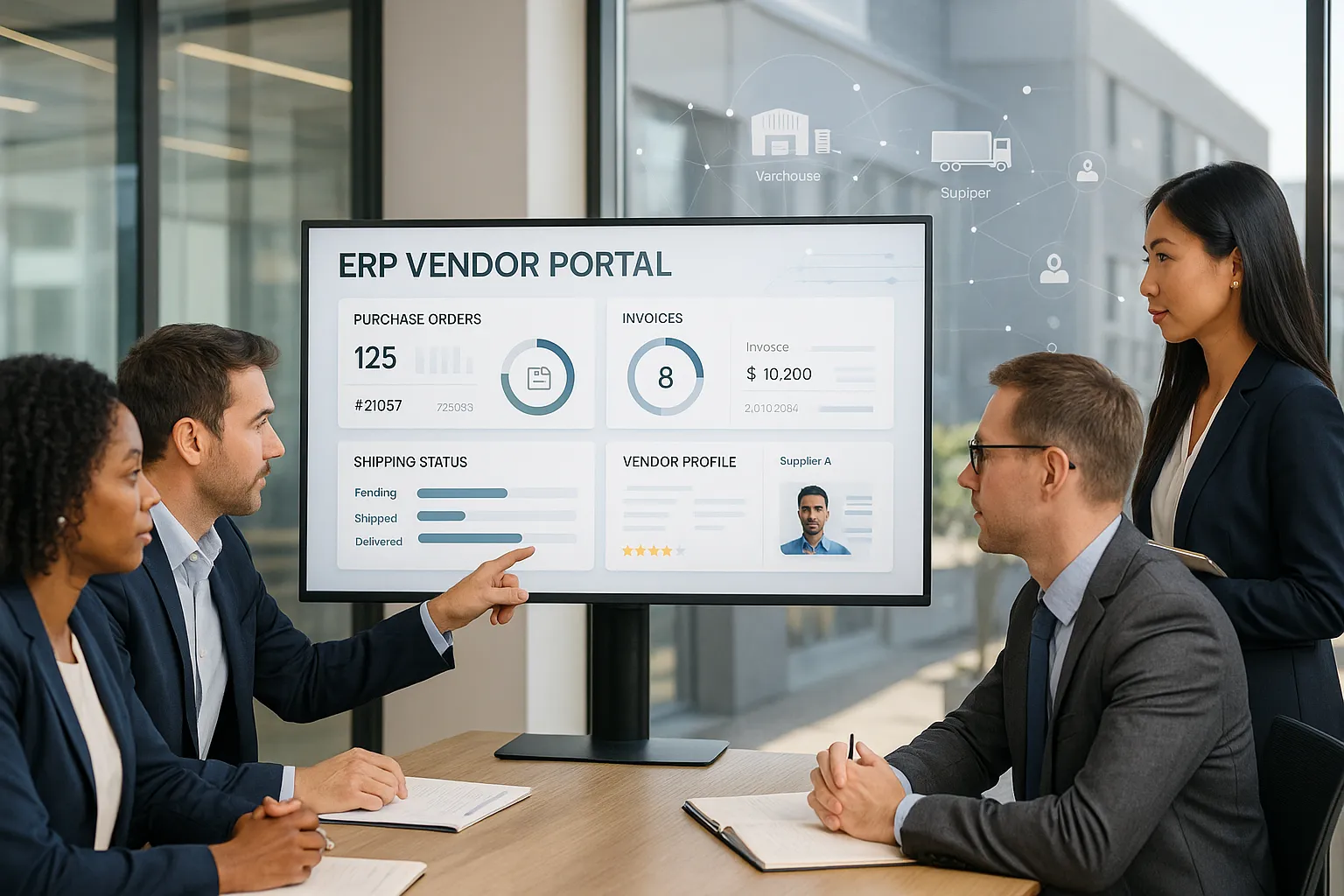
Vendors and managers access one shared interface, displaying purchase orders, invoices, delivery timelines, and status updates. Dashboards reduce the “where is that file?” problem and give every user clear visibility.
Document Management
Modern portals support secure uploads, version control, and e-signatures. Whether it’s tax certificates, compliance forms, or contracts, everything is stored with proper roles and permissions.
Order and Invoice Tracking
Vendors can confirm orders, submit invoices, and check payment status without repeatedly contacting your finance team. Automated updates keep everyone aligned.
Communication Tools
Rather than bouncing between email and chat, portals often integrate direct messaging, automated notifications, or even APIs that sync with existing ERP platforms.
Role-Based Access Control
Suppliers see only the data relevant to them. Internal teams manage permissions to ensure security and compliance across all vendor interactions.
Integration with ERP Modules
Since the vendor portal is part of the larger ERP system, it ties into accounting modules, inventory management, and HR automation where vendor records intersect. This integration reduces friction and keeps business software unified.
Read More : The Evolution of MRP Systems: From Legacy Tools to Cloud-Based Platforms
Benefits of ERP Vendor Portals

Eliminate Manual Data Entry
Re-entering supplier details across multiple spreadsheets isn’t just boring—it’s risky. One typo in a vendor’s bank details or delivery schedule can cost thousands. With an ERP Vendor Portal, all vendor information lives in one secure system and updates flow automatically across departments.
Key advantages:
- Fewer errors from duplicate entries
- Faster purchase order processing
- Real-time synchronization with finance and inventory modules
- Less admin overhead for procurement teams
Strengthen Supplier Relationships
A vendor portal isn’t just a piece of software—it’s a trust-building tool. Suppliers value transparency, and when they can see their order history, invoices, and payment status without chasing your team, the partnership deepens. Disputes shrink because expectations are clear.
How it helps:
- Vendors check statuses 24/7 without waiting on emails
- Shared visibility builds accountability on both sides
- Faster dispute resolution keeps projects on track
- Stronger vendor loyalty leads to better pricing and service
Save Time and Cut Costs
Time is money, and vendor portals save plenty of both. By streamlining procurement workflows, your staff spend less time chasing signatures and more time optimizing operations. Gartner reports double-digit efficiency gains for companies adopting ERP-linked portals.
Cost/time savings examples:
- Reduced invoice processing time (from days to hours)
- Lower administrative costs by automating document handling
- Shorter procurement cycles, speeding up product launches
- Clear audit trails that save time during financial reviews
Ensure Compliance and Reduce Risk
Vendor compliance is often a ticking time bomb—one missing certificate can derail a contract. A portal keeps everything centralized and up to date, complete with reminders for renewals and automated audit trails.
Risk management features:
- Automated alerts for expiring certifications
- Secure storage of tax forms and contracts
- Role-based access to protect sensitive vendor data
- Instant audit-ready records, reducing penalties and delays
Scale With Confidence
Growth is exciting, but managing vendors at scale is overwhelming without the right tools. What works for 10 suppliers falls apart when you reach 100. ERP Vendor Portals are designed to grow alongside your business, handling complexity without adding unnecessary overhead.
Scalability benefits:
- Onboard new suppliers quickly with standardized workflows
- Manage multi-location vendors without communication gaps
- Support global supplier networks with currency and tax flexibility
- Handle higher transaction volumes without additional staff
Read More : Understanding the Role of Bill of Materials (BOM) in Elevator Manufacturing with ERP
Common Business Pain Points Solved
- Inventory Shortages: Multi-location businesses often suffer stock-outs because suppliers don’t update delivery delays quickly. Portals provide real-time updates that prevent surprises.
- Payment Confusion: Finance teams spend days reconciling invoices. Vendor portals allow suppliers to check payment status directly, eliminating “when will I get paid?” calls.
- Data Silos: Procurement, finance, and operations all need the same vendor information. Portals eliminate silos by creating one shared source of truth.
- Compliance Failures: Missing documents can cause costly penalties. Automated alerts in the portal ensure vendors keep certifications and documents up to date.
Best Practices for Successful ERP Vendor Portal Adoption
1. Start with Vendor Education
A portal is only as strong as the people using it. Provide clear training, easy-to-follow onboarding guides, and open channels for vendor feedback.
2. Customize Access Levels
Not every supplier needs the same visibility. Tailor dashboards, roles, and permissions to different vendor categories to keep data secure and relevant.
3. Integrate Across ERP Modules
Ensure that the vendor portal connects seamlessly to your accounting, inventory, and HR systems. This avoids duplicate work and gives you true automation.
4. Prioritize User Experience
If the portal feels clunky, vendors won’t use it. Choose intuitive interfaces with simple navigation, clean dashboards, and mobile-friendly access.
5. Automate Notifications and Workflows
Set up alerts for expiring documents, delayed shipments, or pending payments. Automation reduces human error and ensures smoother supplier collaboration.
6. Measure ROI and Adoption Rates
Track key metrics: vendor participation, time saved in procurement, invoice accuracy, and reduction in disputes. These benchmarks demonstrate the tangible value of the portal.
Read More : Top 10 ERP Implementation Mistakes and How to Avoid Them
Real-World Scenario
Consider a mid-sized retail company with 50 suppliers across three countries. Before adopting an ERP vendor portal, purchase orders were sent via email, invoices were processed manually, and compliance documents were tracked on shared drives. Errors were frequent, and the finance team spent 20 hours each week chasing paperwork.
After implementing an ERPbyNet vendor portal, suppliers onboarded within days, invoices synced automatically to accounting modules, and procurement staff cut administrative time by 60 percent. Vendors appreciated the transparency, leading to stronger partnerships and faster deliveries. The company grew its supplier base by 30 percent without adding extra back-office staff.
Looking Ahead: The Future of ERP Vendor Portals
ERP vendor portals are evolving beyond simple transaction hubs. Artificial intelligence is beginning to predict supplier risks, while low-code tools make it easier to tailor workflows without heavy IT involvement. Compliance readiness, once an afterthought, is now built into the design. As ERP systems move toward greater automation, vendor portals will become not just a convenience but a necessity for competitive businesses.
Ready to Take Control of Supplier Chaos?
Supplier management doesn’t have to feel like a juggling act of spreadsheets, emails, and last-minute fire drills. With an ERP Vendor Portal, you gain clarity, transparency, and efficiency—all in one place. From reducing costly errors to building stronger vendor partnerships, the impact extends across every corner of your business.
At ERPbyNet, we specialize in turning supplier management from a constant headache into a streamlined, growth-ready system. Our ERP solutions are designed to scale with your business, giving you the tools to stay compliant, cut costs, and keep suppliers aligned.
Don’t let outdated processes slow you down. It’s time to simplify, centralize, and take control.
Start your journey with ERPbyNet today—and transform the way you work.
FAQs
What is an ERP Vendor Portal?
It’s a secure online platform where businesses and their suppliers collaborate on orders, invoices, documents, and compliance requirements within the ERP system.
How does an ERP Vendor Portal differ from a supplier portal?
The terms are often used interchangeably, but an ERP Vendor Portal is integrated directly into ERP software, connecting procurement with accounting, inventory, and other business modules.
Do small businesses really need a vendor portal?
Yes, even smaller businesses benefit. A portal reduces manual admin, builds stronger supplier relationships, and prepares your operations to scale without adding back-office staff.
What are the most important features to look for?
Dashboards, document management, order tracking, role-based access, and integration with core ERP modules are the essentials. Automation and notifications are also highly valuable.
How long does it take to implement a vendor portal?
Implementation time depends on business size and complexity. Some companies can onboard vendors within weeks, while larger rollouts may take a few months.
What’s the ROI of adopting an ERP Vendor Portal?
Businesses typically see faster order processing, fewer errors, reduced admin hours, and stronger vendor relationships. Over time, the portal pays for itself by cutting costs and improving scalability.