CategoriesERP (Enterprise Resource Planning)

The Real Future of ERP: What Experts Say Actually Works

For years, ERP has been presented as the system that will fix everything: delays, miscommunication, inventory mismatch, production friction, sales reporting gaps, and financial blind spots. It has been sold as a cure, a replacement, a transformation button. But every industry expert agrees on one thing: traditional ERP is not enough anymore.

The future of ERP is not about complexity. It is about clarity. It is about systems that do not just record processes but improve them. It is about empowering leadership to act, not react. And most importantly, the future of ERP will be defined by what actually works, not what marketing teams promise.

What follows is an expert-level breakdown of the ERP landscape ahead — shaped around the philosophy behind ERPbyNet.

ERP Is Becoming a Business Operating System, Not Just Software

ERP as a business operating system instead of software, showing ERPbyNet as the central operational core for decision-making, process control, and organizational visibility.

The future of ERP is no longer defined by how many modules a system contains, but by how completely it supports the business it runs. The organizations that will succeed are those that stop treating ERP as software they use occasionally and start treating it as the operational core that every function relies on. The shift is fundamental: ERP is no longer a tool. It is infrastructure.

This evolution transforms how ERP is understood inside the company:

  • It is not an IT system to manage; it becomes a framework leadership depends on.
  • It is not a reporting repository; it becomes the source of directional decisions.
  • It is not an administrative backend; it becomes operational visibility in real time.
  • It is not automation for tasks; it becomes orchestration for outcomes.

This shift is driven by the speed and complexity of modern operations. As businesses expand products, suppliers, channels, geographies, compliance requirements, and customer expectations, disconnected systems create performance friction. Manual intervention cannot scale past a certain point. Spreadsheets cannot protect margins. Department-driven tools cannot protect cross-functional efficiency.

A business operating system solves that gap.
In this model, ERP becomes the environment the business runs inside:

  • Processes are standardized instead of improvised
  • Data is validated instead of interpreted
  • Workflows are aligned instead of isolated
  • Responsibilities are defined instead of assumed
  • Performance is visible instead of discovered too late

It turns the organization from a collection of departments into a coordinated system.

This is the intention behind ERPbyNet. The goal is not to give companies another platform with menus and modules. The goal is to establish a central operating layer where planning, execution, accountability, and correction are connected. ERPbyNet is positioned not as software that businesses access, but as the structural core they operate on.

When ERP becomes the business operating system, growth stops depending on individual effort and starts depending on scalable structure. That is the shift the future demands

The Real Drivers of Future of ERP Success Are Operational, Not Technical

When experts are asked why ERP projects fail or underperform, the reasons rarely point to features. They point to fundamentals. Future ERP success will depend on aligning operational realities before enabling system automation. The organizations that win will be the ones who:

  • Standardize before digitizing
  • Clarify accountability before dashboards
  • Validate process owners before integrating systems
  • Document workflows before configuring modules
  • Clean data before enabling analytics
  • Align departmental goals before approving budget

ERPbyNet’s methodology is built on readiness first, deployment second. When experts say that the system should not outrun the people operating it, this is what they mean.

Read More : Importance of ERP Integrations with Expense Management Software

ERP Is Transitioning from Data Storage to Decision Enablement

Legacy ERP systems capture what happened. Future ERP systems explain why it happened and what to do next. The shift is from historical reporting to forward-direction intelligence.

A decision-ready ERP focuses on:

  • Predictive warning, not reactive reporting
  • Operational friction alerts before production halts
  • Margin risk indication before financial statements
  • Inventory risk signals before shortages occur
  • Customer churn indicators before accounts close
  • Skill-capacity conflict flags before scheduling errors

ERPbyNet’s architecture is increasingly aligned with this direction — advisory reporting, insight layering, and contextual alerts built to change the outcome, not document it.

Generic ERP Will Lose Ground to Industry-Structured Frameworks

The future is not about one-size ERP. It is about right-size ERP.

Generic platforms force organizations to compromise:

  • Too many unused modules
  • Too much dependency on customization
  • Too much friction between system and workflow

Industry-structured ERP reverses that approach:

  • Deploys only what is relevant
  • Aligns with industry workflow logic
  • Scales based on operational maturity
  • Reduces cost by eliminating unnecessary scope

Examples of sector alignment include:

Sector Core Operational Priority ERPbyNet Alignment
Manufacturing Material planning, capacity alignment, BOM accuracy Production logic + planning intelligence
Construction BOQ flow, subcontract control, on-site visibility Contract + project-led execution
Trading & Distribution Inventory turns, reordering logic, freight Stock velocity + cost-to-serve control
Retail Multi-location sync, pricing control, shrinkage POS + channel visibility + SKU health
Service & Support SLA deadlines, ticket cost benchmarking Workforce allocation + churn prevention

ERPbyNet’s future direction is based on vertical evolution, not universal assumption.

Read More :Why Accurate Data Entry Matters—and How ERP Ensures It Automatically

Integration Will Become the Most Valuable Feature of ERP

The next era of ERP does not reward isolation. It rewards systems that can sit at the center and orchestrate the business ecosystem. ERP will need to integrate with:

  • CRM, support desks, ticketing systems
  • Accounting and compliance engines
  • IoT devices, shop-floor machines, asset sensors
  • eCommerce, marketplaces, billing gateways
  • Workforce planning and scheduling systems

ERPbyNet’s integration philosophy is not bolt-on connectivity. It is architecture-first compatibility — APIs designed for continuity, not patches.

When ERP becomes the point of connection, it becomes the point of control.

AI Will Not Replace Workers — It Will Replace Guesswork

There is a misconception that AI arriving in ERP means automation will replace labor. Experts disagree. AI will not replace employees. It will multiply the capability of those who know how to use it. AI’s true impact in ERP will be:

  • Demand prediction for supply chain planning
  • Production simulation before loading capacity
  • Probability scores for sales win-loss outcomes
  • Margin alerts connected to pricing sensitivity
  • Preventive quality failure notifications
  • Asset failure probability for maintenance timing

ERPbyNet’s approach to AI is practical: insights must be attached to financial relevance. There is no value in predictions that do not save cost.

Reporting Will Shift from Snapshots to Live Operational Narratives

The CFO of tomorrow will not wait for month-end reports. The COO will not wait for shift summaries. The planner will not wait for manual entries. The sales leader will not wait for CRM sync delays.

The future state of reporting is not monthly or weekly — it is continuous. The business will always know:

  • What is performing above expectation
  • What is dropping below threshold
  • What is about to break and why
  • Where cost leakage is building
  • Where capacity failures will occur
  • Where customer dissatisfaction is forming

ERPbyNet is engineered to become the narrative, not a late summary of it.

Cost Strategy, Not Cost Surprise, Will Decide ERP Adoption

ERP pricing has historically been a source of frustration. The future belongs to transparency. Organizations no longer accept:

  • Undefined customization scope
  • Undefined implementation duration
  • Undefined support boundaries
  • Undefined reporting expansion
  • Undefined integration charges

The new standard is clarity:

  • What is essential today
  • What becomes relevant post-adoption
  • What can be deferred without penalty
  • What ROI baseline leadership can expect

ERPbyNet structures its commercial framework around investment-return logic, not acquisition logic. The system is not purchased; it is justified.

Read more : How ERP Helps You Stay Ahead of Competitors With Faster Decisions

User Adoption Will Matter More Than System Capability

The future of ERP will not be won by the system with the most features. It will be won by the system people are willing to use every day. In every unsuccessful ERP project, the issue is rarely the software — it is the gap between what the system expects and what users are prepared to deliver.

A system becomes a liability when:

  • Users do not understand how it connects to their responsibilities
  • Processes feel harder inside the system than outside it
  • Navigation competes with productivity instead of supporting it

A system becomes an asset when:

  • Tasks become faster, not heavier
  • Output becomes more credible, not more questioned
  • Data becomes trusted, not manually corrected

In other words: adoption is the performance factor, not the afterthought.

Why Users Commit to an ERP

Users adopt a system when it directly improves the way they work. Adoption is created when the ERP:

  • Removes duplicated entries instead of multiplying steps
  • Clarifies responsibilities instead of creating dependency on IT
  • Highlights next actions instead of forcing users to search for them
  • Provides one truth instead of conflicting versions of data
  • Helps them perform with confidence instead of hesitation

At this stage, the ERP stops being a platform and becomes part of the operational identity of the company.

How ERPbyNet Engineers Adoption (Not Assumes It)

ERPbyNet does not introduce users to the system when configuration ends. It prepares them while configuration is still in progress. Adoption is built into the deployment architecture through:

Awareness First
Before a feature is taught, the reason for it is explained. People cannot adopt what they cannot contextualize.

Process Before Page
Users learn their workflow inside the system, not just where buttons are placed. Workflow replaces menu memorization.

Scenarios Over Screenshots
Training is built around real daily tasks — customer queries, production delays, purchase requests, stock adjustments — not abstract examples.

Responsibility by Capability
Ownership is handed over only after proficiency is demonstrated, not assumed.

The Result

When adoption is engineered, resistance decreases. Hesitation reduces. Output improves. Software dependency shifts into operational confidence. The ERP is no longer a system that users are forced to operate — it becomes the system they rely on to operate the business.

This is the difference between “ERP installed” and “ERP working.”

Read More :How ERP Helps You Stay Ahead of Competitors With Faster Decisions

Why ERPbyNet Fits the Direction Industry Experts Predict

The future ERP landscape has defined expectations. ERPbyNet aligns with those expectations as a platform built with intention:

Future ERP Expectation ERPbyNet Response
Business operating system Vertical-ready architecture
Decision-led design Advisory insights and predictive context
Integration-first API routing and ecosystem interoperability
Data clarity Validation checkpoints, structured inputs
Controlled cost Milestone investment, no blind commitments
Workforce adoption Scenario-based learning and readiness mapping

The goal is not to replace the business system. The goal is to evolve the business into a system.

Take Control of Your Transformation, Not Chances

The next generation of ERP success will belong to organizations that transform thoughtfully, not those who rush toward technology without preparation. The goal is no longer simply digital adoption; the real value lies in operational clarity, informed decision-making, and sustainable growth. ERP is evolving from being a software solution into becoming the core of business intelligence and performance.

ERPbyNet is built to match that future. It adapts to how your organization truly functions rather than forcing change through complexity. It equips leadership with real-time visibility and confidence, guiding teams toward predictable outcomes. Every feature is anchored to measurable impact, not assumptions.

When ERP empowers people and processes to work smarter together, transformation becomes continuous and scalable. ERPbyNet delivers exactly that direction — clarity first, technology second, and business success always at the center.

Take the lead. Discuss your ERP readiness with ERPbyNet today.

FAQs

1. What actually determines ERP success today?

Success depends on clean data, clear process ownership, and leadership alignment before implementation. When the foundation is prepared, the system delivers value. ERPbyNet focuses on readiness first to ensure this.

2. Why are companies moving toward industry-specific ERP?

Because generic ERP creates rework. Industry-specific ERP aligns with real workflows, reduces customization, and speeds up results. ERPbyNet is built with sector-specific logic to avoid complexity and waste.

3. Is AI in ERP practical or just hype?

AI matters when it supports decision-making, not when it is used as a trend. ERPbyNet applies AI for prediction, prevention, and insight that ties directly to operational outcomes.

4. How does ERP actually reduce operational cost?

By eliminating duplication, preventing delays, and improving accuracy. ERPbyNet reduces cost through phased deployment, integration-first planning, and ROI-based expansion instead of overselling modules upfront.

5. What is the biggest risk during ERP implementation?

Misalignment between expectations and actual processes. ERPbyNet avoids this through readiness evaluation, workflow mapping, and adoption planning before configuration begins.
CategoriesERP (Enterprise Resource Planning)

Importance of ERP Integrations with Expense Management Software

In today’s fast-moving business environment, organisations are under constant pressure to control costs, maintain compliance, and make faster, data-driven decisions. While most companies rely on an ERP system as the backbone of their operations, many still manage employee expenses through disconnected tools, spreadsheets, or standalone expense applications.

This disconnect creates more than just inconvenience. It leads to delayed reporting, manual reconciliation, policy violations, limited visibility into real spending, and increased risk during audits. Over time, these inefficiencies quietly erode profitability and slow down growth.

This is where ERP integrations with expense management software become critical.

At ERPbyNet, we believe expense management should not operate in isolation. When tightly integrated with ERP, expense data becomes accurate, real-time, compliant, and actionable—empowering finance teams and leadership with complete financial control.

This blog explores why ERP–expense management integration is essential, the challenges businesses face without it, the tangible benefits of integration, and how ERPbyNet enables organisations to manage expenses intelligently as they scale.

Understanding ERP and Expense Management: Why Integration Matters

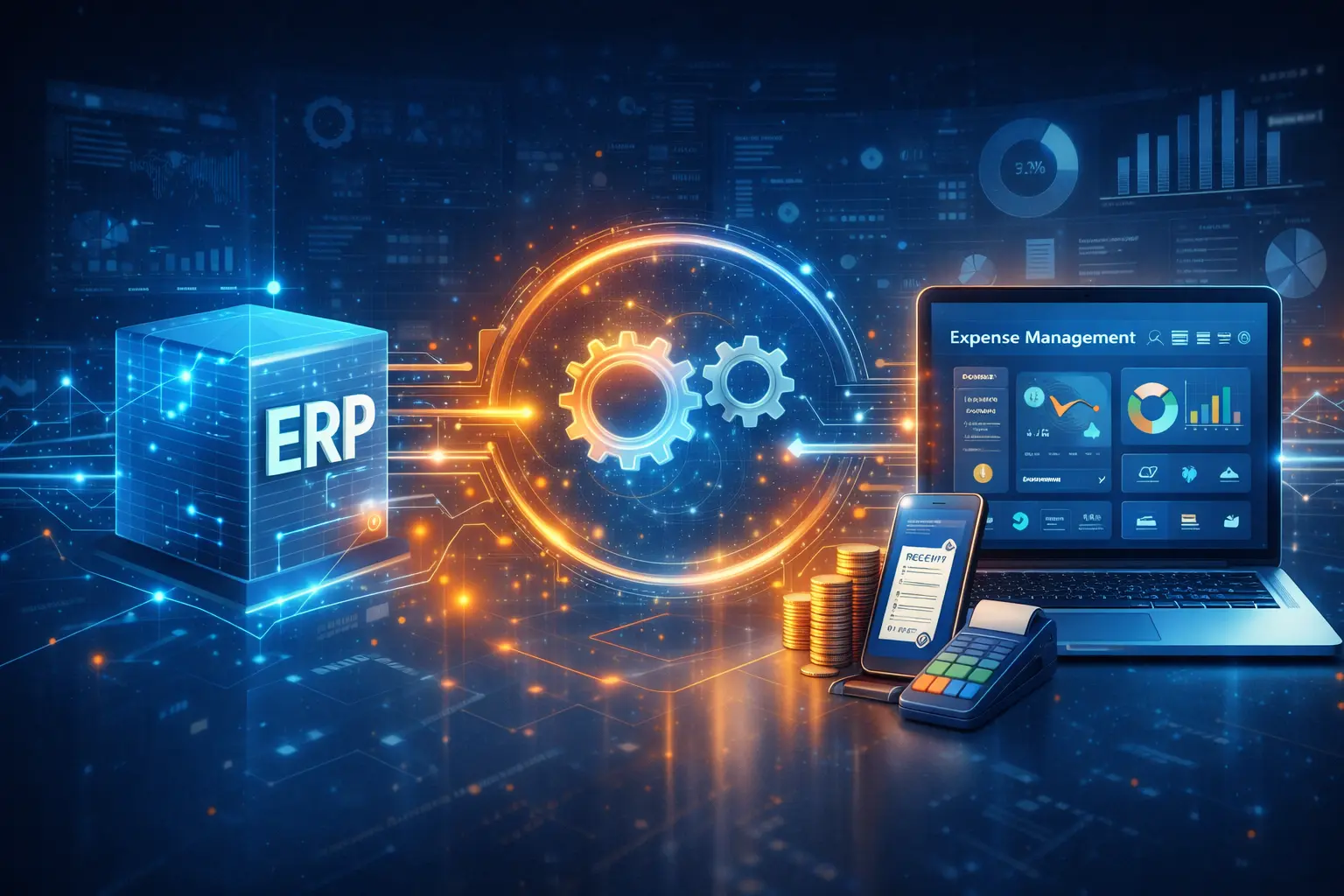
ERP and expense management software integration showing centralized business data and streamlined expense workflows

What Does an ERP System Do?

An ERP (Enterprise Resource Planning) system centralises core business functions such as:

  • Accounting and finance
  • Procurement and vendor management
  • Inventory and operations
  • Payroll and compliance
  • Reporting and analytics

ERP systems act as the single source of truth for business data.

What Is Expense Management Software?

Expense management software focuses specifically on:

  • Employee expense submission
  • Receipt capture and categorisation
  • Policy enforcement
  • Approval workflows
  • Reimbursements and accounting entries

While powerful, expense tools alone do not provide complete financial context without ERP integration.

The Problem with Standalone Expense Tools

When expense management systems are not integrated with ERP:

  • Finance teams manually re-enter data
  • Reports are delayed or inaccurate
  • Budget tracking becomes reactive
  • Policy violations go unnoticed
  • Audits become painful

Integration bridges this gap, transforming expense data into strategic financial insight.

Read More : Best Practices for Automating Elevator Project Planning & Material Management

Why ERP Integration with Expense Management Is No Longer Optional

1. Real-Time Financial Visibility Across the Organisation

One of the biggest advantages of integrating expense management with ERP is real-time visibility into spending.

Without integration:

  • Expense data reaches ERP days or weeks later
  • Leadership views outdated financial reports
  • Budget overruns are discovered too late

With ERPbyNet integration:

  • Approved expenses flow instantly into ERP
  • Department-wise and project-wise spending is visible in real time
  • Finance teams can proactively manage cash flow

This level of visibility enables smarter decisions, tighter controls, and faster responses to financial risks.

2. Elimination of Manual Data Entry and Errors

Manual data entry is one of the biggest sources of inefficiency in finance operations.

Disconnected systems force finance teams to:

  • Re-enter expense data into ERP
  • Match receipts manually
  • Fix duplicate or incorrect entries

This not only consumes time but also introduces errors that compromise reporting accuracy.

With ERPbyNet’s integrated approach:

  • Expense data syncs automatically
  • GL codes, tax rules, and cost centers are applied correctly
  • Errors caused by duplication or omission are eliminated

The result is clean, reliable financial data that finance teams can trust.

3. Stronger Policy Compliance and Spend Control

Policy enforcement becomes extremely difficult when expense systems operate independently from ERP.

Common challenges include:

  • Employees submitting out-of-policy expenses
  • Managers approving expenses without visibility into budgets
  • Finance discovering violations only during audits

ERPbyNet enables rule-based policy enforcement through integration:

  • Expense limits are defined centrally
  • Out-of-policy expenses are flagged automatically
  • Approval workflows align with company hierarchy and budgets

This ensures compliance is enforced at the point of spend—not after the money is gone.

4. Faster Approvals and Employee Reimbursements

Delayed reimbursements frustrate employees and damage trust in finance processes.

Without integration:

  • Approvals move slowly
  • Finance waits for data reconciliation
  • Reimbursements are delayed

ERP-integrated expense management with ERPbyNet enables:

  • Automated approval workflows
  • Faster validation of expenses
  • Seamless posting into accounting

Employees get reimbursed faster, while finance teams operate more efficiently—creating a better experience for everyone involved.

5. Improved Budgeting and Forecasting Accuracy

Accurate budgeting depends on complete and current data.

Disconnected expense systems cause:

  • Gaps in actual vs planned spend
  • Inaccurate forecasts
  • Reactive financial planning

ERPbyNet’s integrated expense management ensures:

  • Expenses update budgets in real time
  • Forecasts reflect actual spending patterns
  • Finance teams can adjust plans proactively

This improves both short-term cash flow management and long-term strategic planning.

6. Enhanced Audit Readiness and Transparency

Audits are often stressful due to missing receipts, incomplete records, and inconsistent approvals.

ERP integration simplifies audits by:

  • Maintaining digital audit trails
  • Linking expenses to approvals and receipts
  • Ensuring consistent accounting treatment

With ERPbyNet:

  • Auditors can trace expenses from submission to posting
  • Compliance documentation is always available
  • Audit preparation time is drastically reduced

Transparency becomes a built-in feature—not an afterthought.

7. Reduced Risk of Fraud and Financial Leakage

Fraud and duplicate claims are common risks in manual or disconnected expense processes.

ERP-integrated systems help:

  • Detect duplicate or suspicious claims
  • Flag unusually high expenses
  • Prevent unauthorised reimbursements

ERPbyNet strengthens internal controls by embedding expense governance directly into the ERP ecosystem, reducing financial leakage and protecting the organisation.

Challenges Businesses Face Without ERP–Expense Integration

Organisations that delay integration often experience:

  • Fragmented financial data
  • Slow month-end closures
  • Limited spend visibility
  • Increased compliance risk
  • Overworked finance teams

These issues compound as the business grows, making integration not just beneficial—but unavoidable.

Read More : Why an ERP Upgrade May Cost More Than an ERP Replacement

ERPbyNet’s Approach to Expense Management Integration

ERPbyNet expense management integration with real-time data sync, configurable approvals, and centralized financial control

At ERPbyNet, we don’t believe in forcing businesses to adapt to rigid systems. Our approach is built around flexibility, scalability, and real-world usability.

1. Seamless Data Synchronisation

ERPbyNet ensures:

  • Real-time syncing of expense data
  • Accurate mapping to GL accounts and cost centers
  • Consistent tax and compliance handling

2. Configurable Approval Workflows

Businesses can:

  • Define approval hierarchies
  • Set department-specific rules
  • Automate routing based on spend limits

3. Centralised Financial Control

All expense data flows into ERPbyNet’s central financial engine, giving leadership:

  • Unified reporting
  • Real-time dashboards
  • Actionable insights

4. SME-Friendly, Scalable Design

ERPbyNet is designed for growing businesses:

  • Simple to implement
  • Easy to use
  • Scales with organisational complexity

Read More : 5 Signs Your Business Needs Manufacturing ERP Software

Who Benefits Most from ERP-Integrated Expense Management

Business Type Challenges Without ERP-Expense Integration Benefits of ERP-Integrated Expense Management
Growing SMEs Growing SMEs often face limited finance team capacity, rely on manual expense tracking, and lack early visibility into spending patterns. With ERP-integrated expense management, these businesses can efficiently control costs without increasing finance staff, automate expense approvals and accounting postings, and gain real-time visibility that prevents inefficiencies from scaling.
Mid-Sized Enterprises Mid-sized enterprises struggle with managing expenses across multiple departments and locations, inconsistent expense policies, and complex audit requirements. ERP integration centralises expense data across teams and locations, enforces consistent approval workflows and company policies, and enhances audit readiness and overall governance.
Enterprises Large enterprises face the challenge of complex multi-region operations, varying regional expense policies, and a higher risk of financial leakage. ERP-integrated expense management standardises expense policies globally, strengthens internal controls and compliance, and consolidates reporting to deliver actionable real-time insights for strategic decision-making.

Key Insight

ERP-integrated expense management scales with your business. SMEs gain control and early financial visibility, mid-sized enterprises achieve governance and efficiency, and large enterprises benefit from global standardisation, compliance, and actionable insights.

Best Practices for Successful ERP–Expense Integration

To maximise value, businesses should:

  1. Clearly define expense policies
  2. Align approval workflows with organisational structure
  3. Ensure accurate master data mapping
  4. Train employees and finance teams
  5. Continuously monitor and optimise processes

ERPbyNet supports these best practices through configurable modules and ongoing support.

The Strategic Impact of ERP-Integrated Expense Management

When expense management is fully integrated with ERP:

  • Finance shifts from data entry to analysis
  • Leadership gains real-time financial insight
  • Employees experience faster, smoother processes
  • Businesses operate with confidence and control

This transformation directly impacts profitability, scalability, and decision-making quality.

Turning Expense Management into a Strategic Advantage

Expense management is no longer just an administrative task. In modern businesses, it plays a critical role in financial governance, compliance, and growth strategy.

By integrating expense management software with ERP, organisations eliminate inefficiencies, reduce risk, and gain real-time visibility into spending.

ERPbyNet enables this integration seamlessly—helping businesses move from reactive expense tracking to proactive financial control.

If your organisation is still managing expenses outside your ERP, now is the time to rethink your approach. The right integration doesn’t just save time—it unlocks smarter, more resilient growth.

Ready to simplify expense management and gain complete financial visibility? Discover how ERPbyNet can help your business integrate, automate, and scale with confidence.

Frequently Asked Questions (FAQs)

1. What does ERP integration with expense management software mean?

ERP integration with expense management software means connecting your expense tracking system directly with your ERP platform so that expense data flows automatically into core financial modules like accounting, budgeting, and reporting. With ERPbyNet, this integration ensures expense entries are accurate, policy-compliant, and instantly reflected in real-time financial reports—without manual intervention.

2. Why is ERP integration important for managing business expenses?

ERP integration is important because it eliminates manual data entry, reduces errors, improves compliance, and provides real-time visibility into company spending. Without integration, expense data often remains fragmented, delaying insights and increasing financial risk. ERPbyNet enables businesses to maintain complete financial control by centralising expense data within the ERP system.

3. How does ERPbyNet help improve expense policy compliance?

ERPbyNet enforces expense policies through configurable rules and approval workflows. Expenses that exceed limits or violate company policies are automatically flagged before approval. This proactive control helps organisations prevent overspending, reduce policy violations, and maintain consistent governance across departments and locations.

4. Can ERP-integrated expense management scale with growing businesses?

Yes. ERP-integrated expense management is especially valuable for growing businesses. As transaction volumes and teams expand, manual processes become inefficient and risky. ERPbyNet is designed to scale smoothly—supporting multi-department, multi-location, and increasing expense volumes without adding complexity to finance operations.

5. How does ERP integration simplify audits and financial reporting?

When expense management is integrated with ERP, all expense records, approvals, and receipts are stored centrally with a clear audit trail. ERPbyNet makes audits faster and more transparent by allowing auditors and finance teams to trace every expense from submission to accounting entry, reducing compliance effort and audit risk.


CategoriesERP (Enterprise Resource Planning)

Why Automation in project Software Is Changing the Game for Businesses Everywhere

Running a business without the right systems is like trying to conduct an orchestra where every musician follows a different sheet of music. Work gets done, yes — but it’s messy, exhausting, and far from harmonious. Field teams chase instructions over calls and messages, managers rely on delayed updates, and leadership struggles to see the full picture. Over time, inefficiency quietly becomes “normal.”

In a business environment where speed, accuracy, and customer experience define success, fragmented operations are no longer just inconvenient — they’re expensive. Companies today need streamlined processes, centralized information, and smarter decision-making to stay competitive. The margin for error has shrunk, while customer expectations continue to rise.

This is where Enterprise Resource Planning (ERP) transforms from a backend system into a strategic advantage. More importantly, when ERP powers field service automation, it removes chaos from day-to-day operations. At ERPbyNet, we help businesses bridge the gap between complexity and clarity — turning scattered field activities into a single, intelligent operational engine.

From Clipboards to Cloud: How Field Service Work Has Evolved

Field service operations were never meant to be simple. Coordinating people who work outside the office — technicians, inspectors, service agents — has always been a logistical challenge.

Traditionally, field operations relied on:

  • Paper job cards
  • Manual scheduling boards
  • Phone-based coordination
  • End-of-day reporting
  • Spreadsheet-based tracking

For small teams, this worked — barely. But as businesses expanded across regions, clients, and service lines, the cracks widened.

This evolution mirrors the journey of ERP itself.

A Brief Look at ERP’s Origins

ERP began decades ago as basic material planning and accounting software. Over time, it absorbed inventory management, HR automation, procurement, compliance, and analytics. Today, ERP platforms act as the central nervous system of modern organizations.

When field service workflows are plugged into ERP, something powerful happens:

  • Data silos disappear
  • Decisions become data-driven
  • Operations become predictable

Field service automation isn’t a separate tool — it’s ERP reaching the frontline.

What Is Automation in Field Service Software?

Field service automation refers to the use of ERP-powered automation technology to plan, execute, track, and analyze all activities performed by field teams.

This includes:

  • Job scheduling and dispatch
  • Real-time technician tracking
  • Mobile work order updates
  • Inventory usage logging
  • Customer confirmations
  • Automated billing and payroll triggers

Instead of relying on memory, manual reporting, or delayed communication, automation ensures every action updates the system instantly.

Think of it as replacing guesswork with clarity.

The Hidden Costs of Manual Field Operations

Many businesses don’t realize how much manual field operations are costing them — because the losses are spread across departments.

1. Data Silos That Kill Visibility

When field teams operate outside ERP systems, data gets trapped:

  • Finance doesn’t see completed jobs
  • Inventory teams don’t know what was consumed
  • Managers don’t have real-time status
  • Leadership sees outdated reports

Decisions based on partial data are risky — and often wrong.

2. Payroll and Billing Bottlenecks

Late job reports lead to:

  • Delayed payroll cycles
  • Incorrect invoices
  • Revenue leakage
  • Employee dissatisfaction

One missed service report can ripple across finance and HR.

3. Multi-Branch Chaos

For businesses operating across cities or regions, manual coordination creates inconsistency:

  • Different processes per branch
  • No unified KPIs
  • Uneven service quality

Growth magnifies disorder when systems don’t scale.

4. Compliance and Audit Risks

Manual documentation increases the risk of:

  • Missing service records
  • Inaccurate logs
  • Regulatory non-compliance
  • Failed audits

Automation doesn’t just improve efficiency — it protects the business.

Read More : How ERP Helps You Stay Ahead of Competitors With Faster Decisions

How ERP-Powered Automation Fixes Field Service Operations

Automation delivers real impact only when it’s centralized, connected, and intelligent — and that’s exactly what ERP platforms are designed to do. Instead of fixing one problem at a time, ERP-powered automation brings every moving part of field service operations into a single, synchronized system. The result is fewer gaps, faster decisions, and smoother execution across the board.

Centralized Scheduling and Smart Dispatch

At the heart of field service efficiency lies scheduling — and manual scheduling is where things most often break down. ERP-powered automation replaces guesswork with logic.

With ERP automation, tasks are assigned based on:

  • Technician availability, ensuring workloads are balanced and realistic
  • Skill matching, so the right expert is sent the first time
  • Location proximity, reducing travel time and fuel costs
  • Priority levels and SLAs, so urgent jobs are handled without disruption

This intelligent dispatching eliminates double bookings, reduces technician idle time, and significantly improves response speed. Instead of reacting to problems, businesses stay one step ahead of them.

Real-Time Field Visibility

One of the biggest challenges in field operations is not knowing what’s happening — until it’s too late. ERP solves this by turning field activity into real-time insight.

With mobile-enabled ERP dashboards:

  • Technicians update job status instantly from the field
  • Managers track progress live without chasing calls or messages
  • Customers receive accurate ETAs, improving transparency and trust
  • Leadership sees performance trends across teams, regions, and timelines

There’s no need to wait for end-of-day reports or manually compiled updates. Every action taken in the field becomes visible the moment it happens — creating accountability, clarity, and confidence at every level.

Inventory Management Automation in the Field

Inventory issues are often the silent killers of field service efficiency. Missing parts, incorrect stock records, and delayed reorders can stall jobs and frustrate customers.

When field service workflows are connected directly to inventory management automation:

  • Parts usage updates automatically as soon as a job is completed
  • Stock levels adjust in real time, eliminating manual reconciliation
  • Reordering triggers intelligently, preventing both shortages and overstocking

This tight integration ensures technicians always have what they need, finance teams maintain accurate records, and operations run without avoidable interruptions.

Learn more through ERPbyNet’s inventory management automation solutions and see how field operations and inventory finally work in sync.

Use-Case Storytelling: Real Problems, Real Impact

Use Case 1: Payroll Delays That Hurt Morale

A service company with 50 technicians processed payroll manually. Every month:

  • Job completion data arrived late
  • Managers corrected errors
  • Payroll took 8–10 days

After ERP-driven automation:

  • Job completion synced instantly
  • Payroll data auto-updated
  • Processing time dropped to 2 days

Employee trust improved — and HR stress vanished.

Use Case 2: Scaling Across Multiple Locations

A growing SME expanded into four cities. Suddenly:

  • Managers lost visibility
  • Reporting formats varied
  • Service quality fluctuated

ERP dashboards centralized:

  • Job completion metrics
  • Technician productivity
  • Branch-level KPIs

Growth became controlled, not chaotic.

ERP Platforms vs Standalone Field Tools

Many businesses try to fix field challenges using isolated apps. While helpful short-term, they create long-term problems.

Standalone Tools:

  • Operate in silos
  • Require manual data syncing
  • Don’t integrate finance or HR
  • Increase system complexity

ERP Platforms:

  • Centralize all operations
  • Connect accounting modules
  • Enable HR automation
  • Provide unified dashboards

Industry leaders like SAP, Oracle, NetSuite, and Zoho ERP prove that ERP-centric automation scales best — but SMEs need solutions designed for their reality.

ERPbyNet focuses on custom ERP solutions that grow with your business, not against it.

ROI and Adoption Trends: Why Businesses Are Moving Fast

Automation is no longer experimental — it’s measurable.

According to Statista, companies adopting operational automation report productivity improvements of 20–30% within the first year.

Meanwhile, Gartner highlights ERP-driven automation as a top priority for organizations aiming to reduce operational risk and improve decision accuracy.

The message is clear: automation delivers ROI — fast.

Read More : Best Practices for Automating Elevator Project Planning & Material Management

ERPbyNet’s Approach to Field Service Automation

At ERPbyNet, we don’t believe that every business should bend itself to fit rigid software. Field service operations are too dynamic — and businesses grow too differently — for one-size-fits-all systems to work in the real world.

That’s why our approach to field service automation is built around flexibility, scalability, and practicality.

We focus on:

  • SME-first ERP tools designed specifically for growing businesses, not overengineered enterprise systems that add complexity instead of clarity
  • Modular implementation, so you adopt only what you need today — and expand effortlessly as your operations grow
  • Scalable automation that supports both small teams and large, multi-location field forces without performance bottlenecks
  • Role-based permissions that ensure every user sees exactly what they need — nothing more, nothing less
  • API-driven integrations that connect seamlessly with your existing accounting, CRM, and third-party tools

Whether you’re managing 10 technicians or 200, ERPbyNet ensures your ERP adapts to your workflows, your growth pace, and your business reality — not the other way around.

Explore our ERP implementation service to see how field service automation can be tailored to your operations, not forced upon them.

Automation Is About Trust, Not Just Speed

Automation is often talked about in terms of speed and efficiency — but its real power lies in trust.

When automation is implemented the right way:

  • Employees trust payroll accuracy, because completed work is captured instantly and correctly
  • Customers trust service commitments, because schedules, updates, and timelines are reliable
  • Managers trust dashboards, because data is real-time, centralized, and consistent
  • Leaders trust forecasts, because decisions are backed by clean, connected operational data

When systems work quietly and reliably in the background, teams stop firefighting. Instead of chasing updates or fixing errors, they focus on improving service quality, scaling operations, and driving sustainable growth.

Read More : Why an ERP Upgrade May Cost More Than an ERP Replacement

The Future of Field Service Automation

Field service automation is only getting smarter — and ERP systems are at the center of this evolution.

What’s coming next:

  • AI-powered scheduling that dynamically assigns jobs based on urgency, skills, and availability
  • Predictive maintenance that identifies potential failures before they disrupt operations
  • Low-code workflow customization that allows businesses to adapt processes without heavy development
  • Built-in compliance readiness that simplifies audits and regulatory reporting

As these capabilities mature, ERP systems will increasingly act as decision engines, not just record keepers.

Businesses that adopt ERP-driven field service automation early won’t just improve efficiency — they’ll build operations that are resilient, intelligent, and ready for whatever comes next.

Build Smarter Field Operations That Scale With You

Automation in field service software is no longer a “nice-to-have” or a future consideration — it has become the backbone of modern, high-performing businesses. As customer expectations rise and operations become more complex, relying on manual coordination or disconnected tools only limits growth. True scalability, resilience, and profitability come from systems that work together seamlessly and intelligently.

This is where ERP-driven automation makes the difference. By centralizing field operations, finance, inventory, and people management, businesses gain real-time visibility, operational control, and the confidence to make faster, smarter decisions. The result isn’t just efficiency — it’s consistency, accountability, and a foundation that supports long-term growth.

At ERPbyNet, we help businesses move beyond operational chaos with custom-fit ERP solutions designed around how you actually work. Our platforms grow with you, adapt to your processes, and simplify complexity at every stage of your journey.

Ready to take control of your field operations and scale with clarity?
Explore our ERP implementation service and let’s transform your workflow into a system that works as hard as you do.

FAQs

Still have questions about ERP and how it fits your business? Let’s clear them up.

What is field service automation in ERP?

It connects field activities directly to ERP systems, enabling real-time updates, automated billing, and centralized visibility.

Is ERP suitable for SMEs?

Absolutely. ERPbyNet designs ERP platforms specifically for growing businesses, not just enterprises.

How does ERP improve technician productivity?

By reducing manual reporting, optimizing scheduling, and providing real-time access to job details.

Can ERP integrate with existing software?

Yes. ERP systems use APIs to integrate accounting, CRM, and third-party tools.

How long does ERP implementation take?

ERPbyNet uses phased rollouts to ensure faster adoption with minimal disruption.

What’s the biggest benefit of field service automation?

Complete operational visibility — from job assignment to billing — in one centralized system.


CategoriesERP (Enterprise Resource Planning)

How ERP Helps You Stay Ahead of Competitors With Faster Decisions

In a rapidly evolving business landscape, speed matters — not just in execution, but in decision-making. Companies that can digest data quickly, respond to market changes, and align internal processes in real time typically outpace their peers. This is where a robust Enterprise Resource Planning (ERP) platform becomes more than just software — it becomes a strategic advantage.

At ERPbyNet, we believe modern businesses — especially in project-driven, engineering, manufacturing, and services sectors — need more than fragmented tools: they need a unified system that empowers fast, data-driven decisions across every function.

In this blog, we unpack how ERP helps your organization stay ahead of competitors through faster decisions — and why ERPbyNet is uniquely positioned to deliver this advantage.

What is ERP — and why “faster decision-making” matters

ERP system enabling faster decision-making with real-time data visibility across finance, inventory, and operations — ERPbyNet

The essence of ERP

Enterprise Resource Planning (ERP) refers to a suite of integrated applications that manage a company’s core business processes — finance, inventory, procurement, manufacturing or services operations, HR, sales, and more — all unified under a single data model. 

Rather than using disparate systems for each department — spreadsheets for finance, separate tools for inventory, manual logs for production planning, etc. — ERP consolidates everything into one platform. This means all data flows into a single source of truth. This consolidation unlocks key advantages: cross-department visibility, real-time data access, and automated workflows — all essential for businesses that need to respond quickly to internal changes or market shifts.

Why speed of decisions is a competitive differentiator

In traditional setups, making critical decisions often involves data gathering from multiple silos — sales data here, inventory status there, pending orders somewhere else. Compiling that data manually is time-consuming and error-prone. By the time you have the report, the business context may have changed.

But in fast-moving industries — manufacturing, project-based services, engineering — delays can cost you: delayed shipments, stock-outs, inefficient resource allocation, cost overruns, lost opportunities.

With ERP-driven real-time visibility and analytics, you can:

  • Spot bottlenecks or capacity constraints before they become critical 
  • Forecast demand or cash flow and proactively plan resource allocation or procurement 
  • React quickly to new orders or changing priorities without waiting for manual reports

In other words: faster, data-driven decisions = better agility & competitiveness.

What ERPbyNet offers — built for fast, informed decision-making

Before diving deeper into ERP benefits, it helps to understand why ERPbyNet is particularly suited for businesses that need speed, accuracy, and flexibility.

  • Specialization for project- & engineering-driven businesses — ERPbyNet isn’t a generic ERP. It’s designed with contract engineering, project-based, and service-management industries in mind. This focus means features are tailored to real-world challenges faced by such businesses: dynamic scheduling, multiple stakeholders, complex procurement, site-based operations, etc. 
  • Integrated across all processes — From engineering, procurement, inventory to installation planning, dispatch, finance and project-level tracking — ERPbyNet links all critical functions. 
  • Better long-term cost efficiency than generic ERP solutions — While generic ERPs may sometimes appear cheaper up front, ERPbyNet offers long-term value, especially for specialized operations where generic packages would require heavy customization. 
  • Real-time control, transparency & unified data model — ERPbyNet ensures you have up-to-date, accurate data across teams and functions, facilitating faster, well-informed decisions.

In short: ERPbyNet is built not just for process automation — but for agility, foresight, and competitive edge.

7 Ways ERP Empowers Faster, Smarter Decision-Making

How ERPbyNet improves decision-making speed through real-time data, automation, forecasting, visibility, collaboration, financial insights, and scalability.

Here’s a detailed breakdown of how ERP (and ERPbyNet in particular) helps organizations speed up decision-making and stay competitive.

1. Unified, Real-Time Data — One Platform, Many Insights

Because ERP centralizes data from finance, operations, inventory, procurement, projects and more — you no longer need to compile fragmented data sources manually. 

This unified view gives leadership and managers a single source of truth. Whether you want to check current inventory levels, project progress, cash flow status, or pending purchase orders — it’s all accessible immediately.

Real-time data eliminates delays. Decisions based on stale or partial data — which often lead to overstocking, stockouts, or resource misallocation — become a thing of the past.

2. Automated Processes & Reduced Manual Overhead

Modern ERP automates repetitive, manual tasks: procurement cycles, stock reordering, invoice generation, financial consolidation, project cost tracking, etc.

By reducing manual work, ERP frees up your team to focus on strategic tasks — resource planning, project bidding, market response, customer service, etc. You’re not busy reconciling spreadsheets — you’re making moves.

This speed translates directly to competitiveness: faster procurement, quicker invoice cycles, immediate project updates.

3. Better Forecasting & Planning = Proactive Decisions

With historical data, real-time updates, and integrated modules (sales, inventory, finance, procurement), ERP systems enable accurate demand forecasting, resource planning, and budgeting. 

For example — if your sales orders spike, ERPbyNet can alert you about upcoming resource constraints (inventory shortfall, manpower shortage) before they derail delivery. This lets you respond proactively: reorder materials, reallocate workforce, or reschedule tasks.

In short: you stop reacting to events — you plan ahead.

4. End-to-End Visibility — From Order to Delivery to Payment

ERP connects all stages: order entry → procurement → production/engineering → dispatch/installation → billing → payment → feedback — ensuring complete traceability. 

This end-to-end visibility helps identify bottlenecks (procurement delays, material shortages, project overshoot), track project profitability, and ensures nothing falls through cracks. Decision-makers get a clear view of what’s going on across departments — enabling quick corrective or strategic actions.

5. Cross-Department Collaboration & Communication

With data and workflows unified, different teams (sales, operations, procurement, finance, projects) don’t work in silos anymore. ERP ensures everyone is on the same page — the same underlying data, updates, priorities. 

This collaboration helps speed up decision cycles. For example: sales may get a large order — procurement can instantly check stock or lead times, operations can assess capacity, finance can project cash flow — all in real time. This collaborative agility helps you seize opportunities faster than competitors stuck in fragmented systems.

6. Financial Transparency & Risk Management

ERP gives clear visibility into finances: costs, margins, cash flow, pending payments, project-level profitability — all in real time. 

When you know your real-time financial health, you can make informed decisions — whether to bid on a new project, defer expenses, hire additional manpower, or adjust pricing.

Moreover, ERP helps standardize controls, ensuring compliance and reducing risks — especially relevant if you’re in regulated industries or manage large supply chains. 

7. Scalability & Flexibility — Grow Without Losing Control

As your business scales — more projects, employees, locations — a modular ERP system like ERPbyNet can grow with you.

Because the system integrates different functions, you can add modules (e.g. procurement, project management, inventory, finance) as you grow — without disrupting existing workflows. This scalability helps maintain agility even as complexity increases, allowing faster decisions even in a larger organization.

Why Many Competitors Fail Without ERP — And How ERPbyNet Bridges That Gap

Running a business without ERP (or with fragmented tools) might seem manageable — until things scale. Common pitfalls:

  • Multiple data silos — finance uses spreadsheets, procurement uses separate logs, inventory runs on manual tracking. Result: inconsistent data, delays, errors. 
  • Slow, manual decision cycles — collating data from different departments, waiting for updates, manual reconciliation → decisions come too late. 
  • Resource misallocation — overstocking inventory, wrong manpower assignment, cash-flow bottlenecks — because data is incomplete or outdated. 
  • Poor visibility into project or cost-level profitability — no clear way to know which projects are profitable, where costs are bleeding. 
  • Inflexibility during scaling — processes break down when operations expand, adding employees, products, or locations. 

ERPbyNet addresses these challenges directly:

  • By centralizing all data, it eliminates silos. 
  • By offering real-time updates and automated workflows, it ensures decision-makers always have current, accurate information. 
  • By being industry-specialist (engineering, projects, services) rather than generic, it fits real business needs with minimal customization — reducing cost and complexity. 
  • By providing scalable modules, it supports growth without compromising agility.
    In short: ERPbyNet helps turn business complexity into strategic strength — enabling faster, smarter management and competitive advantage.

Read More : Best Practices for Automating Elevator Project Planning & Material Management

When Implementing ERP — Best Practices to Maximize Decision-Speed Gains

ERP itself is powerful — but to truly derive the “faster decision-making” advantage, you must implement it thoughtfully. Here are best practices you should follow (and which ERPbyNet supports well):

1. Define Clear Objectives & Use Cases

Before diving in, map out what you need ERP to solve: is it project tracking, inventory issues, procurement delays, financial reporting, resource allocation? Clear goals help you pick modules and shape workflows — ensuring ERP serves your business, not the other way around.

2. Involve Stakeholders from Day One

ERP affects departments across the org: finance, operations, procurement, projects, HR. Involve all relevant stakeholders at the start — so everyone’s needs are captured, adoption improves, and resistance is minimized.

3. Clean Up & Standardize Data

Since ERP works on shared data, consistency and accuracy matter. Clean up your legacy data, standardize product codes, item names, project codes, cost centers — to avoid “garbage in, garbage out.”

4. Modular & Phased Implementation

Don’t try to go “all modules at once.” Begin with critical modules (say, project + inventory + procurement + finance), stabilize them, then expand. ERPbyNet’s modular architecture supports this phased growth — reducing risks, smoothing transition, and delivering value early.

5. Train Users & Build Governance

Users need training; processes need documentation; responsibilities must be defined (who updates what, who approves what). Without governance, data accuracy and speed of decisions suffer.

6. Monitor & Iterate — Use Analytics & KPIs

Once ERP is live, track key KPIs: project completion times, procurement turnaround, cash flow cycles, inventory turnover, cost variances. Use these metrics to fine-tune processes and optimize decision-making.

Read More : How ERP Software Companies in India Are Shaping the Future of the Engineering Industry

Real-World Impact: What Faster Decisions Look Like With ERPbyNet

To bring this into context, here are scenarios — common in engineering, manufacturing or services firms — where ERPbyNet’s decision-speed advantage shines:

Scenario 1: Urgent Client Order — Fast Procurement & Execution

A client gives a last-minute order, demanding quick turnaround. With ERPbyNet:

  • Sales enters the order → system checks inventory and stock status 
  • Procurement module flags low stock for required raw materials / components 
  • Purchase order is generated automatically, vendor lead times are available, approvals flow fast 
  • Project scheduling module reallocates workforce / machines 
  • Delivery date is updated — and finance can forecast payment and cash-flow

Outcome: What would take days of cross-communication, emails and excel sheets — now happens in hours. Faster response wins the client and delivers on time.

Scenario 2: Forecasted Demand Spike — Proactive Resource Planning

Sales data indicates an upcoming surge in orders (e.g. big project win or seasonal demand). ERPbyNet allows management to:

  • Forecast resource needs (inventory, manpower, cash flow) 
  • Pre-order materials, allocate workforce, plan schedules 
  • Ensure no stockouts or overbooking — avoiding delays or overcommitment

This proactive planning — enabled by a unified system — gives a business agility that competitors operating on silos cannot match.

Scenario 3: Real-Time Cost & Profitability Tracking — Better Bidding & Strategy

For project-based businesses, knowing project-level costs and margins is crucial. With ERPbyNet:

  • Costs (materials, labor, overhead) are tracked in real time 
  • Variances are visible immediately — if a project is bleeding costs, you spot it early 
  • Future bids can be made based on accurate historical cost + performance data — leading to more competitive, yet profitable, proposals 

This level of insight and speed empowers strategic decisions — whether to bid, price, or resource — faster and more confidently than traditional approaches.

Read More: Why an ERP Upgrade May Cost More Than an ERP Replacement

Why Businesses Risk Falling Behind Without ERP — The Hidden Cost of Slow Decisions

Many companies (especially small and mid-size) rely on spreadsheets, disparate tools, and manual coordination. While this may work in early stages, as complexity increases the cost of “slow decisions” rises:

  • Delays in procurement or execution → missed deadlines, unhappy clients 
  • Over or under-stocking inventory → tied-up working capital or production holdups 
  • Lack of real-time visibility → delayed detection of issues, cost overruns, inefficiencies 
  • Poor forecast and planning → reactive decisions, higher risk, lower competitiveness

Competitors leveraging ERP (or modern management systems) get ahead by seeing problems before they escalate and reacting faster. In a dynamic market — speed can be the difference between growth and stagnation.

With ERPbyNet, your business doesn’t just keep pace — it stays ahead.

Take the Lead — Choose ERPbyNet for Faster, Smarter Decisions

In today’s high-speed business world, your ability to make quick, confident decisions determines whether you lead the market or fall behind. If you’re still relying on spreadsheets, disconnected tools, and manual reporting, you’re already operating slower than your competitors.

ERP is no longer optional — it’s the backbone of agile, data-driven organizations. And you don’t need just any ERP system — you need a platform built for your industry, your workflows, and your growth goals. That’s exactly what ERPbyNet delivers.

With ERPbyNet, you gain the power to:

  • View real-time insights across finance, operations, inventory, procurement, and projects
  • Make instant, informed decisions that drive revenue and performance
  • Scale without complexity or losing control
  • Respond faster to customers, market shifts, and operational challenges

While others wait for manual reports and approvals, you’ll already be executing the next move. ERPbyNet turns decision-speed into a competitive weapon.

Ready to outperform your competitors?

Move from spreadsheets to strategic speed — Book a Demo with ERPbyNet today.

FAQs

1. How does an ERP help in faster decision-making?

ERP centralizes real-time data from all departments, removing manual reporting delays and enabling quick, accurate decisions.

2. Why is fast decision-making important for competitive advantage?

Faster decisions help businesses respond quickly to customer needs, avoid delays, reduce costs, and seize opportunities before competitors.

3. What kinds of decisions improve with ERP?

ERP supports daily operational choices, tactical planning, and strategic forecasting — covering finance, inventory, projects, procurement, and resource allocation.

4. How does ERP improve team collaboration?

ERP eliminates data silos and ensures everyone works on the same updated information, speeding up coordination and approvals.

5. Why choose ERPbyNet instead of generic ERP systems?

ERPbyNet is industry-focused, easy to implement, offers real-time visibility, and scales with your business — enabling faster decisions with lower cost and complexity.

CategoriesERP (Enterprise Resource Planning)

How Cloud-Based Material Management Improves On-Site Execution

Every engineering project begins with a blueprint, a BOQ, and ambitious delivery timelines. But the reality of execution is often different. On-site teams wait for critical components that should have arrived days earlier. Warehouse teams pack items that were not actually needed. Procurement teams raise urgent purchase orders that could have been planned weeks before. Meanwhile, management hears late that the project has slipped because a single missing part halted progress.

Even the most experienced project managers know this truth well:
Projects rarely fail due to weak engineering.
Projects stumble because of poor material flow, poor visibility, and poor real-time coordination.

This challenge is not due to incompetence. It is a symptom of outdated systems.
In most elevator companies, fabrication units, industrial contracting environments, or multi-site project operations, material management is still handled through spreadsheets, paper registers, WhatsApp approvals, and verbal coordination. When operations scale, this model collapses.

Cloud-based material management changes everything. It transforms the way organizations plan, control, deliver, and utilize materials across their entire execution pipeline. It creates a real-time digital nervous system that connects procurement, inventory, finance, site engineers, project managers, stores, and leadership into one synchronized ecosystem.

ERPbyNet was designed for exactly this need.

A platform engineered specifically for the Elevator Industry, Engineering Companies, and Project-Based Industries, where execution reliability determines business survival.

This blog explores, in deep detail, how cloud-based material management transforms on-site execution and why modern project-execution-dependent businesses cannot scale without it.

The Real Problem: Why Traditional Material Management Fails On-Site

 Traditional material management challenges in engineering and construction projects caused by manual tracking, outdated spreadsheets, poor visibility, and lack of real-time coordination across sites.

No matter how good the BOQ is or how strong the technical design, execution falls apart when material oversight breaks. Some deep-rooted operational realities explain why:

Material visibility is scattered or outdated

Site engineers never have a real-time view of material availability across warehouses or other sites. By the time they check stock manually, the situation has changed, resulting in unnecessary procurement or delays.

Communication between departments is slow and fragmented

Approvals take days, decisions get stuck, requests are lost in conversations, and actions slow down execution.

Manual tracking creates mismatches and confusion

Spreadsheets are editable, error-prone, outdated, and untraceable. When data integrity is weak, execution becomes guesswork.

BOQ planning is rarely integrated with actual workflows

The difference between planned consumption and actual consumption is rarely measured until it is too late.

Delayed procurement leads to emergency purchases

Emergency procurement always costs more, impacts timelines, and damages client confidence.

Materials move without documentation

Unrecorded issues, returns, scrap, damage, or site transfers become uncontrollable.

Multiple sites operating without a unified control system

Without central coordination, materials get stuck where they are least needed.

These challenges destroy execution rhythm, inflate costs, and lead to missed deadlines.

But they are not caused by a lack of effort.
They exist because the execution environment has evolved faster than the management systems meant to control it.

Read More : Why Accurate Data Entry Matters—and How ERP Ensures It Automatically

The Cloud-Based Solution: How ERPbyNet Re-Architects Material Management

Cloud-based material management turns scattered operations into a coordinated real-time digital workflow. It centralizes everything, automates approvals, tracks consumption, provides analytics, and transforms field control.

Unlike traditional on-premise ERPs or isolated excel systems, a cloud-based ERP like ERPbyNet offers:

  • Real-time visibility from anywhere
  • Unified data seen simultaneously by all departments
  • Live dashboards for decision-making
  • Workflow automation that removes manual follow-up
  • Mobile accessibility for site engineers
  • Zero dependency on local servers or physical presence
  • Integration with project, installation, billing and procurement modules

A cloud system does not just store data.
It aligns execution behavior, prevents errors before they occur, and turns operational chaos into controlled movement.

Let us explore how this transformation happens in real execution environments.

Real-Time Material Visibility Across All Locations

Visibility drives execution.
Without it, planning is impossible, and decisions are reactive instead of strategic.

Cloud-based material management gives a central real-time picture of:

  • Stock available in central and regional warehouses
  • Stock reserved for each project
  • Items in transit
  • Material shortages flagged automatically
  • Expected delivery timelines
  • Consumption versus planned BOQ usage
  • Project-wise stock allocation and history

For site engineers, this means:
They know immediately whether required material is already available rather than raising urgent requests.

For procurement teams:
They purchase based on actual global need rather than assumptions.

For management:
They see execution risks before they become delays.

Real-time visibility eliminates unnecessary calls, questions, confusion, and firefighting.
Execution becomes intentional instead of accidental.

Digitized Material Requests, Approvals, Dispatches, and GRN

 Cloud-based digital material request and approval workflow system improving on-site execution and inventory control through real-time tracking and automated processes using ERPbyNet.

In any project-driven engineering environment, every movement of material is critical and time-sensitive. Whether it is a major machine assembly, an elevator controller, or a simple fastener pack, delays or mismanagement create ripple effects at the site. Traditional manual handling using paper slips, WhatsApp messages, verbal approvals, or spreadsheets causes inconsistencies that slow execution and create confusion across teams.

Cloud-based material management through ERPbyNet completely transforms this workflow by digitizing every step of the material lifecycle. Instead of disconnected communication, every request and approval is tracked inside the system with real-time visibility for all stakeholders.

With ERPbyNet:

  • Site engineers can raise Material Requests directly from the field using their mobile devices. They no longer rely on handwritten notes, emails, or delayed communication.

  • Approvals move instantly through automated routing. Project managers and department heads are notified immediately, enabling fast decision-making without physical presence.

  • Stores teams receive approved requests instantly, eliminating communication gaps and dispatch delays.

  • Every dispatch from a warehouse or site store is recorded through digital Issue Notes, removing ambiguity and building an accountable chain of custody.

  • Goods Receipt Notes (GRN) are submitted digitally when materials reach the site, with real-time status updates for procurement and management.

  • Finance and costing modules automatically update based on issued and received material values, keeping project budgets and expenditure in alignment.

Transforming material movement into a fully digitized workflow means there are no more misplaced requests, no more waiting for signatures, no more unclear responsibilities, and no possibility of unauthorized material release.

Digital control builds operational discipline. And discipline accelerates execution.

Read More : How ERP for Engineering Industry Is Beneficial for Business Growth

BOM-Driven Material Planning for Precise Execution Control

In engineering and elevator installation environments, accuracy is everything. Projects depend on hundreds of components and deeply interconnected sequencing. One missing or delayed material can delay weeks of manpower and planning. Successful execution requires structured, data-driven material planning.

ERPbyNet integrates cloud-based material control directly with BOM and BOQ to ensure accurate planning and consumption tracking.

This enables:

  • Automatic calculation of exact material quantities required for each installation stage or production phase.
  • Early identification of shortages before they become execution delays, giving procurement time to act proactively.
  • Automated generation of purchase requirements based on real consumption, not assumptions or manual estimates.
  • Wastage and scrap monitoring through deviation analysis to ensure that patterns of material loss are identified quickly.
  • Accurate benchmarking of actual consumption versus planned consumption to evaluate project profitability and efficiency.

Where previously site engineers would discover shortages only when a job halted, now predictive planning ensures smooth execution without firefighting.

By linking planning with real usage data, ERPbyNet shifts decision-making from reactive correction to proactive control. Time, cost, and quality performance improve simultaneously.

Material Reservation for Project Priority and Commitment

In industries executing multiple parallel projects, internal competition for available material is inevitable. Without a structured reservation policy, materials are often diverted, conflicts escalate, and timeline commitments are broken.

ERPbyNet offers project-based material reservation that ensures fair planning, transparency, and priority-based fulfillment.

With reservation control:

  • Once allotted, materials are locked for a specific project and cannot be reallocated without authorized approval.
  • High-priority projects receive commitment on stock allocation, preventing unplanned interruptions.
  • Dispatches follow project priority automatically, eliminating internal conflict.
  • Completion forecasting improves, as supply dependencies are known well in advance.

Reservation ensures readiness.
Readiness enables execution speed.
Speed drives profitability and client satisfaction.

A reserved material strategy changes execution confidence from uncertainty to assurance.

Procurement Optimization and Forecasting

Procurement should be a strategic and predictive function, not a last-minute emergency-driven activity. In traditional setups, procurement operates without real-time visibility leading to urgent purchases, inflated costs, and panic-driven decisions.

ERPbyNet empowers procurement with transparent, accurate planning data.

The system provides:

  • Automated alerts when materials reach minimum stock levels.
  • Forecasting based on historical consumption trends and project requirements.
  • Demand planning aligned directly with project schedules and installation phases.
  • Supplier lead-time visibility that allows smarter ordering decisions.
  • Modular planning for phased project execution, reducing storage cost and material aging.

This transformation results in:

  • Reduced emergency purchases and premium pricing
  • Lower overall procurement expenditure
  • Better negotiation and supplier performance management
  • Predictable and stable execution cycles

Procurement becomes a business advantage instead of a crisis-management function.

Read More : How ERP Software Companies in India Are Shaping the Future of the Engineering Industry

Live Consumption Monitoring and Wastage Prevention

Material wastage, theft, pilferage, and undocumented usage are hidden cost drivers that silently erode profitability. These losses are rarely visible until projects exceed estimated costs and margins collapse.

ERPbyNet develops a transparent material consumption culture by providing:

  • Real-time tracking of material usage at site level
  • Digital issue registers tagged to the project and user
  • Scrap and wastage recording with mandatory reason logging
  • Material return workflows for unused or excess items
  • Variance analysis between estimated and actual consumption
  • Alerts when usage patterns exceed expected behavior

With transparency, behavior transforms.
Teams become more careful, accountable, and performance-oriented.
Execution becomes efficient because everyone understands the cost impact of their actions.

A controlled material environment is a profitable execution environment.

Multi-Site Coordination and Material Transfer Control

For organizations operating across multiple locations, the ability to redistribute materials effectively is a critical success factor. Without visibility into stock at each site, companies often purchase new material despite having unused stock elsewhere.

ERPbyNet simplifies multi-site control through:

  • Site-to-site transfers logged and tracked digitally
  • Transfer approvals through standardized workflows
  • Complete visibility on material movement and transit status
  • Elimination of duplicate orders
  • Internal optimization by moving slow-moving stock to active sites
  • Real-time transfer reporting accessible to management

Instead of chaos, logistics becomes intelligent, cost-efficient, and planned.
Material moves where it is needed most, not where it happens to be stored.

Role-Based Access and Approval Security

Material control demands structure and responsibility. Too many people with uncontrolled access leads to confusion and leakage. ERPbyNet enforces role-based permissions to ensure that every action is validated and traceable.

Within the system:

  • Site engineers raise material requests
  • Project managers approve requests based on project needs
  • Stores issue approved material only
  • Procurement purchases based on approved data
  • Finance tracks cost impact and budget alignment

The result is a clear chain of accountability that eliminates unauthorized activity and strengthens governance discipline.

Governed execution improves trust, transparency, and operational control.

Mobile-First Execution Control from Site

Site teams operate in dynamic, challenging environments. They are stationed at heights, on factory floors, inside construction shafts, or across remote project locations. Expecting them to rely on desktop computers is unrealistic.

ERPbyNet enables true mobility by allowing critical updates to be executed directly from the field:

  • Material Requests raised from mobile devices
  • Delivery completion acknowledged on phone
  • Issue transactions recorded digitally at the site store
  • Material availability checked remotely
  • Photos and proof documents uploaded instantly

Execution becomes faster because the system adapts to the field environment instead of forcing field teams to adapt to the system.

Productivity rises because time spent walking to an office becomes time spent progressing the project.

Stronger Documentation, Audit Control, and Customer Transparency

Material traceability is one of the most critical compliance needs for engineering and project-based organizations. Paper + Excel-based documentation is hard to maintain, prone to manipulation, and nearly impossible to audit accurately.

ERPbyNet makes documentation fully digital and secure.

Audit trails preserve:

  • Who requested materials
  • Who approved them
  • What quantity was issued
  • When dispatch or delivery occurred
  • Where material was used or transferred
  • What was returned or scrapped

Client communication becomes simpler, claims resolution becomes factual, accounting becomes automated, and audits become stress-free.

Where documentation once hindered execution, it now strengthens credibility.

Impact on Elevator Installation Projects

Elevator installations depend heavily on material readiness. Each phase requires precise components such as guide rails, brackets, machines, controllers, COPs, landing doors, wiring kits, and fixtures. One missing piece halts installation, civil alignment, scaffolding usage, and manpower scheduling.

ERPbyNet improves elevator execution by enabling:

  • Dispatch sequencing aligned with installation progress stages
  • Packing list mapping to each lift installation
  • Serial and batch tracking for vital components such as controllers
  • Real-time dashboards that confirm readiness before site mobilization
  • BOQ accuracy between estimation and execution reports

This reduces idle manpower, compresses installation timelines, increases handover speed, and dramatically improves customer satisfaction.

When material flow becomes predictable, revenue cycles accelerate.

Impact on Engineering Fabrication and Assembly

Fabrication and assembly operations depend on timely material availability for welding, machining, bending, cutting, or assembly processes. Production stoppages are expensive and disruptive.

ERPbyNet strengthens fabrication by enabling:

  • Multi-level BOM planning
  • Stage-based material staging for work orders
  • Batch and heat number traceability for critical materials
  • Raw material to finished product traceability
  • Real-time coordination with subcontract manufacturing

This increases production throughput, improves quality accuracy, and shortens overall project duration.

Impact on Project-Based Contracting Environments

In project contracting industries such as HVAC, EPC, automation, and industrial construction, execution requires balancing cost, time, scope, and compliance requirements.

ERPbyNet supports contracting operations by enabling:

  • Material alignment based on Work Breakdown Structure (WBS)
  • Benchmarked tracking of material usage versus progress
  • Certification and billing based on accurate consumption records
  • Documentation readiness for government audits and customer verification
  • Strong dependency planning for interconnected tasks

Profitability becomes predictable because material handling becomes intelligent.

The ERPbyNet Advantage

ERPbyNet is designed for industries where material execution determines business viability. It is engineered with operational understanding rather than theoretical ERP architecture.

It delivers:

  • Cloud-native infrastructure for real-time, anywhere access
  • Workflows tailored specifically for elevator and engineering industries
  • End-to-end traceability from planning to consumption
  • Real-time dashboards and decision analytics
  • Automated workflow routing and alerts
  • Mobile-first user experience for field execution
  • Deep integration across procurement, finance, project management, CRM, HR, QC and stores

ERPbyNet is not just a software tool. It is a command center that brings control, discipline, speed, and predictability to execution environments.

Take Charge of Your Project Execution with Cloud-Based Material Management

In today’s fast-moving engineering and project world, relying on spreadsheets and manual coordination just doesn’t cut it. Every small delay, missing part, or undocumented issue quietly impacts your profits and reputation. Cloud-based material management is no longer optional—it’s the backbone of smooth, reliable execution.

ERPbyNet helps you turn chaos into control. With real-time visibility, clear workflows, and data-driven decision-making, your teams can complete projects faster, reduce waste, stick to schedules, and track everything with confidence.

The industry is moving quickly. Companies that modernize now will scale efficiently, while those stuck in old ways will struggle to keep up.

If you want faster project delivery, better profitability, and a future-proof way to manage execution, ERPbyNet is the partner you need.

Precision. Speed. Control. Your next-level project execution starts here.

FAQs

1. What is cloud-based material management and why is it important?

Cloud-based material management centralizes all material data, tracking, and workflows in real time. It eliminates delays, reduces wastage, improves coordination, and ensures projects stay on schedule—critical for engineering, elevator, and project-based industries.

2. How does ERPbyNet improve on-site project execution?

ERPbyNet provides real-time visibility of stock, digitized material requests, automated approvals, and mobile access for site teams. This ensures materials are always available when needed, reducing downtime and keeping projects on track.

3. Can ERPbyNet handle multiple projects and sites simultaneously?

Yes. ERPbyNet enables multi-site coordination, project-wise material reservation, and real-time transfer tracking, ensuring materials are allocated efficiently and projects don’t compete for resources.

4. How does ERPbyNet help reduce material wastage?

By monitoring consumption versus planned usage, tracking scrap, documenting returns, and providing alerts for abnormal patterns, ERPbyNet promotes accountability and minimizes unnecessary losses.

5. Is ERPbyNet suitable for small and large engineering firms?

Absolutely. ERPbyNet is scalable for both small teams and large, multi-location operations. Its cloud-based platform allows seamless access, workflow automation, and data-driven decision-making for businesses of any size.


CategoriesERP (Enterprise Resource Planning)

Why Accurate Data Entry Matters—and How ERP Ensures It Automatically

Every business decision, every customer interaction, every project schedule, every purchase order, and every financial entry depends on one thing—data. The accuracy of that data determines whether decisions are correct or flawed. Yet in many engineering, project-based, manufacturing, and elevator companies, the root problem goes unnoticed: inaccurate, incomplete, or inconsistent data entered into ERP systems.

Data is supposed to be the foundation of a business, but when incorrect entries slip into the system—even small ones—they multiply into operational chaos, financial losses, and customer dissatisfaction. This is why businesses are shifting from manual data entry to automated ERP-driven controls. Today, modern ERP platforms like ERPbyNet don’t just store data—they protect its accuracy at every step.

This blog explores why accurate data entry matters more than ever, how poor-quality data silently damages operations, and how ERPbyNet ensures ERP data accuracy automatically through intelligent validation, workflows, automation, and process standardization.

Why Accurate Data Entry is the Heart of a Business

Office desk with a laptop showing an ERP system dashboard, clean data forms, and a glowing heart-shaped data outline symbolizing the importance of accurate data entry in business.

When data is wrong, everything built on top of it becomes wrong too. Businesses rely on data for costing, planning, material forecasting, scheduling, engineering design, billing, procurement, service management, and reporting. If the foundation is weak, every outcome becomes unreliable.

Here is why correct data entry is mission-critical:

1. It protects decision-making

Leaders take decisions based on ERP dashboards—approvals, budgets, vendor selections, customer commitments, production plans. Wrong data creates a false picture. A wrong figure in inventory may show stock available when it’s not. A wrongly entered cost may lead to underquoting. A mistake in project progress may mislead management into assuming everything is on track.

2. It prevents material wastage and operational delays

Incorrect material codes, quantities, drawings, BOQs, dispatch dates, or vendor details cause avoidable delays. One wrong entry in a goods receipt note can cause mismatched inventory. A wrong specification can result in purchase of incompatible material. A simple typing error can lead to expensive rework.

3. It ensures financial accuracy

Finance teams rely on clean data for GST/taxation, invoicing, credit notes, vendor payments, profitability reports, and audits. Incorrect entries create compliance risks, financial discrepancies, revenue leakage, and unnecessary reconciliation hours.

4. It improves customer satisfaction

Customers judge companies based on accuracy—accurate delivery dates, accurate service records, accurate project progress, accurate breakdown tracking, accurate billing. Wrong data leads to missed commitments, repeated corrections, and distrust.

5. It ensures regulatory and safety compliance

Engineering and project-based industries often operate under strict standards. Wrong equipment specifications, outdated drawings, or incorrect service records can put compliance and safety at risk.

Accurate data is not a luxury—it is a non-negotiable requirement for every modern business.

Read More: How ERP for Engineering Industry Is Beneficial for Business Growth

Why Data Accuracy Fails in Traditional ERP Usage

Most companies struggle not because ERP is weak, but because data entry practices are weak. Here are the root causes:

1. Excessive manual data entry

Manual typing is slow, error-prone, and inconsistent. Humans can misread, mistype, or forget important details. The more fields employees must manually fill, the higher the error probability.

2. No validation rules

If an ERP doesn’t force correct formatting, allowed values, dropdown selections, or dependency-based validation, users can enter anything in any field—even if it doesn’t make sense.

3. Poor master data management

Duplicate customer/vendor codes, poorly structured item masters, inconsistent naming conventions, and outdated data create confusion and downstream chaos.

4. Lack of user training

Many ERP errors happen simply because users don’t know which values are correct, or which fields are mandatory. Different people follow different practices, leading to inconsistency.

5. Complex screens and workflows

If users see too many fields, manual forms, or complicated screens, they skip or incorrectly fill data.

6. Multi-platform work

Many companies store some data in Excel, some in WhatsApp, some in emails, some in ERPs. This leads to mismatched, duplicated, and incomplete entries.

7. Absence of automation

When processes rely heavily on human input instead of system-driven rules, errors multiply.

Poor data accuracy is not a user problem—it is a structural problem. This is exactly what ERPbyNet solves.

How ERPbyNet Ensures ERP Data Accuracy Automatically

ERPbyNet automated data accuracy system with validations, workflows, and real-time sync

ERPbyNet is designed with one clear mission: make data accuracy automatic, not an effort. Instead of depending on users to stay careful, disciplined, or perfectly trained, the system takes control. It enforces rules, prevents mistakes, guides users, and automates whatever can be automated—ensuring every piece of information that enters the system is correct, clean, and consistent.

Below is a more engaging and detailed breakdown of how ERPbyNet guarantees accuracy at every step.

Automated Field-Level Validation

ERPbyNet doesn’t allow errors to enter the system in the first place. Every field is checked the moment a user tries to save data.

It validates through:

  • Allowed value checks
  • Format and length validation
  • Mandatory field enforcement
  • Dropdowns instead of free-text entries
  • Smart auto-suggest and auto-complete
  • Logical sequence checks (dates, quantities, numeric ranges)

This ensures users cannot save wrong, incomplete, or inconsistent data, even by mistake.

Auto-Populated Data from Master Tables

The system reduces manual typing and minimizes human error by auto-filling most fields from structured, approved master data.

It automatically populates:

  • Customer details (name, GST, address)
  • Vendor information
  • Item descriptions, specifications, UOM, HSN
  • BOQ components
  • Project and site details
  • Pricing, tax slabs, lead times

This creates uniformity and prevents duplication or incorrect entries.

Workflow-Driven Data Entry

ERPbyNet guides every user through a step-by-step workflow, ensuring data is entered in the right order and with complete correctness before the process moves ahead.

It eliminates:

  • Missing approvals
  • Half-filled records
  • Wrong sequencing
  • Misaligned documentation

Workflows add discipline, consistency, and accuracy to every process.

Permission-Based Access Control

Users only see what they need to see. Nothing more. Nothing less.

Examples:

  • Storekeepers manage stock movement
  • Design teams update drawings/BOQs
  • Service teams enter breakdown/service data
  • Finance manages billing, payments, taxation

This reduces confusion, prevents unauthorized edits, and ensures accountability.

Interlinked Modules for Data Consistency

Everything inside ERPbyNet is connected. When one module updates, others adjust automatically—preventing mismatches across departments.

For example:

  • Sales order updates scheduling
  • Scheduling updates material planning
  • Material planning updates purchase
  • Purchase updates stock
  • Stock updates consumption
  • Consumption updates costing
  • Costing updates profitability

This creates one synchronized system, not isolated data islands.

Strong Master Data Governance

ERPbyNet maintains the foundation of all accuracy—clean master data—through powerful controls such as:

  • Duplicate entry restrictions
  • Naming conventions
  • Hierarchical item structure
  • Auto-generated standardized codes
  • Limited edit permissions
  • Centralized approval workflows

Clean master data ensures clean, reliable transactional data.

Automated Alerts and Notifications

The system actively warns users whenever something doesn’t match business rules.

It flags issues like:

  • Incorrect or impossible dates
  • Quantity mismatches
  • Out-of-stock items
  • Duplicate invoices
  • Wrong allocations
  • Unbalanced entries

Errors are stopped before they reach the next stage—not discovered weeks later.

Real-Time Data Sync Across All Devices

Every update made anywhere—web, mobile, tablet, or on-site—is instantly reflected across the system.

This eliminates:

  • Outdated records
  • Parallel data versions
  • Conflicting numbers between teams

Everyone works with one real-time version of the truth.

Audit Trail for Accountability

ERPbyNet records every action, ensuring transparency and control.

It tracks:

  • Who changed data
  • What they changed
  • When they changed it
  • Old and new values

This creates strong accountability and eliminates guesswork during audits or disputes.

Simplified, User-Friendly Screens

Data entry becomes easy and error-proof because ERPbyNet designs screens with usability in mind.

It uses:

  • Minimal fields
  • Guided forms
  • Dropdowns instead of free text
  • Auto-calculations
  • Smart prompts

Users spend less time entering data—and make fewer mistakes.

Automation That Removes Manual Work Entirely

Wherever possible, ERPbyNet eliminates manual entry altogether by automating the data creation process.

Automation includes:

  • Automatic PO creation from MRP
  • Auto-generated work orders
  • Auto material consumption updates
  • Automated maintenance scheduling
  • Auto-updated costing
  • Auto conversion of leads to projects
  • Auto recalculated timelines

Each automation reduces human dependency and boosts accuracy to near-perfect levels.

Read More: How ERP Software Companies in India Are Shaping the Future of the Engineering Industry

Real-World Scenarios Showing Why ERP Data Accuracy Matters

Below are real situations businesses face daily—and how ERPbyNet eliminates the underlying data issues with precision.

Scenario 1: Wrong Inventory Data Causes Project Delay

A project team checks the ERP and sees 12 motors available, but only 7 units are actually in stock due to outdated entries. This leads to unnecessary delays and additional costs.

Outcome:

  • Project delay
  • Emergency purchase
  • Higher expenses
  • Customer dissatisfaction

How ERPbyNet Fixes It:

  • Real-time inventory accuracy
  • Auto-updates from material consumption
  • No ghost or duplicate stock
  • Clean, consistent stock data

Scenario 2: Duplicate Vendor Code Creates Payment Confusion

Finance receives invoices with slightly different vendor names, resulting in duplicate vendor entries in ERP—one with GST, one without—causing reconciliation chaos.

Outcome:

  • Payment on hold
  • Manual reconciliation workload
  • Audit challenges
  • Vendor frustration

How ERPbyNet Fixes It:

  • Auto-detection of duplicate vendors
  • Unified and standardized vendor master
  • Validation of GST, PAN, and contact details
  • One reliable vendor record

Scenario 3: Wrong BOQ Entry Leads to Incorrect Material Purchase

A design engineer enters the wrong material thickness in the BOQ, and the purchase team unknowingly procures the wrong item—causing costly setbacks.

Outcome:

  • Wrong material delivered
  • Rejection and reordering
  • Financial loss
  • Project timeline disruption

How ERPbyNet Fixes It:

  • Controlled engineering master data
  • Multi-level approval workflow
  • Validation and standard checks
  • Prevention of incorrect BOQ submissions

Scenario 4: Service Team Enters the Wrong Breakdown Category

Service engineers mark a breakdown as “mechanical” instead of “electrical.”

Outcome:

  • Wrong spare parts sent
  • Long downtime
  • High customer dissatisfaction

With ERPbyNet:

  • Predefined service categories
  • Auto-suggestion based on fault codes
  • Mandatory fields to prevent wrong classification

Accuracy becomes guaranteed.

The Hidden Costs of Poor ERP Data Accuracy 

Most companies underestimate how expensive inaccurate ERP data truly is. Small mistakes quietly cascade into major financial losses—often unnoticed until the damage is already done. Incorrect entries force teams to spend countless hours fixing records, rechecking transactions, and reconciling mismatched reports. They trigger emergency purchases at premium prices, create unnecessary material wastage, and lead to wrong dispatches that disappoint customers and weaken trust.

A single data error can cause delayed payments, audit penalties, planning inefficiencies, and incorrect profitability calculations. Over time, these issues add up—resulting in losses worth lakhs or even crores every year.

ERPbyNet eliminates these hidden drains by enforcing accuracy at the source, ensuring every entry is clean, validated, and reliable the moment it enters the system. This prevents errors before they begin and protects your business from avoidable operational and financial setbacks.

Read more : Why an ERP Upgrade May Cost More Than an ERP Replacement

How ERPbyNet Transforms a Business from Data Chaos to Data Confidence

ERPbyNet fundamentally reshapes the way organizations operate by turning scattered, inconsistent, and error-prone data into a single source of truth. Instead of relying on manual entries, disconnected spreadsheets, and department-level silos, the system brings every function onto one unified platform—ensuring accuracy, consistency, and total visibility at every step. When businesses adopt ERPbyNet, they move away from guesswork and operational firefighting and step into a culture of clarity, accountability, and real-time insight. The transformation is not just technological; it becomes a complete shift in the way teams make decisions, collaborate, and drive performance.

Businesses that implement ERPbyNet experience:

  • Clean, reliable data that removes confusion and eliminates conflicting records. 
  • Zero manual duplication, thanks to automated workflows and interlinked modules. 
  • Seamless interconnection between departments, ensuring information flows smoothly across sales, projects, inventory, procurement, finance, and service. 
  • Accurate reporting powered by real-time, validated data. 
  • Faster decision-making, because leaders can trust the information displayed on dashboards. 
  • Reduced operational friction, as errors, rework, and miscommunication drastically decline. 
  • Higher customer satisfaction through timely deliveries, accurate service records, and transparent updates. 
  • Improved team accountability, supported by audit trails, role-based access, and clear workflow ownership. 
  • Predictable costs and timelines, driven by reliable data feeding into planning and scheduling systems. 
  • Stronger compliance and governance, ensuring the organization meets standards, audits, and regulatory requirements without gaps. 

With ERPbyNet in place, data stops being a problem and becomes a strategic advantage—a powerful, dependable asset that strengthens every decision and every process across the business.

Make Accuracy Your Competitive Power—Not Your Weakness

Data accuracy is no longer a back-office task. It determines whether your business moves forward with confidence or gets stuck in costly errors, delays, and customer dissatisfaction. Every wrong invoice, every missed approval, every project slowdown, and every service escalation begins with inaccurate data.

ERPbyNet eliminates this risk completely. It automates ERP data accuracy at the source—validating every field, enforcing clean workflows, preventing duplication, and keeping every department aligned with real-time, error-free information.

When your data becomes reliable, your business becomes unstoppable.
Stronger decisions. Faster execution. Happier customers. Higher profits.

If accuracy drives your success, ERPbyNet is the system built for you. Take control of your data—take control of your business.

FAQs

1. What is ERP data accuracy?

ERP data accuracy means every entry in the system is correct, consistent, updated, and reliable, ensuring error-free operations and decisions.

2. Why is accurate data entry important for businesses?

Accurate data entry prevents costly mistakes, improves planning, avoids delays, enhances customer trust, and ensures every department works with reliable information.

3. How does ERPbyNet improve data accuracy automatically?

ERPbyNet uses validations, workflows, automation, permissions, and real-time syncing to eliminate manual errors and enforce correct, consistent data entry.

4. What happens if data accuracy is poor in ERP?

Poor data accuracy leads to wrong decisions, financial mismatches, material shortages, project delays, compliance issues, and loss of customer confidence.

5. Does automation really reduce manual data entry errors?

Yes, automation removes repetitive typing, auto-fills correct values, and validates entries, drastically reducing human mistakes across all processes.

6. How does ERPbyNet prevent duplicate or wrong entries?

ERPbyNet uses automated checks, approval control, master data governance, and field-level restrictions to block duplicate, incomplete, or incorrect entries.

7. Can ERPbyNet help reduce project delays caused by bad data?

Yes, accurate data flow across inventory, procurement, planning, and scheduling minimizes delays, ensuring projects progress smoothly and predictably.

8. How does real-time data syncing improve accuracy?

Real-time syncing ensures all users see updated information instantly, avoiding mismatches, outdated records, or conflicting entries across devices.

9. Is ERPbyNet suitable for project-based and engineering companies?

Yes, ERPbyNet is designed for complex, project-driven workflows where accuracy in BOQ, scheduling, costing, and inventory is critical.

10. How does ERPbyNet simplify data entry for employees?

ERPbyNet uses guided forms, dropdowns, auto-calculations, and minimal fields to make data entry simple, fast, and nearly error-proof.


CategoriesERP (Enterprise Resource Planning)

Best Practices for Automating Elevator Project Planning & Material Management

Elevator companies today are under unprecedented pressure. Customers expect faster project completion, zero downtime, and complete transparency. At the same time, BOMs are becoming more complex, materials are expensive, and labor teams are distributed across multiple project sites. In this environment, traditional spreadsheet-based planning or manual coordination simply cannot keep up. Every missing item delays installation, every wrong cost reduces profitability, and every mismatch between planning and inventory creates customer escalations.

This is why automation in project planning and material management is no longer optional — it is now the foundation of how modern elevator businesses operate. Companies that embrace centralized planning, automated scheduling, intelligent MRP, and digital tracking are achieving 40–60% reduction in manual work, faster site execution, and significantly improved customer satisfaction.

Industry platforms like ERPbyNet bring all these capabilities together in one place — not as a heavy “ERP sales pitch,” but as an example of how real digital transformation looks inside elevator, project-based, and engineering organizations. In this blog, we will explore the best practices followed globally, how automation solves common challenges, and how solutions like ERPbyNet enable more predictable planning, tighter material control, and real-time profitability.

1. The Real Problem: Elevator Projects Fail Due to Planning & Material Gaps

Most elevator companies don’t struggle because of engineering issues. They struggle because planning and material flow break down at multiple stages. Elevators have long lead items, multi-level BOM structures, and project dependencies that require precise sequencing. When this flow is not automated, companies face:

  • Delayed project kickoffs 
  • Material shortages at critical installation stages
  • Over-purchasing due to lack of visibility
  • Excess stock that sits unused
  • Mismatch between drawings, BOQ, BOM, and purchase
  • Poor coordination between sales, engineering, sourcing, and site teams 

These gaps slow down execution, increase costs, and reduce margins. Many elevator companies operate multiple projects at once — making it even harder to manage materials manually.

The result is predictable:
delays → customer dissatisfaction → penalties → profitability drop.

This is why the industry is shifting to structured, automated project planning and digital material management. Tools like ERPbyNet demonstrate how coordinated planning can directly eliminate chaos and provide real-time visibility.

2. Start With a Unified Project Structure (The Foundation of Automation)

Before any automation tool can work, the first best practice is to bring structure. In elevator projects, every team works with different data:

  • Sales team uses BOQ & quotations
  • Engineering uses drawings & technical sheets
  • Production team uses BOM & routing
  • Site team uses checklists & milestone plans
  • Procurement uses vendor lead times
  • Finance uses cost budgets

When these are disconnected, the entire project flow weakens. A unified project structure means every element — material, cost, time, work stage — connects back to a single source of truth.

This is where ERPbyNet  becomes relevant as an example. It organizes the project lifecycle so every department pulls data from the same structured project header. As a result:

  • The project cost baseline becomes clear
  • The planning team sees exact material requirement
  • Sourcing understands purchase timeline
  • Store teams track receipts more accurately
  • Installers know what is ready and what is pending

Even if a company is not using ERPbyNet, the principle remains the same: create a single connected framework where planning is not done in different silos.

3. Digitize the Bill of Material, Don’t Manage It in Excel

Elevator companies often face the highest material waste and cost overruns due to inaccurate BOMs. Since elevators use multiple assemblies — car frame, door operator, landing doors, electrical panels, harnesses, machine parts — any mismatch triggers rework.

Manual BOM updates in spreadsheets lead to:

  • Outdated versions
  • Engineering changes not reflected
  • Missing items
  • No visibility of actual vs planned quantities
  • Wrong MRP calculations

A digital BOM system eliminates these problems entirely. When the BOM is used directly for planning:

  • MRP automatically calculates shortages
  • Drawings revisions are tracked
  • Project cost variance becomes visible
  • Procurement knows exact material priorities

This is a core function of systems like ERPbyNet . It supports multi-level elevator BOMs, ensuring accuracy from tender to installation.

4. Automate MRP to Ensure Zero Material Shortage on Sites

Automated MRP for Elevator Material Planning and Zero Shortage

Material shortage is the biggest cause of elevator project delays. When one item is missing — a bracket, hanger roller, guide rail bracket, rope socket — the entire stage is blocked.

Automated MRP solves this by:

  • Calculating exact material need
  • Comparing requirements with available stock
  • Highlighting shortages early
  • Considering vendor lead times
  • Generating timely purchase plans 

You should never rely on manual checking or site calls to know what is missing. Modern MRP systems, such as ERPbyNet , ensure that the entire material requirement of every project remains visible. This significantly reduces delays and provides:

✔ Improved MRP
✔ Faster procurement
✔ Predictable installation timelines

MRP automation alone can help achieve 40–60% reduction in manual follow-ups.

5. Use Real-Time Material Tracking (Not Paper, Not WhatsApp)

Elevator companies often lose materials because tracking is done in multiple channels:

  • Paper goods receipt notes
  • WhatsApp updates from supervisors
  • Verbal confirmations
  • Manual ledgers
  • Unrecorded transfers between sites

This leads to material leakage, duplicate purchases, and poor traceability.

Real-time digital tracking fixes this by enabling:

  • Every inward/outward movement to be recorded
  • Auto-updated stock levels
  • Serial number tracking for critical components
  • Site-to-site transfer logging
  • Dashboard visibility of shortages

ERPbyNet is an example where QR-based material updates and automated logs keep every movement accurate, eliminating confusion.

Read More : How ERP Software Companies in India Are Shaping the Future of the Engineering Industry

6. Automate Project Scheduling to Avoid Delays and Cost Overruns

Project manager reviewing automated elevator installation schedule showing task dependencies, material readiness, and delay alerts on a digital ERP dashboard.

Elevator installations do not fail because of technical mistakes. They fail because teams lose alignment. When the site team, procurement team, engineering team, and store team operate on different timelines, projects slip, materials arrive late, and customer expectations become difficult to manage.

Automation in project scheduling solves this by providing a single view of all upcoming tasks, dependencies, material readiness, and target dates. Instead of relying on manual calendars and follow-ups, companies adopt structured digital planning:

  • Each project stage has defined timelines.
  • Dependencies between tasks are mapped clearly.
  • Material readiness is automatically linked to the schedule.
  • Delayed tasks trigger automatic alerts.
  • Workload distribution becomes visible.

This coordination eliminates the biggest cause of project delay: lack of communication. Platforms such as ERPbyNet  make it possible to link engineering, purchasing, stores, fabrication, dispatch, and installation planning on one central schedule. The major benefit is predictability. Teams know exactly when a project is slipping and what corrective action is required.

Automation ensures that planning is proactive, not reactive. Instead of learning about delays on the installation day, companies identify the risk two to three weeks earlier and adjust accordingly. This is one of the strongest ways to improve on-time completions across multiple elevator projects.

7. Build Vendor Lead-Time Intelligence Into Planning

Most elevator materials have different lead times. Guide rails may require weeks. Electrical panels may require fabrication. Door operators may depend on OEM cycles. Counterweight frames may take additional machining. If these lead times are not built into planning, the company will always be chasing suppliers and losing valuable days.

A best practice is to capture the vendor lead time inside the automated planning tool. Once this is done:

  • The system calculates the last possible purchase date.
  • Any delay in engineering triggers an alert.
  • Procurement gets a realistic material timeline.
  • Installation supervisors receive predictable delivery schedules.
  • Urgency-based purchase decisions reduce because planning becomes structured. 

Platforms like ERPbyNet  bring this intelligence into MRP and purchase planning. When the system knows lead times, it generates accurate purchase requests and ensures materials arrive exactly when needed. This prevents both shortages and excess stock.

The result is simple: projects move faster because the right item arrives at the right time. Companies reduce unplanned urgent purchases, improve vendor relationships, and increase overall efficiency.

Read More : Why an ERP Upgrade May Cost More Than an ERP Replacement

8. Align Engineering Outputs Directly With Material and Project Planning

In elevator projects, engineering changes are common. Drawings get updated, technical requirements evolve, and site conditions sometimes force redesign. These changes must reflect immediately in BOM, MRP, and procurement. Without this connection, companies face:

  • Purchasing wrong materials.
  • Delays due to outdated drawings.
  • Incorrect fabrication.
  • Mismatch between planned and executed quantities. 

A best practice is to link engineering data directly to project planning. When engineering updates a drawing or changes specs, the BOM updates automatically. The planning system recalculates shortages instantly. Procurement receives real-time impact notifications.

ERPbyNet  offers this type of integrated engineering-to-BOM flow. This ensures accuracy and prevents rework. For companies not using digital systems, the principles are still the same:

  • Standardized drawing approval process
  • Version-controlled BOM
  • Structured engineering change request process
  • Real-time communication between engineering and procurement

When engineering, planning, and purchasing work in a synchronized environment, elevator projects become significantly more reliable.

9. Sequence Installation Activities Based on Material Readiness

The most important—and often ignored—best practice is proper installation sequencing. Elevator installation has multiple stages:

  • Shaft preparation
  • Rail installation
  • Car frame setup
  • Machine room work
  • Door installation
  • Electrical fit-outs
  • Testing and commissioning 

Each stage depends on specific materials and labor readiness. If materials are not available at the right time, the installer is forced to wait or move to another project.

This increases labor cost, reduces productivity, and creates customer dissatisfaction.

Automated planning solves this by linking material readiness directly to installation sequencing:

  • If the guide rails are ready but landing doors are not, the system sequences the rail activity first.
  • If panels are delayed, the system adjusts the schedule automatically.
  • Supervisors get clear visibility on what can and cannot be done.

ERPbyNet  provides this capability by connecting store data, MRP outputs, and project planning in real time. As a result, installations become predictable, faster, and more structured.

10. Monitor Real-Time Project Profitability for Better Decision-Making

Elevator projects include multiple cost elements:

  • Materials
  • Fabrication
  • Labor
  • Subcontracting
  • Transport and logistics
  • Rework
  • AMC revenue potential

If these costs are tracked at the end of the project, it becomes impossible to control profitability. Smart elevator companies now adopt real-time profitability monitoring, which allows them to see:

  • Project cost overrun as it happens
  • Material cost vs BOQ
  • Labour and subcontractor utilization
  • Whether the project is losing margin
  • Which stage is consuming maximum cost

Instead of waiting for finance to compile reports, companies get profitability insights daily.

ERPbyNet enables project-wise profit tracking, helping elevator companies see exactly where costs are leaking. The accuracy of this data allows leadership to make corrective decisions in time. This contributes significantly to the measurable results that companies experience:

  • 40–60% reduction in manual work
  • Real-time profitability across projects
  • Improved MRP and inventory accuracy
  • Faster issue identification

When decision-making is based on live data, not assumptions, project performance improves across the board.

Read More : How ERP Simplifies Multi-Location Warehouse Management for Indian Businesses

11. Control Excess Inventory and Reduce Wastage

Uncontrolled inventory is one of the biggest hidden expenses for elevator companies. Excess items stored without tracking eventually become dead stock. Missing items cause urgent purchases at higher cost. Poor visibility creates duplication of material planning.

Automated inventory control provides clarity:

  • Stores know the exact quantity available.
  • Procurement knows what to avoid purchasing.
  • Planning knows which materials can be reallocated.
  • Site teams know what has been dispatched.

The result is lower working capital, fewer purchase errors, and better stock rotation. Digital platforms like ERPbyNet support serial-level tracking, bin location mapping, project-based issue records, and consumption monitoring.

This ensures materials move through the system efficiently, reducing wastage and improving profitability.

12. Build Accountability Across Teams With Centralized Data

The best-performing elevator companies have one thing in common: accountability. Every team member knows their responsibilities, and every action is recorded. Automation ensures:

  • Purchase delays are tracked automatically
  • Engineering drawing approvals have timestamps
  • Site supervisors update progress digitally
  • Stores record inward and outward entries
  • Planning teams monitor upcoming bottlenecks

Centralization creates transparency. Transparency creates accountability. Accountability improves project speed and accuracy.

Digital systems like ERPbyNet reinforce this culture by ensuring every project stakeholder works from the same dataset. This eliminates arguments, miscommunication, and dependency on memory-based operations.

13. Integrate Service & AMC Planning With Project and Material Automation

In the elevator industry, revenue does not end with installation. The real long-term profitability comes from AMC. However, if service teams are operating manually, they face major challenges:

  • Incomplete site history
  • Missing parts during breakdown visits
  • No visibility of warranty status
  • Inefficient scheduling
  • Poor documentation
  • Lack of coordination with stores 

A best practice is to link project data directly with AMC operations. When the same platform manages installation and service, the service team receives:

  • Installed material list
  • Warranty timelines
  • Past breakdown details
  • Parts consumed during installation
  • Vendor information
  • Serial numbers of critical components

Systems such as ERPbyNet maintain this continuity automatically. When installation is completed, the project information transitions into AMC. This ensures service readiness from day one.

With automated service and AMC:

  • Technicians reach the site with the correct spare.
  • Calls are logged and completed faster.
  • Call history helps reduce repeat failures.
  • AMC revenue becomes predictable.
  • Compliance and safety documentation remain accurate.

Service and maintenance are where companies lose or gain customer trust. Automation turns AMC into a consistent and profitable business pillar.

14. Build Standard Operating Procedures (SOPs) Within the Automated System

Every elevator company has processes, but not every company follows them consistently. SOPs often exist in files, training notes, or verbal instructions. To improve execution, companies must embed SOPs into the actual workflow.

Examples of SOP automation:

  • Sales cannot submit BOQ without required documents.
  • Engineering cannot release drawings until approvals are logged.
  • Stores cannot issue materials without project references.
  • Procurement must follow approval limits and vendor rules.
  • Installation cannot mark milestones until material readiness is met.

When SOPs become part of the digital workflow, they cannot be skipped. This eliminates human error and brings discipline.

Platforms like ERPbyNet enable these workflow rules so processes are followed automatically. This leads to faster approvals, less confusion, and consistent quality across all projects.

15. Adopt a “Single Source of Truth” Approach Across the Company

Elevator companies often suffer from data fragmentation. Sales data sits in one place, engineering data in another, purchase data in another, and site data in WhatsApp groups. When teams work with different versions of the truth, decisions become unreliable.

A single source of truth means:

  • One customer database
  • One BOQ and BOM master
  • One project status dashboard
  • One material stock record
  • One cost and profitability view
  • One approval and communication trail

Whether a company uses ERPbyNet or another system, the principle remains the same: consolidate everything. Once teams stop depending on individual spreadsheets, accuracy improves, and the management gains clear visibility.

16. Ensure Change Management: Automation Succeeds Only When Teams Adapt

Automation is not about installing software; it is about changing habits. Teams must accept structured planning and digitized workflows. To make automation successful, companies follow these best practices:

  • Train every department thoroughly.
  • Start with priority modules (BOQ, MRP, Scheduling).
  • Convert manual templates into digital formats.
  • Monitor usage during the first 90 days.
  • Assign department-level champions.

The real transformation happens when employees stop working outside the system. Leadership must support the change by ensuring all processes run through the centralized platform.

ERPbyNet implementations are successful because of strong industry-specific training and process handholding during onboarding. The technology works only when people adopt it. With proper change management, companies experience rapid gains:

  • 40–60% reduction in manual work
  • Faster project turnaround
  • Improved inventory accuracy
  • Clear accountability
  • Higher profitability

17. Real Elevator Scenarios: How Automation Solves Everyday Problems

Below are real operational problems faced by elevator companies and how automation addresses them.

Scenario 1: Missing Materials at Installation Stage

Problem: Installer reaches the site for frame installation and finds the guide rail brackets missing. Work stops.
Automation Outcome: MRP flags shortages days in advance. Procurement completes purchase in time. Stores dispatch full kits. Installation progresses without interruption.

Scenario 2: Drawing Revision Not Reflected in Procurement

Problem: Engineering updates the door operator requirements but procurement purchases old model based on outdated Excel.
Automation Outcome: Engineering updates BOM in the system. MRP recalculates automatically. Procurement receives updated purchase requirement. No mismatch.

Scenario 3: AMC Technician Reaches Site Without Spare Parts

Problem: Technician visits during breakdown but the required PCB is not available. Two more visits are needed.
Automation Outcome: AMC team checks breakdown history, available stock, and spare requirements before dispatch. One visit completes the job. Customer satisfaction improves.

Scenario 4: Excess Stock Due to Lack of Visibility

Problem: Company purchased extra landing door frames because site teams reported shortages incorrectly.
Automation Outcome: Real-time stock visibility and site-to-site transfer tracking prevent duplicate purchases. Inventory remains optimal.

Automation eliminates the chaos, reduces cost, and brings control back to the company.

18. Measure Results Using Quantifiable Metrics

To improve, you must measure. Leading elevator and engineering companies track clear, data-backed KPIs to understand performance and identify bottlenecks. The most impactful metrics include:

  • Manual work reduction (40–60%)
  • On-time project completion rate
  • Purchase cycle time
  • MRP accuracy
  • Inventory holding cost
  • Service call closure time
  • AMC renewal rate
  • Live vs final project profitability
  • Engineering issue turnaround time
  • Vendor performance score

ERPbyNet captures and analyzes these metrics automatically, giving management real visibility into what’s working and what needs attention. With data-driven insights, teams perform better because they know exactly where to act.

19. Summary of Best Practices for Elevator Project & Material Automation

To build predictable, profitable, and delay-free elevator operations, companies must adopt industry-aligned best practices that connect every stage from sales to AMC. When these practices work together, they create a streamlined, data-driven workflow that eliminates confusion, prevents material delays, and improves visibility across all departments.

Key Best Practices to Follow

  • Build a unified project workflow that connects sales, engineering, procurement, stores, and installation under one structured lifecycle.
  • Digitize BOQ, multi-level BOM, and engineering data to eliminate version errors and ensure accurate planning across teams.
  • Automate MRP to prevent shortages, reduce emergency purchases, and ensure timely material availability.
  • Track materials in real time, avoiding paper slips, WhatsApp updates, and unrecorded movements.
  • Use structured installation scheduling so teams know exactly what must be done and when.
  • Integrate vendor lead times into purchasing to ensure long-lead components arrive on schedule.
  • Connect engineering changes to procurement so updated drawings instantly reflect in purchase requirements.
  • Sequence installation activities based on material readiness, ensuring smooth and continuous field operations.
  • Monitor real-time project profitability to identify cost overruns early and protect margins.
  • Control excess and slow-moving inventory through accurate stock visibility and project-based consumption tracking.
  • Integrate installation with AMC operations to enable service teams with full equipment and site history.
  • Embed SOPs into the workflow, ensuring compliance, faster approvals, and consistency across projects.
  • Create a single source of truth for all data, improving clarity and reducing follow-up delays.
  • Prioritize team training and change management to ensure every department adopts the automated process fully.

When these practices are combined, elevator companies achieve significant improvements in coordination, accuracy, productivity, and profitability across all functions—from sales and engineering to installation and long-term service.

20. Automation Is Now the Operating Standard for Elevator Companies

The elevator industry is evolving rapidly. Customers demand transparency. Projects require precision. Material costs are rising. Skilled labor is limited. In this environment, manual operations cannot support growth.

Automating project planning and material management is not just an efficiency improvement; it is a competitive advantage. Companies that adopt structured digital workflows, accurate MRP, real-time tracking, and connected processes set a new operational standard.

Solutions like ERPbyNet demonstrate how elevator-specific platforms can bring measurable outcomes such as:

  • 40–60% reduction in manual work
  • Real-time profitability
  • Better MRP and inventory control
  • Faster engineering-to-procurement alignment
  • Stronger AMC performance

With automation, companies deliver projects faster, reduce waste, protect margins, and scale confidently.

The future belongs to elevator companies that operate with data-driven clarity, disciplined processes, and end-to-end visibility. Automation is the foundation that makes all of this possible.

Ready to Transform Your Elevator Operations With Predictable Planning and Zero Material Delays?

If your teams are still depending on Excel, WhatsApp updates, last-minute purchases, or manual follow-ups, it’s time to upgrade to a more predictable and scalable way of running your elevator business. Modern elevator companies are moving toward structured automation—accurate MRP, unified project tracking, real-time profitability, and complete visibility across sales, engineering, stores, procurement, and installation. Whether you manage 10 projects or 300, the companies that automate first are the ones who complete more installations on time, reduce material waste, and improve customer experience consistently.

ERPbyNet is designed specifically for elevator manufacturers, contractors, and service providers who want to eliminate delays, streamline planning, and operate with confidence. If you’re ready to reduce manual work by 40–60%, prevent stockouts, and improve execution across every stage, now is the right time to move toward intelligent automation. Let’s discuss how your elevator company can scale faster with clarity and control.

FAQs

What is elevator project planning automation?
Elevator project planning automation streamlines scheduling, material flow, and coordination, ensuring faster installations, fewer delays, and smoother execution across departments.

Why is MRP important for elevator companies?

MRP ensures the right materials arrive on time, preventing project delays, unnecessary purchases, and costly stockouts during installation stages.

How does automation reduce manual work?

Automation replaces spreadsheets, WhatsApp updates, and follow-ups with centralized workflows, cutting manual effort by nearly half.

Does automation improve project profitability?

Yes, real-time cost tracking highlights overruns early, helping companies control expenses and maintain healthy project-level profitability.

Can automation support AMC operations?

Automation centralizes service history, spare usage, warranty data, and AMC contracts, improving call closure speed and customer satisfaction.

How does automation help inventory teams?

It provides accurate stock visibility, reduces duplicate purchases, prevents shortages, and optimizes storage through real-time updates.

Is automation useful for small elevator companies?

Yes, even smaller firms gain predictable planning, better coordination, and faster installation efficiency with simpler automated workflows.

What departments benefit most from automation?

Sales, engineering, purchasing, stores, installation, and service teams benefit equally through structured planning and shared project data.

How fast can companies see results?

Most companies see reduced delays, improved material readiness, and fewer follow-ups within the first ninety days.

Why choose an elevator-specific platform like ERPbyNet?

It aligns naturally with elevator workflows, enabling accurate planning, integrated MRP, and seamless installation-to-service visibility.


CategoriesERP (Enterprise Resource Planning)

How ERP for Engineering Industry Is Beneficial for Business Growth

The engineering industry has always been one of the most complex, fast-paced, and precision-driven sectors. Whether it is industrial machinery, heavy fabrication, EPC projects, custom engineering, or equipment manufacturing, every engineering organization operates within intricate workflows that integrate design, procurement, production, quality, costing, and project execution.

As markets become more competitive and customer expectations rise, engineering companies cannot depend on legacy tools, spreadsheets, siloed software systems, or manual tracking. The demand for accuracy, faster delivery, cost control, compliance, and cross-department visibility has made digital transformation a necessity—not a choice.

This is where Enterprise Resource Planning (ERP) plays a central role. A modern ERP platform designed for engineering businesses helps organizations streamline operations, eliminate manual errors, reduce project delays, and improve profitability. It becomes a single source of truth for the entire project lifecycle.

This comprehensive guide explores how ERP is transforming engineering companies and why platforms like ERPbyNet have become a strategic growth enabler for global engineering organizations.

Challenges in the Engineering Industry

Engineering companies face operational and business challenges that are far more complex than general manufacturing or service industries. Projects involve multiple variables, long lead times, technical dependencies, and constant cost fluctuations. Without unified visibility, companies struggle with coordination, planning, and execution.

Complex Project-Based Operations

Engineering companies often execute customized, long-cycle projects with deep coordination requirements across departments. Without centralized tracking, project managers often lack accurate visibility on cost, progress, material requirements, and resource availability. This leads to budget overruns and delayed delivery.

Lack of Real-Time Cost Visibility

Costing in engineering is dynamic. Material price changes, supplier variations, rework, and design changes directly impact margins. When costing is done manually or in disconnected systems, companies face inaccurate estimates, lower profitability, and poor financial forecasting.

Fragmented Communication

Important information such as customer requirements, engineering changes, procurement updates, quality results, and delivery timelines often remains scattered. Teams rely on emails, calls, and spreadsheets, creating miscommunication and delays.

Difficulty Managing Inventory and Materials

Engineering projects depend heavily on long lead-time materials, precision components, and multi-level bill of materials (BOMs). Without real-time inventory visibility, companies frequently face stock shortages, excess stock, or incorrect procurement.

Compliance Requirements

Engineering manufacturers must meet multiple global regulations and quality standards. Tracking quality documentation, certifications, inspection reports, and safety records becomes difficult without digital workflows.

Inefficient Resource Management

Engineering operations require skilled workforce planning, machine scheduling, and capacity management. Manual systems cause resource conflicts, idle time, and productivity loss.

These challenges highlight the clear need for intelligent digital tools that improve visibility, coordination, and decision-making across the engineering workflow. This is exactly what a tailored ERP system delivers.

What an ERP System Does for Engineering Companies

ERP system features for engineering companies including project lifecycle management, costing, supply chain automation, production planning, and BOM integration.

An ERP system centralizes data, automates processes, and provides real-time control across every business function. For engineering companies, the system becomes the backbone of project, production, financial, and supply chain management.

Here are the core functions of ERP in engineering operations:

Unified Project Lifecycle Management

ERP connects the entire project lifecycle—from enquiry, costing, and quotation, to design, procurement, production, dispatch, and installation. Every stage is tracked in a single system to eliminate silos.

Real-Time Costing and Budgeting

ERP integrates material costs, labor hours, machine utilization, and overheads to provide accurate, real-time project costing. Companies gain better control over budget deviations and profitability.

Supply Chain Automation

Procurement, vendor management, RFQs, purchase orders, delivery schedules, and supplier performance are all streamlined to avoid delays and shortages.

Production and Workshop Planning

ERP enables engineers and planners to schedule operations, allocate resources, assign work orders, and track shop floor progress with complete accuracy.

Multi-Level BOM and Design Integration

Engineering companies depend heavily on detailed BOMs. ERP integrates multi-level BOMs with design revisions so production always follows the latest information.

Quality and Compliance

ERP tracks inspections, tests, documentation, compliance certificates, and non-conformance reports across the product lifecycle.

Financial Integration

All operational transactions automatically flow into finance, ensuring real-time profitability and cash-flow visibility.

Customer and Service Management

From customer communication to warranty tracking and service requests, ERP ensures a smooth after-sales experience.

With such integrated capability, engineering organizations gain a foundation for growth, consistency, and operational excellence.

Read More : The Role of Artificial Intelligence in Modern ERP for Field Service Teams

Key Benefits of ERP for Engineering Industry

A modern ERP system brings transformative benefits across all functions of an engineering company. Below are the major advantages that directly contribute to business growth.

Improved Project Visibility

With centralized dashboards and real-time tracking, project managers get complete visibility of progress, materials, costs, and resource utilization. They can identify delays early and act proactively.

Accurate Cost Estimation and Margin Control

ERP enables precise estimation by integrating BOM data, procurement rates, manufacturing time, and labor costs. This helps companies maintain healthy margins and avoid budget overruns.

Faster Decision-Making

Instant access to accurate data empowers leadership to take faster decisions on project pricing, procurement, resource allocation, production timelines, and customer commitments.

Enhanced Collaboration

ERP eliminates information gaps between engineering, production, procurement, finance, and sales teams. Everyone works using shared, real-time data, leading to higher efficiency.

Reduced Operational Costs

Automated workflows minimize waste, rework, unnecessary procurement, and labor inefficiencies. Companies reduce costs across inventory, operations, and project execution.

Better Supplier Management

Companies can evaluate vendors based on quality, price, delivery performance, and reliability. This improves supplier selection and negotiation capability.

Improved Quality and Compliance

ERP establishes structured quality control processes, enabling companies to meet international compliance standards and reduce failure rates.

Leaner Inventory Management

By automating MRP and material planning, ERP prevents excess inventory and shortages, balancing working capital and production needs.

Higher Customer Satisfaction

Customers receive accurate delivery timelines, faster project execution, transparent communication, and better service experiences.

These benefits ultimately increase competitiveness, profitability, and sustainable growth.

Engineering-Specific Modules in Modern ERP Systems

Engineering companies need specialized modules that address their unique complexities. Platforms like ERPbyNet offer advanced functionality designed exclusively for engineering environments.

Project and Job Management

Tracks project budgets, timelines, work breakdown structures, resource allocation, and cost variations.

Material Requirement Planning (MRP)

Calculates material demands based on BOM and shop floor schedules to ensure availability at the right time.

Multi-Level BOM Management

Handles revisions, configurations, version history, quantity variations, and cascading changes across the structure.

Estimation and Quotation

Generates accurate estimates based on engineering drawings, materials, time, and labor.

Procurement and Vendor Management

Automates RFQs, purchase orders, sourcing, vendor performance analysis, and procurement planning.

Production Planning and Scheduling

Manages routing, work centers, job scheduling, and machine loading to improve utilization.

Inventory and Warehouse Management

Tracks stock movement, lot/serial numbers, warehouse locations, and consumption patterns.

Quality Control

Ensures inspections, test records, compliance documentation, rejection tracking, and non-conformance workflows.

Financial Accounting

Automates cost allocation, job costing, asset management, budgeting, and financial statements.

CRM and After-Sales Service

Supports service requests, breakdown management, AMC, warranty tracking, and customer communication.

Together, these modules build a unified digital backbone for engineering businesses.

Read More : How ERP Simplifies Multi-Location Warehouse Management for Indian Businesses

How ERP Supports Each Stage of the Engineering Lifecycle

To understand the true value of ERP, it’s essential to see how it supports every stage of engineering operations.

Enquiry and Estimation

ERP enables accurate costing based on materials, labor, drawings, and overheads. It improves quotation speed and increases the probability of winning projects.

Engineering and Design

Revision-controlled BOMs and design documents integrate with downstream processes, ensuring everyone uses updated information.

Procurement

Automated material planning prevents delays and reduces cost overruns by purchasing based on real requirements.

Production

From work orders to real-time shop floor progress, ERP ensures efficient resource utilization and timely manufacturing.

Quality

Each product and component undergoes structured inspections, helping companies deliver reliable and compliant output.

Delivery and Installation

ERP tracks logistics planning, dispatch documentation, and installation processes for smoother project execution.

After-Sales

Breakdown calls, preventive maintenance, warranty coverage, and spare parts management are integrated for better customer retention.

ERP becomes a single source of truth for the complete lifecycle.

How ERPbyNet Fits the Engineering Industry

Core functions of an ERP system for engineering companies, including project management, costing, supply chain, production planning, BOM control, quality, finance, and service management.

ERPbyNet is designed specifically to meet the needs of project-based and manufacturing-centric engineering companies. Its capabilities help organizations manage complexity while improving speed and collaboration.

Industry-Focused Features

ERPbyNet offers project-based workflows, multi-level BOM management, engineering change control, material planning, workshop scheduling, and integrated costing—features engineered for real-world engineering challenges.

Cloud-Based and Accessible

Engineering teams, field staff, and management can access real-time data from any location using ERPbyNet’s secure cloud platform.

Faster Implementation and Configuration

ERPbyNet is modular and scalable, enabling engineering companies to go live quickly without heavy technical overhead.

Integrated Service and Maintenance

For companies with installation and service operations, ERPbyNet provides end-to-end service management including breakdown handling and preventive maintenance.

Real-Time Dashboards and Reporting

Leaders can track project status, financial performance, resource utilization, and cost variations instantly.

These features position ERPbyNet as a powerful growth enabler for engineering organizations worldwide.

ROI and Business Growth Impact

Engineering companies adopting ERP experience significant improvements in efficiency, cost control, and customer satisfaction. Key outcomes include:

Higher Project Profitability

Accurate costing, reduced rework, and optimized procurement contribute directly to improved margins.

Faster Turnaround Times

Streamlined processes reduce project cycles, enabling companies to take on more projects.

Reduced Operating Costs

Automation lowers administrative overhead, material waste, and labor inefficiencies.

Improved Compliance and Quality

Consistent quality management strengthens brand reputation and customer trust.

Scalable Operations

ERP supports expansion into new markets, product lines, and service offerings.

These outcomes highlight ERP as not just a software investment but a long-term strategic driver of growth.

Read More : Why an ERP Upgrade May Cost More Than an ERP Replacement

Conclusion: Transform Your Engineering Operations with ERPbyNet

Engineering companies worldwide are under pressure to deliver high-quality products, reduce costs, meet tighter deadlines, and maintain profitability despite increasing competition. Without a unified digital system, these goals remain difficult to achieve.

ERPbyNet helps engineering businesses operate with precision, transparency, and efficiency. It centralizes your design data, standardizes workflows, strengthens costing accuracy, improves production planning, and enhances collaboration across departments. With integrated project, engineering, supply chain, production, finance, and service management, ERPbyNet becomes the digital core of your engineering operations.

If your organization is planning to scale, improve operational visibility, or eliminate manual inefficiencies, now is the time to adopt a modern engineering-focused ERP.

Start your digital transformation journey with ERPbyNet and build a stronger, faster, and more profitable engineering business.

FAQs

What makes ERP important for engineering companies?

Engineering operations involve complex processes, multi-level BOMs, long lead times, and high-cost components. ERP brings real-time visibility and integration across all these functions.

Is engineering ERP different from manufacturing ERP?

Yes. Engineering ERPs support project-based workflows, drawing revisions, estimation, engineering change management, and multi-level BOMs, which general manufacturing ERPs often do not.

How does ERP improve project costing?

ERP integrates actual material costs, labor, machines, and overheads into real-time dashboards, offering accurate costing and margin visibility.

Does ERP help with design and drawing management?

Modern ERP systems integrate revision control, engineering changes, and BOM updates to ensure design accuracy throughout the production lifecycle.

Can ERP improve supplier management?

Yes. ERP monitors vendor performance, delivery timelines, pricing, and quality history, helping companies choose the best suppliers.

Is ERPbyNet suitable for global engineering companies?

ERPbyNet is designed for engineering businesses of all sizes and supports global operations through cloud-based accessibility, modular structure, and industry-specific workflows.

Name
Verified by MonsterInsights