What Will Predictive Maintenance Actually Look Like for Elevator Companies in 2026?
Key Takeaways
- Predictive maintenance identifies potential faults earlier using equipment data, operating patterns, and historical service records.
- IoT sensors, connected controllers, and AI analytics can help detect unusual elevator behaviour and recurring faults.
- Predictive maintenance complements preventive maintenance; it does not replace required inspections or safety procedures.
- Technician readiness and spare-parts availability determine how effectively teams respond to maintenance alerts.
- Connected service and ERP workflows help turn maintenance insights into actionable work orders, service records, and cost tracking.
What You’ll Learn
- How IoT monitoring and AI-based fault detection support elevator maintenance decisions.
- How to identify recurring component failures and potential maintenance risks.
- Why asset history, accurate fault records, and reliable data matter for predictive maintenance.
- How to connect maintenance alerts with technician scheduling, spare parts, and AMC management.
- How ERPbyNet supports the operational workflow through connected service, field-team, inventory, and financial information.
Real Insights
- An alert has limited value unless it leads to the right maintenance action.
- Repeated service complaints may reveal a developing component problem that isolated reports can miss.
- Predictive insights cannot compensate for incomplete equipment records or unreliable service data.
- Unnecessary technician visits and emergency spare-parts purchases can reduce AMC profitability.
- Successful predictive maintenance connects equipment intelligence with service execution, safety, and measurable business outcomes.
Elevator breakdowns rarely affect just one part of a business. A faulty door operator can disrupt passenger movement, trigger emergency service calls, require an unplanned technician visit, and increase maintenance costs. If the required spare part is unavailable, the repair may take even longer. For elevator companies managing hundreds or thousands of installed units, these recurring issues can put pressure on service teams, customer relationships, and annual maintenance contract (AMC) profitability.
Traditional maintenance practices remain essential for equipment safety and reliability. However, fixed service schedules alone may not reveal every developing fault between visits. This is where predictive maintenance is becoming increasingly important.
In 2026, predictive maintenance for elevators is increasingly associated with connected equipment, Internet of Things (IoT) sensors, artificial intelligence (AI), machine-learning models, remote diagnostics, and equipment performance data. These technologies help maintenance teams identify unusual operating patterns, investigate potential problems earlier, and plan interventions before some faults cause service disruption.
For elevator manufacturers, installation contractors, modernization companies, and maintenance providers, the opportunity extends beyond detecting faults. The real challenge is turning maintenance insights into practical action: assigning the right technician, arranging spare parts, prioritizing service calls, documenting repairs, and understanding the cost of maintaining each unit.
Predictive maintenance is not simply about predicting when an elevator component might fail. It is about connecting equipment intelligence with the service and business processes required to respond effectively.
Why Traditional Elevator Maintenance Is No Longer Enough
Elevator maintenance has traditionally relied on periodic inspections, preventive maintenance schedules, technician experience, customer complaints, and breakdown reports. These activities remain important because elevators are safety-critical systems that require appropriate inspection, servicing, testing, and compliance with applicable requirements.
The limitation is that a scheduled visit provides a snapshot of equipment condition. A component may appear to operate normally during inspection but begin showing abnormal behaviour several days later.
For example, a door operator may start taking longer to open or close, experience repeated interruptions, or generate recurring controller faults. If these changes are not identified and investigated early, the issue may eventually result in a service call or an elevator shutdown.
The problem becomes more complex when maintenance information is scattered across spreadsheets, technician messages, paper reports, customer complaint records, and separate inventory systems.
Common maintenance challenges faced by elevator companies
- Unexpected breakdowns: Equipment develops faults between scheduled maintenance visits, creating urgent service requirements.
- Recurring component failures: The same lift experiences repeated problems because previous faults are not analysed across service visits.
- Delayed technician deployment: Service managers lack sufficient information to determine which technician should handle a particular issue.
- Spare-parts shortages: A technician reaches the site but cannot complete the repair because the required component is unavailable.
- Limited asset history: Technicians struggle to access previous repairs, installed component details, warranty information, and recurring fault records.
- Rising AMC costs: Frequent emergency visits, additional labour, travel, and replacement parts reduce the profitability of maintenance contracts.
- Inconsistent customer communication: Building managers may not receive timely updates about fault diagnosis, technician arrival, or equipment restoration.
These challenges demonstrate why maintenance improvement requires more than scheduling additional visits. Companies need better information about equipment condition, a reliable method of evaluating maintenance risks, and a coordinated process for responding to identified issues.
What Is Predictive Maintenance in the Elevator Industry?
Predictive maintenance is a maintenance approach that uses equipment condition, operating data, historical records, and analytical techniques to identify signs of potential failure and help determine when intervention may be appropriate.
Unlike purely reactive maintenance, which responds after a breakdown, predictive maintenance attempts to identify developing problems before they significantly affect equipment operation. Unlike conventional time-based preventive maintenance, it uses evidence about equipment behaviour to inform maintenance decisions.
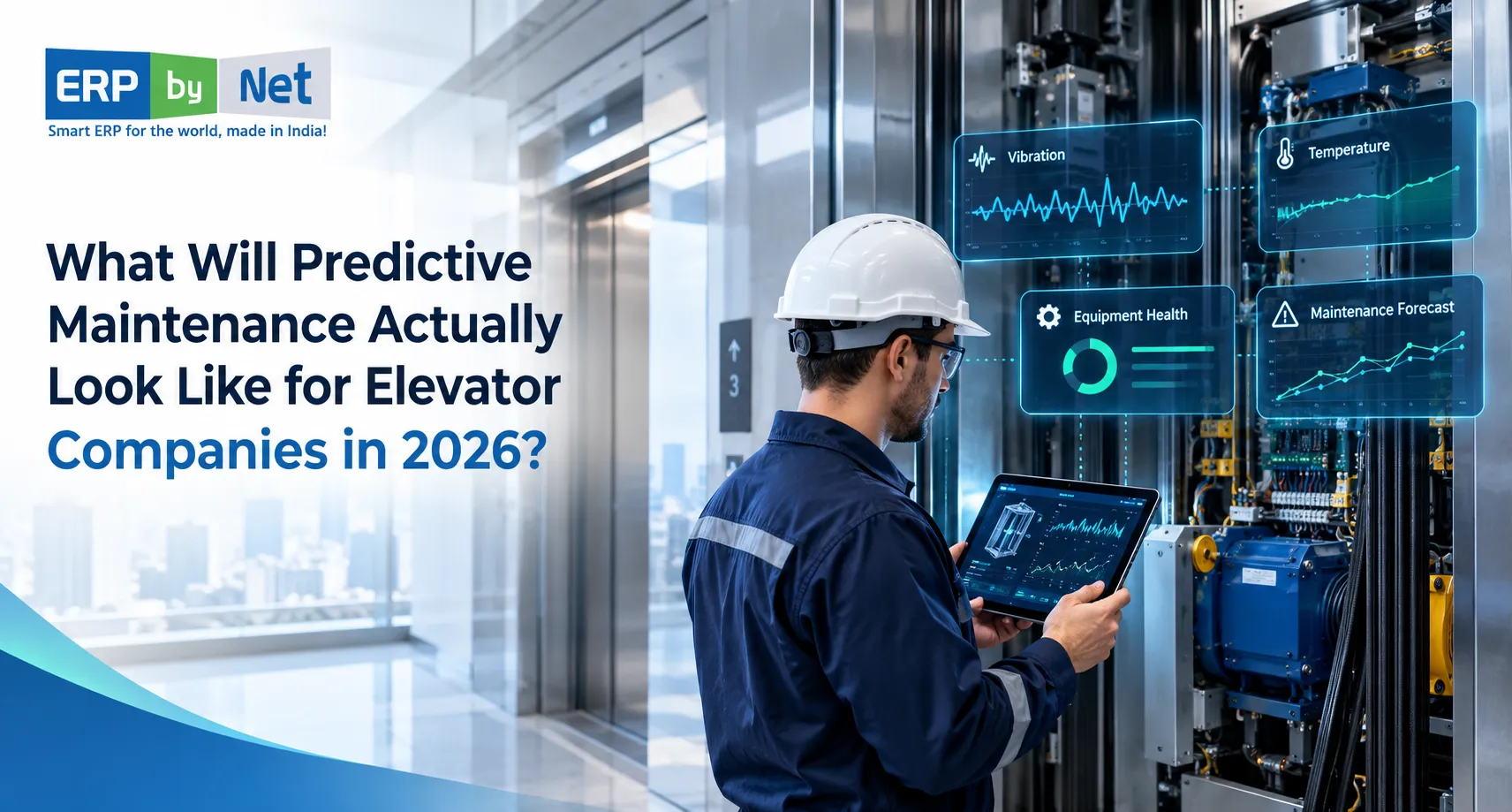
Connected elevators may provide data through controllers, built-in diagnostics, operating logs, and additional sensors. Depending on the equipment and monitoring system, this information may include error codes, door cycles, operating patterns, vibration, temperature, and other relevant indicators.
Analytics systems can examine these signals for unusual behaviour. When a potentially significant pattern is detected, the monitoring platform may generate an alert, suggest a diagnostic action, or recommend that a technician inspect the equipment.
It is important to understand that an alert is not always a confirmed diagnosis. A technician may still need to inspect the equipment, verify the suspected issue, and determine the appropriate corrective action.
How predictive maintenance works
- Collect equipment data: Gather relevant information from connected elevator controllers, sensors, operating logs, and service records.
- Establish normal operating patterns: Understand how the equipment behaves under its usual operating conditions.
- Identify anomalies: Detect unusual changes, recurring error patterns, or signs of deterioration.
- Assess maintenance priority: Evaluate the potential impact, urgency, confidence of the alert, and equipment condition.
- Plan an intervention: Decide whether further diagnosis, remote troubleshooting, or an on-site inspection is required.
- Execute the work: Assign a qualified technician and arrange the required tools and spare parts.
- Record the outcome: Document the confirmed fault, work performed, parts consumed, and final equipment status.
- Improve future decisions: Use verified outcomes and subsequent equipment data to refine maintenance rules and analytical models where supported.
This creates a feedback loop in which equipment information supports maintenance decisions, and completed service work contributes to a more reliable history of equipment performance.
Predictive vs. Preventive vs. Reactive Elevator Maintenance
These maintenance approaches serve different purposes. Predictive maintenance does not eliminate the need for preventive servicing or emergency repairs.
| Comparison | Reactive maintenance | Preventive maintenance | Predictive maintenance |
|---|---|---|---|
| Main trigger | A breakdown or reported fault | A scheduled interval or prescribed task | Equipment condition, data patterns, or analytical alerts |
| Planning approach | Often urgent and unplanned | Planned in advance | Prioritized using available condition information |
| Data requirements | Fault reports and repair records | Maintenance schedules and inspection records | Relevant operating data, condition indicators, and historical records |
| Main advantage | Addresses an existing failure | Helps maintain equipment through planned servicing | Can identify developing problems earlier |
| Main limitation | May result in unexpected downtime | May not identify every fault between visits | Depends on suitable data, monitoring, and reliable interpretation |
| Technician workflow | Respond and repair | Inspect and service according to plan | Investigate alerts and carry out condition-informed interventions |
| Business objective | Restore operation | Maintain equipment condition | Improve maintenance timing and reduce avoidable disruption |
Why elevator companies need a combined approach
A maintenance strategy should not depend on only one method.
Preventive maintenance remains necessary for prescribed inspections, lubrication, testing, adjustments, cleaning, and other manufacturer-recommended or legally required activities. Predictive maintenance adds another layer by identifying potential issues that may require attention between scheduled visits or influence the scope of the next visit.
Reactive maintenance also remains necessary because not every failure can be anticipated.
The most effective approach combines planned maintenance, condition monitoring where available, timely fault response, and reliable service documentation.
How Predictive Maintenance Will Work in 2026

Predictive maintenance is becoming more practical as connected equipment, cloud-based monitoring, data analytics, and digital service workflows mature.
1. IoT sensors and connected elevator controllers
IoT enables equipment and sensors to transmit relevant operating information to connected systems. Depending on the elevator model and monitoring configuration, this information may come from existing controllers, built-in diagnostic features, or additional sensors.
For maintenance teams, the value lies in understanding what happens between site visits.
Instead of relying exclusively on a technician’s last inspection, a connected monitoring system may help reveal changes in operating behaviour, recurring faults, or abnormal readings that warrant further investigation.
Potential applications include:
- Monitoring relevant operating and fault indicators.
- Recording controller errors and equipment events.
- Tracking usage patterns where supported.
- Identifying changes in sensor readings.
- Supporting remote diagnostics and maintenance prioritization.
However, not every elevator has the same connectivity, sensors, controller interfaces, or access to equipment data. Older installations may require compatible monitoring hardware, integration work, or other technical changes before these capabilities become available.
2. AI-powered fault detection and anomaly analysis
AI and machine-learning techniques can analyse equipment data to identify patterns that may be difficult to detect through manual review alone.
A system might examine repeated fault codes, changes in operating cycles, unusual vibration measurements, or deviations from previously observed behaviour. Depending on the model and available evidence, it may flag a developing issue for investigation.
The practical value is not that AI can guarantee a breakdown will be predicted. It is that analytics can help maintenance teams identify potentially significant patterns earlier and focus their attention where it may be most useful.
For example, imagine an elevator with a history of intermittent door faults. A conventional service report may record each incident separately. An analytical system may help identify a recurring pattern across those events, prompting a more detailed inspection of the door mechanism, sensors, alignment, or associated controls.
Research published in Sensors in June 2026 examines physics-informed neural networks for elevator degradation diagnosis and early warning. The research highlights limitations in conventional fixed-threshold and rule-based approaches when detecting progressive degradation under changing operating conditions.
Source: Physics-Informed Neural Network-Based Elevator Degradation Diagnosis and Early Warning.
3. Component condition assessment and remaining useful life
One potential application of predictive maintenance is estimating the remaining useful life of a component. This means estimating how long a component may continue operating before it reaches a defined maintenance or replacement condition.
Such estimates may use equipment usage, observed degradation, historical failures, operating conditions, and engineering knowledge.
For elevator companies, these estimates can help inform maintenance planning and component replacement decisions. They should not be treated as guaranteed failure dates.
A predicted replacement window may change when operating conditions change, new data becomes available, or an inspection reveals a different condition from the one expected.
The appropriate decision must consider the manufacturer’s recommendations, the applicable safety requirements, the reliability of the available evidence, and the judgement of qualified personnel.
4. Remote monitoring and condition-based servicing
Remote monitoring allows service teams to review equipment information without relying exclusively on a physical site visit.
When supported by the elevator and monitoring platform, remote diagnostics may help a service team understand an issue before dispatching a technician. Some faults may be resolved through approved remote actions, while others require an on-site inspection or repair.
The information can also help service managers prepare for a visit by identifying the suspected issue, reviewing relevant service history, and checking whether particular tools or spare parts may be needed.
Remote monitoring should not be confused with remote control of every elevator function. Available actions depend on the equipment, system configuration, security controls, and manufacturer permissions.
5. Predictive maintenance scheduling
Predictive insights can help service managers decide which maintenance tasks need earlier attention and which can be incorporated into an upcoming scheduled visit, where appropriate.
A useful scheduling decision considers several factors:
- The seriousness and confidence of the alert.
- The potential consequences of continued operation.
- The urgency of inspection or intervention.
- Technician availability and required qualifications.
- Spare-parts availability.
- Site access and customer coordination.
- Existing maintenance commitments and service-level agreements.
Safety-critical warnings must be escalated according to approved procedures. A scheduling algorithm must never override a required safety action simply to optimize technician utilization.
The goal is to improve maintenance planning without compromising equipment safety or prescribed servicing.
Which Elevator Components Can Benefit from Predictive Monitoring?
Predictive maintenance opportunities depend on the component, available measurements, equipment configuration, and quality of historical data. Not every component can be monitored effectively using the same technique.
| Elevator component or system | Potential indicators | Possible maintenance value |
|---|---|---|
| Door operator and door mechanism | Repeated door faults, abnormal operating time, cycle behaviour, or suitable sensor readings | Investigate recurring door issues before they cause repeated interruptions |
| Traction machine and motor | Vibration, temperature, operating behaviour, and other suitable measurements | Identify unusual conditions that may warrant mechanical or electrical inspection |
| Bearings and rotating components | Vibration trends, temperature changes, and noise reported during inspection | Support condition assessment where appropriate sensors and baselines are available |
| Drive and control systems | Error codes, operating events, power-related indicators, and fault history | Identify recurring control or drive issues for diagnosis |
| Brake system | Relevant diagnostics, inspection findings, and equipment-specific condition indicators | Support maintenance investigations; safety-critical brake checks remain essential |
| Electrical components | Temperature, electrical measurements, alarms, and historical fault records | Help identify abnormal conditions that require qualified investigation |
| Lift-wide operating system | Trip patterns, interruptions, controller events, and service history | Understand usage patterns and prioritize maintenance across an equipment portfolio |
Example: Detecting a recurring door-operator issue
Consider a commercial building where one elevator experiences repeated door-related service calls.
Initially, each incident appears to be an isolated fault. The technician resets the system, records the visit, and returns the elevator to service. A few days later, the same complaint occurs again.
A more data-driven approach would connect the information across visits.
- Step 1: Review the controller events, where available, and previous service reports.
- Step 2: Check whether the fault is recurring under similar operating conditions.
- Step 3: Investigate the door mechanism and related components using approved diagnostic procedures.
- Step 4: Determine whether maintenance, adjustment, repair, or component replacement is required.
- Step 5: Record the confirmed cause, action taken, and parts consumed.
- Step 6: Monitor subsequent performance to determine whether the problem has been resolved.
This example illustrates how historical evidence and monitoring can support earlier diagnosis. It does not mean every recurring door fault can be predicted automatically.
What Predictive Maintenance Means for Elevator Service Teams
The impact of predictive maintenance depends on what happens after a potential fault is identified.
An alert that remains in a monitoring dashboard may provide limited operational value if the service manager cannot assign work, check stock, arrange site access, or record the result.
For this reason, maintenance intelligence needs to connect with everyday service operations.
1. Better technician allocation
Service managers need to consider more than geographic proximity when assigning work. The nature of the fault, technician skills, workload, location, site access, and contractual response commitments can all influence the assignment.
When an alert contains useful diagnostic information, the service manager can review the suspected problem before dispatch. This can help select an appropriately qualified technician and prepare for the visit.
2. Improved first-visit repair preparation
A technician may lose valuable time when arriving at a site without the necessary information, tools, or replacement components.
A connected service workflow can bring together:
- Equipment identification and site details.
- Previous fault reports and repair history.
- Suspected component or system involved.
- Required tools and safety procedures.
- Spare-parts availability.
- Customer contact and site access information.
This preparation can improve the chances of completing a repair during the first visit when the diagnosis is accurate and the required resources are available.
3. Better spare-parts planning
Predictive maintenance may help purchasing and stores teams prepare for likely maintenance requirements.
Suppose multiple elevators of a similar configuration begin showing a recurring component issue. After validating the pattern, the service manager may coordinate with engineering and procurement to assess likely parts demand and replenishment requirements.
This does not mean companies should automatically purchase parts whenever an alert appears. Procurement decisions should consider alert confidence, equipment criticality, lead time, existing stock, alternative parts, and the cost of holding inventory.
4. Stronger AMC and CMC management
Annual maintenance contracts (AMCs) and comprehensive maintenance contracts (CMCs) often involve recurring visits, complaint handling, labour costs, travel, and component consumption.
When service records are incomplete, a company may struggle to determine which contracts generate repeated emergency work or require unusually high maintenance expenditure.
Connecting fault histories, work orders, parts usage, technician time, and contract information can help service managers evaluate:
- Repeat breakdowns by customer, site, and elevator.
- Emergency visits against scheduled maintenance.
- Labour and travel expenditure.
- Parts consumption by equipment or contract.
- SLA response and resolution performance.
- Contract renewal and maintenance planning requirements.
These insights can help management review contract performance and investigate the causes of rising service costs.
The Role of ERP and Service Management Software in Predictive Maintenance
Predictive maintenance and ERP software perform related but different functions.
A connected monitoring platform may collect equipment data and identify unusual operating patterns. An ERP or service management platform can coordinate the resulting business activities, such as creating service work, assigning technicians, checking spare parts, recording labour, updating customer information, and tracking costs.
An ERP system does not automatically become a predictive analytics platform simply because it stores maintenance records. Real-time monitoring, AI models, and condition forecasting may require separate technologies and a verified integration.
How the workflow can connect
Equipment monitoring → Potential fault alert → Alert assessment → Service work order → Technician assignment → Parts planning → On-site diagnosis and repair → Service closure → Cost and performance reporting
Each stage needs appropriate ownership and reliable information.
| Workflow stage | Information required | Operational purpose |
|---|---|---|
| Equipment monitoring | Equipment ID, readings, controller events, or sensor data | Identify changes in operating condition |
| Alert assessment | Alert type, severity, confidence, and recent history | Determine whether investigation or escalation is needed |
| Work-order creation | Site, unit, fault details, priority, and required action | Convert an alert into actionable service work |
| Technician assignment | Skills, location, availability, workload, and SLA | Assign suitable resources |
| Parts planning | Component details, stock levels, reservations, and lead times | Prepare for the required repair |
| Field execution | Inspection findings, labour, photographs, readings, and work performed | Document the intervention |
| Service closure | Verified fault, corrective action, test results, and equipment status | Confirm completion under approved procedures |
| Business reporting | Contract, labour, travel, parts, and service history | Evaluate maintenance performance and cost |
Where ERPbyNet fits
ERPbyNet is a modular ERP platform from XECOM Information Technologies for elevator companies, manufacturing, engineering, and project-based businesses.
For elevator businesses, integrated service and AMC workflows can help coordinate customer and equipment records, service activities, field-team execution, spare-parts management, and financial information. These capabilities are relevant to the operational work that follows a maintenance alert.
For example, when a service issue is identified, the business needs to know which elevator is affected, which customer contract applies, what work has already been performed, whether the required part is available, who should attend the site, and how the completed job affects contract costs.
Connecting these records helps reduce fragmented workflows and gives service managers a more complete view of maintenance operations.
Predictive analytics and live equipment monitoring should be treated as complementary capabilities unless the specific monitoring system and its integration with ERPbyNet have been verified. Companies should evaluate the availability of relevant APIs, controller data, integration requirements, and operational safeguards before assuming a real-time predictive workflow is supported.
How Elevator Companies Can Prepare for Predictive Maintenance
Predictive maintenance does not have to begin with a large-scale AI deployment. Companies can first improve the quality of their equipment records, maintenance processes, and historical data.
A phased implementation allows businesses to establish a reliable operational foundation, identify suitable pilot projects, and evaluate results before expanding the programme.
Phase 1: Organize elevator asset records
Begin by creating a reliable record for each elevator and its relevant components.
Capture information such as:
- Unique equipment and site identifiers.
- Manufacturer, model, and installation details.
- Equipment configuration and relevant component information.
- Warranty and maintenance-contract details.
- Previous service visits and breakdown history.
- Existing inspection and maintenance records.
- Relevant controller or monitoring-system information.
Why this matters: If records are incomplete or different systems use inconsistent equipment identifiers, it becomes difficult to associate an alert with the correct elevator and its maintenance history.
Phase 2: Standardize fault codes and service reports
A predictive maintenance programme requires consistent historical information.
If technicians record the same problem using different descriptions, the business may struggle to identify recurring faults or evaluate patterns across multiple units.
Standardize service-report fields, component names, fault categories, root-cause classifications, corrective actions, and closure outcomes.
Technicians should distinguish between a suspected fault and a confirmed cause. This improves the reliability of the information used for later analysis.
Phase 3: Establish maintenance performance baselines
Before measuring improvement, understand current performance.
Useful baseline measures include:
- Number of unplanned breakdowns by elevator and period.
- Repeat fault frequency.
- Equipment downtime.
- Emergency service-call volume.
- Mean time to repair (MTTR).
- First-visit repair rate.
- Preventive maintenance completion.
- Spare-parts stockouts.
- Labour and travel expenditure per service contract.
These measures help companies identify the largest operational problems and determine whether a predictive maintenance pilot is producing meaningful results.
Phase 4: Assess connectivity and data availability
Not every elevator is ready for the same monitoring approach.
Review controller compatibility, sensor availability, network connectivity, data access permissions, cybersecurity requirements, and the cost of installing additional monitoring equipment.
Determine which indicators can be collected reliably and which faults cannot be monitored with the available configuration.
A pilot should begin with a clearly defined maintenance problem rather than an assumption that AI can predict every failure.
Phase 5: Pilot predictive monitoring
Select a manageable group of elevators or a specific component-related problem.
For example, a company might investigate recurring door-related faults across a group of similar units, provided it has sufficient historical information and suitable monitoring data.
Define the pilot’s objectives, alert criteria, escalation process, responsible personnel, and success measures before deployment.
During the pilot:
- Record every alert and its severity.
- Track whether the alert led to an inspection.
- Compare the alert with the confirmed field finding.
- Record false positives and missed faults where identifiable.
- Measure the time between alert, assessment, and intervention.
- Evaluate the impact on repeat faults, downtime, and maintenance costs.
A pilot should be evaluated on the quality and usefulness of its predictions, not simply the number of alerts generated.
Phase 6: Connect alerts with service and inventory workflows
Once the pilot demonstrates useful results, connect validated alerts to service processes.
Depending on the systems available, this may involve integration with service management software, ERP, inventory, procurement, and technician scheduling.
Define which alerts require immediate escalation, which require investigation, and which can be reviewed during a planned visit. Maintain clear human oversight for safety-critical decisions.
Phase 7: Review performance and expand gradually
Review the results with service managers, engineering teams, technicians, procurement, and finance.
Expand the programme only when the data quality, diagnostic value, workflow integration, and operational benefits justify doing so.
The long-term goal is to make maintenance decisions more informed, consistent, and measurable—not to automate every decision regardless of its consequences.
Challenges Elevator Companies Should Consider
Predictive maintenance offers useful opportunities, but its success depends on technical readiness, operational discipline, and realistic expectations.
Data quality and availability
An analytics model cannot reliably identify every developing fault if the necessary information is missing, inconsistent, or unsuitable.
Companies need reliable equipment identifiers, useful operating data, accurate fault records, and verified repair outcomes.
Older elevator installations
Older equipment may lack built-in connectivity or compatible diagnostic interfaces. Additional sensors or monitoring hardware may be necessary, and some faults may remain difficult to predict.
The monitoring solution must be evaluated against the actual equipment rather than assuming that one approach works for every elevator.
False alarms and missed faults
A monitoring system may flag normal variation as a possible fault, or fail to detect a developing issue.
Too many false alarms can overload technicians and reduce confidence in the system. Missed faults can create a false sense of security.
Alert quality should be evaluated continuously, with field findings used to improve thresholds, rules, and models where appropriate.
Cybersecurity and system integration
Connected elevators and cloud-based monitoring introduce data access, network security, permissions, and integration considerations.
Companies should evaluate secure communication, access controls, vendor responsibilities, data retention, and the effect of any integration on safety-critical systems.
Technician training and adoption
Technicians need to understand how alerts should be interpreted, how to validate suspected faults, and how to record the outcome.
Predictive maintenance should support qualified personnel, not replace their engineering judgement or required procedures.
Cost and return on investment
Costs may include sensors, connectivity, subscriptions, integration, training, and ongoing system management.
The business case should compare these costs with measurable changes in downtime, repeat visits, parts usage, maintenance expenditure, and contract performance. Results will vary by equipment type, operating conditions, monitoring quality, and service model.
Safety and compliance
Predictive maintenance must complement—not replace—applicable inspections, statutory obligations, manufacturer requirements, and approved maintenance procedures.
A model’s confidence score is not evidence that an elevator is safe to operate. Safety-critical conditions must be handled according to the appropriate technical and regulatory requirements.
How to Measure Predictive Maintenance Performance
A predictive maintenance programme needs measurable outcomes. Without a baseline, companies may invest in monitoring technology without knowing whether it improves operations.
| KPI | What it measures | Why it matters |
|---|---|---|
| Unplanned breakdown rate | Frequency of unexpected equipment failures | Indicates whether disruptive failures are becoming less frequent |
| Mean time to repair (MTTR) | Average time required to restore equipment after a failure | Helps evaluate diagnosis, parts readiness, and repair efficiency |
| Repeat fault rate | Frequency of recurring issues after a repair | Highlights incomplete repairs or unresolved underlying causes |
| First-visit repair rate | Share of eligible service jobs completed on the first visit | Indicates how effectively technicians are prepared |
| Alert precision | Proportion of evaluated alerts that correspond to the defined fault or condition | Helps assess the usefulness of alerts |
| False-alarm rate | Frequency of alerts that do not correspond to the intended condition | Identifies unnecessary investigation and alert fatigue |
| Preventive maintenance completion | Share of planned maintenance tasks completed on time | Ensures predictive work does not displace required servicing |
| Spare-parts availability | Availability of required components when needed | Highlights procurement and inventory constraints |
| Maintenance cost per elevator | Labour, travel, parts, and other relevant maintenance expenditure | Helps evaluate the financial impact of maintenance changes |
| SLA compliance | Performance against contractual response and resolution commitments | Supports service quality and contract management |
Metrics should be defined consistently. For example, alert precision requires a clear definition of what counts as a valid alert and a reliable method of verifying the outcome.
Evaluate results across comparable equipment groups and operating periods wherever possible. Changes in elevator age, usage, site conditions, and maintenance scope can influence the results.
What Will Predictive Maintenance Actually Look Like Beyond 2026?

Predictive maintenance is likely to become more integrated with connected equipment, digital service operations, and equipment lifecycle management. However, the pace of adoption will differ across manufacturers, independent service providers, building types, and installed elevator fleets.
Several developments are worth watching.
More connected equipment
As connected controllers and monitoring solutions become more widely adopted, maintenance teams may gain access to richer information about equipment behaviour. The opportunity will depend on connectivity, compatibility, and access to useful data.
More context-aware analytics
Future analytical systems may combine equipment readings with historical faults, operating conditions, component information, and verified service outcomes. This could improve the relevance of alerts and help distinguish recurring problems from isolated events.
Better integration with service workflows
Predictive insights will become more useful when they are connected to work orders, technician scheduling, spare-parts planning, service records, and cost reporting.
This is particularly important for independent elevator service companies that manage multiple brands, large installed bases, and geographically distributed technicians.
Greater focus on lifecycle decisions
Maintenance data can contribute to decisions about component replacement, modernization, warranty management, and long-term asset planning.
For example, repeated failures across a group of older units may justify a technical review of replacement strategies. Such decisions should consider engineering evidence, safety requirements, total cost, and the specific condition of the equipment.
Human expertise will remain essential
AI can help identify patterns, but qualified professionals must interpret alerts, verify faults, determine safe actions, and perform required inspections and repairs.
The future of elevator maintenance is therefore not simply automated maintenance. It is a more connected operating model in which data supports better decisions and trained professionals remain responsible for appropriate action.
Move from Reactive Repairs to Predictive Maintenance
Prepare your elevator business for smarter maintenance in 2026. Connect service records, maintenance schedules, spare parts, technician activities, and customer contracts with ERPbyNet to support better planning and faster decisions.
Turn Elevator Maintenance Insights into Better Business Decisions with ERPbyNet
Predictive maintenance is changing how elevator companies approach equipment reliability, fault investigation, and service planning. Connected monitoring and AI can help identify potential problems earlier, but their value depends on what happens after a warning is generated.
Service teams still need reliable equipment records, coordinated technician assignments, available spare parts, accurate maintenance documentation, and a clear understanding of the cost of servicing each elevator.
For companies managing installation projects, maintenance contracts, field teams, inventory, and finance, disconnected systems can make these activities harder to coordinate. An integrated ERP platform can help bring essential business processes together and provide a more consistent foundation for maintenance operations.
ERPbyNet, by XECOM Information Technologies, supports elevator companies and engineering businesses with integrated ERP workflows for service and AMC management, field operations, inventory, and finance. These capabilities can complement connected monitoring solutions by helping businesses manage the service activities and business records associated with maintenance work.
If your elevator business is looking to reduce manual coordination, strengthen service operations, and connect maintenance activities with wider business processes, explore how ERPbyNet can support your operational requirements.
Visit ERPbyNet to learn more about an ERP platform built for elevator, manufacturing, engineering, and project-based businesses.
Frequently Asked Questions
1. What is predictive maintenance for elevators?
Predictive maintenance uses equipment data, condition indicators, historical information, and analytical methods to identify signs of potential failure. It helps elevator companies investigate developing problems and plan appropriate maintenance before some faults cause significant disruption.
2. How does AI predict elevator breakdowns?
AI and machine-learning models can analyse relevant operating data, fault histories, and sensor measurements to identify unusual patterns associated with potential equipment problems. Their effectiveness depends on data quality, the specific fault, model performance, and equipment configuration. A prediction is an indication for investigation, not a guarantee that a breakdown will occur.
3. What is the difference between preventive and predictive elevator maintenance?
Preventive maintenance follows planned schedules and prescribed tasks to maintain equipment condition. Predictive maintenance uses condition information and analytical insights to identify potential issues and inform maintenance timing. Both approaches are important and should work together.
4. Which elevator components can benefit from predictive monitoring?
Depending on the equipment and available data, predictive monitoring may support the assessment of door operators, traction machines, motors, bearings, drive systems, and certain electrical or control-system conditions. The monitoring method and predictive capability vary by component and installation.
5. Can predictive maintenance eliminate elevator breakdowns?
No. Predictive maintenance may help reduce certain unexpected failures and improve maintenance planning, but it cannot guarantee that all breakdowns will be identified or prevented. Equipment can fail unexpectedly, monitoring systems can miss faults, and some failures may develop too quickly to predict reliably.
6. Do small elevator companies need IoT sensors to start predictive maintenance?
Not necessarily. Companies can begin by organizing equipment records, standardizing service reports, tracking recurring faults, and analysing maintenance history. Advanced real-time prediction may require connected controllers, suitable sensors, or compatible monitoring equipment, depending on the use case.
7. How does predictive maintenance affect AMC profitability?
It can help companies investigate recurring faults, plan maintenance resources, improve parts readiness, and measure labour, travel, and component costs. Whether profitability improves depends on implementation costs, maintenance outcomes, contract terms, and the company’s ability to act on useful insights.
8. What role does ERP software play in predictive elevator maintenance?
ERP and service management software can coordinate the operational activities that follow a maintenance alert. Depending on the system, these may include work-order creation, technician assignment, spare-parts availability, service documentation, AMC records, and cost reporting. Live monitoring and AI-based prediction may require separate integrated capabilities.
9. How can elevator companies measure predictive maintenance success?
Companies can compare unplanned breakdowns, repeat faults, downtime, repair times, first-visit repair rates, alert quality, maintenance costs, and SLA performance against a defined baseline. Results should be evaluated over comparable periods and equipment groups.
10. Is predictive maintenance a replacement for mandatory elevator inspections?
No. Predictive maintenance complements required inspections, servicing, safety checks, and manufacturer-recommended procedures. Equipment must be maintained and operated in accordance with applicable laws, standards, technical requirements, and approved safety procedures.

COO & Founder Member, XECOM | ERP & Technology Expert
Ganesh Limaye is a technology and business leader with 30+ years of experience in ERP, service management, project-based operations, and business process automation. He specializes in helping elevator, engineering, and service-driven businesses improve operational visibility, productivity, customer service, and business growth.