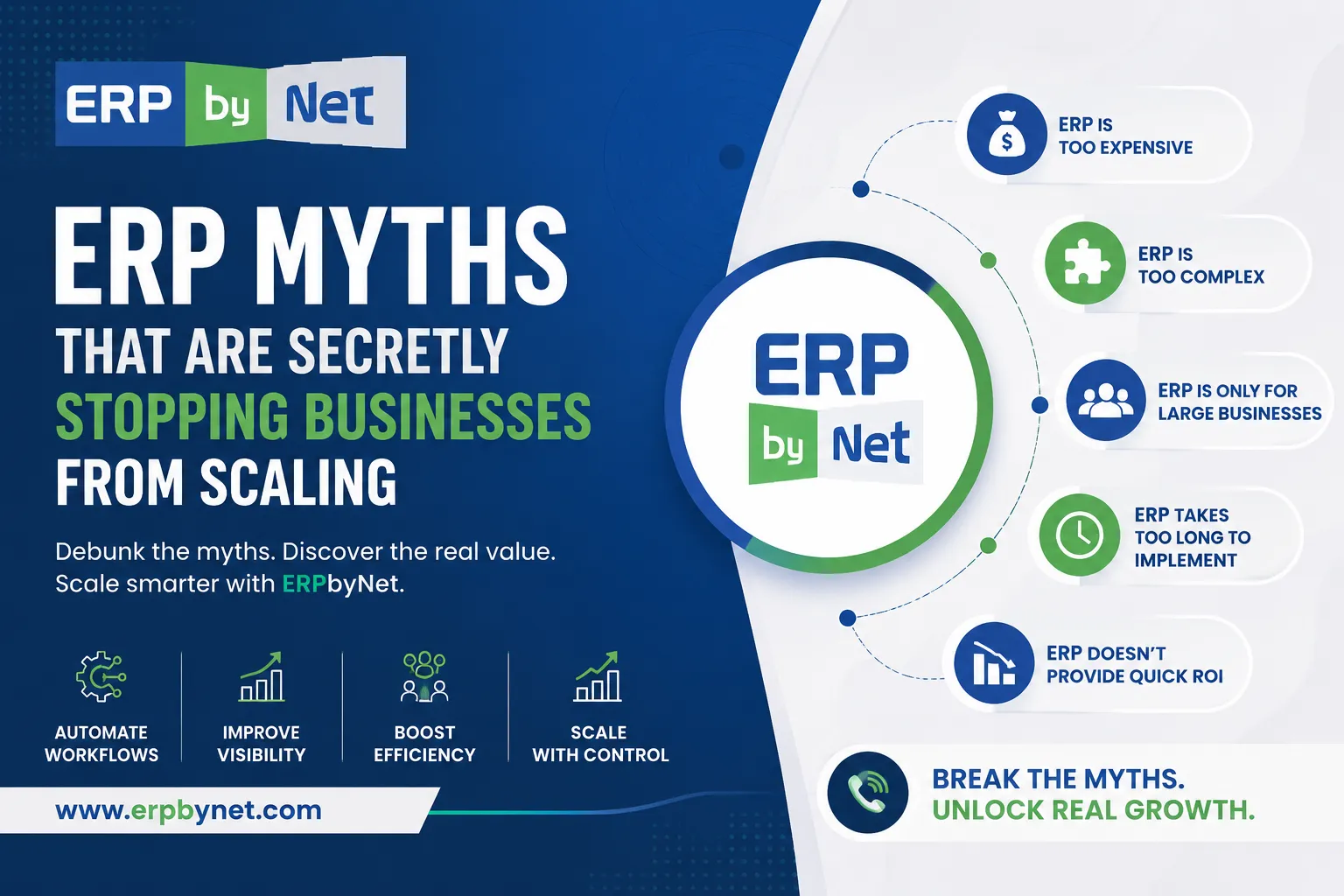
Key Takeaways
- Many businesses delay ERP adoption because of common myths that no longer reflect modern ERP capabilities.
- ERP is not just for large enterprises; small and mid-sized businesses can benefit significantly from automation and centralized operations.
- Modern cloud ERP solutions are affordable and scalable, making implementation easier than ever before.
- Manual processes and disconnected systems often become the biggest barriers to business growth.
- Businesses that overcome ERP misconceptions gain better visibility, efficiency, and long-term scalability.
What You’ll Learn
- The most common ERP myths that prevent businesses from scaling.
- Why spreadsheets and disconnected software tools create operational bottlenecks.
- How modern ERP systems streamline workflows across departments.
- Why ERP implementation is no longer as costly or complex as many businesses assume.
- How ERPbyNet helps growing businesses automate operations and scale with confidence.
Real Insights
- The cost of avoiding ERP is often higher than implementing it, especially when inefficiencies grow with business expansion.
- Businesses relying on manual coordination frequently face delays, errors, and limited operational visibility.
- Cloud-based ERP solutions provide faster deployment and easier adoption than traditional on-premise systems.
- Scalable businesses need centralized data and real-time reporting to make informed decisions.
- Successful growth starts with eliminating operational myths and embracing technology that supports long-term expansion.
Businesses today are under constant pressure to grow faster, improve customer experience, reduce operational delays, and maintain complete visibility across departments. Whether it is a service business, maintenance company, distributor, or operational enterprise, modern growth depends heavily on how efficiently workflows are managed internally.
However, many businesses still operate using disconnected systems such as spreadsheets, manual approvals, WhatsApp coordination, paper records, and scattered reporting tools. While these methods may seem manageable initially, they gradually become one of the biggest obstacles preventing businesses from scaling efficiently.
One major reason behind this problem is the continued belief in outdated ERP myths.
Even today, many organizations assume ERP software is:
- too expensive for growing businesses,
- only useful for large enterprises,
- difficult to implement,
- overly complicated for employees,
- or unnecessary for service operations.
Because of these misconceptions, businesses continue depending on manual operational systems long after they have outgrown them.
The result is increasing operational confusion, slower decision-making, reporting delays, workflow bottlenecks, poor coordination, and limited visibility across teams.
Modern ERP platforms like ERPbyNet are helping businesses replace disconnected operational structures with centralized systems that improve visibility, automate workflows, and support long-term scalable growth.
In this blog, we will break down some of the biggest ERP myths that stop businesses from scaling and explain why modern operational visibility has become essential for sustainable business growth.
Why Businesses Struggle to Scale Without ERP

Many companies believe scaling challenges are caused by market competition, staffing limitations, or business expansion pressure.
In reality, operational inefficiency is often one of the biggest hidden reasons businesses struggle during growth phases.
In the early stages of a business, manual coordination usually works because operations are relatively simple. Teams are smaller, approvals are fewer, and communication happens directly between employees.
But as the business grows, operational complexity increases rapidly.
Businesses begin managing:
- larger teams,
- more customer requests,
- higher inventory movement,
- multiple service workflows,
- technician coordination,
- branch operations,
- approvals,
- and reporting requirements.
Without centralized systems, these growing workflows become difficult to control efficiently.
Departments begin operating independently, information gets scattered across different tools, and managers lose real-time visibility into daily operations.
This eventually creates operational silos that slow productivity and impact customer experience.
Common Operational Problems Businesses Face Without ERP
| Operational Area | Common Challenges Without ERP |
|---|---|
| Inventory Management | Stock mismatch, delayed updates, poor visibility |
| Service Operations | Missed complaints, delayed assignments, inconsistent updates |
| Reporting | Manual reports, delayed analysis, inaccurate data |
| Team Coordination | Dependency on calls, WhatsApp, spreadsheets |
| Customer Management | Scattered communication and poor tracking |
| Approvals | Delayed decision-making and workflow bottlenecks |
| Maintenance Operations | Poor scheduling and inconsistent service records |
Over time, these operational gaps begin affecting:
- customer satisfaction,
- team productivity,
- operational efficiency,
- and overall business scalability.
This is where ERP systems become critical.
ERP is no longer just software for accounting or manufacturing. Modern ERP acts as a centralized operational system that connects departments, automates workflows, and improves business visibility in real time.
Read More: The Hidden Cost of Using Multiple Business Tools Instead of One ERP
Myth 1: ERP Is Only for Large Enterprises
One of the most outdated misconceptions about ERP systems is that they are designed only for multinational corporations or massive manufacturing companies.
This belief prevents many growing businesses from modernizing operations early enough.
Years ago, ERP systems were indeed expensive and infrastructure-heavy. Businesses needed dedicated servers, large IT teams, and long implementation cycles.
Modern ERP systems are completely different.
Today’s cloud-based ERP platforms are designed specifically for:
- growing businesses,
- service companies,
- field service organizations,
- maintenance businesses,
- distributors,
- AMC providers,
- and multi-location operations.
Modern ERP systems are modular and scalable, which means businesses can start small and expand gradually based on operational requirements.
For example, a service business may initially implement ERP for:
- complaint management,
- technician tracking,
- and attendance monitoring.
Later, the same business can expand into:
- inventory management,
- maintenance scheduling,
- AMC management,
- customer communication,
- and reporting automation.
This flexibility makes ERP practical even for medium-sized businesses.
Traditional ERP vs Modern ERP
| Traditional ERP | Modern ERP |
|---|---|
| High upfront investment | Flexible subscription models |
| Complex infrastructure | Cloud-based deployment |
| Long implementation cycles | Faster phased implementation |
| Heavy IT dependency | User-friendly systems |
| Limited flexibility | Scalable modular structure |
The reality is that smaller growing businesses often need ERP earlier because operational inefficiencies affect them faster during expansion.
Without centralized operational visibility, businesses eventually become dependent on:
- manual coordination,
- employee memory,
- scattered spreadsheets,
- and disconnected communication.
This creates operational instability that limits scalability.
Myth 2: Spreadsheets Are Enough to Manage Operations
Many businesses continue relying heavily on spreadsheets because they initially seem simple and cost-effective.
However, spreadsheets are not designed to manage growing operational ecosystems.
As businesses expand, spreadsheets slowly become one of the largest sources of operational inefficiency.
Different departments often maintain separate sheets for:
- inventory,
- attendance,
- complaints,
- service schedules,
- approvals,
- reporting,
- and customer updates.
Because these systems operate independently, information becomes fragmented across the organization.
Managers often struggle with:
- outdated reports,
- version confusion,
- duplicate entries,
- delayed updates,
- and inconsistent operational visibility.
This becomes especially problematic for service and maintenance businesses where workflows are highly dynamic.
For example, businesses managing field technicians manually often face challenges such as:
- delayed technician allocation,
- missed service requests,
- inventory mismatch,
- poor complaint tracking,
- and delayed reporting.
Employees spend large amounts of time coordinating information manually instead of improving productivity.
What Happens When Businesses Depend Too Much on Spreadsheets
Operational Visibility Becomes Limited
Managers cannot access real-time operational insights because information is scattered across multiple files and departments.
Reporting Becomes Slow
Teams spend hours preparing reports manually, reducing decision-making speed.
Human Errors Increase
Manual data entry creates duplication, missing information, and inaccurate reporting.
Workflow Coordination Weakens
Departments struggle to stay aligned because updates are not centralized.
Scaling Becomes Difficult
As operational complexity increases, manual systems become increasingly difficult to manage.
ERP systems solve these problems by centralizing workflows into one connected operational platform.
With ERPbyNet, businesses can manage:
- complaint workflows,
- technician coordination,
- inventory movement,
- maintenance scheduling,
- attendance tracking,
- customer management,
- and operational reporting
through one centralized system.
This improves operational clarity while reducing dependency on scattered manual systems.
Read More:Why Real-Time Visibility Is Becoming Essential for Modern Operations
Myth 3: ERP Is Too Expensive
One of the biggest misconceptions about ERP is that implementation cost is too high for growing businesses.
However, many companies fail to calculate the actual cost of operational inefficiency.
Businesses operating without centralized systems often experience hidden losses such as:
- duplicate work,
- reporting delays,
- inventory leakage,
- missed follow-ups,
- technician inefficiency,
- delayed approvals,
- and poor workflow coordination.
These inefficiencies silently increase operational expenses over time.
For example, businesses managing AMC operations manually may lose revenue because renewal tracking becomes inconsistent. Service businesses may experience customer dissatisfaction due to delayed complaint handling or poor technician visibility.
These operational losses accumulate gradually and often become much more expensive than ERP implementation itself.
Hidden Cost of Manual Operations
| Manual Operational Problem | Business Impact |
|---|---|
| Delayed reporting | Slower decision-making |
| Inventory mismatch | Financial loss and stock issues |
| Missed service requests | Poor customer experience |
| Manual approvals | Workflow bottlenecks |
| Disconnected communication | Operational confusion |
| Technician inefficiency | Reduced productivity |
| Poor visibility | Limited operational control |
Modern ERP systems are also significantly more affordable than traditional ERP platforms because:
- cloud deployment reduces infrastructure costs,
- subscription models reduce upfront investment,
- and phased implementation reduces operational risk.
ERP should not be viewed simply as software expenditure.
It should be viewed as an operational investment that improves visibility, productivity, workflow efficiency, and long-term scalability.
Myth 4: ERP Systems Are Too Complicated for Employees
Many businesses fear employees may struggle to adapt to ERP systems.
However, most organizations are already operating within highly complicated manual environments without realizing it.
Employees often work across:
- spreadsheets,
- WhatsApp groups,
- email threads,
- manual approvals,
- repeated reporting,
- and disconnected software tools.
This creates operational confusion that reduces efficiency and increases dependency on manual coordination.
Modern ERP systems are designed specifically to simplify workflows by centralizing operational information into one structured platform.
Instead of searching through multiple systems, employees can access:
- customer details,
- complaint status,
- inventory visibility,
- technician schedules,
- service reports,
- approvals,
- and operational dashboards
through a single interface.
This improves:
- workflow clarity,
- coordination speed,
- operational transparency,
- and accountability across departments.
ERP systems are not designed to complicate operations.
They are designed to remove unnecessary operational friction that businesses experience during growth.
Read More: Why Elevator Companies Struggle to Track AMC Contracts
Before ERP vs After ERP: The Transformation Businesses Experience
As businesses grow, manual processes and disconnected systems often struggle to keep pace with increasing operational demands. This leads to inefficiencies, communication gaps, and limited visibility across departments. Implementing an ERP system transforms these challenges into streamlined, automated workflows that support sustainable growth.
| Before ERP Implementation | After ERP Implementation |
|---|---|
| Customer complaints are tracked manually, causing delays and missed follow-ups. | Complaints are logged, assigned, and tracked automatically for faster resolution. |
| Inventory information is scattered across spreadsheets, leading to stock discrepancies. | Real-time inventory visibility ensures accurate stock management and better planning. |
| Technician assignments rely on calls and manual coordination. | Technician scheduling and tracking are automated with real-time status updates. |
| Customer communication is fragmented across emails, calls, and messages. | All customer interactions are centralized for better service management. |
| Reports require manual preparation, consuming valuable time. | Automated reports provide instant access to accurate business insights. |
| Approval processes are slow and difficult to monitor. | Digital workflows streamline approvals and improve accountability. |
| Departments operate independently, creating information silos. | Connected workflows improve collaboration and information sharing across teams. |
| Management lacks real-time visibility into operations. | Live dashboards provide complete operational visibility and performance tracking. |
The Result: A More Scalable Business
With ERP in place, businesses gain centralized control over their operations, allowing teams to work more efficiently and make better decisions based on real-time data. Instead of spending time managing operational bottlenecks, organizations can focus on improving customer satisfaction, increasing productivity, and driving business growth.
This shift from manual coordination to automated workflow management enables businesses to scale with greater efficiency, visibility, and control while reducing operational complexity.
How ERPbyNet Helps Businesses Scale Efficiently

ERPbyNet helps growing businesses move from disconnected manual processes to a fully centralized and automated ERP system. As operations expand, managing teams, customers, inventory, and services becomes complex. ERPbyNet simplifies this by bringing everything into one platform with real-time visibility and control.
Instead of relying on spreadsheets, WhatsApp, and separate tools, businesses get one connected system where every workflow is trackable, measurable, and easy to manage.
ERPbyNet supports key business operations such as:
- Complaint Management: Centralized logging, tracking, and faster resolution of customer issues.
- Technician Tracking: Real-time monitoring of field staff, job allocation, and task progress.
- Maintenance Workflows: Timely scheduling and execution of preventive maintenance tasks.
- Inventory Operations: Accurate stock tracking and real-time inventory visibility.
- Attendance Systems: Automated tracking for employees and field teams.
- AMC Management: Efficient tracking of contracts, renewals, and service schedules.
- Operational Dashboards: Real-time insights for faster decision-making.
- Reporting Automation: Instant, accurate business reports without manual effort.
By connecting all operations in one system, ERPbyNet removes manual coordination and improves overall efficiency across departments.
This leads to better workflow speed, improved visibility, stronger coordination, and reduced operational delays. As businesses grow, ERPbyNet ensures scaling remains smooth, structured, and fully controlled without operational chaos.
Final Thoughts
ERP myths continue to stop many businesses from modernizing operations, even as operational complexity keeps increasing across industries. What begins as manageable manual work eventually turns into disconnected workflows, delayed communication, and reduced visibility across teams.
The reality is that manual systems create limitations in productivity, reporting speed, customer experience, and overall workflow efficiency. As businesses grow, these issues become harder to manage without a centralized system.
Modern ERP systems are now scalable, flexible, cloud-based, user-friendly, and easier to implement than ever before. They help businesses bring structure and automation into daily operations.
Businesses that adopt ERP early gain a clear advantage by scaling efficiently without losing control or visibility.
ERP solutions like ERPbyNet help businesses move from manual processes to centralized, growth-focused systems that support long-term success.
If you’re ready to improve operational efficiency, contact us today to get started with ERPbyNet.
Frequently Asked Questions (FAQs)
Why do businesses delay ERP implementation?
Many businesses delay ERP implementation because they assume it is expensive, complex, or only meant for large enterprises. However, as operations grow, manual processes and disconnected systems start creating delays, inefficiencies, and poor visibility that slow down overall business growth.
Is ERP only useful for manufacturing companies?
No, ERP is widely used across service industries, maintenance companies, retail, logistics, healthcare, distributors, and field service businesses. It helps organizations centralize operations, automate workflows, and improve visibility across all departments.
How does ERP help businesses scale?
ERP supports business growth by centralizing workflows, automating repetitive tasks, and providing real-time operational visibility. This helps businesses manage increasing workloads, teams, and complex operations without losing control or efficiency.
Are spreadsheets enough for managing growing operations?
Spreadsheets may work in the early stages, but they quickly become inefficient as businesses grow. They often lead to duplicate data, reporting delays, version confusion, and disconnected workflows that reduce accuracy and operational control.
Is cloud ERP affordable for medium-sized businesses?
Yes, cloud ERP is affordable because it reduces infrastructure costs and offers flexible subscription-based pricing. Businesses can also implement modules gradually based on their operational needs, making it easier to adopt without heavy upfront investment.