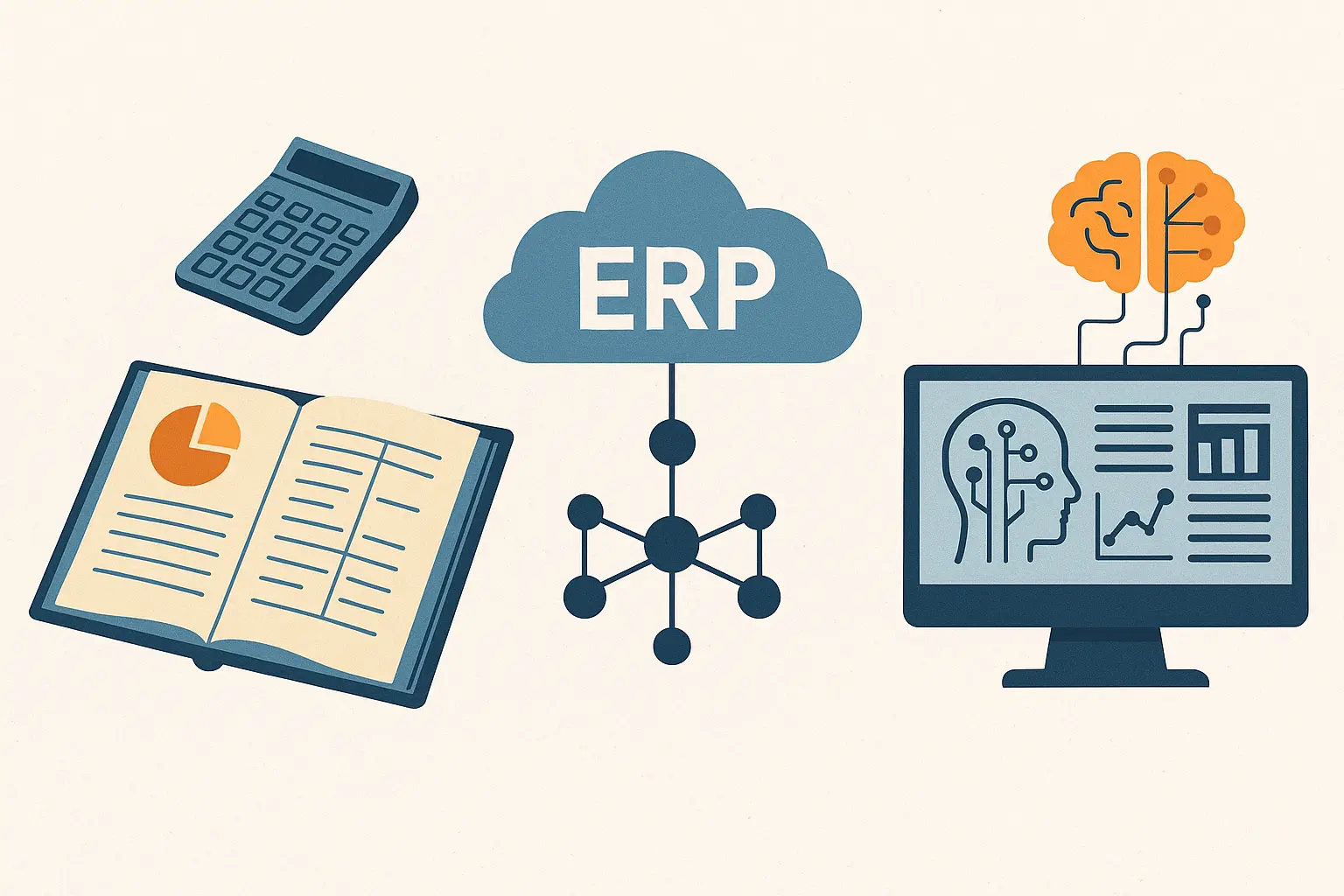
Enterprise Resource Planning (ERP) has transformed the very DNA of how organizations function. What began as simple systems for bookkeeping and record management has now evolved into intelligent ecosystems that analyze, predict, and optimize operations.
The transition from paper files and manual ledgers to AI-powered, cloud-driven ERP platforms marks one of the most significant revolutions in business technology. Today’s ERP is not just about automation—it’s about insight, intelligence, and integration.
ERPbyNet stands at the center of this evolution, offering a platform that embodies decades of technological progress while preparing businesses for the future of intelligent enterprise management.
The Manual Era — Before ERP Was Born
Long before technology entered the boardroom, businesses were driven by human effort and paper trails. Every function operated separately, with minimal coordination and maximum redundancy.
How Operations Worked Then:
- Accounting relied on physical ledgers and handwritten records.
- Procurement handled documentation through printed purchase orders.
- HR maintained attendance and payroll manually.
- Inventory tracking was done with physical stock counts and registers.
Each department had its own version of truth. Data had to be copied multiple times, making processes slow and error-prone. Reports were delayed, decisions were reactive, and efficiency was limited by human capacity.
The lack of integration was the biggest challenge. As organizations grew, this fragmentation caused delays in decision-making and inconsistencies across departments. Businesses needed a system that could connect these isolated functions—and that need became the foundation for ERP’s earliest form.
The Foundation Years — The Birth of MRP
The first major breakthrough came in the 1960s with Material Requirements Planning (MRP). Designed for manufacturing industries, MRP answered one vital question: What materials are needed, and when?
It revolutionized production planning and inventory management by automating what was once manual guesswork. Companies could now coordinate procurement with production schedules, reducing waste and ensuring smooth operations.
By the 1980s, this evolved into Manufacturing Resource Planning (MRP II)—an advanced version that integrated not only materials but also labor, equipment, and financial planning.
Key Milestones of the MRP Era:
- Automated inventory tracking and bill of materials.
- Linked shop-floor operations with financial data.
- Introduced structured scheduling and forecasting.
The concept of integration began to take root. Businesses started viewing technology as the enterprise’s nervous system—linking every department through a shared flow of information.
This idea of connectivity was the seed that grew into modern ERP.
The 1990s — ERP Takes Shape
The 1990s were the decade that defined Enterprise Resource Planning as we know it. The term “ERP” was introduced by Gartner to describe a unified platform that integrated all core business functions—from finance and manufacturing to HR and procurement.
ERP became the new standard for efficiency and visibility. Instead of each department maintaining its own software or paper system, everything was centralized. Data could now move seamlessly across departments in real time.
What ERP Changed:
- Unified database replaced fragmented information.
- Cross-department collaboration improved significantly.
- Real-time dashboards enhanced management decisions.
However, these early ERP systems were on-premise, meaning they required extensive infrastructure, expensive servers, and long implementation timelines. Vendors like SAP, Oracle, and Baan led the market, but only large enterprises could afford the cost and complexity.
While ERP solved integration, it created a new challenge—limited flexibility. The systems were rigid, updates required heavy IT involvement, and customization was costly. These limitations sparked the next evolution: cloud-based ERP.
Read More : The Evolution of MRP Systems: From Legacy Tools to Cloud-Based Platforms
The 2000s — The Cloud Revolution
The early 2000s ushered in a new era. The rise of the internet and cloud computing changed how businesses deployed software. ERP moved from physical servers to the cloud, giving organizations the ability to access systems anytime, anywhere.
What Cloud ERP Brought:
- No need for costly infrastructure or complex installations.
- Subscription-based pricing replaced heavy upfront investments.
- Data became accessible in real time across devices and locations.
For small and medium businesses, this was a turning point. Cloud ERP leveled the playing field, allowing smaller firms to access enterprise-grade tools once reserved for global corporations.
Mobility became another defining feature. Managers could approve purchase orders, review reports, or check inventory from a phone or laptop. ERP became portable, connected, and collaborative.
ERPbyNet was born from this very revolution—offering scalable, cloud-native ERP solutions for organizations of all sizes. Its mission was simple: to make enterprise automation accessible, secure, and affordable without sacrificing customization.
The 2010s — Integration, Analytics, and Industry 4.0
As businesses entered the 2010s, ERP transformed from being a transactional system into a strategic intelligence platform. The fourth industrial revolution—Industry 4.0—further accelerated this shift, integrating IoT, automation, and data analytics.
ERP systems began interacting directly with machines, sensors, and connected devices. Real-time data from manufacturing floors, supply chains, and logistics could now be processed instantly.
Impact of Industry 4.0 on ERP:
- Smart sensors provided real-time production visibility.
- Predictive maintenance reduced downtime.
- Automated alerts improved supply chain efficiency.
ERP also became more analytical. Instead of simply recording data, it began analyzing it—identifying inefficiencies, trends, and growth opportunities. Dashboards replaced reports, and decision-making became proactive rather than reactive.
User experience improved dramatically. Complex interfaces gave way to intuitive dashboards and mobile accessibility. ERPbyNet embraced this shift, designing interfaces that empowered users without technical training, promoting collaboration and real-time workflow approvals.
The Age of Artificial Intelligence — When ERP Learned to Think
The integration of Artificial Intelligence (AI) and Machine Learning (ML) redefined ERP once again. What was once a system of records became a system of intelligence.
AI-enabled ERP platforms such as ERPbyNet now analyze patterns, forecast outcomes, and automate decisions. This marks a monumental leap from managing data to understanding it.
AI in ERP Changes Everything:
- Predictive analytics forecasts demand and sales trends.
- Machine learning automates tasks like invoice matching and scheduling.
- Natural language queries allow managers to “talk” to the system.
Instead of asking IT to run a report, executives can simply ask: “Show me the top five performing regions for last quarter,” and get results instantly.
ERPbyNet integrates AI throughout its workflows. From financial forecasting to production optimization, the system learns continuously, reducing manual effort and improving decision accuracy. It minimizes errors, accelerates processing, and empowers leaders to make faster, data-backed choices.
Read More : How ERP Helps Small Elevator Businesses Operate Like Big Players?
ERPbyNet — Built for the Modern Enterprise

Modern enterprises operate in a fast-moving, data-driven world where agility and intelligence define competitiveness. ERPbyNet was built precisely for this environment — merging the scalability of cloud technology with the intelligence of AI to create a secure, flexible, and future-ready ERP ecosystem.
What Makes ERPbyNet Different
Cloud-Native Foundation
ERPbyNet’s cloud-first design ensures seamless access from anywhere, anytime. With real-time synchronization and zero server maintenance, teams stay connected and productive across geographies.
Modular and Scalable
Businesses can start small and scale easily. ERPbyNet’s modular design allows you to activate only the features you need — from finance and inventory to HR, CRM, and analytics — reducing complexity and cost.
AI-Powered Automation
Intelligent workflows automate repetitive processes like approvals, data validation, and reporting. Machine learning continuously refines accuracy, freeing teams to focus on strategy and growth.
Analytics-Driven Insights
Custom dashboards turn data into decisions. ERPbyNet delivers real-time visibility into operations, performance, and profitability — empowering faster, evidence-based decisions.
Enterprise-Grade Security
Multi-layered encryption, access controls, and compliance with global standards ensure data integrity and business continuity.
Built for Every Business
ERPbyNet delivers equal value to enterprises and SMEs alike. Large organizations gain multi-site visibility and global synchronization, while smaller firms access affordable automation without IT dependency. Its adaptability across manufacturing, retail, logistics, and services makes it one of the most versatile ERP solutions in today’s market.
The Future — From Automation to Augmentation
The next phase of ERP evolution goes beyond automation. It enters augmentation, where systems don’t just execute tasks—they assist humans in strategic thinking.
Future ERPs will become self-learning ecosystems capable of predicting changes and acting autonomously.
What’s Next in ERP Evolution:
- AI-driven systems that recommend real-time production adjustments.
- Integration with blockchain for secure, transparent transactions.
- Use of digital twins to simulate and optimize processes.
- Seamless IoT connectivity for real-time monitoring.
As ERP grows smarter, human roles will evolve too. Managers will focus less on operations and more on interpreting insights. ERPbyNet envisions a world where humans and intelligent systems collaborate, making data-driven decisions faster and more precisely than ever before.
Navigating Challenges in ERP Implementation
Even with all its potential, ERP transformation is not without challenges. Data migration, cultural resistance, and cybersecurity remain key considerations for businesses adopting new systems.
ERPbyNet addresses these challenges with thoughtful design and guided support.
How ERPbyNet Simplifies Transition:
- Tools for seamless data migration and validation.
- Modular rollout plans that ease user adoption.
- Built-in encryption and role-based access for security.
- Compliance with international standards for data protection.
The human element is equally critical. ERP implementation succeeds when people embrace it. ERPbyNet prioritizes user training and intuitive interfaces to ensure that transformation feels natural—not forced.
Read More : A Complete Guide to Elevator Maintenance Software for OEMs and Service Firms
ERP as the Intelligence Core of Modern Business
The story of ERP mirrors the story of modern enterprise itself: a journey from fragmented workflows to unified intelligence. From the days of ledgers and manual labor to AI-driven predictive analytics, ERP has become the digital brain of business operations.
ERPbyNet exemplifies this evolution. It does more than automate—it learns, adapts, and empowers. It transforms data into strategy and operations into growth.
In a world where agility defines success, ERP is no longer optional—it is essential. The shift from manual to machine intelligence represents not just technological advancement but a complete reimagining of business potential.
ERPbyNet stands at the forefront of this transformation, guiding businesses toward a future where intelligence and innovation move hand in hand. The evolution continues, and ERPbyNet ensures every enterprise is ready for what’s next.
Ready to Build the Future of Your Enterprise?
Step into a new era of business intelligence with ERPbyNet — where automation meets innovation. Whether you’re modernizing legacy systems or starting your digital transformation, ERPbyNet empowers your organization with real-time analytics, AI-driven automation, and cloud-native flexibility. Experience the difference between managing data and mastering it.
Transform your workflows, reduce operational bottlenecks, and unlock growth with one unified platform.
Take the first step today — connect with ERPbyNet and make your enterprise truly intelligent.
Frequently Asked Questions
What makes ERPbyNet different from traditional ERP systems?
ERPbyNet is built on a modern cloud infrastructure that integrates AI and analytics directly into workflows. Unlike traditional ERPs, it offers real-time insights, modular flexibility, and predictive automation — reducing manual work and improving decision-making accuracy.
Can ERPbyNet work for small and medium-sized businesses?
Yes. ERPbyNet is designed to be scalable and cost-effective. Its subscription model and modular architecture allow SMEs to implement only the features they need, ensuring affordability without compromising on performance or intelligence.
How secure is ERPbyNet’s cloud-based system?
Security is central to ERPbyNet’s architecture. The system includes encryption, role-based access control, regular audits, and compliance with international standards like GDPR, ensuring that business data remains protected across all departments.
Does ERPbyNet support integration with other tools or legacy systems?
Absolutely. ERPbyNet is built with integration flexibility in mind. It can seamlessly connect with CRMs, HR software, accounting tools, and legacy databases to maintain workflow continuity and unified data visibility.
What kind of support does ERPbyNet provide after implementation?
ERPbyNet offers comprehensive post-launch support including training, updates, system monitoring, and troubleshooting assistance. Businesses also benefit from continuous optimization and AI-driven upgrades that keep the platform future-ready.