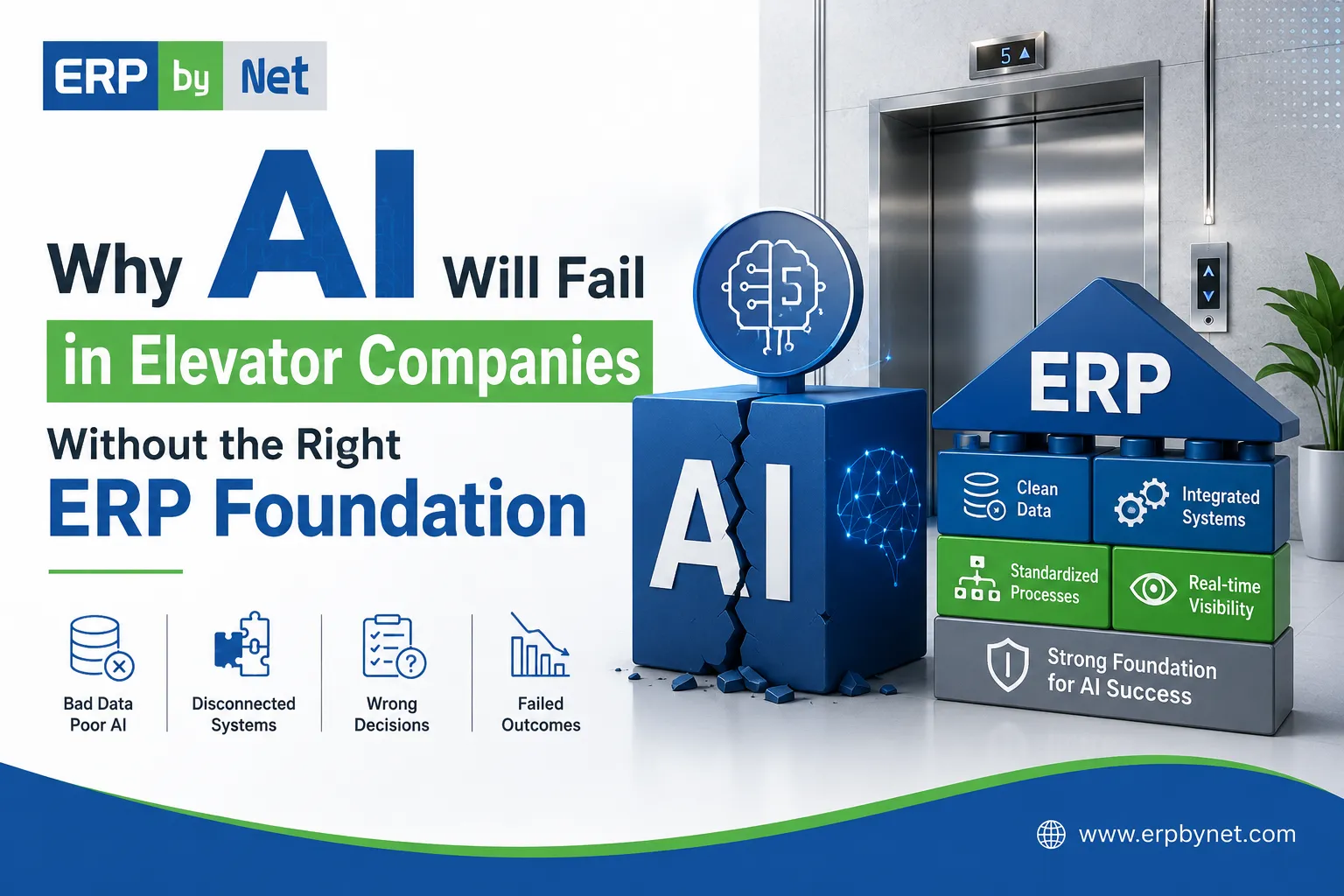
Key Takeaways
- AI cannot succeed without a strong ERP foundation.
- Disconnected data and manual processes produce inaccurate AI insights.
- Clean ERP data enables reliable AI predictions for maintenance, inventory, and operations.
- Integrated ERP provides the visibility AI requires to support better business decisions.
- Elevator companies should strengthen ERP before adopting AI to achieve long-term success.
What You’ll Learn
- Why ERP is the foundation for successful AI adoption.
- How poor ERP data affects AI accuracy.
- The role of real-time ERP data in predictive maintenance and planning.
- Common mistakes elevator companies make when implementing AI.
- How ERPbyNet prepares elevator businesses for AI with connected operations and clean data.
Real Insights
- AI exposes operational weaknesses instead of fixing them automatically. :contentReference[oaicite:0]{index=0}
- Incomplete service records and inaccurate inventory reduce AI reliability. :contentReference[oaicite:1]{index=1}
- Standardized ERP processes improve AI performance across departments. :contentReference[oaicite:2]{index=2}
- Real-time ERP visibility enables smarter AI-driven decisions for maintenance, scheduling, and resource planning. :contentReference[oaicite:3]{index=3}
- Successful AI starts with trusted ERP data, not advanced algorithms. :contentReference[oaicite:4]{index=4}
Artificial Intelligence (AI) is quickly becoming one of the biggest topics in the elevator industry. From predictive maintenance and intelligent scheduling to automated customer support and service optimization, AI promises to transform how elevator companies operate.
Many business owners believe that adopting AI is simply a matter of purchasing the latest software or integrating a chatbot into their operations. In reality, AI is not a magic solution that automatically fixes inefficient processes, disconnected systems, or poor-quality data.
For elevator companies, AI is only as effective as the business information it learns from. If technician records are incomplete, spare parts inventories are inaccurate, customer histories are scattered across spreadsheets, and service operations rely on manual processes, AI will only make poor decisions faster.
This is why many AI initiatives fail—not because the technology isn’t powerful, but because the business lacks the operational foundation needed to support it.
That foundation is an integrated Enterprise Resource Planning (ERP) system.
An ERP connects every critical business function—from sales and project execution to installation, maintenance, inventory, finance, and customer service—into one centralized platform. Instead of isolated data and disconnected workflows, every department works from a single source of truth.
In this article, we’ll explore why AI alone cannot transform elevator companies, why ERP is the missing foundation behind successful AI adoption, and how businesses can prepare today for the next generation of intelligent operations.
AI Is Transforming the Elevator Industry—But Not in the Way Most Companies Think
The elevator industry has always been driven by operational efficiency. Every day, companies manage installation projects, preventive maintenance schedules, Annual Maintenance Contracts (AMCs), emergency breakdowns, technician dispatching, spare parts inventory, compliance inspections, and customer communications—all while trying to deliver fast, reliable service.
As AI technologies become more accessible, many companies are exploring how they can improve these operations.
Potential applications include:
- Predicting equipment failures before they occur
- Optimizing technician schedules based on skills and location
- Forecasting spare parts demand
- Automating service prioritization
- Generating maintenance insights from historical service records
- Assisting customer support through AI-powered chatbots
- Improving decision-making with predictive analytics
These possibilities are exciting, and many software vendors market AI as a shortcut to operational excellence.
However, this creates a dangerous misconception.
AI does not replace operational discipline.
It doesn’t automatically organize years of inconsistent service records.
It cannot understand incomplete maintenance histories.
It won’t correct inaccurate inventory counts.
It cannot identify missing customer information that has never been recorded.
Instead, AI depends entirely on the quality, consistency, and completeness of the information it receives.
Think of AI as a highly intelligent analyst. Give it complete, reliable, and structured business data, and it can uncover valuable insights. Feed it inconsistent spreadsheets, duplicated customer records, or disconnected systems, and its recommendations become unreliable.
For elevator companies, this distinction is critical.
The future belongs not to businesses that simply “adopt AI,” but to those that first build an operational environment where AI can succeed.
The Biggest AI Mistake Elevator Companies Are Making

Many elevator businesses are rushing toward AI because they fear being left behind.
Unfortunately, they often begin with the wrong question.
Instead of asking:
“How can we prepare our business for AI?”
They ask:
“Which AI tool should we buy?”
The difference may seem small, but it completely changes the outcome.
Technology alone cannot solve operational problems that already exist inside the business.
Imagine an elevator company where:
- Service requests arrive through phone calls, WhatsApp, emails, and handwritten notes.
- Technician schedules are maintained manually.
- Customer equipment history exists in multiple Excel files.
- Spare parts inventory isn’t updated in real time.
- AMC renewals depend on manual reminders.
- Installation projects are tracked independently from service operations.
Now imagine introducing AI into this environment.
Can AI predict failures accurately?
Can it recommend the right technician?
Can it estimate spare parts demand?
Can it calculate maintenance trends?
The answer is simple: not consistently.
AI learns from patterns. If the underlying data is incomplete or inconsistent, the patterns it identifies are equally flawed.
This is one of the biggest reasons AI projects fail across industries.
Businesses invest in sophisticated technology while ignoring the operational systems that generate the data AI depends on.
For elevator companies, the biggest mistake isn’t delaying AI adoption.
The biggest mistake is trying to implement AI before establishing a connected digital foundation.
Why AI Cannot Fix Broken Business Processes
Artificial intelligence excels at analyzing information and identifying patterns.
What it cannot do is repair inefficient workflows that generate poor information in the first place.
Consider a typical elevator service operation.
A customer reports an issue.
The coordinator manually assigns a technician.
The technician visits the site and records observations on paper.
Later, those notes are manually entered into another system.
Inventory updates happen separately.
Invoices are generated elsewhere.
Customer history is stored in different locations.
Every manual handoff increases the likelihood of delays, missing information, duplicate records, and human error.
Now imagine asking AI to optimize this workflow.
It faces several challenges:
AI Cannot Create Data That Doesn’t Exist
If previous maintenance visits were never recorded digitally, AI has no historical knowledge to analyze.
Without historical service records, predicting future failures becomes impossible.
AI Cannot Trust Inaccurate Information
Suppose your inventory system indicates ten brake components are available.
In reality, only four remain because inventory wasn’t updated after previous service visits.
AI will confidently recommend maintenance schedules based on incorrect stock levels.
The recommendation sounds intelligent—but it’s based on false information.
AI Cannot Connect Disconnected Departments
Sales teams, installation teams, finance departments, warehouse staff, and field technicians often use separate tools.
Without integration, AI sees fragmented pieces instead of the complete customer journey.
It may optimize one department while unintentionally creating problems in another.
For example:
- Sales promises faster installation.
- Procurement doesn’t receive updated material requirements.
- Projects are delayed.
- Service schedules change.
- Customer satisfaction declines.
AI didn’t cause the problem.
Disconnected operations did.
AI Cannot Replace Standardized Processes
One technician records detailed service reports.
Another writes only a few words.
A third technician skips documentation entirely.
When service quality varies significantly between employees, AI cannot reliably identify equipment trends.
Consistency is essential before intelligence becomes valuable.
Standardized digital workflows create reliable information.
Reliable information enables better AI decisions.
Read More: How Leading Elevator Companies Deliver Better Service with the Same Workforce
Why ERP Is the Foundation AI Depends On
Artificial Intelligence is often compared to the brain of a modern business.
If that’s true, ERP is the nervous system.
Without a connected nervous system, even the most intelligent brain cannot function effectively.
An ERP platform brings together every operational activity into one integrated environment.
Instead of maintaining separate systems for sales, projects, service management, inventory, procurement, finance, and customer support, information flows automatically across departments.
This creates something AI values above everything else:
Trusted business data.
When an elevator company operates through a centralized ERP system, every activity contributes to a continuously growing knowledge base.
For example:
Every Service Visit Becomes Useful Intelligence
Each technician visit captures valuable operational data, including:
- Equipment history
- Failure types
- Parts replaced
- Repair duration
- Technician observations
- Customer signatures
- Service completion times
Over time, these records create rich historical data that AI can analyze to identify recurring faults, predict equipment failures, and improve maintenance planning.
Inventory Reflects Operational Reality
ERP automatically updates spare parts inventory as materials move through procurement, warehouses, installation projects, and service activities.
Instead of relying on assumptions, AI can recommend maintenance plans based on actual stock availability, helping businesses reduce emergency shortages and unnecessary overstocking.
Customer Information Remains Connected
Every quotation, project milestone, installation record, AMC agreement, maintenance visit, complaint, invoice, and payment becomes part of a single customer profile.
This gives AI complete business context rather than isolated transactions.
Instead of answering simple questions, AI begins supporting better business decisions.
Departments Start Speaking the Same Language
One of the biggest challenges in elevator companies is information fragmentation.
Sales focuses on new projects.
Project managers monitor installations.
Service teams manage maintenance.
Warehouse staff control inventory.
Finance tracks invoices and payments.
Without ERP, each department builds its own version of reality.
ERP eliminates these silos by creating one shared operational platform.
Once everyone works from the same information, AI can analyze the entire business instead of isolated departments.
That is where meaningful intelligence begins.
Real-World Scenarios Where AI Fails Without ERP
The conversation around AI often focuses on what the technology can do. However, business leaders should pay equal attention to understanding where AI fails. In the elevator industry, AI doesn’t fail because of poor algorithms—it fails because it lacks access to complete, reliable, and connected operational data.
Let’s examine some real-world scenarios.
AI Recommends the Wrong Technician
An AI-powered scheduling system is designed to assign the most suitable technician based on expertise, location, and availability.
On paper, this sounds straightforward.
However, imagine these common situations:
- Technician skills haven’t been updated for months.
- Leave records exist in HR software but aren’t connected to service scheduling.
- Current job assignments are tracked manually.
- Travel time isn’t considered.
- Technician certifications are stored separately.
The AI assigns the “best” technician according to outdated information.
The result?
- Delayed service response
- Increased travel costs
- Missed service-level agreements (SLAs)
- Frustrated customers
- Reduced technician productivity
An integrated ERP continuously updates technician availability, skills, certifications, work orders, GPS location, and job completion status, giving AI accurate information to make better scheduling decisions.
Predictive Maintenance Produces False Alerts
Predictive maintenance is one of AI’s most promising applications.
The goal is simple: identify equipment that is likely to fail before it actually does.
But prediction requires history.
Consider an elevator installed eight years ago.
Over those years:
- Some service visits were recorded digitally.
- Others exist only in paper files.
- Several maintenance reports were lost.
- Spare part replacements weren’t documented consistently.
- Emergency breakdowns weren’t categorized properly.
When AI analyzes this incomplete history, it cannot accurately identify failure patterns.
Instead of preventing breakdowns, it generates unreliable recommendations.
A connected ERP ensures every inspection, repair, replacement, technician note, customer complaint, and maintenance activity becomes part of the equipment’s digital history, significantly improving predictive accuracy over time.
Inventory Forecasting Goes Wrong
AI can forecast spare parts demand by analyzing consumption patterns.
However, forecasting only works when inventory data reflects reality.
Suppose the warehouse system shows:
- 25 door sensors available
- 18 brake assemblies in stock
- 40 control relays ready for dispatch
In reality:
- Some parts have already been used.
- Others were reserved for ongoing projects.
- A few were damaged but never removed from inventory.
- Several purchase orders remain pending.
AI now believes inventory is sufficient.
Emergency service requests arrive.
Technicians reach customer sites without required components.
Projects are delayed.
Customers wait longer.
The issue wasn’t AI.
The issue was inaccurate operational data.
ERP continuously synchronizes procurement, warehouse operations, project consumption, service usage, and inventory movements, giving AI trustworthy information for forecasting.
Customer Support Becomes Less Intelligent
Many businesses introduce AI chatbots hoping to improve customer experience.
But what happens when a customer asks:
“Has my lift been serviced this month?”
If customer history exists across multiple systems, the chatbot cannot answer accurately.
Similarly:
- It cannot verify warranty status.
- It cannot check AMC validity.
- It cannot identify open service requests.
- It cannot estimate technician arrival time.
Customers quickly lose confidence.
When ERP centralizes customer information, AI can provide faster, more accurate, and context-aware responses.
Five Signs Your Elevator Company Isn’t AI-Ready

Many organizations believe they are ready for AI simply because they have digital tools.
Digital tools alone do not create AI readiness.
Ask yourself these questions.
1. Is Your Business Still Dependent on Excel?
If operational decisions depend on spreadsheets rather than integrated systems, AI will struggle to produce reliable insights.
2. Does Customer Information Exist in Multiple Places?
When sales, service, finance, and projects maintain separate customer records, AI cannot build a complete customer profile.
3. Are Technicians Still Completing Paper Reports?
Paper documentation delays data availability and reduces AI’s ability to learn from field operations.
4. Do Departments Operate Independently?
Disconnected teams create disconnected data.
AI performs best when every department contributes to one unified information system.
5. Are Business Decisions Based on Assumptions Instead of Real-Time Data?
If managers frequently ask:
- Which AMCs expire this month?
- Which technicians are available?
- Which spare parts are running low?
- Which projects are delayed?
…and the answers require phone calls, emails, or manual reports, AI will inherit the same operational uncertainty.
Building an AI-Ready Elevator Business Starts with ERP
Rather than asking,
“Which AI solution should we implement?”
A better question is:
“Is our business generating the kind of data AI can trust?”
The answer depends on how information flows through your organization.
A modern ERP creates a continuous digital thread connecting every stage of elevator operations.
Sales and Quotation
Every inquiry, quotation, and customer interaction becomes structured data instead of isolated documents.
Project Execution
Engineering, procurement, installation, budgeting, and project milestones remain connected from start to finish.
Field Service
Technicians receive digital work orders, update job status in real time, capture service reports, record parts usage, and complete customer acknowledgments from the field.
AMC Management
Renewals, preventive maintenance schedules, compliance activities, billing, and customer communication remain synchronized automatically.
Inventory and Procurement
Warehouse stock, purchase planning, vendor management, and spare parts consumption remain continuously updated.
Finance
Invoices, payments, contracts, expenses, and profitability remain connected with operational activities.
Together, these connected workflows produce something far more valuable than automation.
They produce high-quality operational intelligence.
And that is exactly what AI requires.
How ERPbyNet Creates the Right Foundation for AI
Successful AI adoption doesn’t begin with artificial intelligence.
It begins with operational excellence.
ERPbyNet is designed specifically for project-based and elevator businesses where installations, service operations, AMC management, inventory, finance, and field teams must work together seamlessly.
Instead of isolated applications, ERPbyNet creates one connected platform where business information flows automatically across departments.
This foundation supports future AI initiatives by ensuring that every operational event contributes to a centralized knowledge base.
With ERPbyNet, elevator companies can:
- Digitize service operations and technician reporting
- Centralize customer and equipment history
- Manage preventive maintenance and AMC workflows
- Track spare parts in real time
- Improve project visibility
- Connect finance with operations
- Standardize business processes
- Generate reliable operational data for future AI applications
Rather than treating AI as a separate investment, ERPbyNet helps businesses prepare the operational environment where AI can deliver measurable business value.
Read More: The Hidden Relationship Between Warehousing and Customer Experience
The Next Five Years Will Separate AI Users from AI-Ready Businesses
Over the next decade, AI will become a standard capability across the elevator industry.
Predictive maintenance, intelligent scheduling, automated reporting, demand forecasting, and decision support will become increasingly common.
The companies that succeed, however, won’t necessarily be those that buy AI first.
They will be the ones that prepare their business first.
Organizations with connected operations, standardized workflows, reliable business data, and integrated ERP systems will adopt AI faster, achieve better results, and avoid costly implementation failures.
Those relying on spreadsheets, disconnected applications, and manual processes may invest heavily in AI but struggle to generate meaningful outcomes.
The competitive advantage will not come from owning AI.
It will come from owning high-quality operational data.
Conclusion
AI has the potential to transform the elevator industry—but only when it’s built on the right foundation. Without connected data, standardized processes, and real-time operational visibility, AI becomes an expensive tool with limited business impact.
Before investing in AI, invest in the system that powers it.
ERPbyNet helps elevator companies unify project management, installation, AMC management, field service, inventory, procurement, finance, and customer data into a single ERP platform—creating the reliable foundation AI needs to deliver accurate insights and smarter decisions.
Don’t let disconnected systems hold back your AI journey. Build a future-ready business with an ERP designed specifically for the elevator industry.
Ready to make AI work for your business instead of against it?
Schedule a personalized demo and discover how ERPbyNet can help you streamline operations, improve service performance, and prepare your business for the next generation of AI-driven innovation.
👉 Visit https://erpbynet.com/ today and take the first step toward an AI-ready elevator business.
Frequently Asked Questions
Can AI replace ERP software?
No. AI and ERP serve different purposes. ERP manages and centralizes business operations, while AI analyzes operational data to generate insights, predictions, and recommendations. AI performs best when supported by a well-implemented ERP system.
Why does AI need ERP data?
AI depends on structured, accurate, and connected data to identify patterns and make intelligent decisions. ERP provides that centralized business information across departments.
Is AI useful for elevator maintenance companies?
Yes. AI can improve predictive maintenance, technician scheduling, inventory forecasting, customer service, and operational analytics. However, these benefits depend on having reliable operational data available.
What should elevator companies do before investing in AI?
Before implementing AI, companies should digitize their operations, standardize workflows, centralize customer and equipment data, and implement an integrated ERP platform that connects every department.